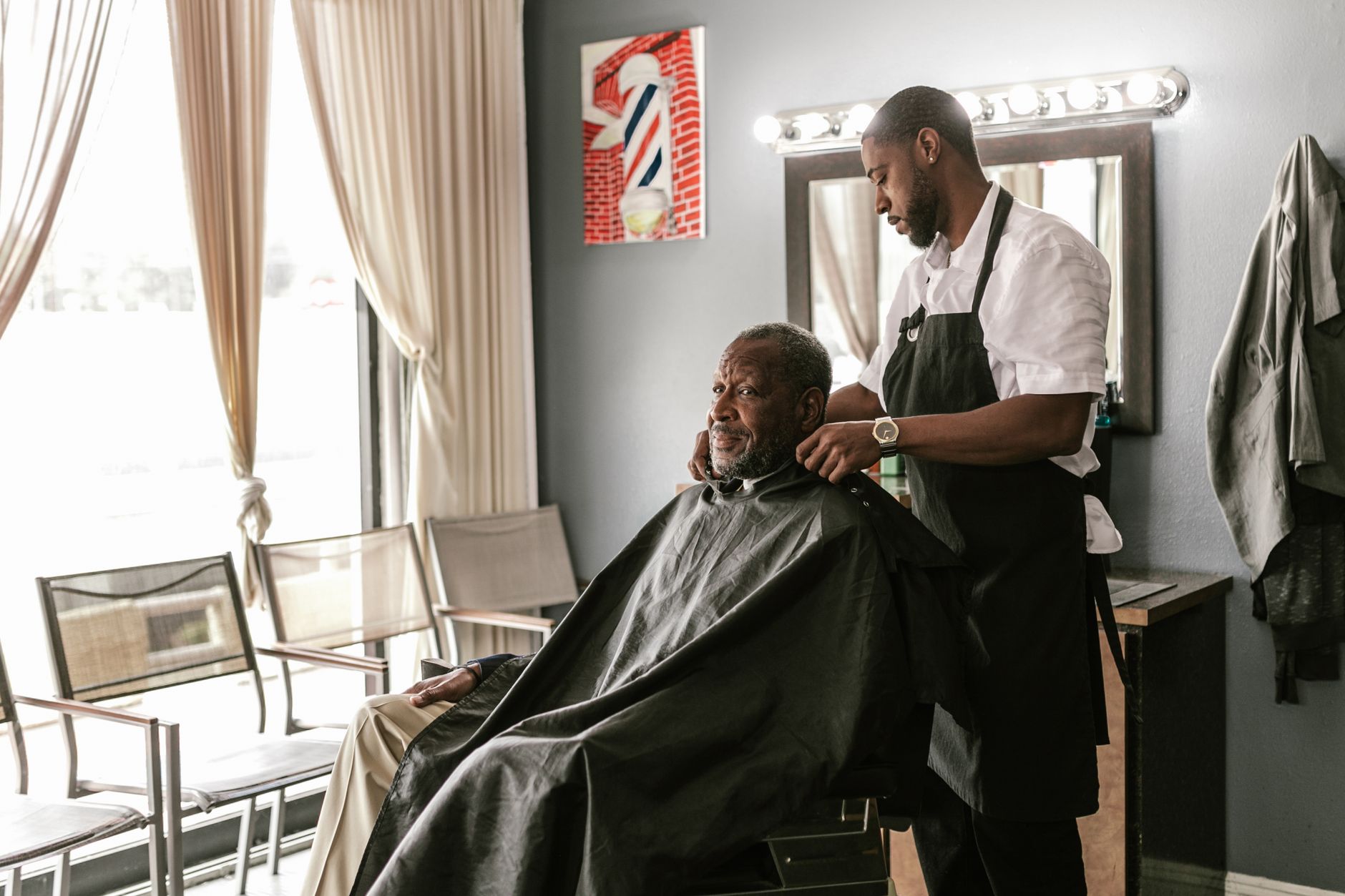
The Tape That Saved My Barbershop
Brantley Hux walked into my barbershop on a Tuesday morning, set his loafer on the footrest of my second chair like it was a shoeshine stand, and told me the handshake I had built thirty-five years of my life on “was never real.”
I had a customer in chair one. Denny from the co-op, half a haircut on his head, cape still snapped around his neck. I had my clippers in my hand. And this young man in a quarter-zip pullover, forty years old at the outside, stood in the middle of my shop on Main Street in Cedar Bend and said those words to me like he was reading a weather report.
“The old terms were never real, Mr. Tarver. There’s no lease in the file. A handshake from a dead man isn’t worth the air it was shaken in.”
Then he laid a folder on my counter, next to my talc and my combs and the photo of my wife, and he said the part he had clearly practiced in the truck.
“New rent is nineteen fifty a month, effective in sixty days. If that doesn’t work for you, I already have a tenant who’s excited about the space. People love smoothies, Mr. Tarver. They love them a lot more than they love a seven dollar haircut.”
Nineteen hundred and fifty dollars. I had been paying six hundred and fifty. He tripled my rent standing on my own floor, in front of a man in my chair, without ever once taking his hands out of his pockets except to put down that folder.
I am seventy years old. I have cut hair in that shop since 1991. And I want to tell you the whole thing, because the ending is the part nobody in this town will ever forget, least of all Brantley Hux.
The handshake
Let me take you back, because you cannot understand what that man tried to take until you understand how it was given.
In the spring of 1991 my wife Nadine and I drove into Cedar Bend with everything we owned in a borrowed cargo van. I had spent fifteen years cutting hair in Memphis, working another man’s chair, paying another man’s booth rent, and Nadine’s people were from here. Her mother was getting on in years and needed somebody close. So we came. I was thirty-five years old and I had exactly enough money saved to be dangerous and not one dollar more.
Main Street back then had a hole in it. The old Kessler Hardware building sat on the corner of Main and Third, and the little storefront attached to its side, the one that used to be a watch repair shop, had been empty for six years. Dead flies in the window. Yellowed newspaper taped over the glass. But it had good bones, a high tin ceiling, and morning light that came through the front glass like it was being poured.
The man who owned it, who owned half that block if we are being honest, was Odell Kessler. Hardware man. He was in his late fifties then, wore the same gray work shirt every day of his life, and had a habit of answering questions a full ten seconds after you asked them, so that you were never sure if he was ignoring you or thinking.
I asked around about the space and everybody said the same thing. Odell won’t rent it. Odell doesn’t need the money. Odell is particular.
I went and asked him anyway. I stood in his hardware store between the nail bins and the coils of rope and I told him who I was, what I did, and what I wanted to do with his empty storefront. He looked at me for that famous ten seconds. Then he said, “You any good?”
I said, “Mr. Kessler, I’m the best barber you’ve ever met, and I say that knowing you haven’t met many.”
He didn’t laugh. He walked me next door, unlocked the storefront, and stood in the middle of that dusty room with his thumbs in his belt. Then he said the sentence that set the course of the rest of my life.
“Town needs a barber more than I need a fortune. Three hundred a month. And here’s my word on it, son. Long as you’re cutting hair in this room, the rent stays what a barber can pay. Not what a bank says the corner’s worth. What a barber can pay. That’s the deal, and the deal outlives me.”
And he put out his hand.
I want you to understand what that handshake meant to a Black man in 1991 walking into a small town where he knew nobody but his in-laws. I had been turned down in Memphis for lease applications with my savings account sitting right there on the table. I had been told spaces were “just rented” that stayed empty for another year. And here was this white hardware man in a gray work shirt offering me the corner of Main and Third on his word, at a price that made my eyes sting.
I shook his hand. Nadine cried in the van. We opened Tarver’s Barbershop eight weeks later, two chairs, a strop, a striped pole Odell mounted himself with a masonry bit, cussing gently at the brick the whole time.
There was paper eventually, a simple month-to-month thing his insurance man made him do in the nineties, but it was never the deal. The deal was the handshake. Everybody in Cedar Bend knew it. The rent went from three hundred to four, four to five, five to six fifty over thirty-five years, and every raise came the same way. Odell would sit down in my second chair on a Friday, wait for the shop to empty, and say, “Emmanuel, taxes went up on me. Can the shop do another fifty?” And I would say yes, because it could, because he only ever asked when it could.
Thirty-five years of chair two
You should know what that shop became, because a barbershop is never just a barbershop, not in a town like this.
I gave first haircuts to boys whose fathers I had given first haircuts to. I have a drawer, right there under the register, with hundreds of little envelopes in it, each one holding a curl of baby hair, each one labeled in whatever pen was closest, because mamas always want the first curl and daddies always forget to bring something to put it in.
Every Thursday morning was veterans’ morning, unofficial but ironclad. The VFW crowd came in whether they needed a cut or not. Korea at first, then Vietnam, then the desert boys as they got old enough to have gray to complain about. Fridays in the fall the football team came through, and if a boy couldn’t pay, he swept, and if he was too proud to sweep, I found something on the high shelf I suddenly needed a tall kid to get down.
I cut hair for job interviews for free. Always have. A man who is trying deserves to look like he is trying. I have cut hair in the back room of the funeral parlor at ten o’clock at night so a family could see their daddy looking like himself one more time. I did it for Odell’s own brother. I did it, six years ago, for my Nadine, standing over her with my shears and my comb and my heart torn clean out of my chest, because no other hands were going to touch her head but mine.
And every Friday afternoon for more than thirty years, Odell Kessler sat in chair two. Not for a haircut, the man barely had enough left to argue about. He came for the checkerboard I kept on the shelf and the coffee I kept bad and strong. Chair two was his chair. When new folks would go to sit in it, my regulars would clear their throats until they moved.
Odell died two years ago this September, ninety-one years old, in his sleep, with his boots by the bed. Half the county came to the funeral. I closed the shop for two days, first time ever except for Nadine, and I taped a sign in the window that said CLOSED, GONE TO SEE ABOUT A FRIEND.
He had no children. The hardware store had already closed in 2019 when his knees gave out. The buildings, the whole corner of them, went to a great-nephew out in Arizona I never met, a voice on a phone who wanted exactly one thing, which was to never think about Cedar Bend again. For a year and a half he did nothing, and the rent checks I mailed got cashed by an estate account, and life went on.
Then last fall the great-nephew sold the whole block to something called Hux Property Group, LLC.
The man in the quarter-zip
Brantley Hux showed up in January the way winter shows up, gradually and then all at once.
First it was surveyors. Then it was a leaf blower crew that blew the sidewalks of “his” buildings and stopped exactly at the property lines, which tells you everything about a man before he says a word. Then it was letters. The florist two doors down, Miss Dot’s flowers, got one. The alterations lady got one. Rents doubled, tripled, “adjusted to market.”
He came to see me in person, I found out later, because the smoothie franchise had specifically asked about my corner. Best light on Main, best foot traffic, the corner Odell gave me on a handshake. A franchise outfit called Squeeze Street, out of the city, all white tile and menu boards. Their site man had stood outside my window taking pictures while I was cutting the Meacham boy’s hair, and I had waved at him, fool that I am, because in Cedar Bend you wave.
So that is who was standing in my shop that Tuesday morning. Denny frozen in chair one with half a haircut. Me with my clippers still humming in my hand. And Brantley Hux, thirty-eight years old, telling me the handshake was never real.
I said, “Son, I’ve been in this room since before you could read. Odell Kessler gave me his word.”
And Brantley Hux smiled, and delivered the line I will hear in my head until they lay me down.
“Mr. Tarver, dead men don’t hold leases. There’s a month-to-month in the file from 1998 and that’s all there is. You’re a tenant at will. And I’d think hard about whose will that is.”
He looked around my shop then, at the tin ceiling, at the pole, at the envelope drawer and the photo of Nadine, the way a man looks at a thing he is already mentally hauling to the dump. He said the space had “great bones under all this.” Under all this. Thirty-five years of this town’s life on those walls, and to him it was all this.
“Sixty days,” he said. “Or sign the new lease. Nineteen fifty, three years, annual escalators. Honestly, the smoothie people would pay me more, so this is me being generous.”
Then he left, and the bell over my door rang behind him, the same bell Odell hung, and Denny said quietly, from under the cape, “Emmanuel. What in the actual hell.”
Sixty days
I will not pretend I was brave right away. I was not. I went home that night to the house Nadine and I paid off in 2009 and I sat at the kitchen table with a legal pad and did arithmetic that would not come out right no matter how I held the pencil.
A seven dollar haircut, and yes I still charge seven dollars for the older men because some of them remember when it was two, does not pay nineteen fifty a month in rent. Not with my volume. I could raise prices on the younger crowd, sure. I ran it every way a tired man can run a number at a kitchen table at one in the morning. The shop could survive at maybe nine hundred. At nineteen fifty, Tarver’s Barbershop was dead, and Brantley Hux knew it when he picked the number. That is the part I want you to sit with. He did not need nineteen fifty. He needed me gone, and he priced it so the eviction would sign itself.
I went to see the one lawyer in town, a nice enough fellow who did wills and fender benders, and he looked through the file folder I brought and shook his head slow. The 1998 month-to-month paper was real. It was the only paper. It said either party could end the tenancy with thirty days’ notice. “Emmanuel,” he said, “I believe every word about Odell’s promise. So would a jury. But a spoken promise about land, from a man who’s passed, against a buyer who says he never heard of it, that’s a hard, hard road, and an expensive one. I’d be taking your savings to lose slower.”
Word got around town the way it does, which is to say by Thursday. The veterans’ morning crowd was ugly about it, folding their arms, naming things they’d like to do to a smoothie machine. Miss Dot from the flower shop came down and cried in chair two, which I had to gently get her out of, because it was still Odell’s. My pastor called. The football coach called. Everybody was angry, and nobody had nineteen fifty a month, and anger without paper is just noise. I know that. Brantley Hux knew it best of all.
He came by once more, week three, with a clipboard man measuring my windows for the franchise people. He watched the man run the tape and he said, to the clipboard man, not even to me, “All this comes out easy. It’s mostly just old.”
Mostly just old. Me, the chairs, the town, the deal. Mostly just old.
The tape
Now here is where the Lord, or Nadine, or Odell, or all three of them working a shift together, decided they had seen enough.
My grandson Malachi is twenty-four. My daughter’s boy. He runs the sound board at Second Baptist and fixes phones out of his apartment and is the reason my shop’s little speaker works at all. Back in the winter, before any of this started, I had asked him to put together a slideshow for the shop’s thirty-fifth anniversary, which was coming this summer. I gave him a shoebox and a grocery bag full of what was in the hall closet. Photos. Kodak envelopes. And Nadine’s camcorder tapes, those little cassettes, because my wife filmed everything from 1990 to about 2004 and labeled every tape in her sideways left-handed printing.
Malachi had been digitizing them one at a time on some contraption he bought online. Birthdays. Church picnics. A tape labeled BABY GIRL PAGEANT that we do not discuss.
Five weeks into my sixty days, on a Sunday night, my phone rang and Malachi was talking so fast I had to make him stop and breathe.
“Papa. PAPA. What was the name of the man who owned the shop building. The old white man. Kessler.”
“Odell Kessler. Why?”
“Papa, I got a tape here labeled SHOP DAY ONE 1991. Grandma filmed your grand opening. Papa, he’s ON here. He’s on here TALKING. You need to come see this right now.”
I drove to that boy’s apartment in my house shoes.
And there on his computer screen, out of a thirty-five-year-old cassette my Nadine loaded with her own hands, was my grand opening day. The shop full of folks in 1991 clothes. Me with black hair and a mustache I thought was really something. Nadine’s voice behind the camera, narrating, teasing me, alive. I had to hold on to the back of Malachi’s chair.
And then the camera swings, because folks are hollering for a speech, and there is Odell Kessler, fifty-eight years old, gray work shirt, standing in front of chair two with a paper cup of punch he clearly did not want to be holding.
I am going to write down what he said as close to exact as I can, because I have now heard it more times than any recording except my wedding video. The room shushes. Odell waits his ten seconds. And then:
“I’m not one for speeches, so here’s the whole speech. This town needs a barber more than I need a fortune. Emmanuel and I shook on it, and I’ll say in front of all of you what we shook on. Long as this man wants to cut hair in this room, the rent stays what a barber can pay. That’s the deal.”
Somebody whoops. And then, and I did not remember this part at all, a voice from the crowd hollers out, “That’s fine, Odell, but you’re gonna die someday, then what?”
The room laughs. Odell does not laugh. He takes his ten seconds. And then Odell Kessler looks straight into my wife’s camera, straight down thirty-five years into a future he could not see but somehow saw, and says:
“Figured somebody’d smart off about that. So Wednesday last I walked down to the courthouse my own self and had it put in the record. A memorandum, the lady called it. It’s filed on the land, not on me. Ninety-nine years if he wants them. So whoever’s got the deed after I’m gone has got my word with it, whether they like it or don’t. You can’t buy this corner out from under that handshake. It’s wrote down and it’s recorded, and now every soul in this room is a witness on top of it.”
Then he raised his punch cup about two inches, which for Odell was practically a parade, and said, “All right. Somebody get in the chair so the man can work.”
Malachi paused it there, on Odell’s face, and my grandson looked at me and said, “Papa. What’s a memorandum?”
I said, “Baby, I don’t know exactly. But I know a man who’s about to find out.”
Book 214, page 388
I want to be honest about the next morning, because this is a confession, not a highlight reel. I stood outside the county clerk’s office at 7:40 with a thumb drive in my shirt pocket and my hat in my hand, and I was scared. Scared it was just talk. Scared Odell meant to file it and never did, the way men mean things. Scared the record burned, or flooded, or got lost the way things get lost precisely when a Black man needs them found.
Miss Verna has run the clerk’s office for thirty years and gets her hair done by my niece. I told her the whole thing. Showed her the video on Malachi’s laptop right there on the counter. She watched Odell say “Wednesday last I walked down to the courthouse my own self,” and she took off her glasses, and she said, “If Odell Kessler filed it in 1991, honey, it is in my basement, and nothing in my basement has ever gotten lost. Give me till lunch.”
She did not need till lunch. At 10:15 my phone rang.
“Emmanuel. Book 214, page 388. Recorded June 12, 1991. Memorandum of lease agreement, Odell R. Kessler, owner, to Emmanuel Tarver, tenant.” And then Miss Verna, who is not a dramatic woman, read me the operative line slow, like scripture. “Term of ninety-nine years at tenant’s sole option, contingent on the operation of a barbershop on the premises. Annual rent not to exceed the sum equal to one hundred men’s haircuts at said barbershop’s posted price. Covenant to run with the land and bind all successors and assigns.”
One hundred haircuts a year. That was Odell’s formula, in his own cussed hardware-store language. The rent stays what a barber can pay, forever, written in a way no bank and no Brantley could ever argue sideways. At my prices, that worked out to less than I had already been paying. That old man had not just kept his word. He had filed his word at the courthouse, and then never once, in thirty years of Fridays in my chair two, mentioned it. He just let me think it was a handshake, because to him there was no difference.
The lawyer, when I brought him the certified copy, read it twice and started to laugh in a way I had never heard out of him. He said, “Emmanuel, this is recorded. It ran with the land through every sale. Hux Property Group bought this building subject to it whether they read it or not. Their title company is going to have a very bad week.” He said the month-to-month paper from 1998 changed nothing, it was for insurance, the recorded memorandum controls. He said, and I will treasure this, “You are the most protected tenant I have ever seen. A ninety-nine-year lease at the price of a hundred haircuts. Sir, you could outlast the smoothie people’s grandchildren.”
The meeting
Now. I could have handled the rest quietly. Lawyer letter, certified mail, done. My lawyer wanted it that way.
But Brantley Hux had not done it quietly. He had done it standing in my shop, in front of a man in my chair, calling a dead man’s word air. He had said “mostly just old” over my life’s work to a fellow holding a tape measure. Miss Dot had cried in chair two, and the whole street was scared of their own mailboxes because of this man. So no. Not quietly.
The town council meets the second Tuesday of the month, and there is a public comment period, and it happened that the council had before it that very night Hux Property Group’s application for facade and signage changes at the corner of Main and Third. For the smoothie franchise. Brantley sat in the second row in his quarter-zip with the franchise site man beside him, both of them looking at their phones, because to them this was a formality in a town full of nobody.
The room, on the other hand, was full. Word had gone around, because I had told exactly two people, which in Cedar Bend is a broadcast license. Veterans’ morning was there in force. Miss Dot. My pastor. The football coach brought half the offensive line. Malachi set up the projector he uses for youth night, and nobody on that council asked him a single question about it, which tells you the council had heard some things too.
When they called my name I walked up to the little podium with my hat in my hand and I said this. I had practiced it in the mirror where I have watched myself cut hair for thirty-five years.
“My name is Emmanuel Tarver. I cut hair at the corner of Main and Third. Mr. Hux there has told me the terms I had with Odell Kessler were never real, that a handshake from a dead man isn’t worth the air it was shaken in. Now, I’m old, and my memory is long, but I understand a young businessman can’t be expected to take an old barber’s word for what Odell promised.” I looked at Brantley. He was smirking, arms crossed. “So I won’t ask you to take mine. I’ll let Odell say it himself.”
And Malachi hit play.
You want to know what a town sounds like when a dead man talks to it? It sounds like nothing. Like held breath. Odell Kessler had been gone two years, and there he was on the wall of the council room, ten feet tall, gray work shirt, punch cup, telling the whole room the rent stays what a barber can pay. When the voice from the crowd hollered “you’re gonna die someday, then what,” a sound went through that room, half laugh, half sob, because everybody was suddenly doing the same arithmetic Odell had already done.
And then Odell took his ten seconds, and looked into Nadine’s camera, and said the courthouse part. It’s filed on the land, not on me. Whoever’s got the deed after I’m gone has got my word with it, whether they like it or don’t.
Malachi froze it there, on Odell’s face, the same frame he froze for me.
I turned around and looked at Brantley Hux, and I said the only thing I had left to say.
“Book 214, page 388. Miss Verna pulled it this morning. Certified copies for the council, and one for you, son. Turns out the handshake was the only thing on this street that was ever completely real.”
What the town did
I have heard people describe what happened next as an uproar, and that is not right. Cedar Bend does not uproar. What it did was worse, for Brantley. It got organized.
The council tabled his facade application without a motion, which the town paper described, in the driest sentence ever printed in this county, as “a pause for further review of the record.” Miss Verna’s office got so many requests for copies of Book 214, page 388 that she put one in a frame by the front counter, and it is still there, and people show it to their grandkids like it’s the Declaration.
The franchise pulled out inside of two weeks. Turns out Squeeze Street corporate does a search on their locations, and “landlord tries to force out beloved seventy-year-old barber, gets answered by a dead man at a council meeting” is not the smoothie news they want. Their site man never came back for his tape measure. I keep it in the drawer with the baby curls.
Miss Dot’s rent letter got quietly “revised.” So did the alterations lady’s. A recorded covenant only protected my corner, but it turns out shame is a covenant too, and that one ran with Brantley. His leaf blower crew started doing the whole sidewalk.
And here is the part I did not expect, the part that still gets me. Hux Property Group put the building up for sale by fall. Brantley never said why, and never apologized, and the one time he had to come into my shop to sign for a certified letter, he stood as close to the door as a grown man can stand while technically being inside a room. But everybody knew why. He had bought that corner for the smoothie money, and instead he owned a building whose best space was leased for ninety-nine years, at the price of a hundred haircuts, to a barber who was never, ever leaving. Odell had built a trap in 1991 with a thirty-five-year fuse, and Brantley Hux had walked into it wearing a quarter-zip.
My lawyer called me in October. The asking price on the building had come down twice. He said, “Emmanuel, with the lease encumbering it like it does, the only person on earth this building is worth full value to is you.”
Nadine and I never had much beyond my daughter and that shop, and we had saved like people who came up with nothing. Thirty-five years of seven dollar haircuts is not a fortune, but it is not nothing either, and the bank in this town knows exactly who I am, because I have cut three generations of its loan officers.
In January, a year almost to the day after Brantley Hux first put his loafer on Odell’s chair, I signed my name more times than I have ever signed it in my life, and Emmanuel Tarver became the owner of the building at the corner of Main and Third.
The great-nephew’s sale had passed Odell’s corner to a stranger for money. The stranger passed it to me at a loss, through his teeth. I like to think Odell would find that outcome hilarious, and would take his ten seconds, and then not laugh, on purpose.
Chair two
There is a young woman named Priya who grew up here, went away to school for cosmetology, and wanted to come home. The old hardware side of my building, Odell’s side, had been empty since 2019. She came to see me in March, nervous as a June bride, with a business plan in a folder, and she asked me what the rent would be, and I heard myself take about ten seconds before I answered.
I told her, “Long as you’re doing hair in this room, the rent stays what a young woman starting out can pay.”
And then, because I am Odell’s student but I am also a man who met Brantley Hux, I said, “And we’re going to shake on it, and then we are going to write it down, and then you and I are going to walk it down to Miss Verna’s office together and record it, and you’re going to keep a certified copy in your shop where you can see it. Both things, baby. The handshake and the paper. That’s the whole lesson I’ve got.”
We open her side in August.
The thirty-fifth anniversary party for Tarver’s Barbershop happened in June. Malachi’s slideshow ran on a loop in the front window all day. The football team ate everything that was not nailed down. Miss Verna came, and Miss Dot did the flowers, and at six o’clock, when the light through the front glass got poured and golden the way it does, I asked everybody to hush, and we played the tape.
Folks who had seen it at the council meeting watched it again like they hadn’t. When Odell said “long as this man wants to cut hair in this room,” my daughter squeezed my hand hard enough to hurt, and I let it hurt.
Nobody sat in chair two all day. Nobody has to be told.
I still charge the old men seven dollars. I still keep the coffee bad and strong. Most mornings, early, before I turn the sign, I stand in the middle of my shop, in my building, and I think about a fifty-eight-year-old hardware man taking a walk to the courthouse in June of 1991, on a Wednesday, by his own self, telling nobody, so that a barber he had known for two months would be safe from a man who had not even learned to be mean yet.
Brantley Hux told me a handshake from a dead man isn’t worth the air it was shaken in.
He was wrong about the handshake, wrong about the dead man, and wrong about the air. The air in this shop is thirty-five years of talc and bay rum and boys getting their first haircuts and old soldiers arguing over checkers, and every bit of it, every single breath of it, is rent I can pay.
Come by Thursday morning. The chair on the left is open.
The one on the right is taken.
This story is a dramatization. Names, characters, and details are invented, and any resemblance to real people or events is coincidental.