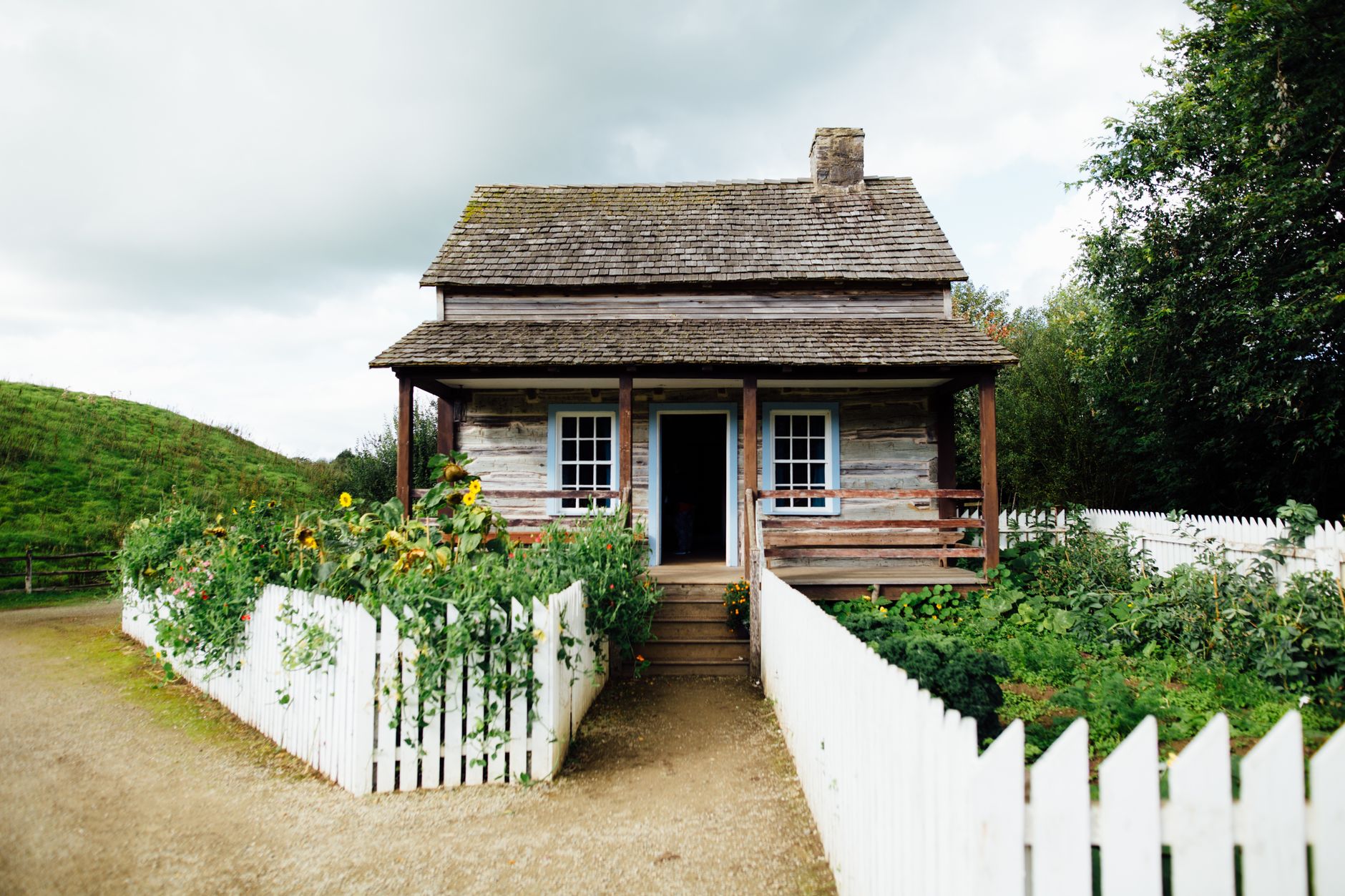
The Farmhouse My Father Never Owned
The locksmith’s van was the first thing I saw when I opened my curtains that Saturday, and the moving truck was the second, and my mother standing on my own front step in a cashmere cardigan was the third. It was 7:58 in the morning. I hadn’t even finished my coffee.
I want to tell this story the way it actually happened, not the way it felt in the moment, because the moment felt like drowning and drowning doesn’t make for a very useful account. So I’ll start with the facts. My name is Thackeray Cravenshaw. I am thirty four years old. I live outside Millbrook, Iowa, on County Road 9, in a three bedroom farmhouse with a wraparound porch and twelve acres that used to grow soybeans before I let half of it go back to prairie grass because I liked the way it looked in October. I bought that house with my own money. I have the paperwork. I have always had the paperwork. That turned out to matter more than anything else that morning.
I work as a claims compliance auditor for a regional insurance cooperative headquartered forty minutes from here, in Cedar Junction. My job, in plain terms, is to find the places where a paper trail doesn’t match what actually happened. I spend my days reading contracts the way other people read the newspaper, looking for the sentence that contradicts the sentence three pages later. It is not a glamorous job. It pays well. It also means I am, by profession and by temperament, extremely hard to bluff with a piece of paper.
That turned out to matter too.
Millbrook is not a big place. Population just under two thousand, one stoplight, a Lutheran church and a Methodist church that have argued good naturedly over the Fourth of July parade route since before I was born, a diner with a pie case that gets restocked every morning at five, and a feed store where the men who run it know my truck by sound before they see it turn in. Everyone in a town that size has an opinion about everyone else’s business, which meant that by the time the sun was fully up that Saturday, at least four separate people had already driven past my place slow enough to get a good look at the moving truck.
*The morning it started*
I stood in the doorway in my flannel pajama pants and a T shirt with a coffee ring on it, holding a mug that said WORLD’S OKAYEST FARMER, which a coworker had given me as a joke last Christmas, and I looked at the scene in my own driveway like it belonged to somebody else’s life.
Three men leaned against the moving truck at the end of the drive, arms crossed, in no hurry, the way men are when they are being paid by the hour and the job hasn’t officially started. Behind them the gravel road ran off toward the Lutheran church and the feed store and, eventually, the rest of Millbrook. In front of them, closer, stood a locksmith with a case of tools at his feet and an expression that told me he had already started to suspect this was not a normal Saturday call.
And on my top step, blocking her own path to my door because I was standing in it, was my mother.
She looked like she’d stepped out of a catalog for a life none of us actually lived. Hair blown out. A cardigan the color of oatmeal that had never once touched a bale of hay. My father stood a few steps behind her in a golf shirt, arms crossed, jaw set in the particular way it set whenever he expected a room to simply agree with him and the room was, for once, being slow about it.
“What is this,” I said. Not even really a question. More like a statement I needed her to confirm or deny.
My mother did not say good morning. She has never once, in thirty four years, opened an uncomfortable conversation with good morning. She stepped forward like she intended to walk straight past me into my own kitchen.
I did not move.
“Pack a bag, Thackeray,” she said, bright as a Sunday announcement. “You’ll want to be out by noon so the movers have daylight.”
“Excuse me?”
“Verity and her fiancé are getting married in eight weeks,” she said, as if that sentence explained a locksmith standing in my yard. “They need a real place to start their life together. A house. Land. You’re one person. You don’t need three bedrooms and twelve acres just to rattle around in by yourself.”
Then she smiled at me. It was the smile she used at church potlucks right before she told someone their casserole needed more salt. Sweet on the surface, with a blade folded up inside it.
“So your father and I have decided to gift this place to your sister.”
For a second the only sound was the moving truck idling at the end of the driveway and the small clink of my mug against my knuckles.
This was not family property. This was mine. I had put twenty two thousand dollars of my own savings down on it, money I built up over eleven years of overtime and a second job doing weekend bookkeeping for the co-op elevator. I had made three years of mortgage payments without missing one, out of an account with my name on it and nobody else’s. I had scraped and budgeted and gone without so many small comforts that I could not now, looking back, remember most of what I had given up, only that I had given up plenty.
And I was a compliance auditor. My entire professional life was built around the idea that confidence is not evidence. People think if they say a thing firmly enough, with enough certainty in their voice, it becomes true. I spend my working hours proving that it doesn’t.
So when my own parents showed up with a locksmith and a moving crew to take a house out from under me, I did not scream. I did not cry. I did something closer to what I do at my desk on a Tuesday.
I audited the situation.
“Are you serious right now,” I said, and I meant it as a real question, because for half a second I honestly could not tell.
My father stepped up beside my mother, color already climbing into his face. “Don’t make a scene, Thackeray. We’re family. Family looks out for family. Your sister needs this more than you do.”
I looked past both of them at the locksmith, who had gone very still, the way a man goes still when he senses he has wandered into something that is not going to end with a tip.
“Don’t touch that door,” I told him.
My father snapped his fingers at the man like he was calling a waiter. “Go on. Drill the deadbolt. Front door first, then the mudroom. These men are on the clock.”
The locksmith didn’t move. “Sir, I need to see proof of ownership before I drill a high security lock. I can lose my license over an illegal lockout.”
My mother made a small disgusted sound, like the law was an inconvenient houseguest. “I am her mother,” she said. “We co-signed on this place. We have every right to be standing here.”
Then she reached into her purse and produced a folded, slightly crumpled paper, and held it out like it settled the matter.
The locksmith took it. Studied it. Looked back up at her, and there was something almost gentle in how he said it, like he didn’t enjoy being the one to tell her.
“Ma’am. This is a welcome packet. It’s got driving directions to the title company on it.”
Because that’s exactly what it was. A photocopied brochure from the closing three years earlier, the kind every title office hands you along with a pen and a bowl of peppermints. Not a deed. Not a mortgage document. Not anything with legal weight at all. Just an old map to an office none of us needed directions to anymore.
I took a slow sip of my coffee, and for the first time that morning I watched something flicker behind my father’s eyes. Not doubt, exactly. Not yet. More like the first hairline crack in a foundation that had held for a very long time.
Because in my father’s mind, he had never really stopped owning me.
*How we got here*
To understand that driveway, you have to understand the family it grew out of.
I was the older daughter. The responsible one. The quiet one, which in my family was never a compliment, it was a category, the same way you’d describe a heifer as a good milker. I paid my own way through everything from the time I was seventeen. I learned early that asking my parents for help usually cost more than it was worth, because help came with strings and interest neither one of them ever wrote down but both of them expected repaid.
My younger sister, Verity, was the golden one. Warm and funny and dramatic in a way that people mistook for charisma, and allergic, in a deep and abiding way, to anything that resembled sustained effort. When I got into a two year accounting program at the community college in Cedar Junction, my parents told me they simply couldn’t help with tuition, because they needed to keep what they had for Verity’s future.
So I worked. I waited tables at the Millbrook diner until close on weeknights. I cleaned the community college’s library floors at five in the morning before class. I tutored freshmen in algebra on Saturdays for twelve dollars an hour. I drove a Chevy Cavalier with a hundred and ninety thousand miles on it that shuddered like it was having a religious experience anytime I hit fifty.
Verity dropped out of the same program after one semester because, in her words, it was stressing her out. My parents bought her a two year old Ford Escape to cheer her up. Barely used. Heated seats.
Years after that, she showed up on my porch crying because her car had died and she couldn’t afford to fix it, and my parents called me and said this was what family does for each other, and I believed them, because some part of me was still seventeen years old and hoping that if I just gave enough, eventually it would count for something.
I gave her thirty two hundred dollars. It took me four months to save it back.
Two weeks later she posted a photo from a girls’ weekend at a lake resort two hours from here, mimosa in hand, captioned: Sometimes you just have to treat yourself.
That was the day the good daughter in me quietly finished dying. I didn’t announce it. I didn’t cut anyone off dramatically. I just stopped. Stopped paying. Stopped rescuing. Stopped explaining myself at every Sunday dinner like I owed the table an accounting of my choices.
And I started keeping what my therapist, a patient woman who works out of a converted farmhouse of her own on the other side of the county, called a ledger. Not a real one. A private, mental record of the lies, the guilt trips, the dollar amounts, the small insults dressed up as concern, every time my family tried to hand me a version of reality that required me to be the problem in order to make sense.
Then I built a life around not needing them to see it clearly. I finished my degree at night while working days at a farm supply distributor doing their books, and when a compliance position opened up at the insurance cooperative in Cedar Junction, I applied even though I didn’t think I had the résumé for it, and I got it anyway, because it turned out eleven years of catching discrepancies in other people’s paperwork by necessity had trained me for exactly that kind of job without my ever meaning it to. I moved up twice in six years. I made more money than anyone in my family wanted to say out loud at Thanksgiving, and I noticed, without ever mentioning it, that the years I started earning real money were the same years my mother started introducing me at church as “our Thackeray, she’s very good with numbers,” instead of just Thackeray, like the numbers were the only part of me that had finally become worth naming out loud. I saved carefully, invested what I could, drove the same ten year old truck long after I could have afforded a new one, and three years ago I bought the farmhouse on County Road 9 that my parents were now standing in front of with a locksmith.
There is one detail from that closing that matters more than anything else in this story, and I need to lay it out plainly, because it is the hinge the whole morning eventually turned on.
When I was finishing the purchase, I was about four thousand dollars short of the closing costs the lender wanted covered in cash, separate from my down payment. My parents offered to help with that piece. I was surprised, and grateful, and for one soft moment I let myself believe it meant something uncomplicated.
But a mortgage lender doesn’t just let family money appear in a closing without paperwork. If a relative contributes toward a purchase, the lender requires what’s called a gift letter, a signed, notarized statement affirming the money is a true gift, with no expectation of repayment and no ownership interest created by it. My loan officer explained all of this to my father directly, in the title company’s conference room, in front of me and the closing agent.
My father signed that gift letter without much of a glance at it. I remember him saying something like, “Sure, sure, whatever gets it done,” while checking his phone for the Cardinals score. He signed his name, the notary stamped it, and the closing agent filed it with the rest of the loan file.
In his memory, over the following three years, that signature slowly transformed. It stopped being a gift letter and became, in the retellings at Thanksgiving and Christmas and any other gathering where the subject of my house came up, something else entirely. “We co-signed on that place.” “We helped you get that house, don’t forget.” By this Saturday morning, the story had fully calcified into a fact in his mind, the way stories do when nobody in the room is willing to correct the person telling them.
Nobody had ever corrected him. Until now.
*The voicemail*
Three days before the locksmith showed up, my sister accidentally sent a voice memo to the family group chat that was clearly meant for her bridal party instead.
“Oh my gosh, girls,” she squealed, “Mom and Dad said we’re moving into Thackeray’s place this weekend. She’s been playing house out there long enough. Mom’s going Saturday with a crew to get that stubborn old maid out for good.”
I was standing at my own kitchen counter when it came through, listening to my sister plan the redecoration of a home she had never once helped pay for, describing me, at thirty four, as an old maid who needed to be handled like an eviction problem.
I did not call anyone. I did not send back a single angry text. I set my phone down, finished my coffee, and started pulling files.
I printed my mortgage statements. My deed, recorded with the county. The bank’s amortization schedule showing three years of on time payments from an account solely in my name. And, because I am the kind of person who keeps everything, a copy of that old gift letter from the closing, the one with my father’s signature on it, the one that said in plain notarized language that the four thousand dollars was a gift with no ownership interest attached.
Then I called the sheriff.
I’d known him since I was sixteen, back when he used to buy sweet corn from the roadside stand I ran every August to save for community college. He knew what those years had actually looked like for me, underneath the version my parents told at church. More importantly, for the purposes of that Saturday, he knew how to read a deed, and he knew the difference between a family disagreement and an attempted illegal lockout, which is a crime in the state of Iowa whether or not the people committing it happen to share your last name.
*The driveway, again*
So there I was on Saturday morning, coffee in hand, watching my father raise a hand like he intended to physically move me out of my own doorway, when a siren cut through the quiet of County Road 9.
Red and blue light hit the porch windows. The moving crew straightened up off the truck. The locksmith took a full step backward, already halfway to deciding this job wasn’t worth his license. My mother’s smile folded in on itself like a tent losing its poles.
A county cruiser came up the gravel drive and stopped at an angle behind the moving truck, close enough that the truck couldn’t easily pull out. the sheriff stepped out in uniform, unhurried, his badge catching the early sun.
My mother’s whole voice changed in half a second. “Officer, this is just a family misunderstanding, nothing that needs, ah, official anything.”
“It’s Sheriff,” he said, not unkindly, just factually. “And I’ve had a call about an attempted illegal eviction at a private residence. I’d like everybody to just hold where they’re standing a minute.”
My father puffed himself up the way he always did when he sensed an audience slipping away from him. “We co-signed this place. We signed papers at the title company. We have every right to be here.”
The sheriff nodded slowly, the way a man nods when he already suspects the story he’s about to hear is going to be more complicated than the person telling it thinks it is.
“You co-signed,” he repeated.
“That’s right,” my father said. “We were there. We signed documents.”
“Well now,” the sheriff said, “that’s interesting, because your daughter called me three days ago and asked me to pull the county file on this property, since she figured this conversation was coming.” He reached into his jacket and produced a folded, county-stamped copy of the recorded deed, along with a second document clipped behind it. “According to the recorder’s office, this parcel has exactly one owner of record. Her.”
My mother went pale in a way I had never once seen on her before, not even the year my grandmother’s estate went through probate and things got ugly over a set of dishes.
My father stopped talking entirely, which for him was its own kind of confession.
“And before you say another word about co-signing, Arthur,” the sheriff went on, using my father’s first name in a way that somehow landed harder than his rank would have, “you might want to see what this second page actually is.”
He held it up. It was the gift letter. My father’s own signature, notarized, dated the day of the closing, stating in language a first year law student could parse without help that the four thousand dollars he’d contributed had been given as an outright gift, with no ownership interest, no lien, no claim, and no expectation of repayment, now or ever.
“You signed this,” the sheriff said. “Your daughter’s lender required it before they’d let your money touch the closing table. I imagine the man who filed it into the county’s records that afternoon has probably forgotten your name by now. But he kept the copy. County keeps everything.”
My father took the paper. His hands were not steady. He read it once, and then, because some part of him clearly didn’t believe it the first time, he read it again.
“This isn’t,” he started, and then stopped, because there wasn’t an end to that sentence that didn’t make things worse for him.
“That’s your signature, sir,” the sheriff said. Gently now, the anger gone out of his voice, replaced with something almost like pity. “You didn’t co-sign a house. You signed a gift letter, three years ago, right there in that conference room, and from what I understand you didn’t read it real closely at the time. I’d guess that’s on you, not on her.”
*What happened next*
I wish I could say my father apologized on the spot, that some dam broke and thirty four years of favoritism came pouring out in a heartfelt confession on my front porch. It didn’t happen that way, and I’ve learned not to write endings that didn’t actually occur, because the false comfort of them never survives the next holiday dinner.
What actually happened is that my father stood there holding a piece of paper that proved, in his own handwriting, that he had never owned one square foot of my land, and he did not know what to do with his hands. My mother, for the first time in longer than I could remember, did not have a follow up line ready.
The locksmith quietly picked up his case. “I’m going to head out,” he said to no one in particular, and nobody stopped him. He glanced at me on his way past and said, low enough that only I heard it, “Smart of you to have that ready. You’d be surprised how often it isn’t.”
The moving crew took a little longer to catch up to what was happening, standing around by the truck with the specific confusion of men who are paid by the hour and would honestly be fine either way. Eventually one of them walked up the drive and asked, not unreasonably, whether the job was still on. The sheriff told him it was not, and suggested, in the calm tone of a man who has broken up a hundred family arguments and expects this to be one more, that everybody currently standing in my driveway who did not live there ought to think about getting back in their vehicles.
My mother tried one more time. “Thackeray, honey, we can talk about this like a family, there’s no need for,” and she gestured vaguely at the cruiser, at the whole morning, like it was a piece of furniture she wanted moved out of the room.
“We can talk,” I said. “Not today. Not with a locksmith standing in my yard.”
She opened her mouth again and then, for once in her life, closed it without saying anything.
They left before nine. My father did not look at me on his way to the car. I don’t know if that was shame or fury, and honestly, after that morning, I stopped being all that interested in sorting out the difference.
*The weeks after*
Verity called me that afternoon, furious, though not, notably, on my behalf. She accused me of humiliating our parents in front of the whole county, as if the sheriff cruiser in my driveway had been my idea of a fun Saturday rather than the direct result of a locksmith she’d requested. I told her, as calmly as I could manage, that I hoped her wedding was everything she wanted, and that it was not going to happen on my twelve acres, and that if she wanted a house with a wraparound porch she was welcome to go build the kind of life that gets her one, the same way I had.
She hung up on me. We have not had a real conversation since, though I hear through my aunt, who still speaks to both sides, that the wedding ended up at a rented barn venue outside Cedar Junction, which by every account I’ve gotten was lovely, and which I was not invited to.
For a while after that, the town did what small towns do, which is talk. I heard three different versions of the driveway story by the following Wednesday, one of them so exaggerated that in it I had apparently changed the locks while my parents were still standing there and called two deputies instead of one. I let most of it pass without correcting it. A woman at the diner I barely knew patted my hand over a plate of biscuits and gravy and told me her own sister had done something similar to her twenty years back over a piece of farmland, and that some wounds just get managed, not healed, and you learn to live a good life around the edges of them. I think about that more than I expected to.
My aunt, my mother’s older sister, called me in November, not to relitigate the Saturday but just to ask how I was doing, which was the first time in longer than I could remember that anyone in my family had asked me that question without an agenda folded inside it. I told her the truth. I told her I missed the version of my family I’d spent thirty four years hoping we could still become, more than I missed the version we’d actually been. She didn’t try to talk me out of that. She just said she understood, and that door stayed open in a way none of the others did.
My father has not called. My mother called once, in October, and asked, without apologizing for anything specific, whether I’d like to come for Sunday dinner sometime. I said maybe, and I meant it as an honest maybe, not a kind one and not a cruel one. Some doors you close. Others you just stop propping open with your whole body, and let them sit however they’re going to sit.
I did change my locks that week, as it happens, though not because anyone forced my hand. I decided on my own that a fresh set of deadbolts, and a small camera above the porch light, were reasonable things for a woman living alone on a county road to have, regardless of who her family turned out to be. I hired a locksmith out of Cedar Junction to do it, not the one who’d stood in my yard that Saturday. I did, though, mail that man a thank you card, because a person who protects his license instead of taking the easy money deserves to know it mattered to somebody.
I kept the gift letter. I framed it, actually, small and plain, and hung it in my hallway, not out of spite, but because it is, in its own strange way, the truest document my father ever signed about our relationship. He meant it as a formality. It turned out to be the one honest thing in the whole story, sitting quietly in a county file for three years, waiting for a Saturday morning when somebody would finally need it to speak.
I still live in the farmhouse on County Road 9. The porch still needs painting one of these summers. The twelve acres are mostly prairie grass now, and in October, when the light comes low across it, it still looks the way it did the first morning I stood on that porch as its actual, sole, recorded owner, coffee in hand, home.
That’s the whole story. Not the version where everybody hugs it out by the last page, and not the version where I burned every bridge on principle either. Just the true one: a family that spent thirty four years treating my steadiness like it was theirs to spend, until one Saturday morning, one piece of paper, signed and forgotten and filed away exactly where it needed to be, told the truth louder than any of us could argue with.
This story is a dramatization. Names, characters, and details are invented, and any resemblance to real people or events is coincidental.