The Gnome War That Ended in Friendship
There was a plaster gnome standing in the middle of my peony bed with a chip out of his pointed hat and a grin like he owned the place, it was six fifty on a Tuesday morning in April, and I knew exactly whose porch he had walked off of.
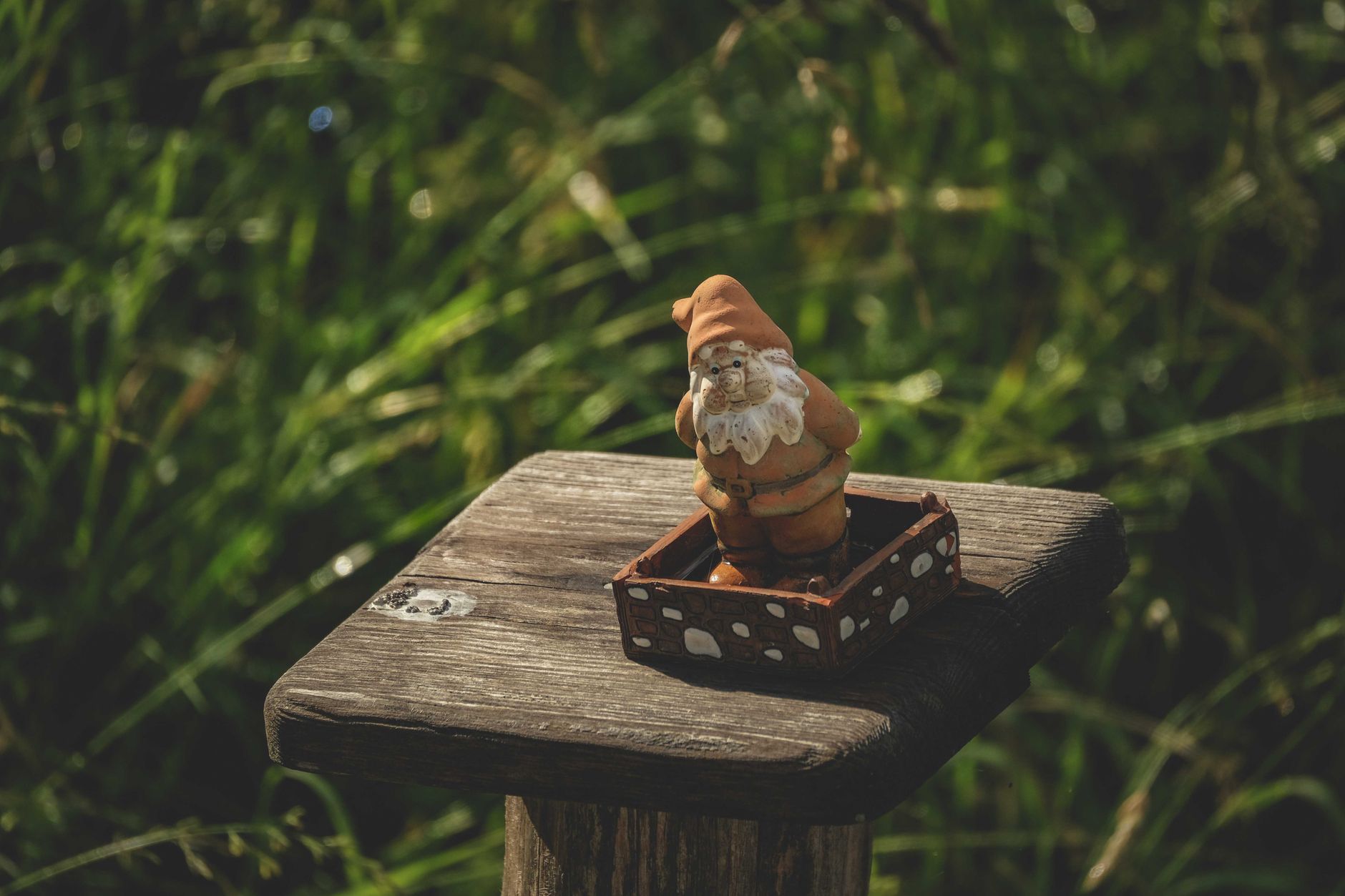
His name, I would later learn, was Norman. He was maybe fourteen inches tall, hand-painted, with a fishing rod glued permanently to one fist and a face that had faded from forty summers of sun into something between friendly and unhinged. He had not walked anywhere on his own. He had been carried, deliberately, across the property line that ran somewhere invisible between my house and Gilroy Hatch’s, and set down in my flower bed with what I can only describe as intent.
I am Louetta Fenimore. I was sixty-seven that spring, three years widowed, retired from thirty-one years of teaching fourth grade at Larkspur Elementary, and I had lived in the house on Chicory Lane long enough to remember when it was the only house on the street with a working television antenna. Gilroy Hatch had lived next door for going on twenty years, ever since he retired from the county road crew, and in all that time our relationship had consisted of waving from our respective mailboxes and, once, arguing for forty minutes at a town meeting about whether the new stop sign at the corner was necessary. He said it was. I said a four-way stop for a street with six houses on it was government waste. We had not fully recovered from that argument by the time Norman showed up in my peonies, and we would not fully recover from it for another six months, though not for the reasons either of us expected.
The line nobody could find
Here is the thing about the property line between my house and Gilroy’s. It does not exist in any useful sense. It exists on a survey filed with the county sometime around 1962, a survey so faded and water-stained that the surveyor’s own signature looks more like a rumor than a name, and it places the boundary somewhere in what is now the exact middle of a rose of Sharon bush that has grown for so long it has erased the question entirely. My late husband, Ashford, used to say that bush was the Switzerland of Chicory Lane. Neutral ground. Nobody’s business.
Gilroy did not believe in neutral ground. Gilroy believed, with the quiet, immovable certainty of a man who had spent three decades reading county surveys for a living, that the line ran one foot and four inches into what I considered my flower bed, and that Norman the gnome had every right to stand there fishing in my peonies for the rest of his plaster life.
I did not agree. I had planted those peonies the spring after Ashford died, when I needed something in the ground that would come back every year whether I tended it perfectly or not, because that was the year I could not be trusted to tend anything perfectly. Those peonies were not government waste. Those peonies were mine, and so, I had decided without much discussion, was the one foot and four inches of dirt underneath them.
So on that Tuesday morning I picked Norman up by his fishing rod, carried him back across the invisible line, and set him down on Gilroy’s side of the rose of Sharon with a note taped to his hat that said, in my best fourth-grade-teacher handwriting, “This gentleman prefers my tomatoes to your peonies. Kindly keep him home.”
By Thursday, Norman was back in the peonies. This time he had a second gnome with him, smaller, holding a lantern, and a note of his own taped to his boot in handwriting so cramped it looked angry even before you read it: “Survey says otherwise. Ask the county.”
I did not ask the county. I went to the garden center in Larkspur and bought three gnomes.
I want to be clear that this was not, in the moment, a rational decision. I stood in the seasonal aisle of that garden center for the better part of twenty minutes, holding a gnome in a fireman’s coat in one hand and a gnome playing a fiddle in the other, having a genuine internal debate about tactics, before I noticed the teenager working the register watching me with an expression somewhere between concern and admiration. I bought both. I bought a third, a small stern-looking fellow in overalls that reminded me, for reasons I could not have explained to anyone that day, of my late husband on a bad-mood Tuesday, and I drove home with all three buckled into the passenger seat like unruly children and set them down under the rose of Sharon before I had even brought in my groceries.
That, more than anything else that happened over the following months, tells you what this war actually was, though it would take a summer, a storm, and an ambulance before either Gilroy or I were honest enough to say so out loud.
The rules nobody wrote down
I want to be honest about what happened over the next several months, because Gilroy still tells this story wrong at the diner, and somebody ought to get it right for the record.
We never once discussed rules. We never sat down and agreed on terms the way reasonable adults do. But by the second week of May, we both understood, the way you understand the rules of a game you have never been taught but have clearly been playing your whole life, exactly how this worked. You did not touch the flowers. You did not touch the vegetables. You did not so much as bruise a marigold. The war was fought entirely in gnomes, on the strip of disputed dirt beneath the rose of Sharon, and it escalated only in gnomes, and if you ran out of gnomes, you lost.
I had three. Gilroy had two, plus Norman, plus the lantern one, whose name I later learned was Roscoe, which seemed like an unusually dignified name for a fourteen-inch plaster man holding a lantern in a stranger’s peonies.
By Memorial Day I had nine. Gilroy, who I would learn had once driven forty-five minutes to a going-out-of-business sale at a garden supply store rather than let me get ahead of him, had eleven, including one enormous fellow, nearly two feet tall, wearing a Santa hat for reasons that had nothing to do with the season and everything to do with the fact that it was the biggest gnome the store had.
He named the Santa-hat one General Norman the Second, in honor of the original, and set him at the front of the line like he was reviewing troops.
I bought a garden flag. It said “TRESPASSERS WILL BE COMPOSTED.” I planted it directly behind my own line of gnomes, which by then numbered fourteen and were arranged, I will admit, with more military precision than a woman who taught fourth-grade reading circles for three decades has any business showing.
The whole street picks a side
I would like to say the rest of Chicory Lane stayed out of it. That is not what happened.
It started with the mail carrier, a cheerful, weathered man everybody called Halcyon, who had been delivering to that street for eleven years and had therefore developed strong opinions about everyone’s business, whether or not anyone had asked for them. Halcyon began timing his route so he passed the rose of Sharon last, purely, he claimed, for the entertainment. By June he was keeping a running count in a little notebook he carried in his mail satchel. “Fenimore fourteen, Hatch sixteen,” he would announce to whoever was on their porch, like a man calling a horse race.
Then it was the Kowalski boys from three doors down, ages nine and eleven, who set up a card table at the end of my driveway with a hand-lettered sign that said GNOME COUNT TODAY: 5 CENTS A GUESS, and made, by their own later admission, eleven dollars and forty cents over the course of the summer, none of which their mother let them keep until they had donated half to the church roof fund, which felt like the sort of justice this street specializes in.
Then it was the whole rest of the block, quietly and then not quietly at all. People started walking their dogs an extra loop past Chicory Lane just to see the latest developments. Somebody, to this day nobody has confessed to it, started an actual betting pool at the counter of the Sunrise Diner on County Road 9, a spiral notebook kept behind the register where you could put a dollar down on FENIMORE or HATCH, with the payout going to whoever’s gnome count was higher come the first frost. Halcyon told me the pot got up over two hundred dollars by August. I did not ask how he knew that. Halcyon knows everything.
Then it was my granddaughter, Yseult, who drove up from three hours south for a long weekend in June expecting a quiet visit with her retired grandmother and instead found herself drafted, within an hour of arrival, into helping me research glow-in-the-dark garden paint on my kitchen laptop. Yseult is twenty-four and works in marketing for a company that sells athletic shoes, and she took one look at the situation, declared it the funniest thing that had ever happened to anyone in our family, and posted a photograph of the two front yards to whatever the young people use now, which is how, for one strange week in June, the Chicory Lane gnome war briefly had eleven thousand strangers on the internet weighing in on who was winning. The consensus, Yseult informed me with some delight, was firmly Team Fenimore, on the grounds that my gnomes had, in her words, “better styling.” I do not fully know what that means, but I painted twelve of them a coordinated shade of blue that weekend anyway, just in case.
The Fourth of July nearly ended the whole war early, and not in a good way. Gilroy, who takes patriotic observance about as seriously as he takes a survey line, spent two full days constructing a gnome float, a child’s wagon dressed in red, white, and blue crepe paper with six gnomes wired upright on it including General Norman the Second wearing a paper Uncle Sam hat, and towed it the length of Chicory Lane behind his riding mower during the little unofficial parade the street runs every year for the kids. I countered the following morning with a firework display of my own, six sparklers stuck in the dirt in front of my line at dusk, purely decorative, purely legal, and Halcyon still swears to this day that half the street came out onto their porches at nine p.m. specifically to see what I would do next, which is either the nicest or the most alarming thing anyone has ever said about me, and I have not fully decided which.
Gilroy’s grown son, a big quiet man named nothing I need to tell you here because he only appears in this story twice, drove up from two counties over in July, took one look at the rose of Sharon, now flanked by what had become two genuine armies of garden statuary, and said, “Dad, you’re sixty-nine years old.” Gilroy said, “I’m aware of my own age, thank you,” and bought four more gnomes that week out of what I can only assume was spite, or possibly grief he did not know what to do with, though I did not understand that part yet.
By the middle of July I had twenty-three gnomes. Gilroy had twenty-six. The line under the rose of Sharon looked like a diorama of a war nobody had bothered to explain to the participants, two ranks of small ceramic and plaster men, fishing, reading, wheelbarrowing, one memorably riding a plaster tortoise, facing off across roughly sixteen inches of disputed topsoil, visible from the road, visible, Halcyon assured me, from a slow-moving car all the way at the stop sign we had once argued about for forty minutes.
The Larkspur paper sent a photographer. We ran, both of us, above the fold, under a headline that said NEIGHBORS AT WAR (OVER GARDEN GNOMES), and I clipped it out and did not tell Gilroy I had, and found out three weeks later he had done the exact same thing, because his son mentioned it, laughing, at a barbecue I was not supposed to know I had been the subject of.
The night the sky turned green
The last week of July, the sky over Larkspur turned the color of a bad bruise around six in the evening, and the weather radio that lives on my kitchen counter, the one Ashford insisted on buying after the ’98 storm took the Hendersons’ whole roof off two streets over, started making the sound it makes when it means business.
I have lived in this part of the country my whole life. I know what a green sky means. I went out to bring in what I could, the porch cushions, the bird feeder, and, because I am apparently the kind of person who thinks about ceramic lawn ornaments during a tornado warning, I started grabbing gnomes off the front line and carrying them two at a time into the garage.
I was on my ninth trip, rain coming sideways by then, wind pulling at the rose of Sharon hard enough to strip half its leaves in a single gust, when I heard something over the wind that did not belong to the storm at all. It was Gilroy’s voice, and it was wrong. Not angry-wrong, which is the only way I had ever heard Gilroy’s voice before. Wrong the way a voice gets when the person underneath it is scared.
He was on his knees in his own front yard, half his gnome army knocked flat around him by the wind, one hand pressed hard against his own chest, and he could not get up.
I do not remember crossing the sixteen inches of disputed dirt. I remember being beside him, soaked through, shouting his name over the wind, and I remember him saying, through his teeth, in a voice that had gone thin and gray at the edges, “Louetta, I can’t get my breath,” which is the only time in six months that man had ever said my first name to me without a note attached to it taped to a gnome’s hat.
I got my phone out with hands that were shaking too hard to be useful and called for an ambulance while a funnel cloud that thank God never touched down was doing its business somewhere south of us, and I sat down in the mud in my good garden slacks and held onto Gilroy Hatch’s hand, this man I had been at open war with since April over one foot and four inches of dirt, and I did not let go of it once, not through the whole wait, not through the sirens, not through any of it.
He looked past me, once, at his front yard, at the wreck of gnomes lying scattered in the rain like a small toppled civilization, and he said, “Norman’s face down. Somebody’s got to turn Norman face up. He hates the rain in his eyes.”
I turned Norman face up. It felt like the least I could do for a man having a heart attack in front of me.
What I learned at County General
It was not a full heart attack, in the end, the doctors at County General called it a cardiac event brought on by exertion and a blood pressure situation Gilroy had apparently been ignoring since spring, which told me something about a man who had spent an entire summer hauling twenty-six garden gnomes back and forth across his yard rather than sit still with whatever was actually bothering him. They kept him three days. I drove to that hospital every one of them, because his son could not get away from work until the weekend, and because somewhere in the mud of that front yard I had stopped thinking of Gilroy Hatch as the enemy and started thinking of him as a stubborn old fool I was apparently not prepared to lose.
It was on the second day, in a hospital room that smelled like antiseptic and the terrible coffee from the machine down the hall, that Gilroy told me about Norman.
Norman had belonged to his wife, Josephine. She had bought him at a roadside stand outside Larkspur the summer they were married, forty-six years ago, set him in the flower bed of the first house they ever owned, and moved him with them, faithfully, through three more houses over the decades, including the one on Chicory Lane, where he had stood, fishing patiently in one flower bed or another, for the entire twenty years Gilroy had lived there. Josephine had passed four years before I ever met Gilroy, of the kind of cancer that takes its time and asks nothing of you but patience you do not have, and in four years of living alone next to her garden, Gilroy had not been able to bring himself to move Norman, or replace him, or so much as touch him, until the April morning he looked out his kitchen window and saw my new peonies coming up thick and healthy in a flower bed that used to be, in some long-erased survey, arguably his.
“I didn’t do it because of the line,” he told me, looking at the ceiling instead of at me, which is a thing men of his generation do when they are about to say something true. “I did it because your peonies looked so much like something Josephine would’ve planted, and I couldn’t stand looking at them without doing something about it. Moving Norman over there was the only thing I could think of that wasn’t crying in my own kitchen, which I’d already done plenty of.”
I sat there in a hospital chair that had not been comfortable since the Eisenhower administration and understood, finally, the whole shape of the thing. I had planted peonies because I could not bear an empty flower bed the year Ashford died. Gilroy had sent a gnome across a property line because he could not bear an empty house the year Josephine did. We had spent an entire summer building small plaster armies at each other, and the whole time we had both just been telling each other, in the only language either of us apparently had left, that we were still standing here, that we had not gone anywhere, that grief had not gotten the better of us yet even if it had come awfully close.
“You could have just brought over a casserole like a normal neighbor,” I told him.
“I’m not a casserole man,” Gilroy said. “I’m a gnome man. Was always going to be one or the other.”
What we built instead
Gilroy came home from County General on a Friday with a new prescription, a new diet he complained about constantly, and strict doctor’s orders to take it easy for at least a month, orders his son and I enforced together with a level of joint bossiness that surprised us both. I brought supper over four nights that first week. He complained about the low sodium in every single one of them and ate every bite.
The second week, I caught him out in his yard trying to right the gnomes the storm had knocked flat, moving slow and gray-faced, one hand still pressed to his chest the way it had been in the mud, and I marched across that sixteen inches of no-longer-disputed dirt and told him in my best fourth-grade-teacher voice that he would sit down on that porch step this instant or I would call his son, his doctor, and the county sheriff, in that order, and let them sort out who got to yell at him first. He sat. I righted forty-one gnomes myself that afternoon, sweating through my blouse, while Gilroy Hatch sat on his porch step and directed traffic like a man who had never once in his life taken an order from anybody and had decided, temporarily, to make an exception for me. “Norman’s crooked,” he called out twice, and both times I fixed it, and both times he said “still crooked,” and I have come to understand that this is simply how the man says thank you.
By the third week he was walking the length of Chicory Lane every morning on doctor’s orders, slow, cane in hand, and I took to walking it with him, not because anyone asked me to, but because a seventy-year-old man with a bad heart has no business walking an empty street alone at six in the morning, storm season or not. We did not talk about gnomes on those walks, mostly. We talked about Ashford, and about Josephine, and about a great many things two widowed people apparently have a backlog of thirty years’ worth of needing to say to somebody who will not flinch at any of it. Halcyon, delivering mail at his usual hour, took to timing his own route to catch us on our fourth or fifth lap, and reported back to the diner, apparently, that the betting pool ought to be retired, because whatever was happening on Chicory Lane now did not look like a war to him anymore, not even a little.
Somewhere in that month, without either of us deciding it out loud, the rose of Sharon stopped being a battle line and started being what it probably should have been the whole time, which is just a bush between two old people’s yards. We took the flags down. Halcyon was disappointed for exactly one delivery cycle and then found something new to gossip about, which around here does not take long.
What we did not do was put the gnomes away.
Instead, come the end of October, we did something that made the Kowalski boys’ card table look like small potatoes. We combined the armies. Every gnome that had ever crossed that line in either direction, forty-nine of them by the final count, Norman and Roscoe and General Norman the Second and forty-six others whose names I have mostly forgotten and whose faces I never will, got arranged together across both front yards, no fence, no line, no dividing bush left standing guard between us, decorated for the season, first in cornstalks and pumpkins, then, because we discovered neither of us wanted to stop, in a full Christmas display two months later that had cars slowing down all the way from the stop sign at the corner, the very same stop sign we had once fought about at a town meeting like our lives depended on it.
We call it the Chicory Lane Gnome Parade now. It has grown every year since. Gilroy’s son builds a new gnome out of leftover fence posts and a bowling ball for a head every Christmas, uglier and more beloved each time, and my granddaughter Yseult, who thought the whole feud was the funniest thing she had ever heard when she first came to visit that June, now drives up from three hours away every December just to help us set it up, and takes more pictures of it than she does of her own tree. She brought her boyfriend last year, a quiet young man who works in insurance, and made him hold the extension cord for two full hours while she adjusted the lighted reindeer at the center of the display, and I noticed Gilroy watching the two of them with the particular attention of a man doing arithmetic about rings and church dates, though he has had the good sense not to say so out loud yet, and neither, for the record, have I.
The display itself takes up both front yards entirely now, edge to edge, no fence, no line, no fifty-year-old survey mattering one bit to anybody. String lights run porch to porch across the rose of Sharon, which we finally trimmed back for the first time in a decade, and every gnome that ever crossed that disputed dirt in anger gets a spot somewhere in the arrangement, veterans of a war that ended, if you want to know the truth, in a tie neither of us has ever formally conceded. Cars slow down for it all December, sometimes stop entirely, and more than one stranger has knocked on my door to ask if they can bring their grandchildren by after dark to see it lit up. I always say yes. Gilroy grumbles about the extra traffic and then goes out and adjusts the extension cords so the display looks better for whoever is coming, which tells you everything you need to know about that man that six months of gnome warfare never quite managed to.
Halcyon still keeps a running count in that same little notebook, though now it is just for his own satisfaction, since there is nobody left to bet against.
Last December we put out a coffee can at the end of the driveway with a sign that said DONATIONS FOR THE FOOD PANTRY, THE GNOMES INSIST, and between the two of us and forty-nine plaster men in Santa hats, we raised over six hundred dollars for the Larkspur food pantry in three weeks. Gilroy says Norman would be pleased with himself about that, and honestly, at this point, I have come to believe him completely. That gnome has more influence on this street than the town council.
I still tease Gilroy that his side of the display is crooked. He still tells me my peonies are encroaching, which they are, a little, and neither of us has any interest in fixing it.
Some wars end with a treaty. Ours ended with a heart attack in the rain and a gnome named Norman turned face up so the storm wouldn’t get in his eyes, and somewhere in between those two things, a man I had never so much as shared a cup of coffee with became the person I check on every single morning before I do anything else, out of habit now, the way you check on family. We are, the both of us, too old and too stubborn to call it anything as soft as a friendship out loud, so we don’t. We just keep buying gnomes.
Forty-nine and counting. Come spring, I hear there’s a new shipment coming in at the garden center, and Gilroy has already mentioned, very casually, over a supper he complained about the sodium in, that he thinks the parade could use a marching band section this year. I did not ask where he intends to get thirty ceramic gnomes holding tiny trombones. I have learned, over one very long summer, never to ask that man what he is capable of when he has decided to commit to something completely.
I already know the answer. It is everything. It has always been everything, since the day he carried Norman across an inch of disputed dirt because he did not know how else to tell a stranger he was lonely.
This story is a dramatization. Names, characters, and details are invented, and any resemblance to real people or events is coincidental.