The Butter Churn They Left Me
The reading of the will
The lawyer’s office in Marisburg smelled like burnt coffee and floor wax, and I sat in the back row of folding chairs while my cousins picked my grandmother apart like a Thanksgiving carcass.
I want you to understand something before I tell you the rest. I was not there to fight. I had driven the ninety minutes from my little rented place outside Sedalia with my hands steady on the wheel and my heart already made up that whatever they gave me would be fine. Gram had been gone eleven days. I still had the funeral casserole dishes in my back seat, washed and stacked, because three different church ladies had brought food and I could not remember which Pyrex belonged to whom. That was the kind of thing I thought about. Not the money.
The others thought about the money.
There was Aunt Connie, my mother’s oldest sister, who had not set foot on Gram’s farm in four years and who wore a black dress that still had the tag tucked into the collar. There was my cousin Brett, who sold something to do with insurance in Kansas City and who kept checking his phone under the table like the will was a conference call he was too important to attend. There was his sister Danielle, who had already, and I mean this, already listed a photo of Gram’s dining set on a Facebook resale group before the woman was cold. I saw it. Somebody screenshotted it and it went around the family like a bad flu.
And there was me. Ruth. Named after Gram, though nobody ever called me that with any warmth except her. To the rest of them I was “poor Ruthie,” the one who never married well, the one who cleaned houses and did some catering on the side, the one who had lived twenty minutes from Gram her whole adult life and therefore, in their arithmetic, had already gotten hers just by being close.
The lawyer, a soft-spoken man named Mr. Petrie who had done Gram’s papers for thirty years, cleared his throat and read it out plain.
The house and the eighty acres went to Aunt Connie, to be sold and the proceeds split three ways among Connie, Brett, and Danielle. The savings, and there was more of it than any of them expected, close to a hundred and ninety thousand dollars from a lifetime of a woman who reused aluminum foil, split the same three ways. The truck to Brett. The dining set to Danielle, who had the decency to look at her shoes for exactly one second. The good china to Connie.
Then Mr. Petrie turned a page, and his voice changed, went careful and a little sorry, and he said, “And to my granddaughter Ruth, I leave my butter churn.”
The room went quiet for a beat. And then Danielle laughed.
She did not even try to hide it. She put her hand over her mouth the way you do when something slips out at a funeral, but the laugh got through her fingers anyway, bright and mean, and Brett caught it and grinned down at his phone, and Aunt Connie made a sound in her throat that was supposed to be sympathy and came out as a snort.
“The churn,” Connie said. “Oh, Ruthie. Well. You always did like the old junk.”
Mr. Petrie looked at me over his glasses. “There is a note,” he said. “Handwritten. She asked that it go to you along with the churn.” He slid a folded card across the desk, and I had to get up out of my folding chair and walk the length of that room while my family watched me collect my inheritance, a wooden butter churn and a note card, and I felt the heat climb up my neck and I hated that it did.
I did not open the note there. I would not give them that.
The drive home
The churn rode in my passenger seat all the way back to Sedalia, buckled in like a child, because I did not have the heart to lay it down in the trunk with the casserole dishes.
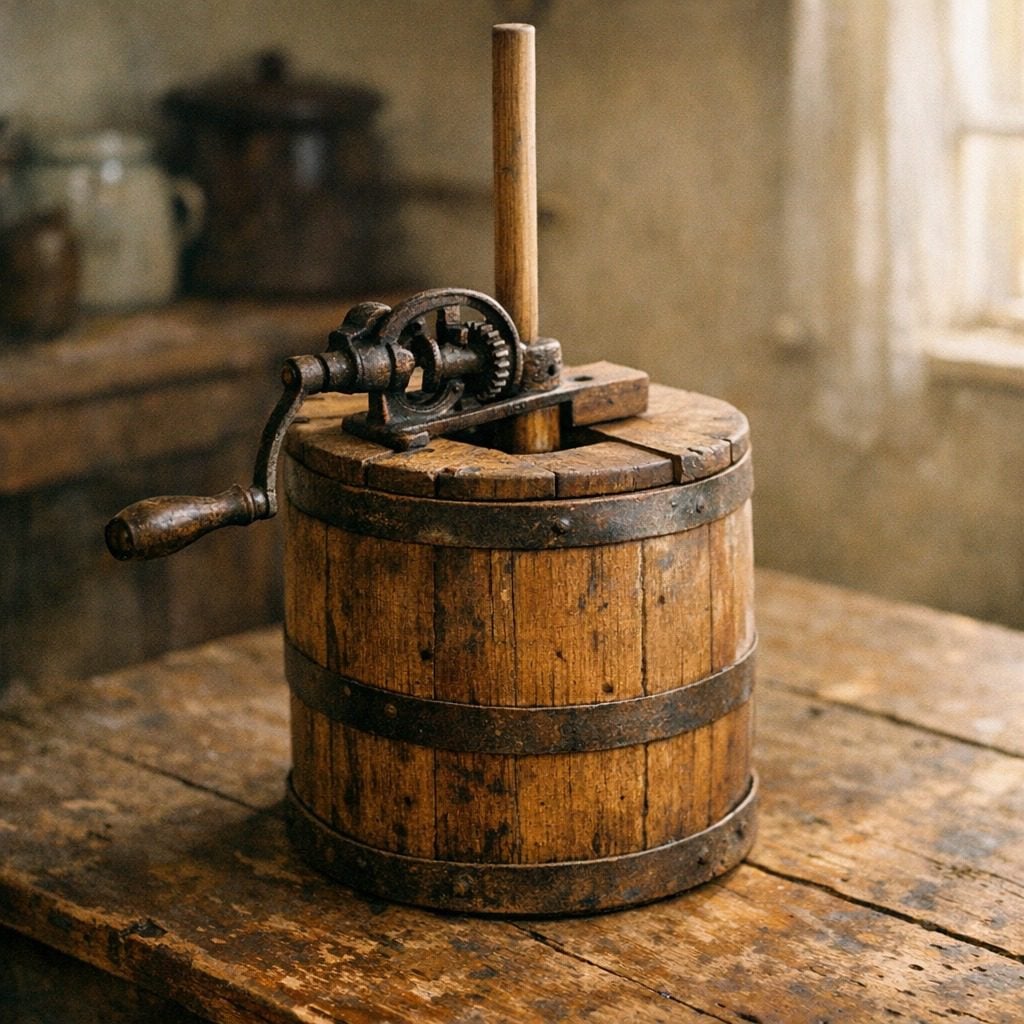
It was a dasher churn, the tall kind, a straight-sided cedar barrel maybe two feet high with iron bands around it gone soft brown with age and a hole in the lid where the plunger, the dasher, rode up and down. Gram had a crank churn too, a later one with a glass jar and gears, but she never trusted it for the good butter. “The dasher does it right,” she used to say. “The dasher makes you earn it.” The wood was dark from a hundred years of cream and hands. There was a burn mark on one stave from the time it sat too near the woodstove in 1974, a story she told me more than once.
I knew every inch of that churn because I was the one who churned with her. Not Danielle. Not Brett. Me. From the time I was six years old and could barely reach, standing on an overturned milk crate in her kitchen while she guided my hands on the dasher and sang, up and down, up and down, and told me you could feel the butter come, feel the cream go from loose to thick to a sudden heavy drag, and then the break, the moment the fat gave up and gathered into gold and the buttermilk went thin and blue around it. “There,” she would say. “There it is. You felt that?” And I did. I always did.
I pulled over at the gas station on Route J because my eyes were too full to see the road, and I sat in the lot and opened the note.
It was her handwriting, the real thing, shaky at the end of her life but hers.
Ruthie. They will laugh. Let them. You are the only one who ever asked me how. Everything I know is inside this. Look under the bottom the way I showed you, slow, and mind the grain. Love, Gram.
Look under the bottom the way I showed you. I read it four times. And then I understood, and I laughed out loud alone in a gas station parking lot with tears running down into my collar, because I knew exactly what she meant, and it had nothing to do with a false bottom or hidden money the way you would think. Gram never hid money. Gram hid something better.
What was under the bottom
Let me tell you how you take a dasher churn apart, because most people do not know and it matters to the rest of this.
The base of that churn had a removable disk, a wooden round that sat down inside the bottom to make the seal, and you lifted it out to clean because cream will spoil in a seam and turn a whole batch. Gram taught me to lift it slow and mind the grain so you did not crack the old wood. Under that disk, flat against the true bottom of the barrel, she had glued a piece of oilcloth, and under the oilcloth, folded to the size of a playing card, were three pieces of paper.
The first was her butter recipe. Now people think butter is just cream, and it is, but Gram’s butter won ribbons at the Pettis County Fair for going on forty years, and there was more to it than cream. It was the wash, and the salt, and the timing, and one thing I will not print even here because I promised her, a small thing she added, a way she cultured the cream two days ahead in a crock by the pilot light that gave it a taste people at the fair called nutty and a little tangy and could never place. She had it written out in her own words, with the measurements in “a good handful” and “count to what feels like sixty,” the way she actually cooked, and I could hear her voice in every line.
The second paper was her buttermilk. The real cultured buttermilk, not the fake stuff, the kind her own mother sold off the back porch during the Depression.
The third paper was a list of names. Marisburg names, some of them still alive, families that had bought Nelson butter at the Saturday market on the courthouse square for three generations before the market died and Gram got too old and it all just stopped. Beside each name, in her hand, a note. Likes it unsalted. Two pounds standing order. Pays cash, always. Tell her mother sent you.
She had left me the business. She had left me the whole thing, the recipe and the trade and the good name, folded up under the bottom of a churn her own children thought was junk, because she knew, she absolutely knew, that the only way to keep it safe from people who would sell it or laugh at it was to hide it inside the one thing only I would ever bother to open.
I sat in that gas station lot until the streetlights came on.
The winter I decided
I would love to tell you I marched out the next morning and built an empire. It did not go like that. It went slow, the way real things do.
That first winter I was scared. I had eleven hundred dollars in savings and a part-time cleaning route and a landlord who had already told me the rent was going up in spring. I did not have a cow. I did not have a barn. I did not have any earthly idea how a person in the year we were in was supposed to sell butter made in a wooden churn to anybody, and every practical bone in my body told me to put the churn on a shelf and be grateful for the memory and go back to scrubbing other people’s baseboards.
But I kept taking the papers out and reading them. And one night in February, with the wind coming across the field behind my rental like it had a grudge, I called a number.
There is a family named Hoefer that runs a small dairy off Highway 50, and I had cleaned for the wife, Pam, for years. Pam Hoefer was the one who told me, over her own kitchen table, that they had cream coming out their ears they could not move because the co-op price had cratered, and that if I wanted raw cream for butter she would trade me for cleaning and we would call it square. She said it like it was nothing. It was everything.
So I churned. In my own kitchen, on an overturned milk crate because I could not afford a proper stand, standing at that dasher for forty minutes at a time the way Gram taught me, up and down, up and down, feeling for the break. My arms were jelly for a week and then they were not. The first three batches were wrong. The fourth batch was Gram’s. I stood in my kitchen at eleven at night and tasted it off my finger and I had to sit down on the floor because it was her. It was exactly her. Forty years I had watched her make it and it was in my hands now, that nutty tang, that clean sweet finish, and she was gone but the butter was not.
I cried on my own kitchen floor for the second time that winter. Then I got up and washed the crock and started the next batch culturing for Saturday.
The Saturday market
The farmers market in Sedalia sets up in the parking lot by the old depot from May to October, and a ten-by-ten space costs fifteen dollars a week, and the woman who runs it, Delores, has a clipboard and a folding chair and has been telling vendors where to park since before I was born.
I showed up that first Saturday in May with a card table, a cooler of ice, forty half-pound pats of butter wrapped in wax paper, two gallons of buttermilk in mason jars, and a hand-lettered sign that said NELSON FARM BUTTER, CHURNED THE OLD WAY. I had the churn itself on the table, empty, just for show, because I wanted people to see the thing that made it. I priced the butter at six dollars a half pound, which felt like robbery to me, and Delores walked by and looked at my sign and looked at the churn and said, “Nelson. You Ruth Nelson’s people?”
“Her granddaughter,” I said.
Delores stood there a second. Then she said, “Her butter took the ribbon the year my mother took second and my mother never got over it,” and she almost smiled, and she moved my table up front by the entrance without me asking, which if you know how farmers markets work is the same as being knighted.
I sold out by nine-thirty.
I did not know what to do with myself. I had brought a book to read for the slow hours and there were no slow hours. Old women came up and read my sign and got a look on their faces, that far-off look, and said things like “my grandmother had a churn just like that” and “you cannot get real buttermilk anymore” and they bought two, three at a time. A man about eighty bought a half pound, unwrapped it right there, and ate a corner of it plain like an apple, and stood there with his eyes closed. He came back every Saturday after that for the rest of the season. His name was Earl. He is in this story again later.
I made two hundred and ten dollars in one morning off fifteen dollars of cream and a wooden churn my family threw at me as a joke.
Word gets around
Small towns run on two things, church and talk, and by July both of them were working for me.
The butter went from the market to the Methodist bake sale to the diner on the square, the Blue Star, where the owner, a woman named Cheryl, started buying ten pounds a week to put real butter on the tables and charge an extra dollar for the biscuits, which nobody minded paying. Cheryl put a little card on every table. CHURNED LOCAL BY NELSON FARM. People drove in from Warrensburg for those biscuits.
I want to be honest about the work, because the money makes it sound easy and it was not. I was up at four to start the churning. My hands cramped. My back learned the shape of that dasher and complained about it. I had cream to pick up and jars to sterilize and wax paper to cut and a cleaning route I could not afford to drop yet. I lost fifteen pounds that summer without trying. But I was building something that was mine, and every single pat of butter had Gram in it, and I have never in my life slept as hard or as sweet as I slept those nights.
By August I had that standing-order list from under the churn half filled again. I would knock on a door in Marisburg and an old woman would open it and I would say, “Mrs. Tillett? My grandmother Ruth Nelson sent me. She said you like it unsalted.” And Mrs. Tillett’s face would just come apart, and half the time she would make me come in and sit down and tell her how Ruth passed and cry a little and buy four pounds and pay cash, always, just like the note said. Gram knew her people. Even from the grave she knew exactly who would open the door.
Meanwhile
Now I have to tell you what my family did with what they got, because you have been waiting for it and because it is true, and I will try to tell it without any more meanness than the plain facts carry on their own.
The eighty acres and the house sold that first fall for a good deal less than Aunt Connie swore up and down it would. The farm crisis had the whole county’s land soft, and Connie, who did not know a soil map from a placemat, had already spent the money in her head. She had told everyone she was getting three hundred thousand for her share. She got, after the split and the realtor and the back taxes nobody knew about, closer to seventy. She had already put a down payment on a condo in Florida against it. That did not end well and I will leave it there.
Brett, my insurance cousin, took his share and his half of the savings, call it a hundred and ten thousand all told, and put it into a thing a friend told him about. I do not fully understand it and I do not think Brett did either. Something with a franchise, a smoothie franchise, in a strip mall in Lee’s Summit. He signed a ten-year lease. The smoothie place was open fourteen months. When it closed he still owed on the lease and on the equipment loan and on a home equity line he had opened to feed the thing, and the last I heard he had sold the truck, Gram’s truck, the one he got in the will, to help cover it.
Danielle sold the dining set for four hundred dollars to a dealer who resold it for two thousand, and she is still mad about that, and it is the smallest of her troubles.
I did not gloat. I want you to believe that. I had loved these people once, before the folding chairs. But I would be lying if I said there was no part of me, standing at my market table with a line six deep, that did not think about Danielle’s laugh coming through her fingers at the reading. The churn. Oh, Ruthie. You always did like the old junk.
The old junk paid my rent by September and let me quit the last of my cleaning route by Thanksgiving.
The letter from Connie
Connie called me in December. First time in a year.
She did not lead with sorry. Connie has never led with sorry in her life. She led with the market, which she had heard about, everybody had heard about it by then, there had been a little piece in the Sedalia paper with a photo of me and the churn. She said she was “so proud” of me, which cost her nothing, and then she got to it, which was that she was in “a temporary spot” and wondered if, given that Mother had “really meant for the family to share,” I might see my way to helping out. She had a number in mind. She said the number like she was doing me a favor by keeping it low.
I sat with the phone against my ear and I looked at the churn, which by then lived on a proper stand a man from the woodworking club had built me for the price of a month of butter, and I thought about what to say.
Here is what I did not say. I did not say that she laughed. I did not say that the will was the will and she got the house and the land and a third of a hundred and ninety thousand dollars and I got a wooden barrel and a note card. I did not say that if Gram had “really meant for the family to share” she would not have hidden the only thing that mattered under a bottom she knew only I would open. I did not throw the smoothie place or the Florida condo in her face, though the good Lord knows I had them loaded.
What I said was, “Connie, I loved her too. If you are hungry I will always feed you. Come to the market Saturday and there will be butter and buttermilk and eggs for you and you will never pay me a dime for food as long as I have it. But I am not going to write you a check, and I think you know why, and I think if you sit with it you will know it is not about being cruel.”
She was quiet a long time. Then she said, small, “She taught you the butter.”
“She taught me the butter,” I said.
“She tried to teach me once,” Connie said, and her voice cracked on it, “when I was a girl, and I told her it was hot in that kitchen and I went outside.” And then my aunt Connie, who wore a tag tucked in her collar to her own mother’s funeral, cried on the phone with me for a good five minutes about a morning seventy years gone when she chose to go outside instead of stand at the churn. And I understood something then that took the last of the anger out of me. They did not lose the money because they were stupid. They lost it because they never learned to stand at a hard thing until it broke into gold. Nobody taught them, or somebody tried and they went outside. Gram spent her last strength making sure at least one of us stayed in the hot kitchen.
Connie came to the market that Saturday. She took her butter. She cried again at my table, in front of everybody, and hugged me hard, and I have fed her free every week since and I always will.
The fair
I have to tell you about the fair, because it is the part Gram would want told.
The Pettis County Fair runs the last week of July, and the domestic arts building, the one with the quilts and the canned goods and the pies, has a butter class in the dairy competition that had been running, and I checked, every year since 1911. Gram won it thirty-eight times. There was a gap of four years at the end where she was too sick to enter, and in those four years the ribbon went to a woman named Sharla Boone whose butter, and I will be charitable, comes out of a stand mixer.
I entered the second summer. I did not tell anybody. I churned a batch three days ahead, cultured it Gram’s way, washed it Gram’s way, worked it and salted it and packed it into the same wooden mold Gram used, a mold with a sheaf of wheat carved in the bottom that had been pressing the Nelson name into butter for a hundred years, and I carried it into that building in a cooler with my hands shaking worse than they shook at the reading of the will.
The judging is blind. They number the entries. You stand back behind a rope with everybody else and you watch three women in aprons taste butter off little crackers and make notes and confer, and it takes forever, and Sharla Boone stood four feet from me the whole time telling her friend how she had “refined her technique” that year.
They gave me the blue ribbon.
I heard my number and I did not move, could not move, and the woman next to me had to nudge me and say “that’s you, honey, that’s you,” and I walked up on legs that did not feel like mine and one of the judges, an old woman named Frances who had judged that class for decades and had tasted Gram’s butter thirty-eight times, took my hand and turned it over and looked at the callus the dasher leaves on the heel of your palm, and she said, quiet, just to me, “I wondered when a Nelson would come back. It tastes just like her. Whatever she did with the cream, you have it.”
“I have it,” I said.
I could not say more. Frances squeezed my hand and let me go.
I hung that ribbon on the churn stand, on a little nail the woodworking man had put there without me asking, like he knew. It is not the last one. I have three now. But the first one, the blue one from that July, that is the one I look at.
What the churn is worth
People ask me sometimes, now that there is a little bit of a name to it, what the churn is worth. Antique dealers have asked. One offered me nine hundred dollars for it, an actual serious offer, because the old cedar dasher churns in good condition have gotten scarce and collectible. Nine hundred dollars, for the barrel, empty, as a thing to put in a farmhouse-style kitchen that has never made a pound of butter in its life.
I want to answer that question honestly, so here is the arithmetic.
That churn has made, by my rough count, something north of nine thousand pounds of butter in the two and a half years I have been at it. At the prices I get now, and I get more now than I did at that first card table, that is real money, more money than Brett’s smoothie franchise ever saw, more money than Connie’s third of the savings after Florida ate it. It built a little cinderblock creamery behind a farmhouse I now rent-to-own on four acres, with two Jersey cows of my own named Biscuit and Gravy so I do not have to trade cleaning for cream anymore, though I still clean Pam Hoefer’s house once a month for free and we both pretend it is a favor going the other way. It put the Nelson name back on the tables at the Blue Star and back on the doorsteps of Marisburg and back on the blue ribbon in the domestic arts building.
But that is not what the churn is worth, and the dealer with the nine hundred dollars did not understand why I laughed.
The churn is worth a note card in a shaky hand that said you are the only one who ever asked me how. The churn is worth every four a.m. and every cramped hand and the shape it wore into my back. It is worth the look on Mrs. Tillett’s face when I said my grandmother sent me. It is worth Connie crying at my table about a hot kitchen seventy years gone. It is worth the fact that when I stand at that dasher now, up and down, up and down, feeling for the break, I am not alone, I have never once been alone, because Gram is in my hands and her mother is in her hands and it goes back like that further than any of us can count, all the women who stood in the hot kitchen until the cream broke into gold, and I am the one who stayed, and I am the one who will teach it forward.
Earl, and the teaching forward
I told you Earl would be back. The old man who ate butter like an apple that first Saturday.
Earl came every week for two years and then one week he did not come, and the week after that his granddaughter came in his place, a girl of maybe nineteen named Whitney with a nose ring and a look on her face like she did not want to be there. She said Earl had passed. She said he had asked her, near the end, to go to the butter lady and tell her that her butter was the last thing his wife made before she died in 1998 and that eating it was like getting his wife back for a minute every Saturday, and that he never could say so to my face because it made him cry and old men do not like to cry in a parking lot.
I did cry, right there. Whitney did too, the nose ring and all.
Then I did a thing I did not plan. I asked Whitney if she wanted to learn. She said learn what, and I said the butter, the real way, the churn. She said why would I want to learn that, and I said because your grandfather’s wife knew it and it died with her and it does not have to, that is the whole point, that is the only point there has ever been.
Whitney has been churning beside me for eight months now. She is faster than I was. She has the callus on her palm. Last month she felt the break for the first time on her own, felt the cream give and gather, and she looked up at me with her whole face lit and said “did you feel that, it just, it just went,” and I said “there it is, you felt that?” in Gram’s exact words, and I had to turn around and wipe my eyes on my sleeve so the girl would not see.
What I keep
They split the money and the land and left me my grandmother’s old butter churn as a joke.
I have thought a lot about the word joke. A joke is a thing you laugh at because you have decided you understand it and the other person does not. Danielle laughed because she thought the churn was junk and I was a fool and Gram had, at the last, forgotten me the way the whole family had spent a lifetime forgetting me, given me the leftover, the nothing, the old barrel in the corner of the cellar.
But Gram did not forget me. Gram remembered me hardest of all. She gave the money to the people who only understood money, and it slipped through their hands the way it always slips through the hands of people who never learned to stand at a hard thing. And she gave the churn, and the recipe, and the good name, and the list of every door that would open, to the one grandchild who had stood on a milk crate in a hot kitchen at six years old and asked her how, and never stopped asking, and never went outside.
The land is somebody else’s now. The house has a family in it I do not know. The hundred and ninety thousand dollars is scattered to Florida and a smoothie franchise and a dining set some dealer flipped for a profit. All of it gone, the way everything they fought over was always going to go.
And I have a wooden barrel two feet high with iron bands gone soft brown, and a burn mark on one stave from a woodstove in 1974, and three blue ribbons on a nail, and two Jersey cows, and a girl with a nose ring learning the break, and a name back on the tables where it belongs.
I got the only thing in that whole estate that was ever actually worth anything. My family handed it to me laughing, and I carried it out to my car and buckled it into the passenger seat like a child, and I have been getting richer off their joke every single morning since.
Gram knew. She always did. The dasher makes you earn it, and I earned it, and it is mine, and I am not laughing at anybody. I am just churning. Up and down. Up and down. Feeling for the gold.