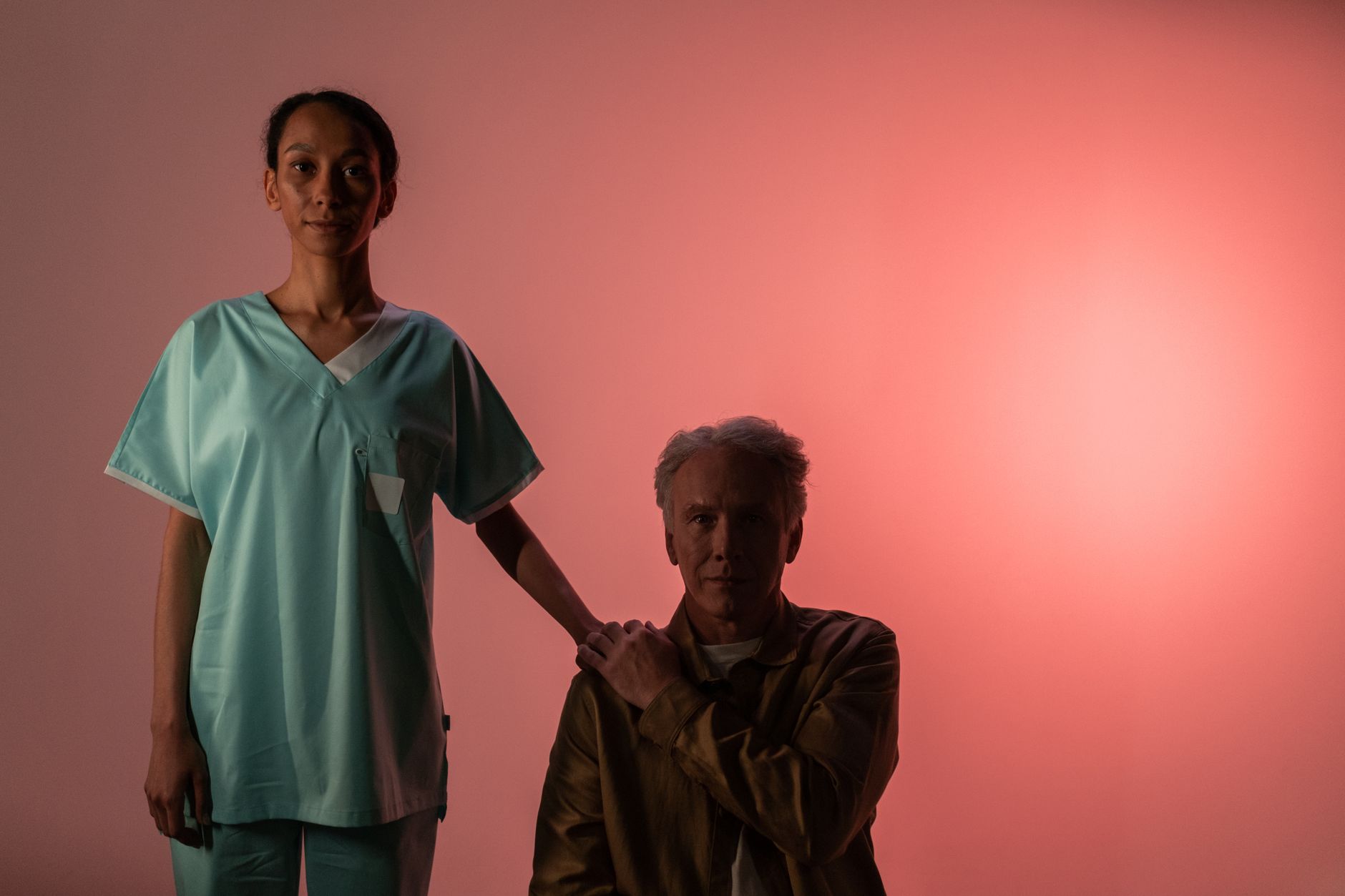
The Nurse Who Waited Thirty Years
The night nurse came into my father’s room at ten past seven on a Tuesday evening in October, and the first thing she did was stop.
She had a tablet in one hand and a plastic cup of pills in the other. She was about forty, with a plain brown ponytail and white shoes worn down at the heels. Her badge had spun around on its clip so that all I could see was the blank back of it.
She looked at the whiteboard beside the bed, where somebody on the day shift had written my father’s name in green marker. She looked at it a long time. Then she looked at the tablet, and back at the board, the way you check a number twice when you cannot believe it.
I figured she had him confused with another patient. I opened my mouth to say so.
“Hello, Mr. Bernard,” she said.
She said it quietly, to him and not to me. She set the cup down on the tray table and stood very still, and I watched her take a breath that seemed to start somewhere around her knees.
Nobody called my father Mr. Bernard in Wichita. At home in Wendell, Kansas, a handful of old people on his mail route had called him that for thirty years, the way you do with a man who has come to your gate six days a week since before your children were born. But this was a hospital three hours from Wendell, and the woman had never laid eyes on us.
“I’m Beatrice,” I said. “His daughter.”
“I’m glad,” she said. “I mean, I’m glad he has you.”
She said it as if it were the plainest fact she knew. Then she turned and went to work.
How we got there
My father was eighty-four years old. His heart had been failing for two years, slowly enough that he had made a kind of peace with it, the way he made peace with weather. He still got up at five and fed the barn cats.
Then on the last Wednesday of September he sat down on the porch step to pull his boots on and could not stand back up.
Wendell’s hospital has twelve beds and no heart doctor. They did what they could for four days, and then the young doctor there sat down on the edge of Dad’s bed and told us what we had been avoiding. His kidneys were going too. If anybody could do anything, it would be the cardiology people in Wichita. So on Saturday they put him in an ambulance, and I followed down Highway 81 with my husband Brendan driving, because my hands would not stop shaking.
Three hours and ten minutes.
Wichita did not have good news either. A doctor named Reinholt, a tall quiet woman with reading glasses pushed up in her hair, met us Sunday in a little room with a box of tissues and a painting of a barn.