
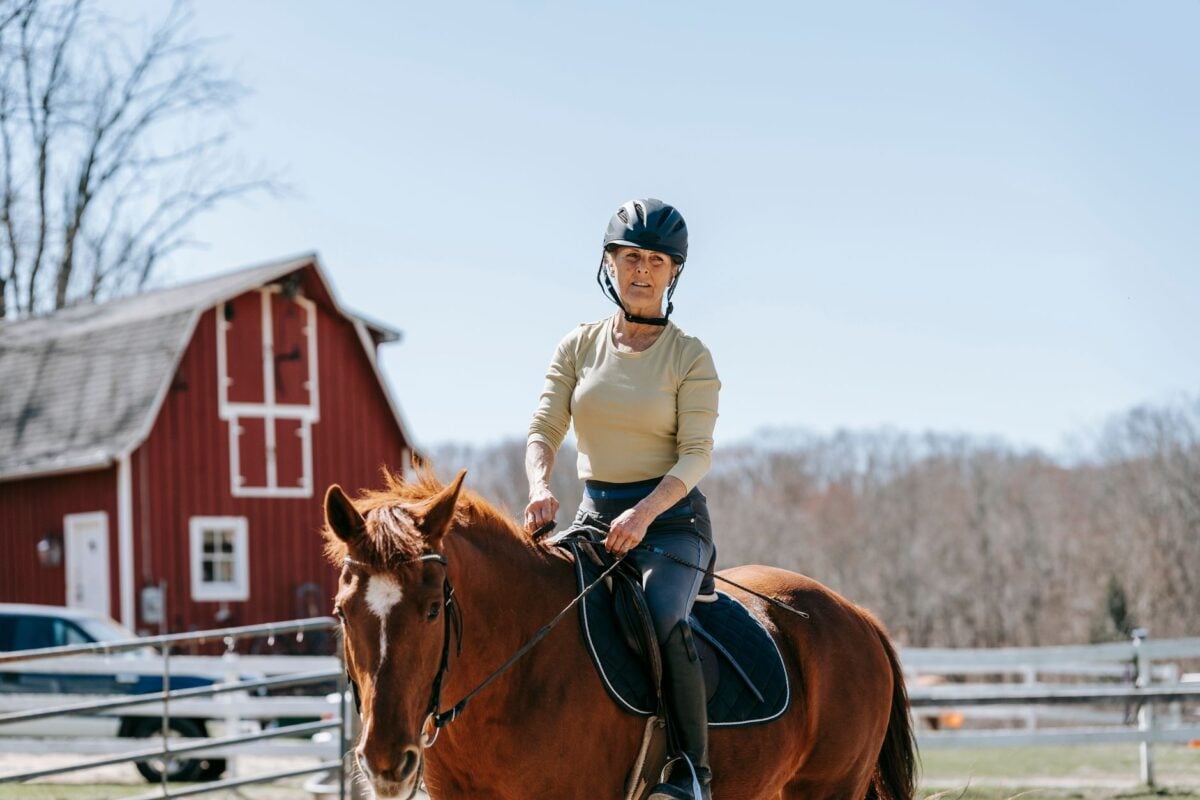
I pulled into the home place on a Friday morning in June with my curling irons in a tote bag, and the first thing I saw from the end of the lane was red where the blue and gold should have been.
I stopped the car right there in the gravel. I sat with the engine running and looked at the barn for a long time, because I thought for a second I had the angle wrong.
I didn’t. The front and the road side of the barn were fresh red, every board of them, from the stone foundation to the peak. The yard side, the one nobody photographs, still wore its old faded paint.
The hayloft door on the road side was red too, smooth and shiny, like nothing had ever been on it at all.
Twenty years of Mom’s Lone Star was under that paint. Eight feet across, a blue star with gold points, with her initials and Dad’s tucked down in the bottom corner where only she ever looked.
Get a new story in your inbox every morning.
Facebook doesn’t show you every story we post. Our free newsletter does. Join 2,500+ readers.
Tammy was out in the yard with a garden hose, rinsing paint drips off the concrete apron in front of the big doors.
She waved at me when I got out of the car, the way you wave at someone coming to admire something.
“Doesn’t it look like a different place?” she called. “The magazine people are coming on the twentieth. I about cried when the painters pulled out yesterday. It finally looks finished.”
I walked over to her slowly. I didn’t trust my voice yet, so I just stood next to her and looked up at the hayloft door with her.
“Tammy,” I said, “what happened to Mom’s quilt?”
She squinted up at it like she had to think about what I meant. Then she shrugged and turned the hose off at the nozzle.
“Oh, the painted square? I had them go right over it. Honestly, Kendra, it looked too country. Every barn on every county road has one now. I wanted it to look like the magazines.”
She said it lightly, the way you would talk about pulling out an old shrub.
She went back to rinsing the concrete, and I stood there in the sun with my tote bag full of curling irons and nothing at all to say.
The Year Dad Died
My dad, Elbert Kettner, died in April of 2006, out in the heifer pen, on a Tuesday morning. His heart just quit.
Neal found him when he went out to see why the skid steer was sitting idle with the bucket half raised.
Mom was 64 that spring. She had been married to Dad for 45 years, since she was 19 and he was 22, and she had never once in her life slept in that farmhouse without him.
She didn’t fall apart in front of anybody. She cooked for the funeral lunch herself, which the church ladies tried to stop and could not.
She wrote every thank you card by hand. Then summer came, and she went quiet in a way that scared me.
In July, three months after the funeral, she called me on a Thursday and asked if I could bring her two sheets of exterior plywood from the lumberyard. She said she would show me what for.
Mom had been quilting since 1966. She had made quilts for every baby, every wedding, every graduation, and every funeral in our family for forty years. But she had never painted anything bigger than a birdhouse.