
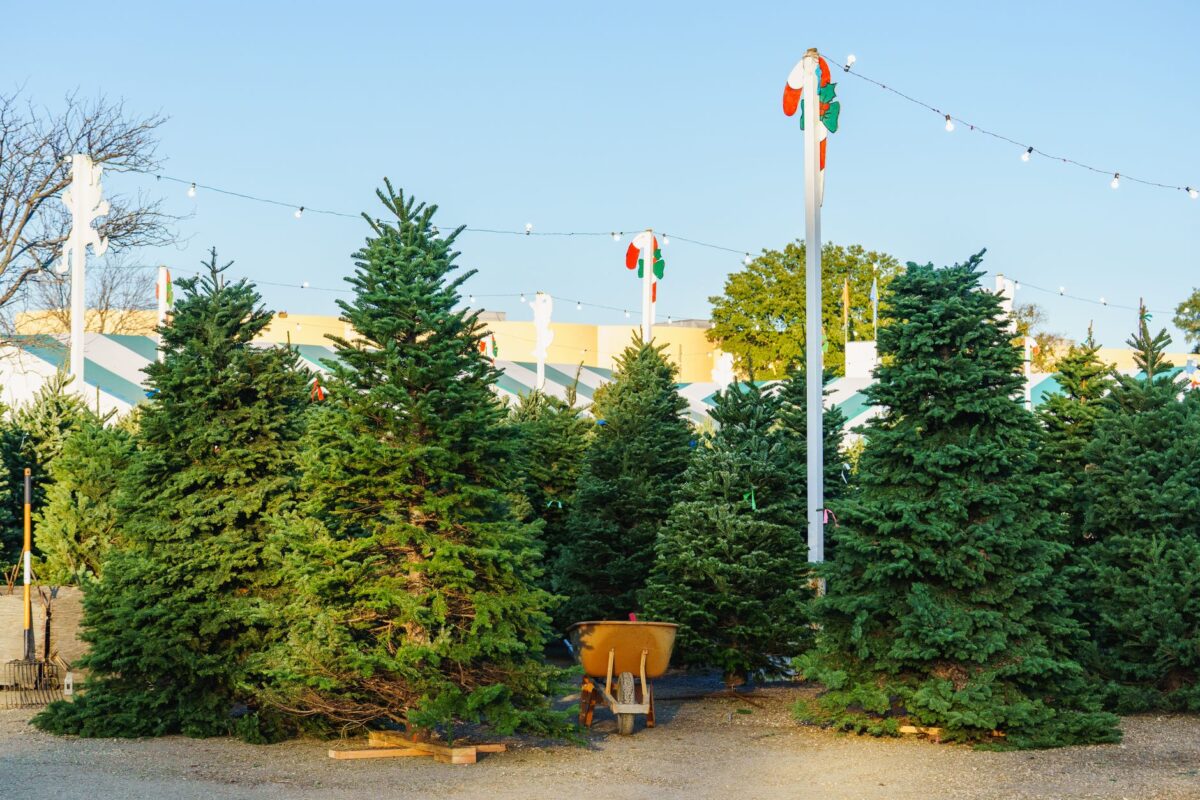
When we buried my father in March, three hundred people filled the Grange hall in Molalla, Oregon, and I had never met two hundred of them.
They stood along the walls in rain jackets and church shoes, because the folding chairs ran out by eleven o’clock. Some had driven from as far as Eugene.
I had planned for sixty, maybe seventy if the weather held. My father, Ferris Quillen, was eighty, and in forty-seven years of selling Christmas trees off one gravel lot on Dickey Prairie Road, he had never joined a club or gone to a dinner he could get out of.
So I stood at the front of that hall in a black dress that no longer fit me right, and I shook hands for three hours without understanding any of it.
Get a new story in your inbox every morning.
Facebook doesn’t show you every story we post. Our free newsletter does. Join 2,500+ readers.
Nearly every single person said the same sentence to me.
“I had a Christmas tree because of your dad.”
A deputy in a tan uniform said it with his hat in his hands. A nurse still in her scrubs held onto my wrist a second too long. A woman with a baby on her hip said, “My mother told me to come and say it for her,” and then her face folded and she could not say anything else.
I thanked every one of them. I assumed they meant they had bought a tree from my father once and he had been fair about the price.
Then a man in a Carhartt coat, maybe sixty, took my hand in both of his and said, “I paid him a dollar.”
I smiled and told him that sounded like Dad. It did not sound like Dad. My father charged forty-five dollars for a six-foot Noble fir and he did not haggle, not for the mayor, not for his own brother.
But I let it go. Then a second person told me they had paid him a dollar. Then a third.
By the end of the afternoon, eleven different people had told me, in the same careful voice, that they had once paid my father one dollar for a Christmas tree.
I had worked beside that man every December since I was nine years old, at the register, the twine, and the drill. I had never once seen him take a dollar for a tree.
Near the end, when the rain had thinned the crowd, a very small, very old woman came up the aisle on the arm of a young man in a ball cap. She wore a green wool coat buttoned to the neck, and she walked like every step cost her something.
She stopped in front of me and looked at my face for a long moment.
“You have his eyes,” she said. “Did he ever tell you about the burn pile?”
“No, ma’am,” I said. “What burn pile?”
Her mouth opened. Then the young man, her grandson, said, “Grandma, the car,” and gently turned her toward the door, and she let herself be turned.
“Ask Tobe,” she said over her shoulder. “Ask him about the twenty-seventh.”
She was gone before I could get her name.
I am going to tell you where my father’s trees went, and why, and what I found taped inside the back cover of a green account book. But I have to start on the gravel, in the rain, at nine years old, with a rule I thought was just my father being a bad salesman.