
“Ione, keep your bugs in town.”
That is what Lowell Bahr said to my mother across his fence, at ten minutes to one on a Tuesday in July, with the smell of his spray still hanging over the road ditch.
I heard it because I had just pulled into Mom’s driveway. My mail route ends a little before one most days, and on Tuesdays I swing by her place before I go home.
I was out of the car with the door still open. Mom stood at the barbed wire between her ten acres and his beans. Lowell stood on the other side, maybe six feet back, with his arms folded.
Behind him, out in the field, the custom sprayer was folding its booms up like a big insect putting its wings away. It had just made its last pass along the fence.
The wind was out of the southwest, hard and steady. It had been blowing that way since morning. I remember the clothesline in Mom’s yard was snapping, and the cottonwood by the pump house was showing the pale side of its leaves.
Get a new story in your inbox every morning.
Facebook doesn’t show you every story we post. Our free newsletter does. Join 2,500+ readers.
Mom did not answer him. She is seventy-six, and she has never in her life raised her voice at a neighbor. She just looked at him a long moment, and then she turned and walked back toward the house.
Lowell watched her go. Then he saw me, and he looked at me the way a man looks when he knows he has been overheard and has decided not to care. He turned and walked back toward his field road.
I caught up with Mom by the garden. Her face was gray under her straw hat. She did not stop walking.
“Come see,” she said. That was all.
The Hives
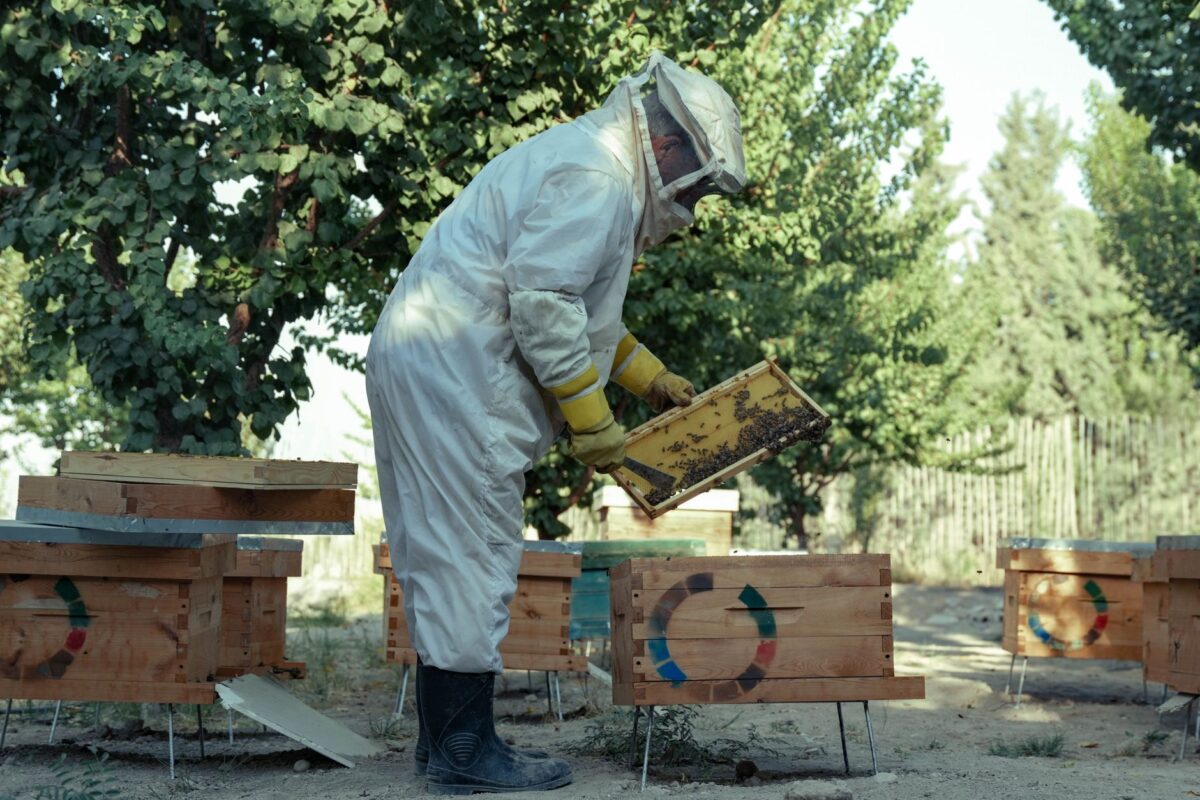
Mom has kept bees for forty years. Dad bought her the first two hives in the spring of 1986, after she read a book about it one winter and would not stop talking about it at supper.
By that July there were thirty of them, white boxes set in two long rows on the south side of the old windbreak, between the garden and the bean field. On a summer morning you could hear them from the porch.
You could not hear them now.
We came around the end of the windbreak, and I stopped. In front of every single hive, the grass was dark. It took me a second to understand that the darkness was bees.
They were piled at the entrances like coffee grounds someone had dumped out of a filter. Thousands of them in each heap. Some were still alive, spinning on their backs in the grass, their legs going.
Mom knelt down in front of the first hive. She did not care that she was kneeling in them. She picked one up on the end of her finger and held it close to her face.
“Look at the tongue,” she said. “See how it’s sticking out. That’s what poison does to them.”
I looked. The little tongue was out, the way she said. I had never once in my life looked that closely at a bee.
She went down the row, hive by hive. She lifted a few lids. Inside, the bees that were left were crawling slow and twitching on the frames. In some of the boxes, there was hardly anything moving at all.
“How many?” I asked her.
She stood up and brushed off her knees. “All of them,” she said. “Thirty. It just took them a little while to come home and die.”