
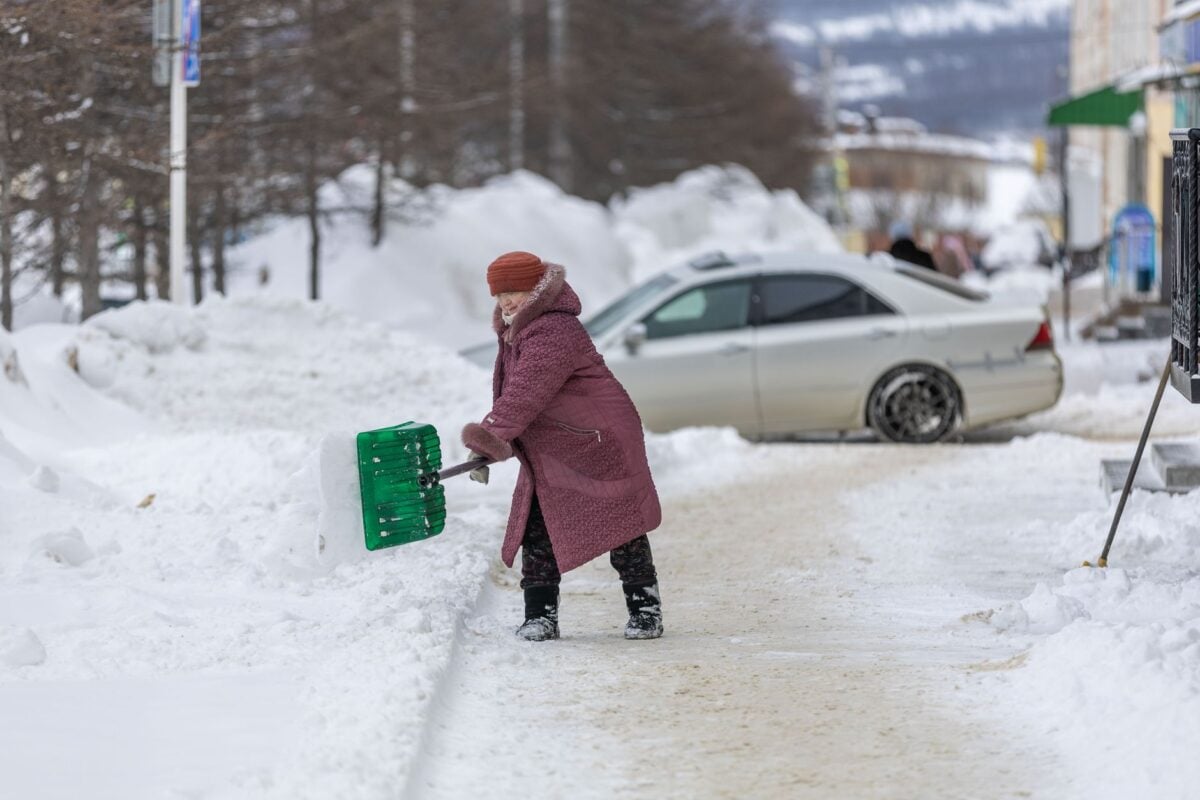
The first real snow of that winter fell on a Thursday night in early December. At ten past five on Friday morning I was standing at my kitchen window in my husband’s flannel robe, holding a cup of coffee I had made out of habit, for two.
I was sixty-six years old. Clement had been dead nine weeks.
I want to tell you exactly what I saw, because I have told it to a few people since and nobody believes it was that small. It was small. That was the whole of it, and it was the thing I came to love.
There was one light out in the dark. A little white circle on the end of an elastic strap, bobbing low, the kind of lamp a person wears when he is afraid of the dark and trying not to show it. Under the light was a shape no bigger than a fence post in a parka, bent over a shovel that was too long for it.
Get a new story in your inbox every morning.
Facebook doesn’t show you every story we post. Our free newsletter does. Join 2,500+ readers.
The shovel was Clement’s.
I knew it by the sound before I knew it by the handle. After forty-four years of marriage you know the scrape of a particular tool the way you know a cough in the next room. It was the green-handled aluminum scoop that lived on the porch behind the milk box, with a dent in the blade where Clement had once caught the edge of a granite step and said a word I will not put in print.
The shape started on the five steps, scraping each one down to the gray stone and then sweeping it with the flat of the blade. Then it started down the walk. Sixty-one feet, from my porch to the town sidewalk on Pleasant Street. I know it was sixty-one because Clement measured it with a surveyor’s wheel the summer we reset the steps, and he talked about the number for a month as if he had discovered it.
The shape did not hurry. It did not stop to look up at the house. When it reached the sidewalk, it turned and came back up the walk, checking its own work, and went over the two worst places, where the maple root heaves the path, with the corner of the blade.
Then it came up my steps, and I heard the storm door open and close, soft as a hand on a sleeping child’s back. The light went away down the street toward the Dufresnes’ house, and I stood there with two cups of coffee, one of them mine and one of them nobody’s.
When I opened the front door, there was the walk, bare and black and wet, with a fine line of rock salt down the middle that had not been there when I went to bed. The steps were swept. The porch was swept.
And inside the storm door, standing on its end between the glass and the wooden door, was the Haddon Courier, folded in thirds with the crossword turned up.
Not on the step, where it had lain every morning since October with its rubber band on, like something nobody had the heart to pick up.
Folded in thirds, crossword up, standing in the dry.
I had to sit down on the hall bench. It was not the shoveling. It was the crossword.