
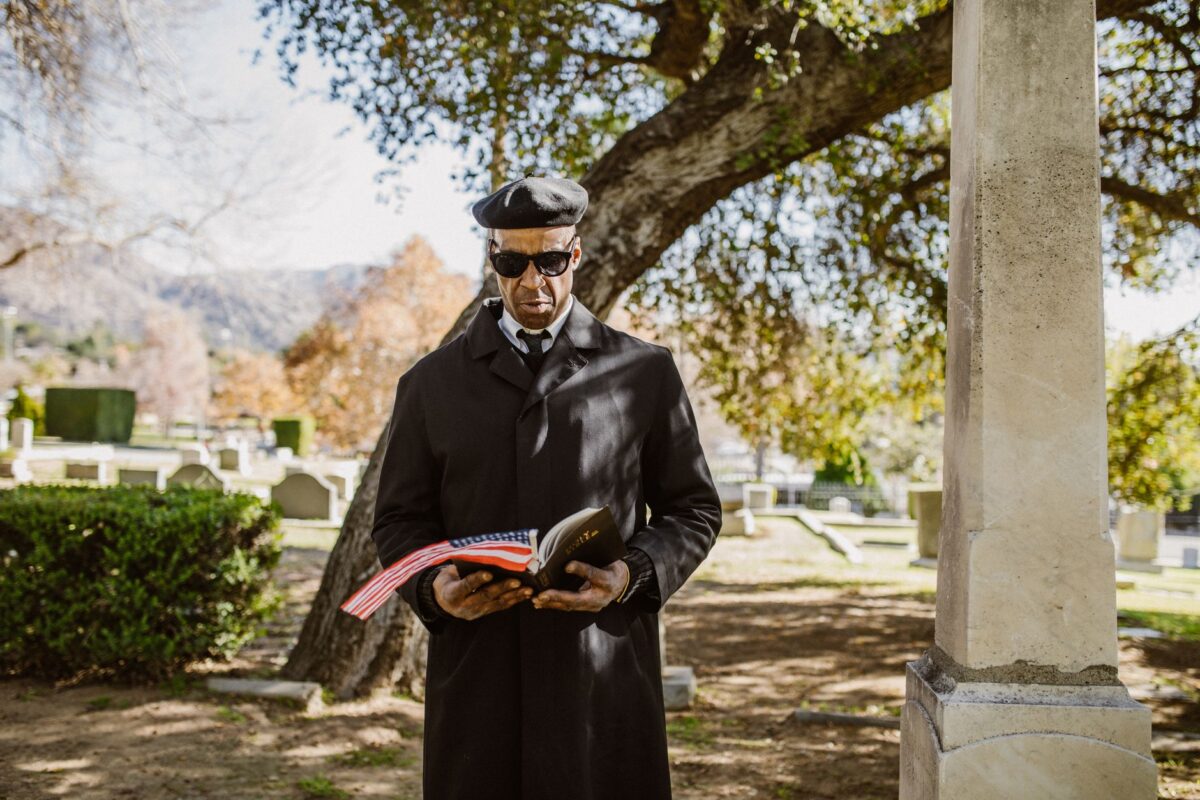
At ten till six on a Saturday in April I pulled the cord on my daddy’s old push mower at the iron gate of Rehoboth Cemetery, and the weeds in front of me were already past my belt buckle.
I had lived in Tamsey, South Carolina, for sixty-five years and I had never seen it like that. Johnsongrass and wild vetch had come up thick across the whole front hill. Privet had put out shoots as high as my shoulder. The tops of the older stones stuck out of it like the backs of sheep in a pasture, and the newer ones had simply disappeared.
Here and there a small cloth flag leaned out of the green at a slant. Somebody had set those flags out last Memorial Day. The sun had since taken most of the color, and the stripes had gone the shade of weak tea.
Get a new story in your inbox every morning.
Facebook doesn’t show you every story we post. Our free newsletter does. Join 2,500+ readers.
My name is Weldon Sullins. I am a retired Army staff sergeant, a combat engineer, twenty years in. Since I came home I have run a little shop on Route 9 called Sullins Small Engine, where I fix lawn mowers, weed eaters, and the occasional chain saw somebody has dropped in a creek.
In twenty-seven years of fixing mowers I had never once pushed one through that cemetery. The county always did it.
Rehoboth sits on a hill at the edge of town, six acres of it, with eleven hundred and forty graves by the church ledger. The oldest belongs to a militia captain who died in 1811. Two hundred and nineteen of the people under that ground wore a uniform of this country, in every war from the Revolution to Iraq.
For sixty years a county man on a tractor had come through every two weeks from March to November, and nobody in Tamsey thought about it any more than they thought about the water coming out of the tap.
Then last fall the county passed its budget.
I do not want to make a villain of anybody, because there was not one. A hurricane had torn up the roads in September, and the state sent less money than it promised. The council had to find dollars somewhere, and one of the lines it cut was forty-one thousand a year for mowing the cemetery. The same vote kept a second ambulance on the road for the east end of the county. If you had asked me to choose, I would have chosen the ambulance. I told myself that all winter. It did not help.
The county administrator, a woman named Annetta Varnadore, drove out to my shop herself in October to tell me before I read it in the paper. She stood in the doorway between a pile of carburetors and a rack of spark plugs, and I could tell she had rehearsed it in the truck.
“Who’s going to mow it?” I said.
She looked at the floor. “Nobody, Mr. Sullins. That’s the honest answer. I’m sorry.”
She looked as sick as I felt. I thanked her for coming, because my mother raised me that way, and then I went in the back room and was angry at a carburetor for twenty minutes.
I wrote the county three letters over the winter. The third one used the word “disgrace” twice and brought up my twenty years in uniform in a way I now find embarrassing.
My wife Neva read it over my shoulder at the kitchen table in March. She has run the lunchroom at Tamsey Elementary for thirty-one years and does not waste words.