
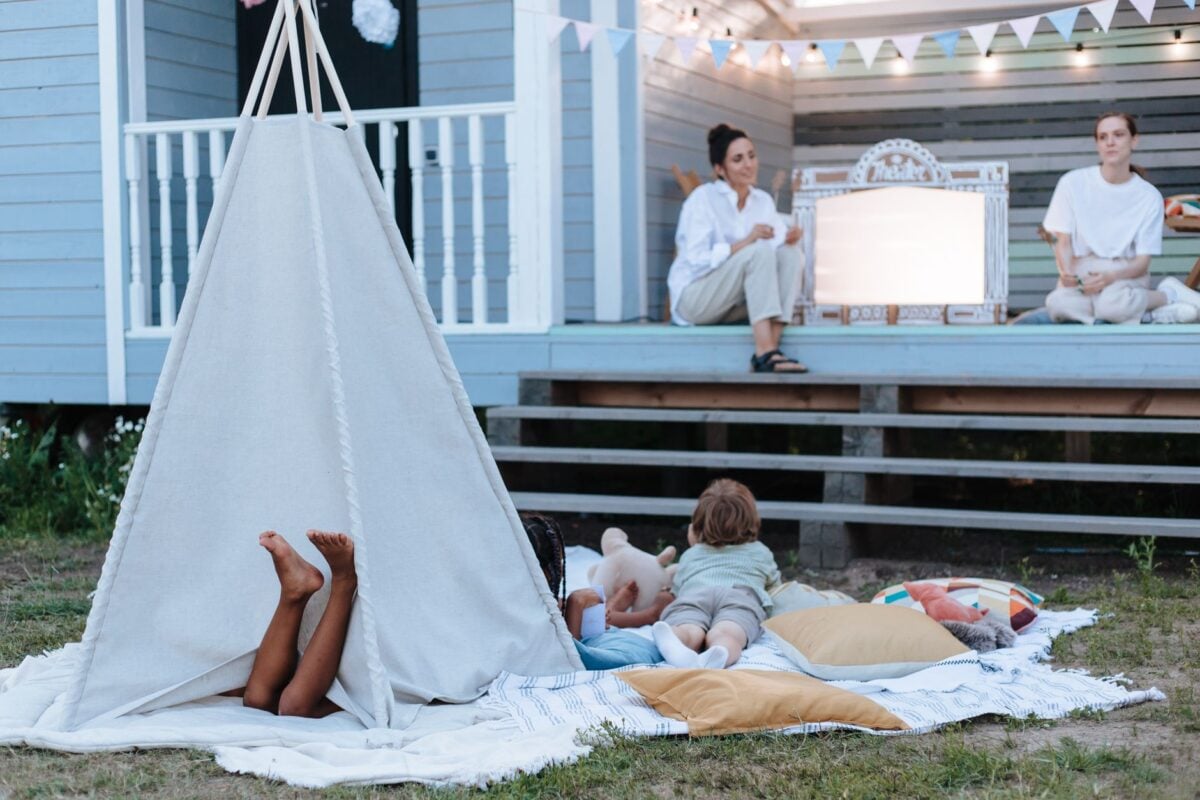
The trailer came across my backyard on a Tuesday afternoon in September, and Archie did not knock on the door first.
I heard the tires in the gravel, then the hitch rattling, and by the time I got outside he was already backing it over the grass.
The girls were on the porch steps with popsicles from the box in the freezer. Maisie was eight. Pearl was six.
They had been arguing about whose turn it was to pick the cartoon, and then they both went quiet at the same moment.
Archie had a buddy with him from the framing crew, a big quiet man named Chuck Brandt who would not look at me.
Get a new story in your inbox every morning.
Facebook doesn’t show you every story we post. Our free newsletter does. Join 2,500+ readers.
They had two lengths of steel pipe for rollers and a come-along hooked to the front of the trailer bed.
The playhouse sat in the back corner of the yard where it had sat for five summers.
Six feet by eight, on two treated four by four skids, with a real door and a little window that slid open. Archie built every board of it himself.
“Archie,” I said from the bottom of the steps. “What are you doing.”
He didn’t stop working. He set the pipe under the front skid, ran the hook down, and started cranking. “It was in the decree as mine, Leona. Tools and anything in the shop. I’m just taking what’s mine.”
That was not exactly true, and we both knew it. The playhouse was not in the decree at all.
Neither of us had thought to put it in there, because neither of us had thought anyone would ever pick it up and leave with it.
“Daddy, where’s it going?” Maisie called. She was standing now, and her popsicle was running down her wrist onto the step. She did not seem to notice it at all.
“My new place, bug,” he said. He said it to the winch handle and not to her. “You’ll see it there. You’ll see it every other weekend, okay? Same house. Just a different yard.”
The come-along clicked and clicked. The playhouse groaned up onto the pipes and then onto the trailer bed, and the little window shook in its track.
Chuck chained it down at all four corners without saying a word to anybody.
It took them maybe twenty minutes. I stood there the whole time, because I could not figure out what a mother is supposed to do with her body while a man drives off with her children’s summers. I didn’t yell. I knew if I started, I wouldn’t stop.
Then the truck pulled out, down our gravel road toward the blacktop, and west toward Salina, twenty five miles off. Pearl watched until she couldn’t see it, and then she looked at the corner of the yard.
There was a square of dead grass where it had been, flat and pale, with a few roly polies scrambling around in the light for the first time in five years.
Pearl walked over and put her doll right down in the middle of it.
Then she sat down beside the doll and cried. Not loud. Pearl has always cried like she is trying not to bother anyone, and that is the hardest kind for me to listen to, because I know where she learned it.