
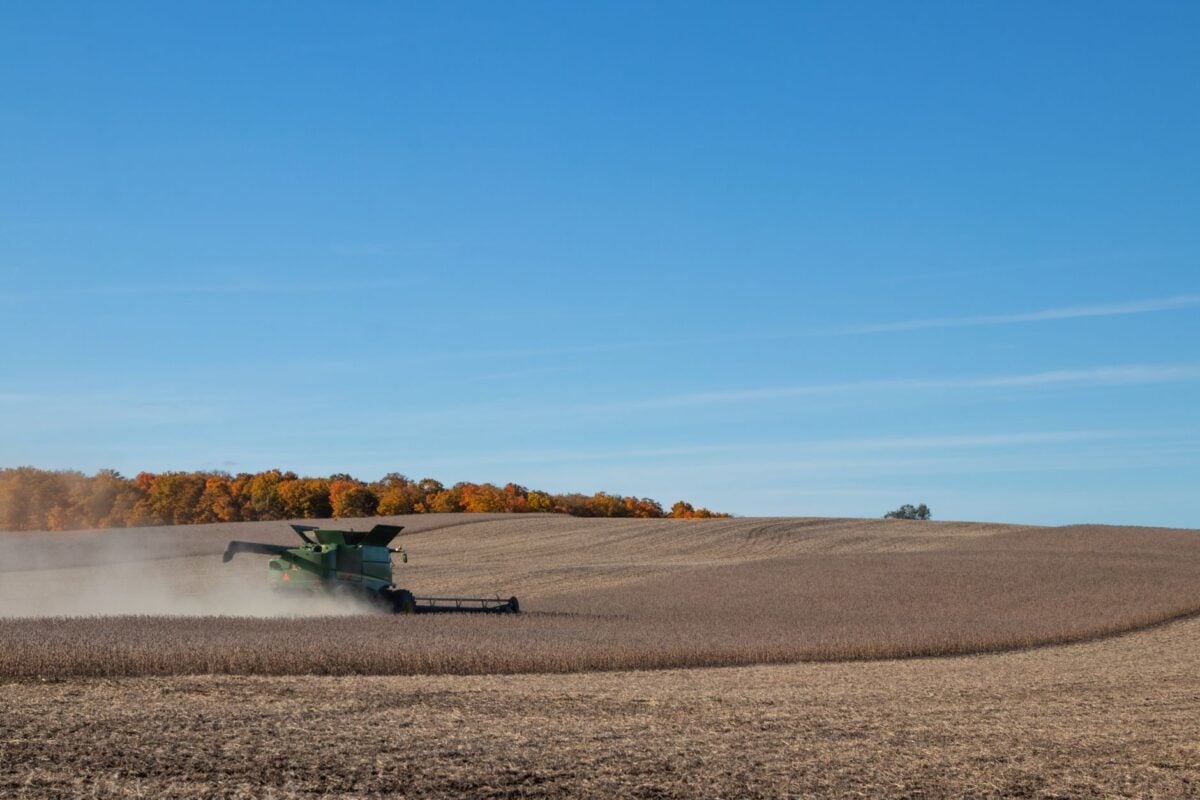
The keys went up in a high, lazy arc against the October sky, turned once in the sun, and dropped into the standing beans without a sound.
I watched them go. I did not move. Somewhere behind me the grain cart tractor idled, and the only other noise in the whole world was the dry rattle of bean pods in the wind.
My brother-in-law, Truman Weller, stood beside the open door of my combine with his empty hand still out in front of him, like he could not quite believe he had done it either. He was forty-one, Morris’s only brother, two years older.
“Now you’ll have some time to think about it,” he said.
It was a Saturday, a little after four in the afternoon, three weeks to the day after we buried my husband.
Get a new story in your inbox every morning.
Facebook doesn’t show you every story we post. Our free newsletter does. Join 2,500+ readers.
I was thirty-six years old, and I had twelve acres of soybeans left to cut.
My name is Anna Weller. I work three days a week as a vet tech at the animal clinic in Hampton, Iowa, and the rest of my life, for fourteen years, I farmed with Morris.
Morris was thirty-nine when his heart quit. He was in the machine shed on a Tuesday morning in September, greasing the bean head before harvest, and he just sat down on an overturned bucket and did not get up.
Our son Henry found him. Henry is ten. He had gone out to tell his dad the school bus was coming, and instead he came running back across the yard without his backpack, without his coat, without any words at all.
I am not going to tell much about those first days. Anyone who has lived through them knows already, and anyone who has not, I hope never has to learn.
What matters for this story is that the beans did not care.
They kept drying down in the fields the way beans do in late September, and by the first week of October they were ready whether we were or not.
The home eighty sits on a gravel road four miles southwest of Hampton.
Morris’s grandfather bought it in 1958 for a price that would not buy a used pickup now, and it was the only ground we owned outright.
We rented another three hundred acres from two widows and a retired dentist in Mason City.
But the eighty was ours, paid off in 2016, the year Henry was born, and Morris used to call it Henry’s ground.
He meant it. He had a little speech he gave Henry every spring at planting, sitting him on the armrest of the tractor seat.
This is your ground, buddy. We just take care of it until you’re big enough.
So when Truman stopped by on the Tuesday after the funeral and handed me a purchase paper on the back step, I said no before I even read the number.
Then I read the number, and I said no again.
Six thousand dollars an acre. Good black dirt in Franklin County was going for something closer to eleven thousand that fall, and everyone at the elevator knew it.
“It keeps the ground in the family,” Truman said that Tuesday. “You can’t farm this alone, Anna. Nobody expects you to. This way Henry still gets to walk on it.”
“Henry already gets to walk on it,” I said. “It’s his.”