
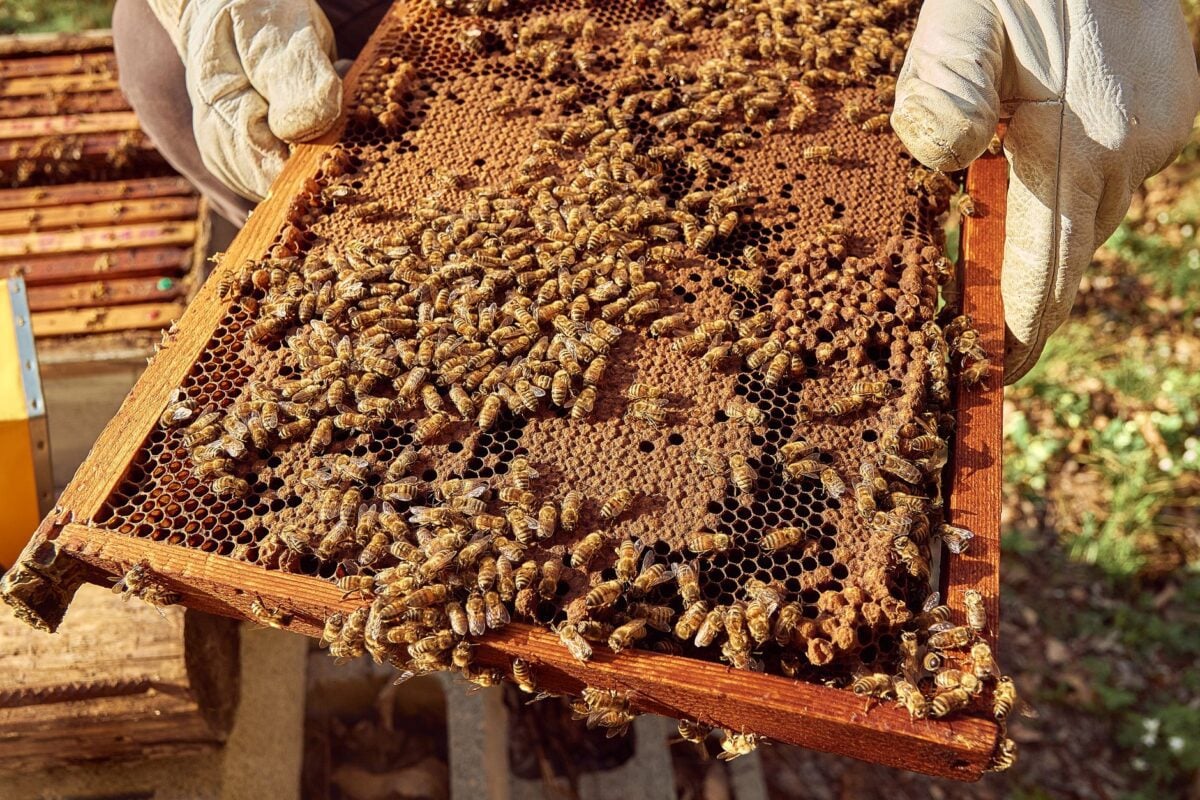
The first thing I noticed was the sound. Twelve hives make a steady hum you can hear from the lane, and that afternoon the creek corner was nearly silent.
I had come straight off my mail route, still in my carrier shirt, with a half-eaten sandwich on the dash of the Jeep. I parked at the field gate like I always did and started walking down through the grass.
Then I saw the tracks. Two wide, flattened ribbons ran across the hay ground and right along the row where my hives had stood since my first spring keeping bees.
Get a new story in your inbox every morning.
Facebook doesn’t show you every story we post. Our free newsletter does. Join 2,500+ readers.
The boxes were not just knocked over. Deeps split along the corners, frames snapped like kindling, lids cracked and flung aside, all of it shoved into a broken line beside the tracks by the blade of a machine.
Bees were everywhere. They crawled over the broken wood in thick, confused clumps. They circled the empty air where their entrances used to be, looking for a home that was not there anymore.
I stood at the end of the row for a full minute. I did not cry and I did not shout. I just stood there and listened to the little sound that was left.
Then I went back to the Jeep, took off the carrier shirt, and pulled on my mustard canvas chore jacket and my white veil. You do not walk into a mess of angry bees in a cotton shirt, no matter how your heart feels.
My name is Gretchen. I was thirty-four that June. I carry Rural Route 3 out of the Eldora post office in Hardin County, Iowa, in a right-hand-drive Jeep that smells like cardboard and coffee.
The bees were mine for four years. I started with two nucs from an old beekeeper up by Ackley, a man named Arlo who sold them out of his pole barn for $185 apiece and told me most people quit inside two seasons.
I did not quit. I read everything. I lost one colony my first winter and learned to wrap them better. By the fourth spring I had twelve strong hives sitting on cinder blocks along the creek, and I sold honey at the Saturday market in Eldora.
The creek corner belonged to my mother-in-law, Marie. It is a five-acre triangle on the home place, cut off from the big field by the creek bend, too wet to crop most years. She told me the first spring I could put my bees there as long as I liked.
I walked the row slowly with my veil pushed back so I could see. Eleven hives were gone past saving. The brood frames were crushed and the queens, I knew, were somewhere under all that broken pine.
At the very end of the row, the last hive had been clipped instead of run over. It lay on its side in the tall grass with the lid off and the top box knocked loose, but the boxes themselves were whole.
I knelt down beside it. My hands were steady, which surprised me. I pried the top box straight, set it back on the bottom one, and lifted out one frame from the middle.