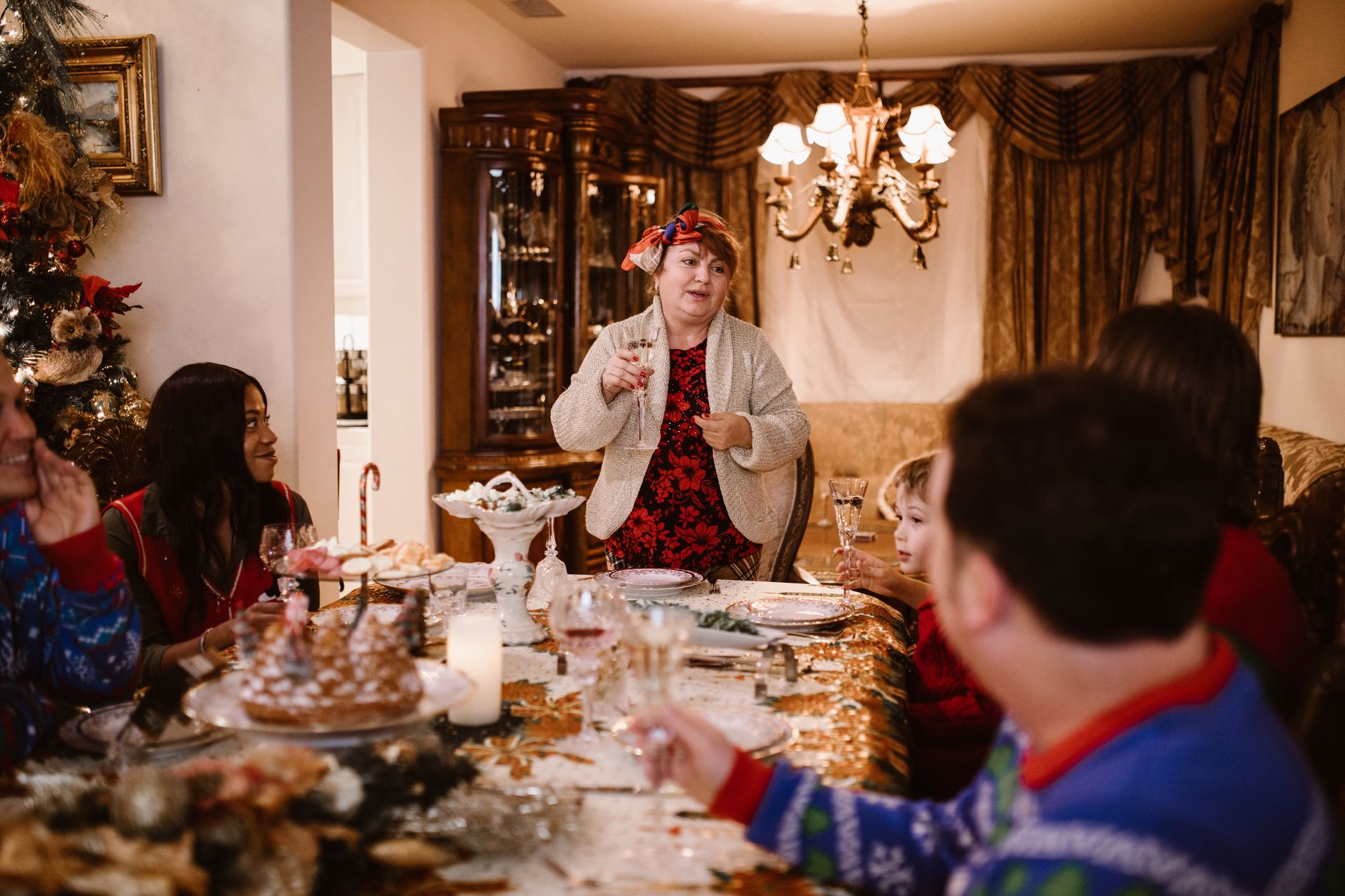
The Chair Grandma Pulled Out for Me
Oldest First
Grandma Opal was the oldest at the table, so Grandma Opal got the first plate.
She was ninety-one that December. She sat at the head of the long table in a cardigan the pale blue of a robin’s egg, her hands folded on the cloth in front of her.
She had not said much since Brett and I arrived. People talked around her the way families do with the very old, loud and over the top of her head, and she just sat and watched them all.
When I set the plate down in front of her, she caught my wrist. Not hard. Just firm enough to stop me where I stood.
“Why are you wearing an apron, honey,” she said.
It was not really a question. Her eyes went from the apron to the kitchen door and then down the table to Lorene, who was filling tea glasses at the sideboard and pretending not to hear a thing.
“I’m serving today, Grandma Opal,” I said. “I’m happy to do it.”
She looked up at me for a long moment. Her eyes were pale and clear, clearer than you would expect at ninety-one, and they moved over my face slow and careful.
She read me the way an old woman reads a letter she has been waiting a long time to get.
“Hm,” she said. That was all. She let go of my wrist and folded her hands again on the cloth.
I served the rest in the order Lorene had drilled into me. The men came next, Brett’s daddy and his uncles and the grown cousins who ran the cattle.
They were big men in clean pressed shirts, and they thanked me without ever quite looking up from their talk about calf prices and the December rain.
Then the children. The little ones needed their ham cut up small, so I cut it. A boy of about four told me he did not like green beans and I told him I would not tell anybody.
A girl of maybe seven caught my sleeve as I passed and whispered that her plate had no ham on it. I went back to the sideboard and fixed that first, before I fixed anything for myself, because a child ought not to wait.
Then, last of all, the wives. They were nice to me, in the bright and careful way of women who had each been the newest one once.
One of them, Brett’s cousin Tammy, met my eyes for just a second when I set her plate down. She had a look on her that I did not understand until later, a kind of apology she could not afford to say out loud.
They had each decided, somewhere along the line, that it was easier to pass the apron on than to stand in that kitchen and burn it. I did not blame them. I almost did the same thing myself.