The Week I Camped Across the Lake
The Hard Day
Monday morning I woke at six to the sound of a heron somewhere down the bank, and I sat in my chair with my coffee and thought about Sophie waking up in a strange bunk.
At twelve forty, my phone rang. It was Kim Dawson.
“Everything’s all right,” she said first, because she was good at her job. “I just want you to know what kind of day it is. The dining hall got loud at lunch. A boy dropped a tray. Sophie went under the table with her hands over her ears.”
I was already standing up. I had my keys in my hand.
“Hannah got her out to the quiet tent,” Kim said. “She put her headphones on and sat with the weighted blanket for about twenty minutes. Then she came out on her own and asked if there was any lunch left. She’s eating a peanut butter sandwich right now.”
“Do you want me to come?” I asked.
“Do you want my honest answer?” Kim said. “If you come, she’ll go home with you. And she will believe it was because she couldn’t do it. Let her have this one.”
I put the keys back in my pocket. It was one of the hardest things I have ever done, and I have helped cut down a whole oak tree with a chain saw that kicked.
That night at eight thirty she was on the dock again. I waved. She waved back, two arms this time. Hannah texted afterward: “She wants you to know she ate two sandwiches and she was not under the table very long.”
Amy texted Brent. “Hard lunch today, loud dining hall. She took a break and went back on her own. Waved with both arms tonight.” This time, after about an hour, he wrote back one word. “Ok.”
Ray’s Lantern
Ray came by again on Tuesday evening around seven thirty, in his own truck this time, off duty, with a paper sack from the gas station.
“Brought you a cold drink,” he said, and handed me a bottle of Cheerwine, because somewhere in our talk Sunday I had mentioned I was from Rowan County, and every man in this state knows Cheerwine comes out of Salisbury.
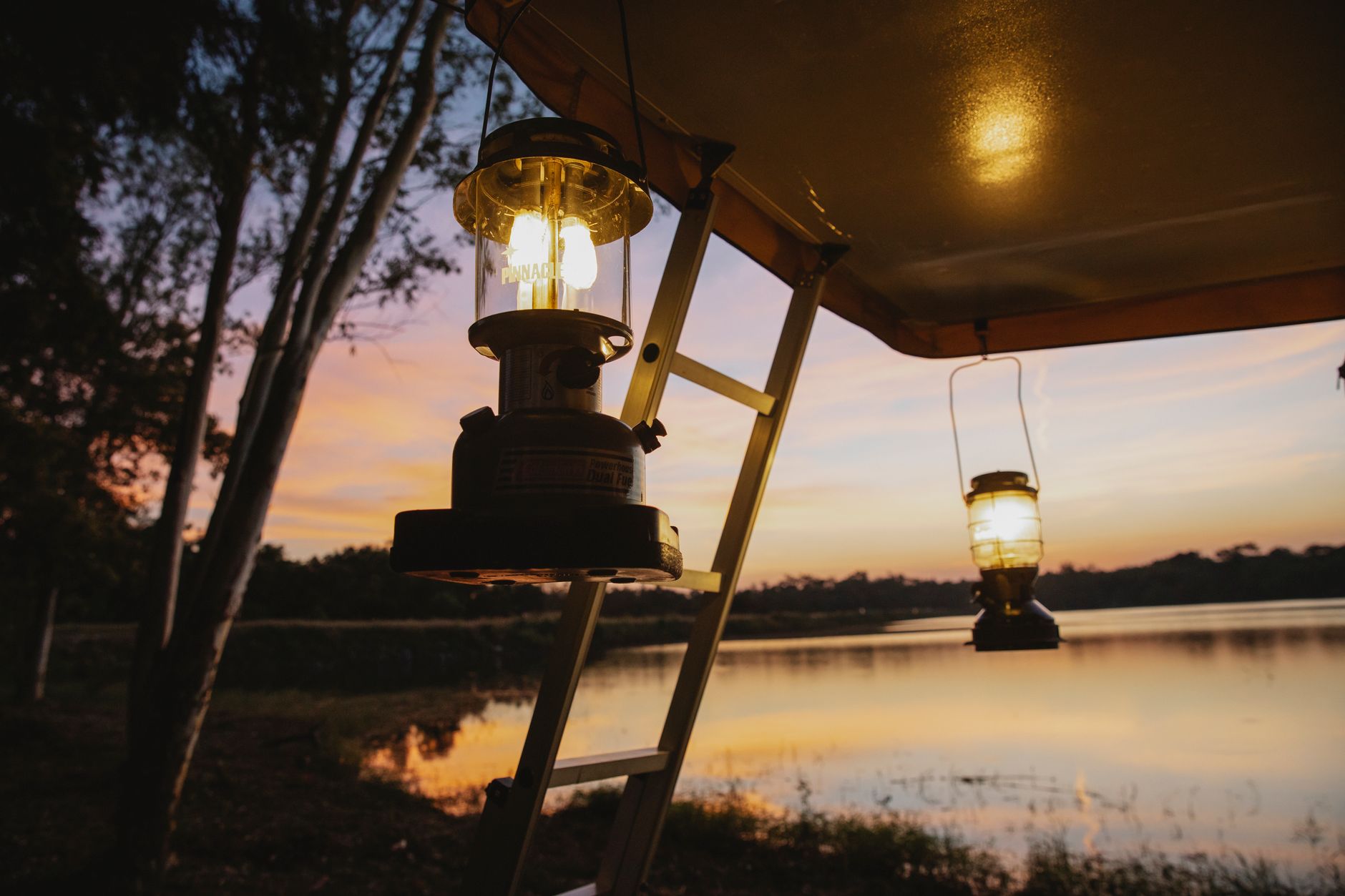
Then he reached back into his truck and pulled out a big battery lantern.
Dark green, with a handle on top and a dial that took it from a glow to full bright, the kind my granddad would have hung in the barn.
“I was down at the boat ramp last night,” he said. “Looked across. I could see that camp dock fine, and I could see the kids. But I could not see you. Not after the sun went down. You’re just a dark spot in the trees.”
I had not thought about that. I had a headlamp and a little flashlight, and neither one would show two hundred yards across water.
“She’s looking for you out there,” Ray said. “Let’s give her something to look at.”
He showed me the dial, and how to hold it up so my arm would not give out.
He had brought a fresh set of batteries and a spare. He would not take a dime for any of it.
“My boy was in the service,” he said, while he was showing me the dial. “Two tours. Every night his mama kept the porch light on. Didn’t matter that he was eight thousand miles away and couldn’t see it. She said a light is how you tell somebody where home is.”
At eight thirty, the kids came down the path. I stood up out of my chair in my old green T-shirt, and I switched on that lantern, and I held it up over my head as high as I could reach.
On the far dock, the yellow life jacket stopped dead. Then I saw her turn and grab Hannah’s arm and point. Then she started jumping.
Up and down on that dock, waving both arms, and I could hear, very faint across the water, a small high voice that carried the way voices carry on a lake at night.