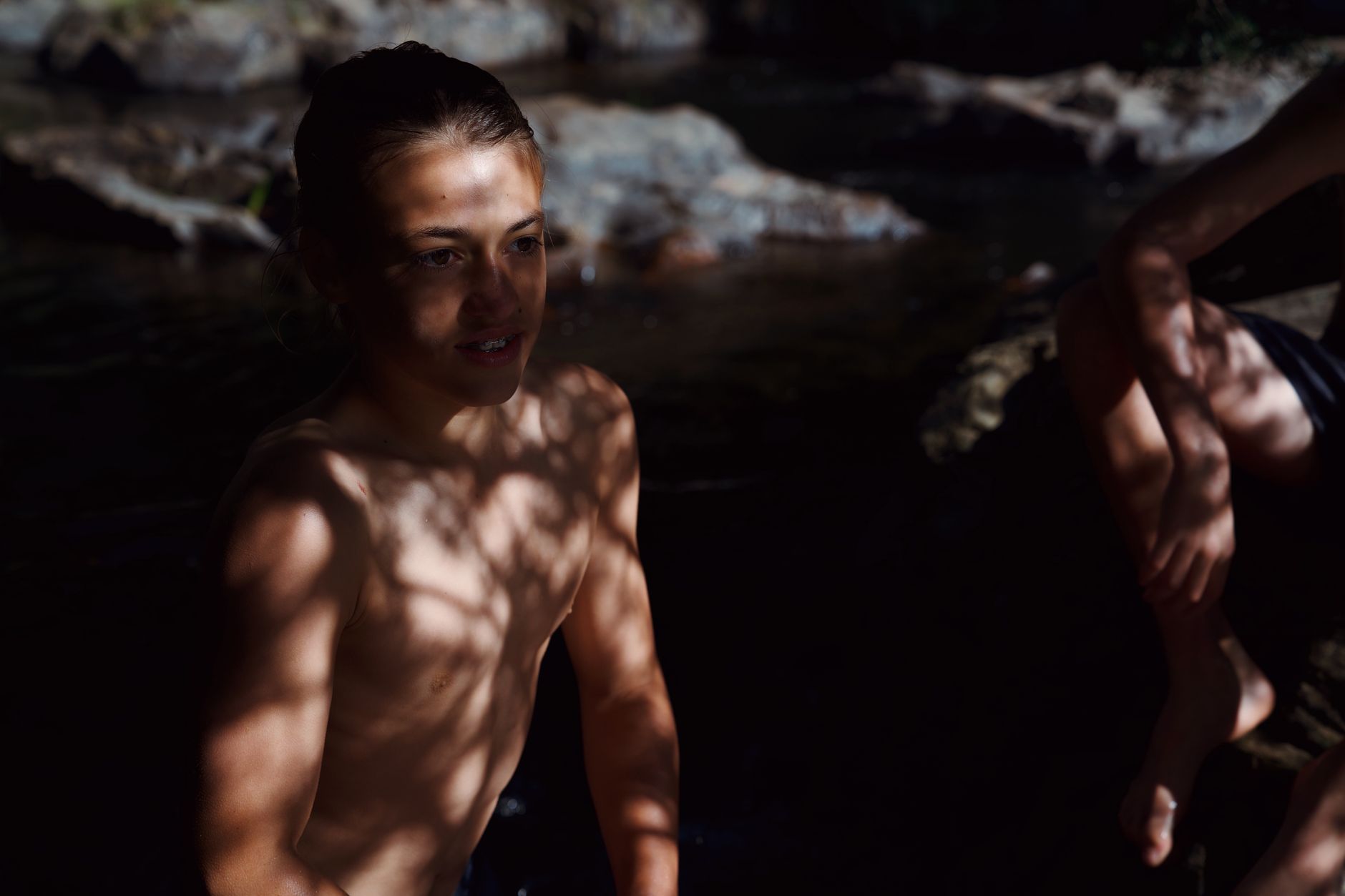
The Creek Behind My Farm
Forty Junes
Sugar Creek is not much of a creek most of the year. It runs shallow and brown over gravel, and in August it gets so low you can walk across it on the stones without wetting your knees. But behind my place it makes a slow bend where the bank drops off, and the water pools up deep and clear and still, maybe up to a tall man’s chest in the middle, with a sand bottom the current laid down smooth. There is a gravel bar on the near side that slopes in gentle, perfect for a child’s first steps, and a big flat limestone rock on the far side that the brave ones learn to jump off of once they are ready.
The Lord made that bend for teaching children to swim. I have believed that my whole life. It is the safest piece of water in this county, a pool with no undertow and a shallow apron and shade from the cottonwoods in the worst of the afternoon heat. A mother could stand on the bank and see the bottom and see every child in the water the whole time.
I started on the first Saturday of June, every year, and I ran it six weeks, two mornings a week, Tuesdays and Saturdays, from nine until noon. I put a hand-lettered sign up at the feed store and another at the Methodist church and another in the window of the Harlan Cafe, though after the first few years I did not need to. The town knew. Mothers brought their little ones the June they turned five, the way you bring a child to kindergarten, and the big kids came back on their own to work on their diving.
I taught them in waves. The littlest ones on the gravel bar first, blowing bubbles, learning to put their faces in and not be afraid of it. Then the floating, on their backs, my hand flat under the small of a bony little spine, telling them the water wants to hold you up, you have to let it. Then the kicking, the arms, the breathing, the long morning when a child finally swims the width of the pool on their own and comes up gasping and proud and looks around to make sure you saw.
I always saw. That was the whole job. To see every one of them, every second, and never once look away.
I did it in a one-piece suit and an old straw hat, standing waist-deep in that cold water three hours at a stretch until my feet went numb and my lips went blue. Mothers used to fuss at me to come out and warm up. I never would. You cannot teach a child to trust the water from up on the bank where it is dry. You have to be in it with them, down at their level, close enough to catch.
My husband Harold used to say I loved that creek more than I loved him, and then he would laugh, because he knew it was not true, and he knew there was a thing under it that was not funny, and he was good enough never to make me say it out loud. He mowed the path every spring. He built the little bench on the bank for the mothers. He strung a rope with floats on it to mark where the bottom dropped off, and he checked that rope every single June for forty years, and the last June of his life, the summer he was already sick, he had our grandson drive him down in the Gator so he could check it one more time. Harold has been gone six years now. I still check the rope myself.