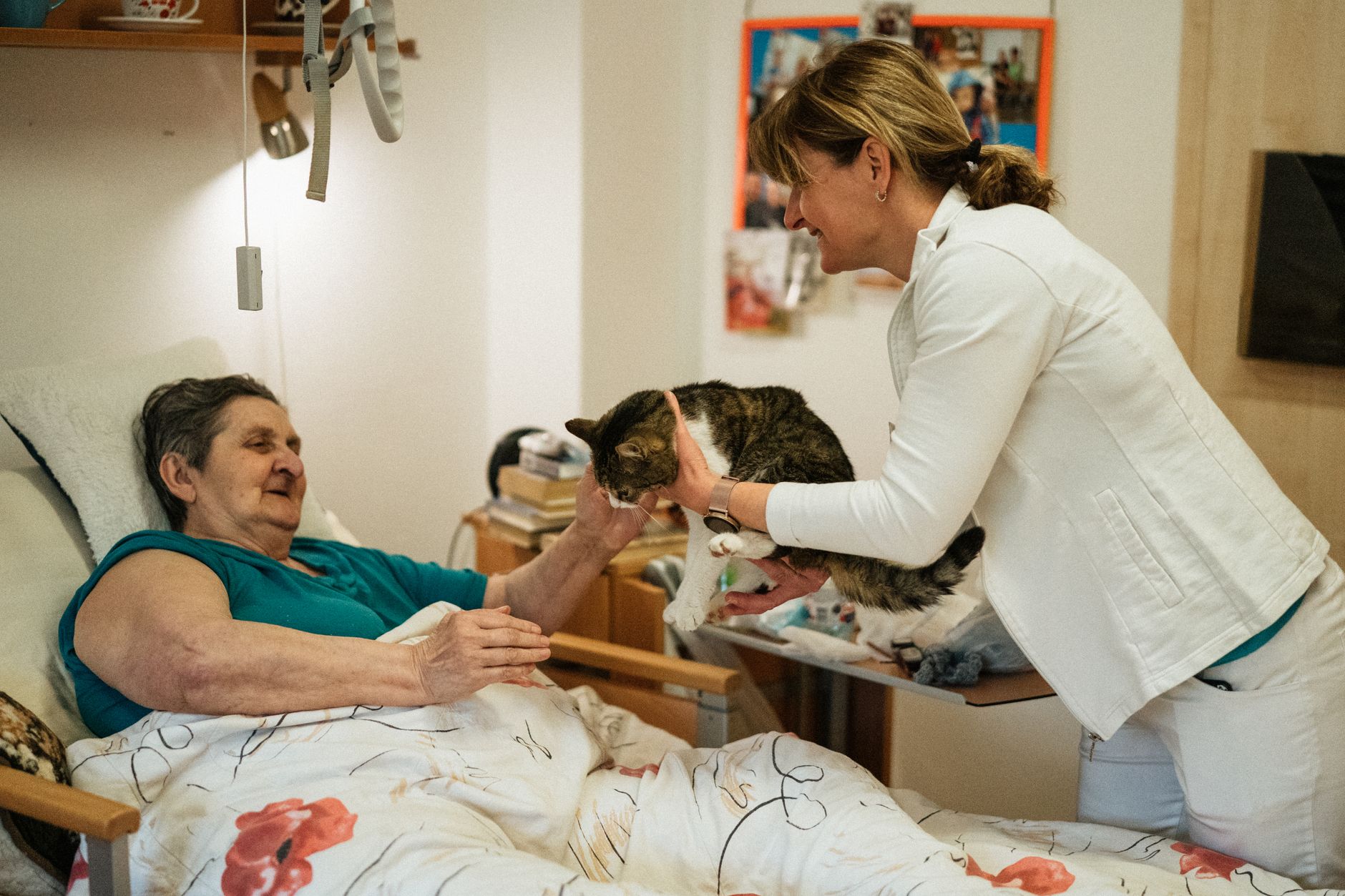
The Quilt the Administrator Threw Out
“Your father got one row crooked,” Mama said. “Third row from the bottom. He had the seam ripper out on the windowsill, right there, and he swore he would fix it.”
“I remember.”
“I told him no.” She looked out the window, where a sparrow was working at the frozen ground. “I liked it crooked, Janice. It was the only thing in the whole quilt that looked like him.”
I put my head on her shoulder like I was seven years old, and she patted my back with her good hand.
It was 1:48. I had twelve minutes left.
At the end of the hall a woman stood in front of the one-cup coffee machine holding a wad of tissue. Her name was Donna Eller, and her mother Ruby was in room 208.
“I’m sorry,” I said. “Are you all right?”
“They took Mother’s rosary,” Donna said. “It came from the old country. And her wedding picture off the dresser. I asked the nurse. Then I asked Renee, and she said she’d look into it. That was three weeks ago.”
I stood very still. Then I took the little yellow legal pad I carry for grocery lists out of my purse and said, “What’s your phone number?”
Donna looked at the pad, and then at me.
“I think it’s not just you and me,” I said.
On my way out, the aide from my mother’s hall caught up to me at the front doors. Bonnie Crandall was a big, quiet woman in her forties with reading glasses on a beaded chain and three kids in the Lindell school. She had a way of tucking Mama’s hair behind her ear that Mama allowed from nobody else.
She held the door for me and looked back down the hall before she spoke.
“I worked a double that Saturday,” she said.
That was all. She went back inside.
I stood in the parking lot wondering why she had told me what shift she worked. It took me five weeks to find out.
By the third Sunday I had nine families on that legal pad.
It did not take long, once I knew to look. Every Sunday I stopped at the coffee machine and the dayroom benches and asked the same plain question: “Did they take anything from your mother’s room?”
Every one of them said yes. Every one of them had asked once. And every one of them had been told it was handled.
Hal Dressler, a sheet metal worker, played cribbage with his father Lester every afternoon on a lap tray. Lester had served in the Navy, and the Navy cap in the shadow box on his wall was gone. “He hasn’t said a word about it,” Hal told me. “He just keeps looking at the wall.”
I asked him to come to a meeting at the church that Thursday night. “My wife’s mother is in 214, Janice,” he said. “If Renee finds out, they’ll take it out on her.”
“I know,” I said. “That’s why I’m asking you in person.”
He came. They all came, in the end, except two who were too afraid. Melinda Sloan, a hairdresser from Spencer, brought a pan of bars and said, “Somebody has to bring food or it’s just a grievance.”