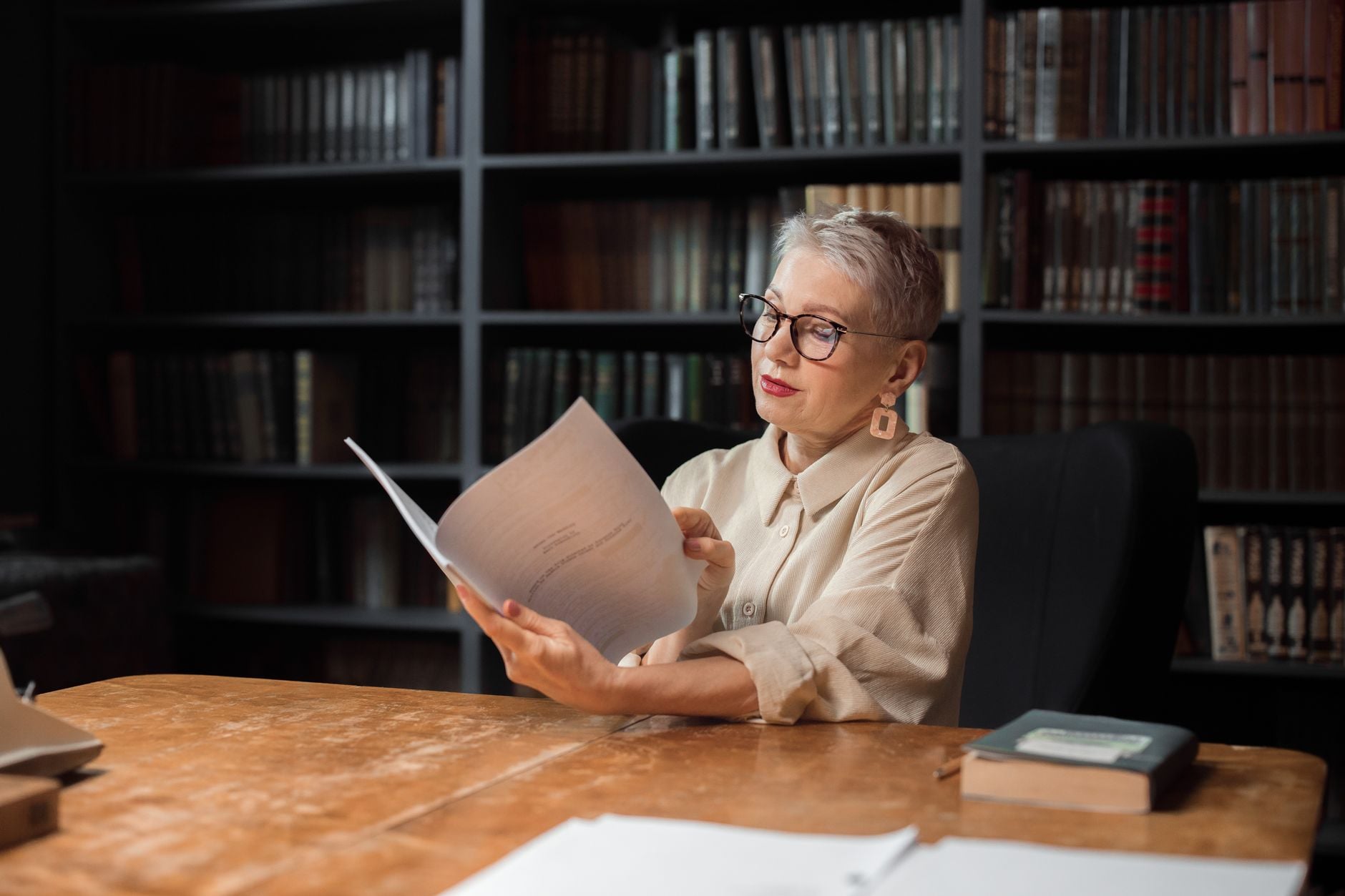
The Book the Librarian Held for Years
I opened it with both hands at the back, where the bookmark was.
Not a bookmark. A half sheet of white paper, torn from a pad: a work slip from the county road shed, with Alder Creek printed small in the corner and my father’s pencil handwriting on it, twenty-eight years of the same lean block capitals he’d used on his grader logs. It said, Stopped here Thurs. Finish it Fri.
I looked at it for a long time.
He had meant to read again tomorrow. That was the whole thing. He had been planning to read again tomorrow, with his glasses on the counter and his plate cleared, and he had put the slip in the place where he’d stopped and gone to take the plates to the sink.
“Oh, Dad,” I said, to nobody.
Myrna got up and found the box of tissues. She set it next to my elbow. It was the second box.
I turned the slip over. On the back, in my mother’s handwriting, smaller, crooked, like she’d written it on her knee, was one line:
He was nearly there.
I don’t know what a person is supposed to do with a sentence like that.
I turned to the page where my father had stopped. It was the narrator, coming back to the country as a grown man after twenty years, to find the woman he had loved as a girl, wondering what he would find.
“Would you like to hear how it ends?” I asked Nan.
She looked at me for a long moment. Then she lowered herself into the wooden rocker by the radiator, the one the children use on Wednesday story hour, and folded her hands in her lap.
“I’d like that very much,” she said. “More than I can say.”
Myrna did not move toward the door. She slid off the table and sat down cross-legged on the rag rug with her chin on her knees, looking at me.
So I read.
I am not a reader-aloud. I was the girl who got the part of Third Shepherd in the Christmas pageant, because the Third Shepherd didn’t have to say anything. But I knew what voice to use. It was the only voice I’d ever heard the book in: flat and steady and unhurried, the voice of a man who knew the road was going to get finished. I read the narrator going back to the farm, and the long road, and the wheat, and the woman, older now, who had lost her teeth and kept her eyes, standing in her own kitchen door with her house full of children. I read the orchard, and the cellar full of jars.
I read for the better part of an hour. The radiator knocked and the afternoon went the color of weak tea in the tall windows. At some point I heard the bell over the door and heard Nan say, “We’re closed, Bernard,” without getting up, and heard Bernard go away without a word, because in a town of eleven hundred people you do not argue with the librarian when she says closed.
When I got to the last page I stopped a moment, and neither of them said anything to hurry me.
Then I read the last line. I won’t tell you all of it. It’s not mine to give away. But it is about the past, and about what we have of it that nothing can take, and it is about the people we hold it with, even the ones who are gone.
I closed the book on the bookmark.