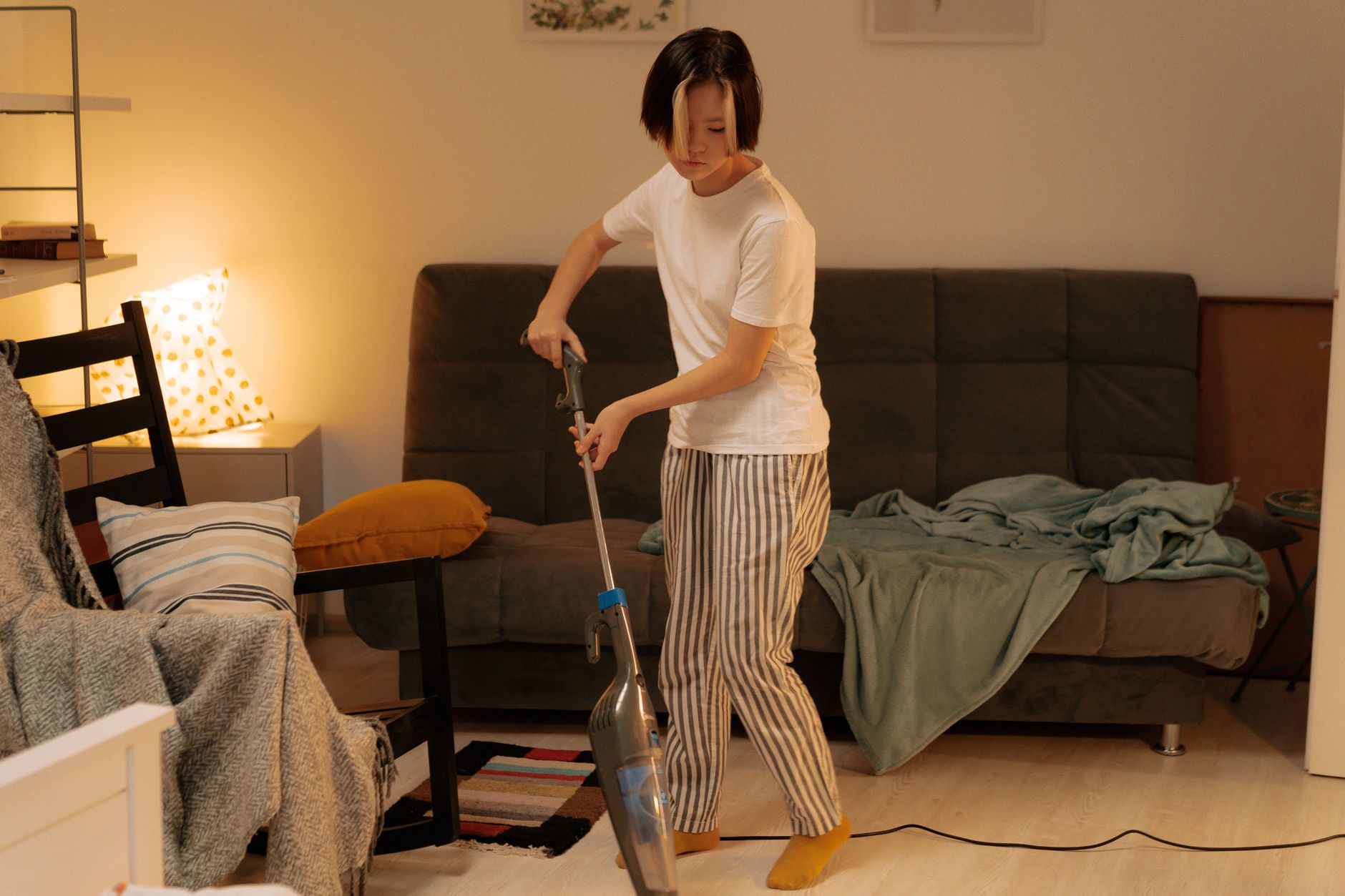
The Saturdays I Took Next Door
I stood on her porch holding that vacuum and I said the number. I had practiced it the whole six blocks.
“I’d need twenty-five dollars an hour.”
My voice shook. I am not ashamed to say so. I had never put a price on myself before.
“Cheap at the price,” said Agnes Pruitt, and she held the door wider.
I worked three hours that morning. Her house was not dirty, exactly. It was the house of a careful woman who could no longer bend, which is its own kind of sad. I did the baseboards and the kitchen floor and the bathroom, and I ran the Kirby over every rug she owned, and she followed me from room to room with her cane telling me who had died that week and who was only pretending to be sick.
At noon she counted three twenties, a ten and a five into my hand at her kitchen table. Seventy-five dollars.
I looked at it for a while.
“That’s wrong, isn’t it,” I said. “That’s too much. For floors.”
“Tina Kowalski,” she said. “That is the first sensible money anybody has spent on this street in years. Sit down and have some coffee cake.”
So I sat. And it was the oddest thing. It was Saturday, a quarter to noon, and I was at a kitchen table with coffee, and there was an old woman across from me who was glad I had come.
It was the wrong table. But it was something.
Agnes Pruitt has a telephone and she is not afraid to use it. By the first of May I had the Hoffmans across the street, Jim and Carol, both of them past eighty and him with a new knee. By Memorial Day I had Mr. Dale Becker on the corner, a widower who had been keeping house the way widowers do, which is around the edges. And when school let out in June, I took on Lisa Schroeder two doors down, a nurse who worked nights at the hospital in Dubuque and had three boys and a kitchen floor you could have planted corn in.
Four houses on one street. Saturday could not hold them, so Saturday spilled into Tuesday and Thursday once school was out.
Mark watched all this happen without saying much. Then one evening in June he came home from work with a small flat box and set it on the supper table next to my plate.
“What’s that?”
“Open it.”
It was magnets. A hundred of them, from the print shop in Dubuque, white with blue letters. They said: Tina’s Saturdays. Houses cleaned right. And our phone number.
“Mark Kowalski.”
“Thirty-eight dollars,” he said. “Agnes said you needed something for people to put on the icebox. She called me at work. I didn’t know she had the number.”
“Tuesdays and Thursdays aren’t Saturdays.”
“I know it. But that’s what it is, isn’t it? It’s your Saturdays. You just moved them.”
I looked at that magnet for a long time. I had been a daughter-in-law and a mother and a school aide, and I had been glad to be every one of them. I had never had my name on anything.
I put the first one on our own refrigerator. Mark took a dozen to work.
Now, Debra. I have to tell you about Debra, because she was there for all of it.
The sisters had decided to sell Helen’s house, and Debra lives twenty minutes away, so the job of emptying it fell to her. Most Saturdays that spring her Buick was in Helen’s driveway. She would be hauling boxes out of the basement or dragging things to the curb, and I would be going up and down Agnes’s porch steps next door with the Kirby.
These stories are wonderful. I love a happy ending.