The Meat Grinder They Left Me
The reading of the will was the first time my whole family laughed at me out loud
The lawyer’s office in Millbrook smelled like burnt coffee and old carpet, and I sat in the folding chair closest to the window because that was the seat nobody else wanted. That has been my seat my whole life. The one by the door, the one by the window, the one where you can slip out to check the oven or tend a crying baby that is not even yours. I am the one who does the tending. I have made my peace with it, mostly.
My grandmother, Ada Vessel, had been dead eleven days. We had buried her in the Lutheran cemetery out on County Road 9, next to my grandfather and the little grave of the baby uncle nobody remembered. It rained the morning of the funeral, then cleared, and the whole congregation of Zion Lutheran stood around that hole in the ground in their good shoes and sang “Abide With Me” until the wind took the words apart. I cried until my face hurt. My cousins checked their phones.
Now here we were in the office of a man named Dale Prentiss who had done my grandmother’s legal work for thirty years and clearly wanted to be somewhere else. My uncle Ray sat up front with his second wife, Cynthia, who wore sunglasses indoors. My aunt Marlene sat next to them with her three grown children, my cousins Brett and Kayla and Dustin, all of them fidgeting like the reading was a wait at the DMV. My mother had passed years before, so I was there alone, the granddaughter of the daughter who died first, the branch of the family everybody forgets to count.
Dale Prentiss cleared his throat and read the numbers. The good white farmhouse on eleven acres out past the grain elevator went to Ray. The forty tillable acres that my grandfather had bought back in 1961, leased out now to the Hoffman boys for corn and beans, went split between Ray and Marlene. The savings, and there was more than any of us had guessed, close to two hundred and forty thousand dollars, was divided among Ray, Marlene, and their children. There were bank certificates. There was a life insurance policy nobody knew about. There was a coin collection in a safe deposit box in Cedar Falls that made Brett actually gasp.
And then Dale Prentiss looked at me over his reading glasses, and he had the decency to look embarrassed, and he said, “To my granddaughter Della, I leave the cast-iron meat grinder.”
There was a silence about the length of a held breath. And then my cousin Brett laughed. Just a short bark of it, the kind you cannot hold in. And once he broke, the rest of them went. Kayla put her hand over her mouth. Ray shook his head with a grin like he could not help himself. Cynthia, behind her indoor sunglasses, made a small satisfied sound like a cat that has found the warm spot.
“The meat grinder,” Marlene repeated, and she said it kind, the way you would say something to a child, which was worse than if she had said it cruel. “Oh, honey. Well. Mama always did have her ways.”
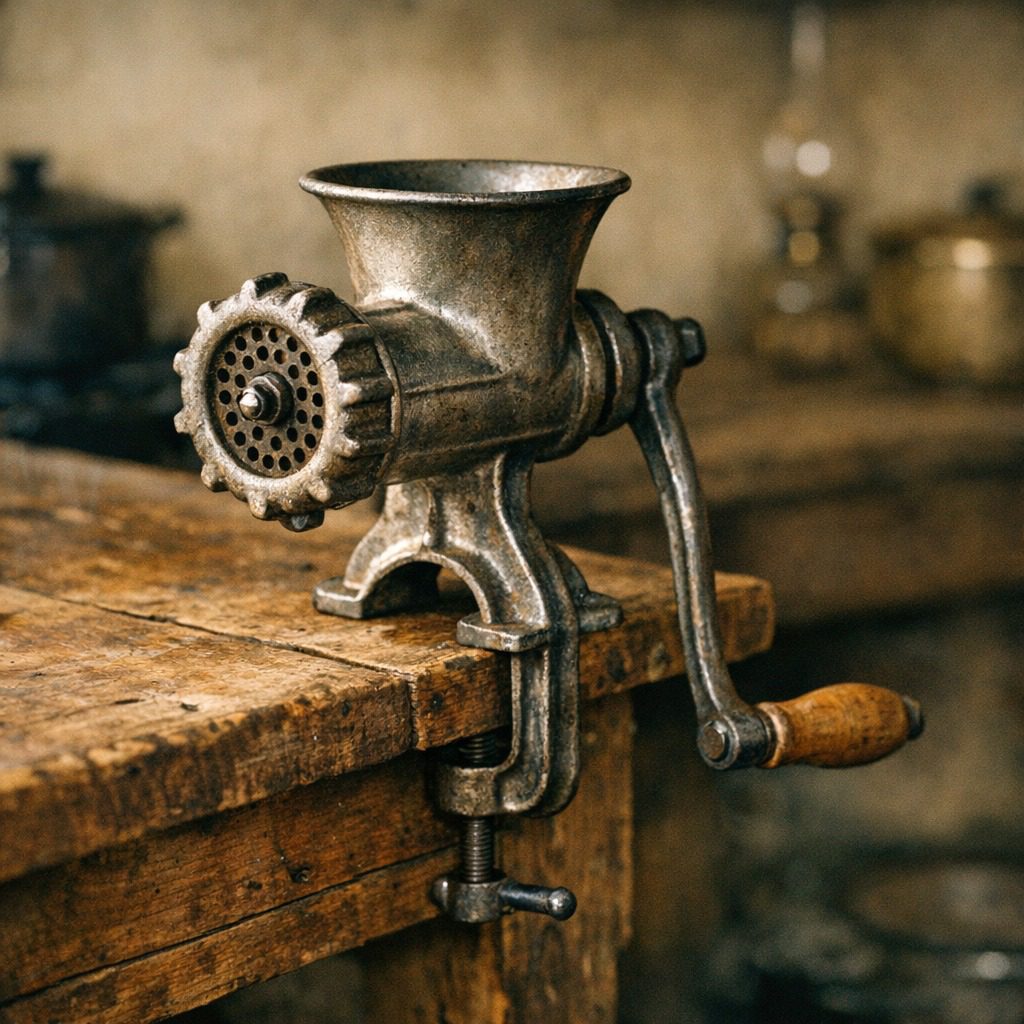
I sat by the window and I felt my face go hot, and I said nothing, because saying nothing is the other thing I am good at. I thought about that grinder. I knew exactly which one Dale Prentiss meant. There was only one. It had been clamped to the edge of my grandmother’s kitchen table for fifty years, a black cast-iron hand-crank grinder with a wooden handle worn pale and smooth as a river stone from all the hands that had turned it, though mostly, in the last twenty years, from mine.
Nobody in that room had ever cranked it but me
Here is the thing they did not know, or knew and did not think about, because thinking about it would have cost them something.
Every Sunday of my life that I can remember, I stood at that table and cranked that grinder next to my grandmother. Not the cousins. Not Ray, who came for the dinner and left before the dishes. Not Marlene, who “couldn’t with her hip.” Me. Della. The forgettable one by the window.
We ground sausage in the fall after the Hoffmans butchered. We ground venison in November when the men brought it in cold and stiff from the deer stands and dumped it on the porch and considered their part done. We ground beef and pork together for the mincemeat at Christmas, and we ground the suet, and the whole kitchen went warm and close and smelled of clove and cider and orange peel and something darker underneath that I understood, once I was grown, was the smell of a woman’s two hands feeding a whole town one crank at a time.
Because that is what my grandmother did, before I was even born. Ada Vessel had a little shop on Main Street in Millbrook, right between the barbershop and the old five and dime, and the sign over the door said VESSEL’S, and under that, in smaller letters my grandfather had painted himself, it said SAUSAGE AND SMOKED MEATS. For twenty-six years she ran it. She made a summer sausage and a bratwurst and a smoked ring bologna that people drove in from three counties to buy, and at Christmas she made a mincemeat that the Lutheran church ordered by the case for the bake sale, and the recipe for all of it lived in exactly two places. It lived in a green metal recipe box with a rooster on the lid on the shelf above the grinder. And, because she taught me, standing at that table Sunday after Sunday for thirty years, it lived in mine.
She closed the shop in 1994 when my grandfather got sick and she could not do both. She sold the building. She let the name go. But she never stopped making the sausage at home, and she never stopped making the mincemeat, and every single time, she made it with me and that grinder clamped to the table, and every single time, she told me the same thing, in the same words, so many times that I can hear her voice saying it right now.
“You’re the only one who ever wanted to learn it, Della. The only one. The rest of them just want to eat.”
I took the grinder home in a grocery sack and set it on my own kitchen table
After the reading, in the parking lot, Ray was already on the phone with a realtor about the farmhouse. Marlene was already telling Kayla which pieces of furniture she was claiming before Ray could get to them. Nobody said a proper goodbye to me. Cynthia did say, on her way to the car, “You want us to have somebody drop off your little grinder, or you gonna come get it?” And she smiled when she said “little grinder,” and I understood that the joke was going to have a long life in this family. It was going to be a story they told at Thanksgivings for years. Remember when Mama left Della the meat grinder. Oh, that was rich. That was Mama all over.
I drove out to the farmhouse that same afternoon, alone, and I let myself in with the key that had been under the geranium pot my whole life, and the house was already half-stripped, drawers hanging open, the good clock gone from the mantel. But the kitchen was untouched, because there was nothing in the kitchen anybody wanted. I stood in that quiet, in the exact spot where I had stood ten thousand Sunday mornings, and I unclamped the grinder from the table.
It came loose the way it always did, with that particular squeak of the wing nut, and I lifted it, and it was heavier than a thing that size has any business being, dense black iron, cold in my hands. I wrapped it in a dish towel that still smelled of her, of the Fels-Naptha soap she used and the cold-cream she wore, and I put it in a paper grocery sack. And then, because it was sitting right there on the shelf and nobody had taken it, I took the green recipe box with the rooster on the lid too. Nobody had wanted that either. It was just a box of index cards in an old woman’s cramped handwriting, and none of them could read her shorthand anyway, the “handful” and the “good pinch” and the “grind twice, then rest it cold overnight,” the language of a woman who cooked by feel and had never in her life used a measuring cup for anything that mattered.
I took the grinder and the box home to my little rented house on Sycamore Street, and I set the grinder in the middle of my own kitchen table, and I sat down across from it, and I cried again, the way I had at the funeral, the ugly kind of crying with sound in it. Because they had turned the one true thing between me and my grandmother into a punchline, and I could not make them see it, and I did not have the words to try.
And then, because it was late and I had not eaten and there was a package of pork shoulder in my refrigerator from before the funeral, I clamped the grinder to my own table for the first time in my life, and I got out the green box, and I found the card that said BREAKFAST SAUSAGE, ADA’S, and I made it. My hands knew what to do without me telling them. I ground the pork twice, the way she taught me, and I worked in the sage and the brown sugar and the good pinch of red pepper and the thing she added that nobody else in three counties ever figured out, and I fried a little patty in my own skillet, and I tasted it standing up at eleven o’clock at night in my sock feet.
And it was her sausage. Exactly her sausage. Fifty years old, that recipe, and it lived, and it lived in me, and it lived in the black iron thing they had left me as a joke.
I found the note in the bottom of the recipe box three days later
I want to tell this part carefully, because it is the part I have gone back to a thousand times, and I do not want to make it more than it was. It was not a treasure map. There was no key to a hidden safe, no bearer bonds, no cash taped under a false bottom, though God knows my family would have torn that box to splinters if they had thought there was a nickel in it.
What there was, was this.
Three days after the funeral, I was going through the recipe box slow, card by card, because it was a way of sitting with her. And at the very back, behind the divider card that said MISC in her hand, there was a folded piece of paper that was not an index card. It was a sheet torn from the little spiral notebook she kept by the phone, and it was folded in quarters and soft at the creases like it had been folded a long time. And I unfolded it, and it was a letter, and it was to me.
I am not going to write the whole thing here, because some of it is mine and I mean to keep it. But I will tell you what it said, in the shape of it.
It said, Della. If you are reading this, then I am gone, and you have the box, which means you have the grinder, because I made Dale write it that way. It said that she knew they would laugh, and she said, Let them. It said that she had watched all of them her whole life, watched them wait for her to die like it was a paycheck, watched Ray borrow against the farm twice and Marlene run through two divorces and every grandchild she had except one measure a person by what was in their hand instead of what was in their two hands. And then she said the line I have taped to my refrigerator now, in her own writing, so I see it every morning.
She wrote: Money is the thing you split up. The work is the thing you carry. I gave the money to the ones who would split it, and I gave the work to the one who would carry it. That is not a joke, sugar. That is the most serious thing I have ever done.
And at the bottom, she wrote: The name is yours if you want it. Dale has the papers. Go see him.
Dale Prentiss had one more envelope, and my name was on it
I went back to Dale Prentiss’s office the following Monday, and I sat in the same folding chair by the window, alone again, and I told him about the note. He took his glasses off and he rubbed the bridge of his nose and he said, “She told me you’d come. She said you might take a while, but you’d come.” And he opened a drawer and took out a plain manila envelope with my name on it in her hand, DELLA, underlined twice.
Inside was a deed to nothing and a fortune in nothing that turned out to be everything.
It was the registration for the business name. VESSEL’S. She had never let it lapse. For thirty-two years, long after she closed the shop and sold the building, my grandmother had quietly paid the small fee every year to keep the sausage-and-smoked-meats trade name registered to her, so that nobody else in the state of Iowa could ever use it. And now, per the papers in that envelope and the will that Dale had drawn exactly the way she wanted, the name transferred to me. Along with it was a second thing, a small transfer-on-death account in my name only, not in the will, and it held nine thousand two hundred dollars, and there was a Post-it stuck to the statement in her writing that said, Seed money. Not for splitting. For starting.
She had planned the whole thing. Down to the last dollar. She had looked at her family with clear eyes and given each of us exactly what we were: she gave the ones who wanted things, things, and she gave the one who wanted the work, the work, and the name to do it under, and just enough money to begin.
I sat in that folding chair and I did not laugh and I did not cry. I felt something else. I felt picked. For the first time in forty-one years of being the one by the window, I felt like somebody had looked at the whole crowded room of us and picked me on purpose.
I did not tell a soul in the family what I was doing
A mean little part of me wanted to march into the next family gathering and slap the papers on the table and watch their faces. But my grandmother did not raise a person who slaps things on tables. She raised a person who cranks the handle. So I kept quiet, and I went to work.
I still had my job at the elementary school, in the cafeteria, where I had worked for sixteen years feeding other people’s children, and I kept it, because nine thousand dollars does not stretch to quitting. But every evening, and every Saturday, and every Sunday after church, I made sausage in my little kitchen on Sycamore Street with the grinder clamped to the table, and I worked through the green box card by card, remaking every recipe until my hands and my tongue agreed that it was hers, exactly hers, and not a step off.
The breakfast sausage first, because it was the simplest and the most beloved. Then the summer sausage, which took a smoker I did not have, so I built one out of an old refrigerator and a hot plate the way my grandfather had built the first one, off a diagram I found folded in the box. Then the bratwurst. Then the smoked ring bologna, which nearly beat me, because there was a step she had never written down, a thing she did with the temperature that I only got right on the fourth try, standing over that ugly refrigerator-smoker at midnight, and when I finally cut into a ring and tasted it and it was right, I said out loud to my empty kitchen, “There it is, Grandma. There it is.”
And then, in November, coming up on Christmas, I made the mincemeat.
The mincemeat is the thing this town remembers, and the mincemeat is the thing they left me without knowing it
You have to understand about the mincemeat. In a lot of the country nobody has eaten real mincemeat in fifty years, the kind with meat actually in it, and they think of it as that jarred brown stuff at the store that tastes like a candle. But in Millbrook, at Zion Lutheran, my grandmother’s mincemeat was a season. It was Advent. It was the thing that meant Christmas was really coming. The women of the church had ordered it from Vessel’s by the case every December for twenty-six years, and even after she closed the shop, she made it for the bake sale out of her own kitchen, with me cranking, right up until the last two years when her hands got too weak and it just, one Christmas, quietly did not happen. And the whole town felt the hole where it used to be. Old Pastor Lindqvist, who is ninety now and eats through a straw half the time, told me at the funeral, “Della, your grandmother’s mincemeat was the closest thing to a sacrament that ever came out of an oven.” And he meant it.
I made the mincemeat in November, twelve quarts of it, ground on her grinder with her recipe, the beef and the suet and the apples all going through that black iron with the wooden handle warm and pale under my palm. And when it was done and resting cold in my refrigerator the way she said it had to, “grind twice, then rest it cold, it needs to think about itself overnight,” I did the one bold thing I had ever done in my life.
I took a jar of it to the Zion Lutheran Advent bake sale, and I set up a card table, and I hung a sign I had made myself with a paint pen, and the sign said VESSEL’S, and under that, in smaller letters, because I could not paint as well as my grandfather, it said BACK AGAIN.
The first Advent bake sale, and the line that formed
I did not expect what happened. I want that on the record. I thought maybe a few of the older folks would remember and buy a jar out of kindness. I brought twelve quarts and I figured I would take half of them home.
What happened was that Ruth Ann Hoffman, who is eighty-three and was my grandmother’s best friend for sixty years, walked up to my card table on her walker, and she looked at the sign, and she looked at me, and her chin started to go, and she said, “Ada’s mincemeat.” Not a question. And I lifted the lid off a jar so she could smell it, the clove and the cider and the orange peel and the dark thing underneath, and Ruth Ann Hoffman put one spotted hand over her mouth and she cried right there in the fellowship hall in front of everybody.
And then she told everybody.
I sold all twelve quarts in forty minutes. I took names and phone numbers on a legal pad for people who wanted more. Pastor Lindqvist’s daughter bought two quarts for him and came back and hugged me. The line got so long that Marlene, who was working the church cookie table twenty feet away and had no idea what her own dead mother had left me, actually looked over to see what the fuss was, and I watched her not understand it, watched her decide it was nothing, and go back to her cookies. She never once came over to look at my table. It did not occur to her that anything at my table could matter.
I went home that night with an empty card table, a legal pad full of names, and four hundred and eighty dollars in a coffee can, and I sat down at my kitchen table across from the grinder, and I said, “Okay. All right. Here we go.”
I built the whole thing one crank at a time, the way she taught me
I am not going to pretend the next two years were easy or fast, because they were neither, and my grandmother would come back and scold me if I made it sound like a montage. Building something real is slow and it is boring and it is a thousand small crankings of a handle, and most of it nobody sees.
I got a license. That was its own mountain, because selling meat to the public is a serious thing and rightly so, and I spent three hundred of my seed money and two months of Saturdays on the commercial kitchen inspection and the certifications and the rules that did not exist the way my grandmother did it in 1968. I rented time in the kitchen at the VFW hall, which sat empty most weekdays, and I paid the post commander, a soft-spoken man named Gary who had served with my late father, forty dollars a session, and he pretended it was a bother and it was not.
I started going to the farmers market in the courthouse square every Saturday from May to October, under a canopy, with a cooler and a card table and that same paint-pen sign, VESSEL’S, BACK AGAIN. I sold the breakfast sausage and the brats and the summer sausage and the ring bologna, and I took orders for the mincemeat that everybody wanted but could only have at Christmas, because I refused to make it out of season, because she refused to make it out of season, because some things you wait for on purpose.
Some Saturdays I brought the grinder and ground fresh in front of people, because I learned fast that people love to watch the handle turn. Children stood and stared. Old men told me their grandmothers had one just like it. I let the kids crank the empty handle, and I watched something happen on their faces, the same thing that happened on mine forty years ago, and I understood that I was not only selling sausage. I was selling the thing my grandmother sold, which was the sight of a person doing honest work with their two hands in front of God and everybody.
The county fair was the turn. The second summer, I entered the summer sausage and the mincemeat in the fair’s food competition, in the preserved-and-cured category, out at the fairgrounds where I had gone every August of my childhood to look at the pigs and eat the funnel cakes. I did not tell anybody. And the summer sausage took a blue ribbon, and the mincemeat took Best of Show in its division, and the local paper, the Millbrook Register, ran a little piece with a photo of me holding the ribbon and the grinder, and the headline said “A Beloved Name Returns to the Square.” And that little piece, in that little paper, is the thing that took me from a card table to a business, because the phone did not stop ringing for a week.
They noticed the money slipping through their fingers about the same time
I would not be telling you the whole truth if I left out what happened to the rest of them, because it is part of it, and because I think about it more than is good for me.
Ray sold the farmhouse within the year, because he never wanted a house, he wanted the money the house was, and he sold it to a couple from Des Moines who tore out my grandmother’s kitchen the first month, and I heard the table went to the dump. He put the money into a thing his brother-in-law was doing with storage units two counties over, and the thing did what those things do, and by the second Christmas Ray was asking around town, quiet, if anybody knew of work. Cynthia and her indoor sunglasses were gone by spring.
Marlene split her share three ways with her kids the way she always split everything, because she is a splitter, my grandmother had her exactly right, and Brett put his into a truck and Kayla put hers into a wedding to a man who was gone inside eighteen months and Dustin, God love him, put his into nothing anybody can find. The coin collection that made Brett gasp turned out to be worth about a third of what he told everybody. Two hundred and forty thousand dollars, and the forty acres, and the house, and within two years there was not much left to show any of them had ever had it, because it was the kind of thing you split, and the thing about a thing you split is that it gets smaller every time you cut it.
And the whole time, out at my card table on the square and my rented kitchen at the VFW and my ugly homemade smoker, the thing my grandmother gave me got bigger, because work is the only inheritance that grows when you use it.
The Sunday Marlene finally understood, and what I did about it
It came to a head, if you can call it that, on a Sunday, which felt right.
It was the third Advent since the funeral. My little business had a real name on a real license now and a chest freezer and a stall at three farmers markets and a mail-order list two hundred names long, and I had, that very month, put money down on the empty building on Main Street between the barbershop and the old five and dime, the same building, the actual building, where VESSEL’S had first hung its sign in 1968. It had been a vacuum repair place and then a vape shop and then empty, and I bought it back.
That Sunday, after church at Zion, there was the Advent bake sale in the fellowship hall, and my table was mobbed the way it was every year now, and my aunt Marlene came over. She had never come over. Three years, and she had never once walked the twenty feet. But she came that Sunday, and she stood at the edge of my table and watched the line, watched Ruth Ann Hoffman, older now and slower but still first in line every year, take her two quarts and pat my cheek, watched me hand a jar to Pastor Lindqvist’s daughter, watched a man from the paper take a picture of the sign.
And I saw it land on her. I watched my aunt Marlene finally do the arithmetic that her own mother had done years before any of us, and understand that the joke in the lawyer’s office had not been on me. It had been on them. That Ada Vessel had stood in that room in spirit and handed her children the thing that gets smaller, and handed the granddaughter by the window the thing that gets bigger, and that every one of them had laughed at the exact moment they should have wept.
Marlene’s mouth worked for a second. She is not a bad woman. She is a splitter, and there are worse things. And she said, quiet, so just I could hear it, “She left you the grinder because you were the only one who knew how to work it.”
And there it was. Three years later, at a church bake sale, my aunt said out loud the thing my grandmother had written in the note I keep taped to my refrigerator, the thing my grandmother had said to me at that table ten thousand Sunday mornings. You’re the only one who ever wanted to learn it, Della. The only one.
I could have been cruel. I had earned cruel, if anybody ever earns it. I had three years of laughter to hand back.
Instead I did the thing she would have done. I reached in the cooler and I took out a quart of the mincemeat, and I put it in my aunt’s hands, and I said, “Take this home for Christmas, Aunt Marlene. Mama would want you to have it.” And I used the word Mama on purpose, her mama, because it was true and because it cost me something to say it kind, and my grandmother taught me that the things worth doing cost you something.
Marlene held that jar like it might break. Her eyes went bright. She said, “Della, I’m sorry.” Just that. And I said, “I know.” And I did know. And I let it be enough, because holding a grudge is a thing you carry that only gets heavier, and I already had enough to carry, and what I chose to carry was the work.
The grinder is clamped to the table in the new shop now, and it will outlast me
I opened VESSEL’S on Main Street the following spring. My grandfather’s grandson painted the small letters and they are crooked in the exact charming way my grandfather’s were, and Ruth Ann Hoffman came on her walker to the ribbon cutting and cried, of course, and Pastor Lindqvist came in his wheelchair and blessed the shop, actually blessed it, with the sign of the cross and everything, and said the mincemeat line again about the sacrament, and everybody laughed and everybody meant it.
The old cast-iron hand-crank grinder is clamped to a table right up front, in the window, where the whole square can see it turn. I use the big electric grinders in the back for the volume, because there is a lot of sausage now, more than two hands can crank. But the front grinder, her grinder, the one they left me off the kitchen table as a joke, that one I still work by hand, every day, on the small special batches, in the window, where the children stand and stare and the old men tell me their grandmothers had one just like it. I let the kids crank the empty handle. I watch it happen on their faces. I am selling the same thing she sold.
The green recipe box with the rooster on the lid sits on the shelf above it, where it belongs, and the note is not in there anymore, because the note is on my refrigerator at home where I read it every single morning before I come in to work. Money is the thing you split up. The work is the thing you carry. I gave the money to the ones who would split it, and I gave the work to the one who would carry it. That is not a joke, sugar. That is the most serious thing I have ever done.
Ray comes in now, sometimes, on a Saturday. He is older and quieter and the storage-unit money is a thing nobody mentions. He buys a ring of the smoked bologna and he stands at the front and watches the grinder turn for a while, and one time he said, not really to me, “She knew, didn’t she. The whole time. She knew which one of us was which.” And I said, “She knew.” And I did not charge him for the bologna, and he let me not charge him, and that was its own kind of forgiveness, passed between us over a black iron grinder with a worn wooden handle.
What I understand now that I did not understand in that folding chair
I have thought a lot, these years, standing at that table with the handle warm under my palm, about what my grandmother actually did, and about why it worked.
She did not leave me a secret fortune. That is not what this is. She left me nine thousand dollars, which is not a fortune, and a business name, which is worth nothing until somebody works it, and a hundred-year-old hunk of iron worth maybe forty dollars at an antique mall. On paper, in that lawyer’s office, my cousins were right to laugh. On paper, I got the junk.
What she understood, that they did not, and that I only half understood myself until I lived it, is that the value of a thing is not in the thing. It is in whether you know what to do with it. That grinder in Ray’s hands is forty dollars of scrap. That grinder in my hands is a livelihood, a shop on Main Street, a name three counties know, a sacrament coming out of an oven every Advent. Same grinder. The whole difference is the knowing, and the knowing only comes from standing at the table Sunday after Sunday for thirty years while everybody else was somewhere they would rather be.
She could not have split the knowing the way she split the savings. It does not divide. You cannot give a fourth of a skill to somebody who never wanted it. So she did the only honest thing. She gave the knowing, and the tool the knowing needs, to the one who had spent her whole life earning it a crank at a time, and she gave the money to the rest because it was the only thing they knew how to receive. That was not cruelty. It was the most precise act of love I have ever seen. She looked at every one of us with clear eyes and gave each of us exactly what we were, and trusted the truth of it to sort us out. And it did. The joke that made my whole family laugh in a lawyer’s office turned out to be the truest and kindest thing anybody ever handed me.
The last Sunday I want to tell you about
Last Sunday, after church, a little girl came into the shop with her grandmother, a woman I did not know, from out of town. The girl could not have been more than seven, and while her grandmother bought a ring of summer sausage the child stood at the window grinder and stared at the handle the way I used to stare, the way they all do.
I came around the counter and said, “You want to turn it?” And her eyes got big and she looked at her grandmother, and her grandmother nodded, and I lifted the girl up a little so she could reach, and she put her small hand on that pale worn wooden handle, the handle my hand and my grandmother’s hand and I do not know how many hands before us have worn smooth, and she turned it, and it went around with that particular heavy honest sound it has always made, and she laughed out loud with the pure surprise of it.
And her grandmother watched her, and I watched her grandmother watch her, and I thought, there it is. That is the whole thing. That is what Ada Vessel gave me. Not the house. Not the land. Not the savings that got split three ways and then split again until it was gone. The handle, and the hand that knows how to turn it, and the willingness to lift up the next small hand and let it feel the weight.
They left me the old meat grinder off the kitchen table as a joke.
It was the only thing in that whole estate worth having, and my grandmother knew it, and now, finally, so do I.
I clamp it to the table every morning. I turn the handle. And somewhere, I am as sure of this as I am of anything, my grandmother is standing at my shoulder the way she stood there my whole life, not by the window this time, right at the center of it, watching me carry the thing she could not split, and I would swear on the green box with the rooster on the lid that I can hear her say it, the way she said it ten thousand Sunday mornings.
You’re the only one who ever wanted to learn it, Della. The only one.
Yes, Grandma. And look what it turned into. Look what your two hands turned into, going around and around, one crank at a time.