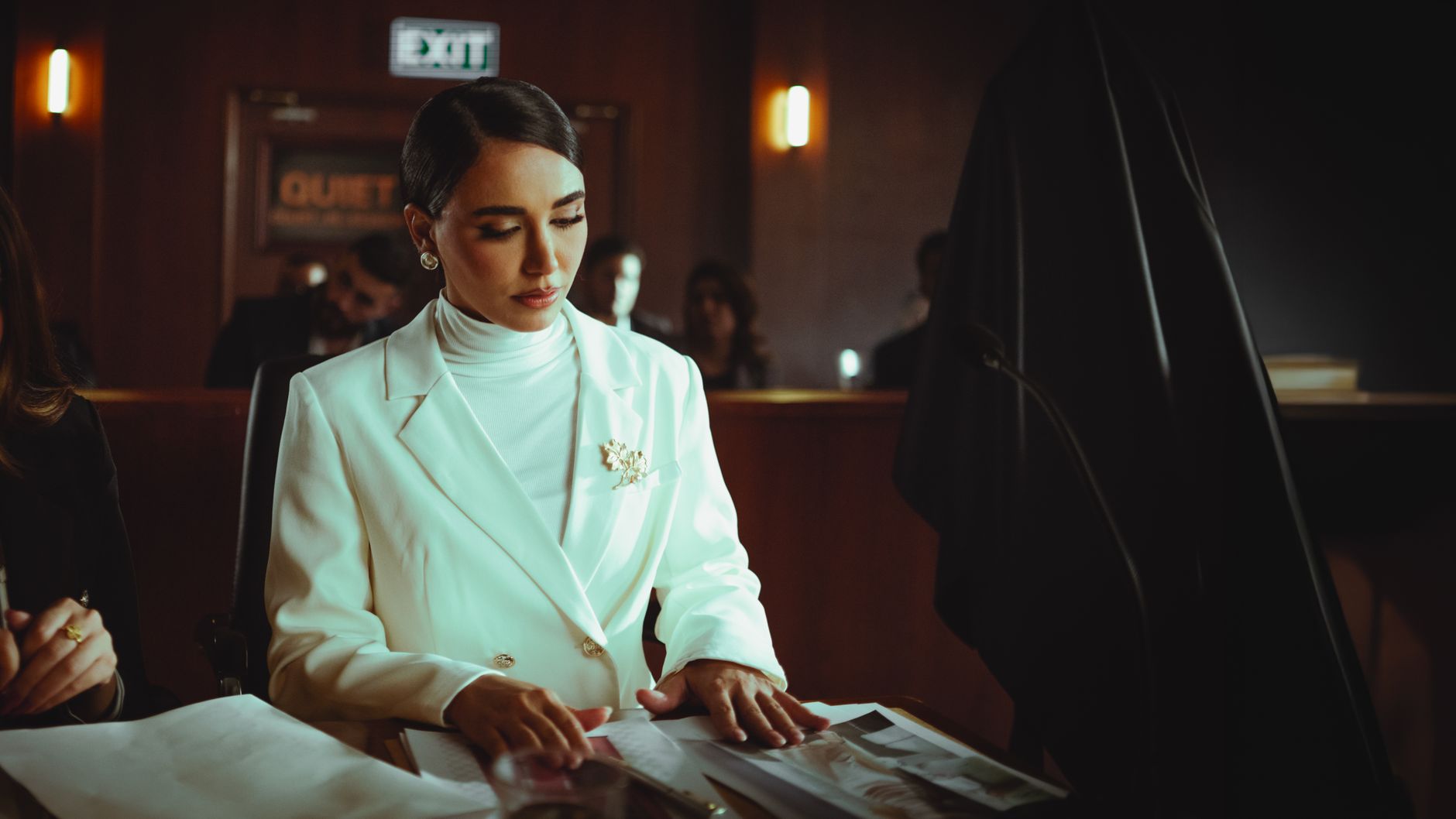
The Question My Daughter Asked The Judge
The papers arrived on a Tuesday, the same way you might get a coupon for oil changes or a reminder that your library books are late. No warning. No conversation. Just a manila envelope left on the counter of the diner where I waited tables, propped against the little caddy of jam packets, with a sticky note on the front in my husband’s handwriting.
The note said, “Let’s keep this simple.”
That was Marcus. He could make cruelty look like courtesy. He could hand you the worst day of your life and act like he was doing you a favor by being neat about it.
I want to tell you the whole thing, start to finish, because for a long time I only knew my half of it. I knew what it felt like to be the one accused. I did not know, until a Thursday afternoon in a county courthouse with a leaking radiator and a flag that had faded to the color of weak tea, what my daughter had been carrying alone. I did not know that a ten year old could stand up in a room full of grown people and change the direction of everything with one quiet question.
Her name is Leah. She is the reason I am able to write any of this down.
The note on the counter
We lived in a town small enough that the pharmacist knew my order before I asked and big enough to have a Walmart out by the highway. Everybody’s cousin worked at the grain elevator or the school or the hospital two counties over. It was the kind of place where your business was never fully your own, which cuts both ways. People talk. People also show up with a casserole when your roof caves in.
Marcus and I met at the community college where I was taking classes at night and he was fixing the heating system in the science building. He had a way of looking at a broken thing and knowing exactly what it needed. I found that comforting back then. I thought a man who could fix furnaces could probably fix anything, including the parts of me I thought were broken. I was twenty three. I did not yet understand that some people learn how a thing works only so they know exactly where to push to make it stop.
We got married at the little brick church on Sedgwick Street. Leah came two years later, in the middle of an ice storm, and Marcus drove us to the hospital going ten miles an hour on roads slick as a skating rink, gripping the wheel, telling me to breathe. For a few years we were happy, or at least I was, which I have learned are not always the same thing.
I picked up shifts at Dot’s, the diner off the county road, because the tips were good on Fridays when the ballgame let out and because it got me out of a house that had started to feel like a museum where I was the exhibit nobody read the little card for. Marcus climbed at the plant. He got a supervisor title and a truck with the company logo on the door and a way of talking about our life like it was a spreadsheet he balanced alone.
Somewhere in there, he stopped coming home right after his shifts. Somewhere in there, money I thought was ours started moving to an account I did not have a card for. When I asked, he told me I worried too much. He told me in that soft, patient voice, the one he used when he wanted me to feel small for asking. And when I pushed, he would sigh and rub his temples and say, “This is what I mean. This is exactly what I mean.”
I did not know yet what he meant. I found out when the envelope showed up against the jam packets, and the sticky note told me to keep it simple.
He was filing for divorce. That part I could have survived. It was the second page that took the air out of me. He was asking for full custody of Leah. And the words he used to explain why were words I did not recognize as belonging to my life.
Unstable. Financially irresponsible. Emotionally unpredictable. Exposes the child to conflict.
I stood in the back hallway by the walk in cooler and read it three times, and Dot found me there and took the papers out of my hands and read them herself and said one word that I will not repeat here because Dot is a churchgoing woman and would be embarrassed to see it in print. Then she poured me a coffee I did not drink and told me to call a lawyer, a real one, not the guy who did wills out of the strip mall.
The version of me he built
Here is the thing about being accused of being unstable. The more upset you get, the more it proves their point. If you cry, you are emotional. If you go cold and careful, you are calculating. If you fight, you are combative. If you go quiet, you have something to hide. There is no way to be a person under that kind of accusation that does not somehow feed it. Marcus knew that. I think he had always known it. I think it was why he was so calm. Calm was the only move on the board that could not be turned against you, and he had claimed it first.
I found a lawyer two towns over, a woman named Ruth who had gray hair cut short and a way of listening that made you feel like the most important case she had ever taken even though I am sure I was not. Ruth was the first person who did not flinch when I said the words out loud. She just nodded and started writing.
“He’s going to look good in that courtroom,” she told me at our first meeting. “Men like this always do. They practice reasonable. You need to understand that going in, so it doesn’t knock you sideways when it happens. The judge isn’t going to see the man who left a note on your jam packets. He’s going to see a guy in a pressed shirt who says he only wants what’s best for his little girl.”
“So what do I do,” I asked.
“You tell the truth,” she said. “And we bring what we can prove. And we do not, under any circumstances, give him the reaction he’s building his whole case around.”
I told her about the money moving to the account I could not see. She wrote it down. I told her about the nights he did not come home, and the way he had started narrating our marriage to other people like I was a problem he was heroically managing. She wrote that down too, and then she looked up and asked me the question that I would think about for weeks.
“What does Leah say,” she asked. “About her dad. About home. When it’s just the two of you.”
I did not have a good answer. That is the part I am ashamed of, even now. Because I had been so busy holding myself together, so busy proving I was not the woman on that second page, that I had not really stopped to ask my own daughter what she was seeing. I assumed she was too young to understand. I assumed I was protecting her by keeping the ugliness away from her. I told myself she was fine because being fine was one less thing I had to carry.
Children are not fine just because we need them to be. That is a lesson I paid full price for.
The first day
Marcus wanted Leah in the courtroom. My lawyer fought it. She said a child that age had no business sitting through a custody hearing about herself, and she was right, and the judge mostly agreed, but Marcus’s attorney found a way to have her present for portions, framed as the court wanting to be mindful of the child’s wishes and welfare. I think the real reason was simpler and colder. I think Marcus wanted Leah to watch me come apart. I think he believed that if she saw her mother small and shaking under those fluorescent lights, she would understand which parent was the strong one, and she would choose him the way you choose the lifeboat that is not sinking.
The county courthouse was a hundred years old and looked it. There was a radiator in the corner that hissed and dripped into a coffee can somebody had set under it, and every so often the drip would be the loudest thing in the room. The flag by the bench had gone pale. The wood was dark and scarred with a hundred years of other people’s worst days. It smelled like floor wax and old paper.
Marcus sat at his table in a charcoal suit I had never seen, which meant he had bought it for this. He looked rested. He looked like a man who slept fine. He looked over at me exactly once, for maybe two seconds, and then he looked away like I was a stain on the carpet he had decided not to mention to the host.
Leah sat next to me. Her feet did not reach the floor. She had picked out her own outfit that morning, a navy dress with a little white collar, and she had brushed her hair flat and careful, and she sat with her hands folded in her lap in a way that was so grown up and so wrong for a ten year old that I had to look at the ceiling for a second so I would not lose it right there before anything had even started.
The judge was an older man named Harlan Pruett. Everybody in the county just called him Judge Pruett, and half of them had been in front of him at some point for one thing or another, a fence dispute or a DUI or a will gone sideways. He had a long, still face that gave away nothing. When he looked at you, you felt weighed. Not judged exactly. Weighed, like produce, like he was finding out what you actually amounted to.
Marcus’s lawyer went first. Her name was Ms. Calloway and she was good, I will give her that. She stood and she spoke gently, almost sadly, like it pained her to have to say these things about a woman she clearly did not know at all.
“Mr. Bell has been the steadying presence in this child’s life,” she said. “He provides the structure. He provides the routine. He is the parent who ensures homework is done, who maintains the household, who keeps the lights on. Ms. Bell, by contrast, works irregular hours, has demonstrated financial instability, and has, on multiple occasions, exposed the child to conflict and emotional volatility.”
Financial instability. He was the one who had moved the money. He was the one who had hidden it. I had worked doubles at that diner for years and handed most of it to a household budget I did not even control.
Exposed the child to conflict. As if the conflict had not been him. As if I had generated it out of thin air like weather.
I felt the heat climb up my neck and Ruth put her hand flat on the table between us, not touching me, just there, a reminder. Do not give him the reaction. Do not be the woman on the second page. I breathed. I looked at the faded flag until my eyes stopped stinging.
Judge Pruett’s face did not move the whole time Ms. Calloway spoke. I remember thinking that was the worst part, worse than the lies, the way his face just stayed still, like water with nothing under it. I remember thinking he had already made up his mind, that the suit had worked, that reasonable had won the way it always wins, and that I was going to lose my daughter to a man who had left me a sticky note.
The hand that went up
Ruth stood and made our case. She was calm and precise and she laid it out like a carpenter laying floor, one plank at a time. The bank records that showed money moving to an account only Marcus could access. The timeline that did not match his story. The character witnesses, Dot among them, who would speak to who I actually was when I was not being described by a stranger in a courtroom.
It was a good case. I could see it landing. But I could also see how much of it was paper, and how much of Marcus’s was performance, and I knew from a life of watching people at a diner counter that performance usually wins the room even when paper wins the argument.
And then, right as Ms. Calloway rose to respond, Leah shifted next to me.
She had been so still all morning. Now she moved, and I felt it before I understood it, the way you feel a change in the weather before the sky does anything. She unfolded her hands. She sat up straight. And then, small and certain, she raised her hand.
Not a wave. Not a fidget. She raised her hand the way she did in school, the way you do when you know the answer and you have decided you are going to say it even though your heart is going like a rabbit.
Every head in that room turned.
“Leah,” I whispered. “Honey, put your hand down. It’s okay. Put your hand down.”
She did not put her hand down.
Judge Pruett looked at her over the top of his glasses. For the first time all day, something crossed his still face. Not annoyance. Something closer to attention. “Young lady,” he said. “Do you have something you’d like to say?”
Leah stood up. Her feet finally reached the floor when she stood. Her chin was trembling but her voice, when it came, did not shake nearly as much as I thought it would.
“Your Honor,” she said. “Can I show you something Mommy doesn’t know about?”
The room went so quiet that the radiator drip sounded like a gunshot. I heard my own heart. I heard Ruth go very still beside me. And across the aisle, I heard Marcus’s chair scrape as he turned toward his daughter, and for the first time that entire day, the calm went out of his face like somebody had pulled a plug.
“Leah,” he said, and his voice was not soft now. It was low and hard and I had heard that voice before, aimed at me, in the kitchen, late, when he thought Leah was asleep. “Sit down.”
Leah did not sit down.
Something happened to me in that moment. I had spent weeks trying to be small and careful and quiet so no one could call me volatile. But when I heard that voice come out of him and land on my child, some old animal part of me stood up inside my chest and would not sit back down. I did not say anything. I just looked at him, and I think he saw it, and I think for the first time he understood that whatever was about to happen, he had lost control of it.
What she had kept
Judge Pruett leaned forward. When he spoke to Leah, his voice changed. It got slower and gentler, the voice you would use with a spooked animal or a child on a ledge. “What is it you’d like to show me, Leah?”
“I have some things,” she said. “In my backpack. Drawings, and a paper I wrote, and a message I saved. I kept them because I didn’t know who to tell. I thought if I told the wrong person, it would get worse.”
Ms. Calloway was on her feet. “Your Honor, we object. This is highly irregular. The child is clearly under emotional strain and may have been coached.”
“I wasn’t,” Leah said, before the judge could answer, and there was a flash of something in her that was pure Leah, the same spark she got when someone told her she was too little to do a thing she had already decided to do. “Nobody told me to. Mommy doesn’t even know I have them. That’s the whole point. She doesn’t know.”
Judge Pruett held up one hand and Ms. Calloway sat. He looked at Leah for a long moment. Then he did something I did not expect. He looked at me.
“Ma’am,” he said. “Is your daughter telling the truth? Do you know what she’s referring to?”
“No, Your Honor,” I said, and my voice cracked on it. “I don’t. I swear to you I don’t.”
He nodded slowly, and I understood later that my not knowing was, in that room, the most convincing thing that had happened all day. A coached child has a mother who knows the script. My face had nothing on it but the same shock everyone else was wearing.
“All right,” he said. “Here’s what we’re going to do. This is not a performance for the courtroom. Leah, you and I are going to look at what you brought, in my chambers, with your mother, your father, and both attorneys present, and no one else. If it’s private, it stays private. Does that sound fair to you?”
Leah nodded. She reached under the table for the backpack I had not even noticed she had brought, a purple one with a frayed strap and a keychain shaped like a fox that she had won at the county fair two summers before. She hugged it to her chest.
Then she looked at the judge and asked the question that broke me clean in half.
“Will I get in trouble,” she asked, “for not telling before?”
“No,” Judge Pruett said. “You will not get in trouble. You did a brave thing. Braver than most grown people manage.”
The chambers were small and lined with books that I do not think anyone had opened in years. There was a window that looked out on the parking lot and the water tower with the town’s name on it. Judge Pruett sat behind a plain desk and told everyone else where to sit, and he told Marcus, when Marcus started to speak, to please be quiet, and there was iron under the courtesy of it, and Marcus was quiet.
Leah opened the backpack.
The first thing she took out was a stack of drawings. She had always drawn. Since she could hold a crayon, she had drawn our life, the house, the dog we used to have, the diner with me in it holding a coffee pot. These were not those drawings. These were newer, and they told a different story, and I understood as she laid them out one by one on the judge’s desk that she had been telling that story to paper because she had no one she trusted to tell it to out loud.
I am not going to describe every drawing. Some of them are hers, and they are private, and she was ten. But I will tell you what they showed, in the general shape of it, because it matters. They showed a small figure with brown hair, herself, in her room, with the door shut and lines coming off it that a child draws to mean loud. They showed a big figure and a small figure at a table, and the big figure had a scribbled angry mouth and the small figure had no mouth at all. They showed who made her breakfast and who packed her lunch and who sat with her when she was scared during the storms, and it was not the person the courtroom had been told was the steadying presence, the one who kept the lights on. It was me. Even on my worst, most exhausted, double shift days, in a child’s own record kept in secret, it had been me.
Marcus had built a case that he was the parent who was there. His daughter had spent two years drawing the truth that he was the parent who was there and frightening, and I was the parent who was tired and gone too much and still, somehow, home.
The second thing she took out was a folded piece of notebook paper. She had written on it in her careful cursive, the kind they still teach in our schools. It was a letter she had never given anyone. It started, “To whoever finds this.” I asked her later if I could keep it, and she said yes, and it lives in a drawer in my nightstand now, and I take it out sometimes when I need to remember what she is made of. I will not print what it says. It is hers. I will only tell you that a ten year old had written down, plainly and without drama, the things she had heard her father say about her mother, and the things she had seen, and the fact that she had been told, more than once, in that low hard voice, not to tell.
The last thing she took out was her tablet, the old one with the cracked corner that we kept meaning to replace and never had the money to. She turned it on. Her hands were shaking now, worse than they had in the courtroom, and I wanted to reach over and hold them still but I made myself sit on my own hands because this was hers to do and I had already made the mistake, once, of deciding what my daughter could handle.
“There’s a message,” she said. “Daddy left it. On my tablet. When I called him one time and he didn’t pick up, and then he called back but I was in the bath, so it went to the voice thing. I saved it. I don’t know why I saved it. I just knew I should.”
She looked at me then. “You’re going to be sad when you hear it, Mommy,” she said. “I didn’t want you to be sad. That’s why I didn’t tell you. I’m sorry.”
I have replayed that sentence more than any other from that day. My ten year old had kept a secret that was crushing her, for two years, and the reason she gave was that she did not want to make me sad. She had been protecting me the whole time I thought I was protecting her. We had been two people in the same small house, each carrying the whole weight alone so the other one would not have to, and neither of us had known.
She pressed play.
I am not going to give you the words. They were his, and hearing them out loud in a small room with the water tower out the window was one of the worst and most necessary things that has ever happened to me, and I do not want to hand them to strangers. What I will tell you is this. It was Marcus’s voice, unmistakable, calm the way he was always calm, and in that calm voice he said things to our daughter, or about our daughter’s mother to our daughter, that a father should never say. He told her which of her parents was the real one and which was the problem. He told her not to tell me things. He made a ten year old the keeper of his contempt and then he swore her to silence, and she had held it, because she was a good girl and she loved us both and she did not know she was allowed to put it down.
When it ended, no one in that room said anything for a long time.
Judge Pruett took his glasses off and set them on the desk and rubbed the bridge of his nose, and I saw that his still face was not still anymore. Ms. Calloway had gone the color of the faded flag. And Marcus, for once in his life, had no reasonable thing to say. He opened his mouth and closed it. He looked at the judge, and the judge was not looking at him. He looked at Leah, and Leah was looking at the desk. He looked at me, and I looked right back at him, and I did not blink, and whatever he had spent our whole marriage building in his own face, that calm, that control, that certainty that he was the steady one and I was the storm, it was gone, and we both knew it was not coming back.
“Leah,” Judge Pruett said finally, very gently. “Thank you. You can turn that off now. You did the right thing bringing it to me.”
“Am I in trouble,” she asked again, because that is the loop a frightened child gets stuck in.
“No,” he said. “And I want you to hear me say something else. None of this is your fault. Not one bit of it. Grown people made these choices. Not you. Do you understand me?”
She nodded, but I do not think she believed it yet. It has taken a lot of Thursdays with a good counselor for her to start to believe it. But it started in that room, with an old judge who had a still face and, it turned out, a soft heart under it, telling my daughter something her own father never would.
After
The hearing did not end that afternoon the way it does in the movies, with a gavel and a speech. Real courthouses do not work like that. There were more dates and more filings and a guardian ad litem appointed to represent Leah’s interests, a kind woman named Sandra who met with Leah several times in a room with beanbag chairs and let her draw and did not push. There was a psychological evaluation, which Marcus’s side had asked for, back when they thought it would sink me. It did not sink me. It said what I already knew, that I was a tired woman under enormous stress who loved her child, which as far as I can tell describes about half the mothers in this country.
Marcus’s lawyer withdrew the request for full custody. She had to. You cannot stand in front of Judge Pruett after a room hears that message and argue that the man on it is the steadying presence a child needs. Marcus’s whole case had been built on a version of me that his own daughter’s backpack had quietly demolished.
In the end, the judge granted me primary physical custody. Marcus received supervised visitation, to be revisited as he completed a program the court required, anger management and a parenting course and individual counseling, and it was made clear to him that the door to more time with Leah ran directly through that work and through Leah’s own comfort, and not through any suit he could buy. Judge Pruett said, in open court, that the child’s expressed wishes and her welfare would guide the arrangement going forward, and that he had rarely seen a young person show the courage this one had. He looked at Leah when he said it. She sat up very straight.
I want to be careful here, because it would be easy to end this like Marcus is a monster and I am a saint and the story has a villain you can hate cleanly. Real life is grainier than that. Marcus is Leah’s father. He is, somewhere under the man who left me the note and left our daughter that message, the man who drove ten miles an hour through an ice storm so I could have her safely. I do not know what happened to that man, or whether the calm cruelty was there all along and I only saw the furnace fixer I needed to see. But I know that Leah still loves him, in the complicated way children love a parent who hurt them, and I have worked hard, harder than I wanted to some days, not to poison that. The court asked me to support her relationship with her father to the extent it is safe, and I have. Not for him. For her. Because the alternative is teaching her that love is a thing you weaponize, and I watched what that does to a person, and I will not hand it down.
Marcus did the required program. Some of it, I think, actually reached him. He does the supervised visits and he has, slowly, over the two years since, earned a little more time, and there are stretches where he is decent and even good, and there are stretches where the old coldness flickers back and Leah comes home quiet and I hold my breath. It is not clean. It is not finished the way a story is finished. But Leah is safe, and she is mine, and the person who decides what she can and cannot handle is no longer a man in a charcoal suit betting on her mother falling apart.
What Leah taught me
We moved. Not far, just across town, into a smaller place that gets better light in the mornings. Dot cosigned so I could get it, because Dot is who she is. I still work at the diner. I picked up a bookkeeping class at the community college, the same one where I met Marcus a lifetime ago, because Ruth told me that the fastest way to never be called financially irresponsible again by anyone is to know your own numbers cold, and I took that to heart. I know my numbers now. I know exactly where every dollar goes. There is no account I cannot see.
Leah is twelve now. She still draws. The drawings are different again, the way they were before, the house and the light and the diner with me in it holding a coffee pot, and a new dog, a gray mutt named Biscuit who sleeps on her feet. She talks now, out loud, about hard things, because we practiced, because I finally learned to ask the question my lawyer asked me that first day, the one I should have been asking all along. What does it feel like, when it’s just us. What are you carrying that you think you have to carry alone.
She sees a counselor named Miss Priya on Thursdays, and she does not love it, and she goes anyway, and slowly the thing that made her keep a secret until it nearly crushed her is loosening its grip. She is learning that she is allowed to put things down. She is learning that a child’s job is not to protect the grown ups from the truth. That was never her job. It was ours to protect her, and we failed her, both of us, in different ways, and she saved herself anyway, with a purple backpack and a fox keychain and the courage to raise her hand in a room full of people who kept telling her to sit down.
I asked her once, a while after, why she did it. Why that day. Why the hand.
She thought about it in the serious way she has. “Because everybody was talking about me,” she said, “and getting it wrong. And I was right there. And I got tired of nobody asking the person who actually knew.”
I think about that all the time. She was right there the whole time. The one person in that courthouse who actually knew what our life had been was a ten year old whose feet did not reach the floor, and it took her standing up and refusing to sit back down for anyone to ask.
I filed the divorce papers he sent me in a drawer, next to the letter that begins “To whoever finds this.” I keep them together on purpose. One is the version of me a man tried to build to take my daughter away. The other is the version of me my daughter drew and wrote and saved in secret because she loved me and did not want me to be sad. I know which one is true. A judge in a hundred year old courthouse with a leaking radiator knows which one is true. And most of all, Leah knows, because she is the one who told it.
People ask me sometimes if I am angry. I was, for a long time. I was angry at Marcus, and I was angry at myself for the years I did not see and the questions I did not ask. But anger is a heavy thing to carry, and I have watched what happens to people who never set it down. So mostly now, when I think about that Thursday, I do not feel angry. I feel something closer to awe.
My daughter looked at a room full of adults who had decided her future without asking her, and she raised her small hand, and she said, “Can I show you something.” And she did. And it was the truth. And the truth, it turns out, when a child is brave enough to carry it into the light, is heavier than any suit, any soft voice, any note left against the jam packets telling you to keep it simple.
Nothing about it was simple. Nothing about it should have been. But it was true, and she made them see it, and we are home.