The Mother Who Stopped Being The Account
I am sixty-two years old, and until the afternoon I found myself sitting on my son’s kitchen floor with my wrist screaming and my ears ringing, I believed there was almost nothing I would not give my family. I had proven it over and over for four decades. I proved it in the years when it was just Jacob and me, when his father left before the boy could even walk and I learned to be two parents at once in a rented duplex on the edge of Delphi, Indiana, a town small enough that the pharmacist knew your name and your business before you finished spelling it.
I want to tell this the whole way through, from the beginning to the part I still have trouble saying out loud, because for a long time I only knew how to tell the pretty version. The version where I was the good mother and everything I did was love. That version is true. But it is not the only true thing, and the day my daughter-in-law put her hand on me and my own son typed the word “us” as if I had been erased from the family portrait, I finally understood that love without a spine is just a door left open for people to walk through and leave muddy.
The boy I built my whole life around
Jacob was an easy child to love and a hard child to raise, which is a sentence a lot of single mothers understand and almost no one else does. Easy to love because he was sweet, quick to laugh, the kind of kid who would pick a dandelion out of a sidewalk crack and carry it home to me like it was a dozen roses. Hard to raise because there was never enough of me to go around. I worked days at the county clerk’s office and picked up evening shifts at a diner out on Highway 25, a little chrome-sided place where the truckers came through and the coffee was always burnt and the tips were just barely enough to cover the difference between what we had and what we needed.
I remember standing at that diner counter at ten at night, feet swollen, apron greasy, watching the clock and thinking about Jacob at home doing his homework at the kitchen table under the one good lamp. I would come in the door smelling like fryer oil and he would look up and say, “Mom, I saved you a spot,” and pat the chair beside him, and I would sit down and check his math even though my eyes were half closed. That was our whole world. Two people and one lamp and a stack of bills I kept in a shoebox on top of the refrigerator so he would not see how thin the margins were.
I never let him go without. That was my private religion. Other kids had new cleats, so Jacob had new cleats, even if it meant I wore the same coat for six winters. Other kids went to the school trip to Washington, so Jacob went, even if it meant I sold my mother’s ring to the jeweler on Main Street and told Jacob I had simply stopped wearing it. He found out about the ring years later, when he was in college, and he cried on the phone and told me he was going to buy it back for me someday. He never did, and I never expected him to. That was not the point. The point was that I would burn anything I owned to keep my boy warm, and I did, gladly, for years.
He grew up good. That is the thing I want people to understand before they judge what came later. He was not a cruel boy. He was thoughtful and gentle and he called me every Sunday from wherever he was, and when he graduated from Purdue with a degree in mechanical engineering, the first person he hugged was me, and he lifted me clean off the ground in that gown and said, “We did it, Mom. Both of us.” I still have the photograph. A woman in a cheap dress she had ironed three times, being lifted into the air by the whole reason she had gotten up every morning for twenty-two years.
So when I tell you what happened, understand that it did not happen to some stranger’s family. It happened to us. To the boy who saved me a spot at the table.
The girl at my kitchen counter
Sophie came into our lives when Jacob was twenty-six. He brought her home for Thanksgiving, and I watched them come up my front walk holding hands, and I loved her before she even got her coat off, because Jacob looked at her the way I had always hoped somebody would.
She was pretty in a soft, tired way, the way young women look when they have been working too hard for too little. She was in nursing school then, second year, and drowning in it. Tuition, textbooks, clinical hours, a part-time job at a nursing home in Lafayette that paid almost nothing and asked everything. She sat at my kitchen counter that first Thanksgiving and told me about it while Jacob was out in the garage with the neighbor, and I recognized the look on her face. It was my own look from thirty years back. The look of someone trying to build a life out of scraps and hope.
“I want to be a labor and delivery nurse,” she told me. “I want to be the one who hands the baby to the mother. That first second. I want to be there for that.”
I liked her for that. I have always trusted people more by what they long to do than by what they say they believe. Anybody can say they are a good person. It takes something real to want to spend your life catching other people’s babies and handing them over in that first holy second.
Over the next two years I helped her. I want to be honest that it was not a small thing. When her financial aid fell through one semester, I paid the balance so she would not have to drop out and lose her whole cohort. When her car died on Route 39 in January, I co-signed the loan for the used Honda that got her to her clinicals. When she was so exhausted from a double shift that she cried at my kitchen counter and said she did not think she could finish, I made her tea and told her she was already the kind of nurse those mothers deserved, and she gripped my hand and said, “I will pay you back for all of it. I promise. The second I graduate, every dollar.”
“You will do no such thing,” I told her. “You will pass your boards and you will catch those babies and you will let me hold my grandbabies someday. That is how you pay me back.”
She laughed and wiped her eyes and said she loved me, and I believed her. I want to be clear about that too. I do not think she was lying then. I think she meant it, in the way people mean things when they need you. The trouble with need is that it does not always turn into gratitude. Sometimes, when the need is finally gone, all that is left is the memory of having been someone’s charity case, and some people can never forgive you for that.
They married on a hot June afternoon at the little Methodist church out on Adams Street, the one with the white steeple you can see from the county road. I sat in the front pew and cried through the whole thing. Sophie’s own mother had passed years before, and her father was not in the picture, so at the reception Sophie came and found me and pinned a corsage on me and introduced me to her friends as “Jacob’s mom, who is basically my mom too.” I have never in my life felt so full.
For a few years, things were good. Not perfect. But good. Sophie passed her boards and got the labor and delivery job at the hospital in Lafayette. Jacob was doing well at the plant, moving up, getting his engineering title and the raise that came with it. They rented a townhouse and talked about kids, and I gave them their space, because I know how a mother-in-law can smother a young marriage if she is not careful. I had watched my own mother do it to my brother’s wife, and I had promised myself I would never be that woman.
But I noticed changes, small ones, the way you notice a season turning. The Sunday calls got shorter. Then they became every other Sunday. Then Jacob would call and Sophie would be in the background and I would hear her say something and Jacob would say, “Mom, I gotta go, Sophie needs me for something.” The visits thinned out. When I did see them, Sophie was polite but cool, and there was a way she looked at me sometimes, when she thought I was not paying attention, that I could not name for a long time. Later I understood it. It was the look of someone who owes a debt she never intends to pay and resents the person who holds it.
I told myself I was imagining things. I told myself that is what young couples do, they pull inward, they build their nest, and a good mother lets them. I made excuses for two years. I have always been good at making excuses for the people I love. It is one of my great talents and one of my great failures, and I did not know how deep it ran until the afternoon everything broke.
The house
Last spring they came to me about the house.
They had found it, a real house at last, a three-bedroom on Sycamore Street with a big backyard and a maple tree out front that would turn the color of fire every October. Jacob was so excited he could barely sit still at my table. He spread the printout across my placemat and pointed at the porch and the kitchen and the little room he said would be the nursery, and for a second he was ten years old again, showing me a drawing he had made at school.
“Mom, it’s perfect,” he said. “But the numbers are tight. With Sophie’s student loans and my car and everything, the bank wants more than we can put down. They said if we had a co-signer with your credit and some help with the down payment, it would clear easy. It’s temporary. Once Sophie makes charge nurse, we’ll refinance and take you right off it. This house means everything to us.”
Sophie was there too, and she reached across the table and put her hand over mine and said, “You’ve always taken care of us. I don’t know what we’d do without you.” Her eyes were wet. I remember thinking she must have meant it, because her eyes were wet.
I said yes. Of course I said yes. I always said yes. I put down thirty-eight thousand dollars, which was the better part of what I had saved for my own retirement, the money I had scraped together over decades of burnt coffee and sensible coats. And I co-signed the mortgage, which meant my name and my credit and my whole financial life were tied to that house on Sycamore Street. I did it with a full heart. I thought I was buying my son a home and buying myself a front-row seat to the grandchildren I had been praying for.
I did not know I was buying my own eviction from the family.
The afternoon it all came apart
It was a Tuesday in April. I remember because I had spent the morning at the church helping set up for the spring rummage sale, and I had baked a pan of my lemon bars, the ones Jacob loved as a boy, and I decided to drive them over to the townhouse as a surprise. They were packing to move into the new place, and I thought I would help, or at least keep them company. I was proud. My boy was getting his house. I wanted to be part of it.
The townhouse door was unlocked, and I heard voices as I came in, so I did not knock. That was my mistake, if a mother wanting to bring her son lemon bars can be called a mistake. Sophie and Jacob were in the kitchen, and they were fighting, the low hard kind of fighting people do when they think no one can hear.
It was about money. It was about me. Sophie was saying she was sick of feeling like they owed me their whole lives, sick of the way I “hovered,” sick of feeling watched, and Jacob was saying something soft and placating, the way he always did, and then they turned and saw me standing there in the doorway with a foil-covered pan of lemon bars in my hands, and everything stopped.
I should have just left. I know that now. But I was hurt, and when I am hurt I get quiet and careful and I try to fix things, so I said, gently, “Sophie, if I have made you feel watched, I am sorry. That was never what I wanted. I only ever wanted to help.”
And something in her just snapped.
I have gone over the next few seconds a thousand times, and I still cannot slow them down enough to understand them. Her face changed. It went hard in a way I had never seen, and she crossed the kitchen fast, and she said, “You want to help? Then get out of our lives,” and her arm came up and she shoved me, both hands, hard, in the chest.
I am sixty-two. I do not bounce anymore. I went backward, and the pan flew out of my hands, and I remember the ridiculous sight of lemon bars scattering across their kitchen floor, and then the corner of the counter caught me and I twisted and went down, and I put my hand out to catch myself, and my wrist took my whole weight against the tile. The pain was white and immediate. I heard something in my wrist give.
For a second, nobody moved.
I lay there on the floor of my son’s kitchen, among the lemon bars I had baked for him, and I looked up at the two of them. Sophie was breathing hard, staring down at me, and there was no shock on her face, no reaching down to help. She just looked at me like she was waiting to see what I would do. And then she said, quiet and cold and somehow rehearsed, “I think it’s best if you leave.”
And she turned around and walked out of the room.
I want to tell you the worst part, and it is not the fall, and it is not my wrist, which was broken in two places, as it turned out. The worst part was Jacob.
He did not come to me. My son, the boy who saved me a spot at the table, the boy I lifted air into, stood in that kitchen and watched his wife knock his mother to the floor, and he did not cross the room. He looked at me, and I saw the war on his face, I saw him want to, and then I saw him choose. He looked away. He mumbled something, I could not even tell you what, and he followed her out, and I heard his feet go up the stairs.
I got myself up. It took a while, one-handed, using the counter. I did not cry, not then. I was too far past crying. I gathered my purse and I left the pan where it was, and I walked out to my car, and the April sun was so bright and so ordinary, birds going about their business, a neighbor’s sprinkler ticking across a lawn, the whole world refusing to notice that something in me had just ended. I sat in my car and gripped the wheel with my good hand and I could not make myself turn the key for the longest time.
Then my phone buzzed.
It was Jacob. I opened it with my thumb, and I felt something rise in me, some last stupid hope, because surely, surely he was writing to say he was coming down, that he was sorry, that this was insane and he was throwing her out and rushing to me.
The message said: “Please don’t come back. It’s better for everyone this way. Stay away from us.”
Us.
I read that word maybe twenty times. Not “me.” Not “us for now.” Not “I’m sorry, Mom, I don’t know what to do.” Just “us,” a wall built out of three letters, with me on the outside of it. Forty-two years of my life, the ring I sold, the coats I wore thin, the babies I helped her catch the training to catch, and I had been reduced to a threat to be kept away from “us.”
I typed back one word. I did not rage. I did not beg. I had begged for love in one form or another for a long time, and I was suddenly, completely done. I typed, “Alright.” And I meant it in a way he could not possibly have understood yet.
Then I drove myself to urgent care.
The nurse who saw me was young, about Sophie’s age, and gentle. She held my swelling wrist so carefully as she turned it for the X-ray. Two fractures, the doctor said, a brace, medication, six weeks minimum, and physical therapy after. Paperwork on a clipboard. And near the bottom of the intake, a question, and then the nurse quietly, kindly, when she saw the shape of the swelling and the age of the woman and the absence of any family in the waiting room, asked me if I wanted to talk to someone about how the injury happened. Whether I wanted to report it.
I thought about it for a long moment. I could have. A part of me wanted to burn it all down. But I said, “Not right now.” Because I already knew, sitting on that crinkly paper in that cold little room, exactly what I was going to do, and it was not going to involve police or drama or any of the noise that people like Sophie feed on. It was going to be quiet. It was going to be paperwork. And it was going to be final.
I went home to my little house, the one I had lived in for thirty years, the one that was paid off because I had never once in my life spent money I did not have. I made myself a cup of tea, awkwardly, with my left hand. And I sat at my kitchen table under the same kind of lamp that had lit Jacob’s homework a lifetime ago, and I let myself feel it. All of it. I cried then, finally, until I was empty. And when I was empty, something clear and calm was left behind, like the air after a storm.
The next morning I opened my folder.
What the paperwork remembers
I am a clerk’s daughter and I worked in the county clerk’s office for nineteen years, and if there is one thing I know down to my bones, it is that promises fade but documents remain. I have kept every important paper of my life in a green accordion folder in the bottom drawer of my desk. And in that folder, from only a month before, were the loan agreement, the co-signer forms, the down payment documentation, and every email from the mortgage company at the bank in Lafayette.
Here is what most people do not understand about the house on Sycamore Street. The deal was not done. Closing was still two and a half weeks away. The mortgage had received conditional approval, but conditional means exactly that. It was conditioned on the down payment, which was my thirty-eight thousand dollars, sitting in an escrow account I had funded but that had not yet been released to close. It was conditioned on the co-signer, which was me, remaining a co-signer. And it was conditioned on the final verification of funds and signatures, which had not yet happened. I know this because I read every word of every document before I sign anything. My mother taught me that, and the clerk’s office beat it into me for two decades.
I logged into the mortgage portal that morning with my good hand and my reading glasses, and I saw my name, still there, still load-bearing. The whole structure of my son’s new house rested on my signature and my money, and neither had finished changing hands.
I did not call anyone. I did not threaten. I did not send some furious letter. I simply did two quiet, lawful, entirely ordinary things.
First, I telephoned the bank and spoke to the loan officer, a soft-spoken man named Raymond who had handled the file, and I told him, calmly, that I was withdrawing my consent to act as co-signer and that I was recalling the down payment funds I had placed in escrow, as was my right before closing. He was quiet for a moment and then he said he understood, and that he would need it in writing, and I said I would bring it in that afternoon, and I did, driving one-handed across town with the forms on the passenger seat.
Second, I closed the door on the money. The thirty-eight thousand dollars went back into my own account, where it had come from, where it belonged, the retirement I had almost given away.
That was all. I did not do anything to them. I want that on the record, because later there would be a great deal of talk about what I “did” to them. I did nothing to them. I simply stopped doing things for them. There is a difference, and it is the whole difference, and it took me sixty-two years to learn it.
Then I set my phone facedown beside my teacup and I listened to the hum of my quiet kitchen, and for the first time in longer than I could remember, I was at peace.
The phone that rang across town
I found out later how it went, because in a small town you always find out.
Two days after I withdrew, the loan officer called Jacob and Sophie to tell them the application could not proceed. The co-signer had withdrawn. The down payment was no longer in escrow. Without both, they did not qualify, not even close, not on their income against that price with Sophie’s student loans still on the books. The house on Sycamore Street, the maple tree, the nursery, all of it, evaporated in a single phone call on an ordinary afternoon, the same way my place in the family had evaporated in a single text.
The sellers had other offers. Of course they did. It was a good house. It was under contract with someone else inside a week.
My phone started ringing that same day. Jacob first. I let it go. Then again. Then Sophie, which surprised me. Then Jacob again. Then the texts came, and I read them all, because I am not a coward and I do not hide from things, I just no longer bend for them.
Jacob’s first texts were confused, then panicked. “Mom what happened with the bank.” “Mom the loan fell through, did something happen with your part.” “Mom please call me.” And then, when he understood, the tone changed, and I saw the thing that had been under the surface the whole time. “How could you do this to us.” “You’re punishing us.” “You’re going to ruin everything over a stupid argument.” A stupid argument. That is what he called his wife breaking his mother’s wrist. A stupid argument.
Sophie sent one long message, and it was a masterpiece, I will give her that. It was full of apology-shaped words that never once contained the actual word sorry for the thing she had done. She was “so sorry things had escalated.” She hoped we could “move past the misunderstanding.” She wanted me to know how much “the kids” (there were no kids yet, this was a strategy) would need their grandmother. And she ended by saying she was sure I would “do the right thing,” because I had “always been so generous.”
I read it twice, and then I understood, finally and completely, what I had been to her for years. Not a mother. An account. A generous, reliable, always-approved account, and the shove in the kitchen had been the moment she finally forgot to keep the account happy, and now she was scrambling to reopen it.
I did not reply to Sophie at all.
I did call Jacob, once, about a week later, when my wrist had settled into a dull constant ache and I had had time to become sure of my own voice.
He answered on the first ring. He started fast, all his lines ready, about the argument and the house and how I was overreacting and how family does not do this to family. I let him finish. I have always let him finish. And then I said the truest thing I have ever said to my son.
“Jacob,” I said. “I sat on your kitchen floor with a broken wrist, in front of the lemon bars I baked for you, and you walked up the stairs. You did not ask if I was hurt. You wrote me a message telling me to stay away from ‘us.’ I want you to sit with that word for a minute, because I have been sitting with it for a week. Us. You put me outside of ‘us.’ So I did the one thing I have never done in your whole life. I believed you.”
He was quiet.
“I am not punishing you,” I said. “I did not take anything from you that was ever yours. That was my money and my name and my credit, and I loaned them to a family I thought I was part of. When you told me I was not part of it, I took my things and went home. That is not cruelty. That is what you asked for. You asked me to stay away from ‘us,’ and staying away means I do not fund ‘us’ either. You cannot have my money in your walls and my body out on your lawn. It was always one thing, Jacob. It was always love. And you chose to keep one half of it and throw the other half on the floor.”
He started to cry then. He said he was sorry. He said Sophie had been under so much pressure. He said he had made a terrible mistake and did not know what to do. And I believed that too, that he was sorry, because I know my son and I know his sorrow is real. But I have learned, at long last, that a person can be truly sorry and still not be safe, and that my job is no longer to make everyone comfortable at the cost of my own bones.
“I love you,” I told him. “I will always love you. That is not a door I can close. But I am not going to be the account anymore, and I am not going to be in a house where your wife can put her hands on me and you will climb the stairs. When you are ready to be my son again, and not just when you need something, you know where I live. It is the same little house it has always been. There is a lamp on. There always was.”
And I hung up, gently, and I did not chase it.
The weeks after were hard, and I will not pretend they were not. There is a particular loneliness in choosing your own dignity, because dignity does not keep you warm at night and it does not call you on Sunday. I went to church, and I told my friend Diane the whole thing over coffee at the diner on Highway 25, the same diner, still there, the coffee still burnt, and she reached across the booth and held my good hand and said, “You did right, Carol. You did right and it still hurts, and both of those are true.” I have thought about that a hundred times. You can do right and have it still hurt. Both are true.
My wrist healed. Slowly, with therapy, with a young therapist who reminded me a little of Sophie in her better days, back before I understood her. I learned to trust the joint again. Some mornings it still aches when the weather turns, and I have decided to let it, because it reminds me of the day I stopped falling, in every sense of that word.
Sophie sent a few more messages over the summer, each cooler than the last, and then they stopped, which told me everything. When the account did not reopen, she lost interest in the customer. That used to be a thought that would have broken me. Now it just made me tired for her, and a little sad, because she is a person who catches babies for a living and cannot see the mother standing right in front of her.
Jacob and I are slow. That is the honest word for it. He calls now, on his own, not because he needs a co-signer or a check or a favor, but just to talk, the way we used to. The first few calls were stiff and careful, both of us walking around the broken thing in the middle of the floor. But last month he called and told me he and Sophie were in counseling, and that the counselor had asked him to think hard about the afternoon in the kitchen, about why he went up the stairs, and that he had cried for an hour afterward and finally understood something about the man he did not want to be. He asked me, at the end of that call, if he could come by sometime. Just him. Just to sit in my kitchen.
I said yes. Not the old yes, the reflex yes, the yes that gave away rings and retirements. A new yes. A yes with eyes open. “Come by,” I said. “There is a spot at the table.”
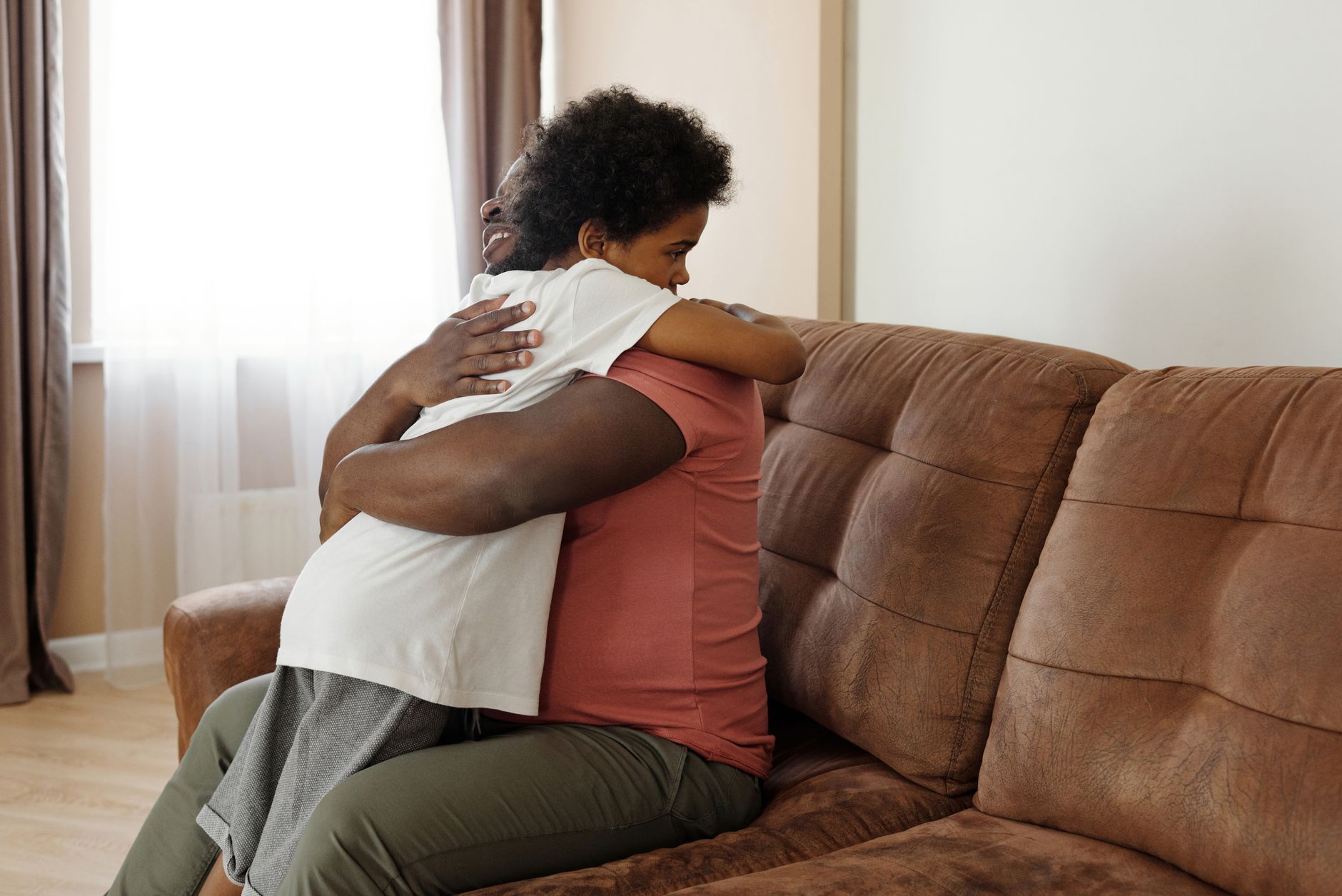
He came last Tuesday. He sat where he used to sit as a boy, and I made lemon bars, and neither of us said anything about it, but he ate three and then he put his head down on the table like he did when he was small and tired, and he said, “I’m sorry, Mom. For the stairs. For all of it.” And I put my healed hand on the back of his head, the way I did when he was ten and the world was too big for him, and I told him I forgave him, because I do, and forgiveness and boundaries are not enemies, whatever people think. I can forgive my son and still never again be the account. Those two things live in me side by side now, and they have made me stronger than all my years of saying yes ever did.
What I know now that I did not know before
I have thought a great deal, in the quiet of my paid-off little house, about the difference between love and self-erasure, because for most of my life I could not tell them apart. I thought that being a good mother meant there was no limit to what I would take. I thought the ring, the coats, the retirement, and finally the wrist were just the price of loving someone, and that a real mother pays it without complaint.
I was wrong, and I want to say this clearly, in case there is another woman my age reading this, sitting in her own kitchen, telling herself that the way her family treats her is just the cost of loving them. It is not. Love is not a debt you owe with your own body. A family that will take your money and put you out on the lawn was never really a family with you in it. It was a family with you underneath it, holding it up, mistaking the ache in your back for belonging.
I did not do anything to Sophie and Jacob. I want to end where I began, on that point, because it is the whole lesson. I never called the police. I never took a dollar that was theirs. I never said a cruel word or slammed a single door. I simply, finally, at sixty-two years old, stopped handing pieces of myself to people who had shown me exactly how little those pieces meant to them. The house did not fall because I pushed it. The house fell because I stopped being the foundation, and a foundation you can knock to the floor was never really being treated like one.
There is a lamp on in my kitchen tonight. My wrist aches a little, the weather is turning. Jacob is coming by Sunday, and this time it is his idea, and this time he is bringing nothing and asking for nothing, which is the only way I will ever have him back. I have my retirement and my dignity and my quiet, and I have learned the thing it took me a lifetime to learn.
You can love someone with your whole heart and still refuse to be knocked down for them. In fact, I think now, that is the only kind of love worth having. The kind that stands up. The kind that says, gently and without a raised voice, alright, and means every letter of it.
And somewhere across town, I hope, in whatever house they finally do end up in, my son has learned it too. That the woman who saved him a spot at the table for forty-two years was never an account to be drawn down. She was his mother. And she is still here. Lamp on. Door unlocked for the right reasons now, and only the right reasons.
That is the whole story, start to finish, the way it really happened. Not the pretty version. The true one. And I am, at long last, at peace with all of it.