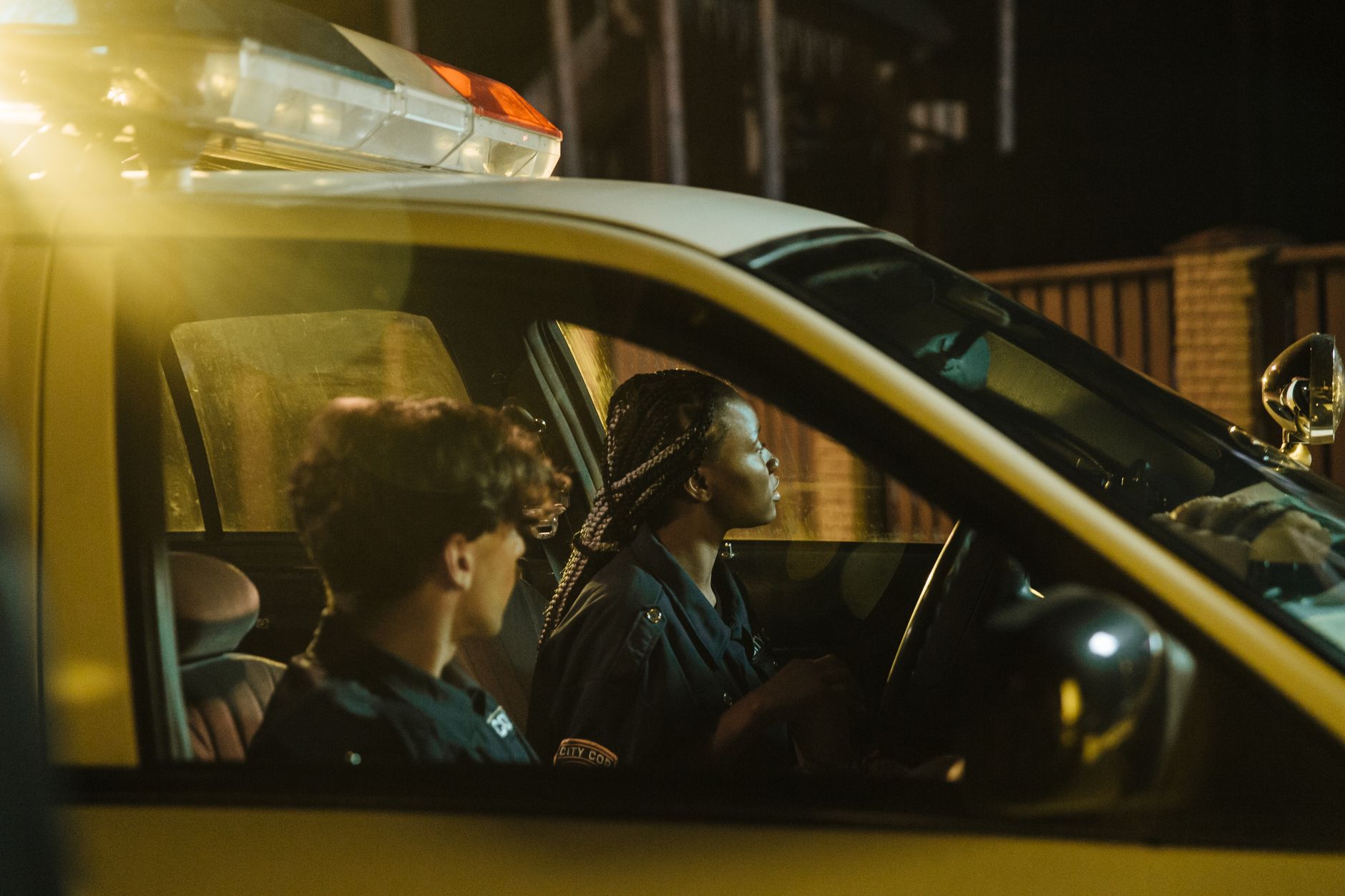
The Deputy Who Underestimated Her
Route 9 ran flat and straight through Larkspur County, Kansas, the kind of road where the wheat leaned the same direction for miles and the only shade came from the water towers. Delaney Voss knew every mile marker on it by heart. She had grown up twenty minutes north, in a house with a wraparound porch and a father who used to say that the law only worked if the people wearing the badge respected it more than anyone else did.
She was twenty-six now, and she carried that sentence with her the way some people carry a rosary or a rabbit’s foot. It was the reason she had left a perfectly good job managing a feed store’s books to join the state’s Office of Professional Standards, the small, quiet division that nobody in law enforcement liked to talk about at barbecues. Her job was simple to describe and hard to do. She drove ordinary roads in an ordinary car, obeyed every law to the letter, and watched to see how the officers who stopped her treated a person who had given them no reason at all.
They called it an integrity check. Delaney privately called it homework, because that was what it felt like: a test nobody was allowed to know they were taking.
Larkspur County had earned itself a file. Three complaints in eight months, all from women, all describing the same two deputies: a rough-voiced man who searched cars without asking and a wiry one who liked to remind people who was in charge. Two of the complaints had been dropped for lack of proof. The third woman had moved out of state rather than testify. Captain Renee Abbott, who ran the Office of Professional Standards out of a converted supply closet in the capitol building, had looked at that file for a long time before she looked at Delaney.
“I don’t want you to provoke anything,” Abbott had told her the week before. “I want you to drive the speed limit, keep your hands where they can see them, and let them show us who they are.”
“And if they don’t stop me at all?”
“Then Larkspur gets a clean report and we move on to the next county. That would be the good outcome, Delaney. Don’t go looking for the bad one.”
Delaney had nodded, but she noticed that Abbott clipped a small recording pin to the inside pocket of her denim shorts herself, testing the angle twice before she was satisfied. “Standard procedure,” Abbott said. “It only matters if nothing happens.”
Delaney’s father had never worn a badge himself. He had been a mechanic, the kind everyone in three counties called when their truck wouldn’t start, and he had spent most of his life watching how the men who did wear badges treated the people who came to him for help. When Delaney was fifteen, she had watched a deputy pull her father out of his own garage over a parts invoice that turned out to be perfectly legal, and she had watched the deputy never once apologize when he was proven wrong. Her father had shrugged it off that night at the dinner table, the way he shrugged off most things, but he had also said the sentence that Delaney still carried with her a decade later, about the badge only working if the person under it respected the law more than anyone else did. She had not understood, at fifteen, that the sentence would end up deciding the shape of her whole life. She understood it now, every time she pulled onto a state highway with nothing in the car but a license, a clean record, and a small red light waiting to turn on.
Now, on a bright Tuesday afternoon with the windows down and the radio low, something was about to happen.
The road that afternoon was almost empty, just a grain truck far ahead and a hawk turning slow circles over the ditch grass. Delaney had the radio tuned low to a station out of Wichita, and she was thinking, of all things, about whether she had left the porch light on at her apartment, when the patrol car came up behind her outside the Larkspur town line, lights flashing before she had even seen it in the mirror. Delaney checked her speedometer out of habit, though she already knew it read exactly fifty five. She signaled, eased onto the shoulder in a clean, unhurried line, and cut the engine.
The first deputy who reached her window was a big man, thick through the shoulders, with a face that looked like it had been left out in weather too long. His name tag read BRAGG. The second one hung back a few steps, thinner, quicker in his movements, watching her from behind sunglasses even though the sky had gone hazy. His tag said SIKES.
“Give me the documents,” Bragg said, not quite a request.
Delaney handed over her license and registration without a word, the way Abbott had coached her. Bragg took his time with them, turning the license over as if the truth might be hiding on the back, walking a slow circle around her car, running his hand along the trunk. He found nothing, because there was nothing to find. Still, he did not hand the papers back.
“Why did you stop me?” Delaney asked, keeping her voice level.
“A check,” Bragg said.
“What kind of check? I wasn’t speeding, and neither of you has introduced yourselves.”
Something shifted in his face, a small tightening around the jaw. Sikes drifted closer, hooking his thumbs in his belt. “Are you too smart?” he said, with the kind of smile that wasn’t one. “Sit calm while somebody talks to you normal.”
“I’m being calm,” Delaney said. “You two are the ones being rude, stopping a person for no reason and refusing to explain it. Tell me who you are and why you pulled me over.”
Bragg’s jaw worked. He tossed the license and registration onto the roof of the car, hard enough that the registration slid nearly off the far side.
“Step out of the vehicle.”
“On what grounds?”
“I said step out.”
Delaney understood, in the plain, unhurried way she had learned to understand things in this job, that the two men in front of her had decided somewhere in the last thirty seconds that she needed to be taught a lesson. She reached for her phone, thumb already moving toward the camera icon, and Sikes lunged past her and wrenched the door open before she could finish the motion. His fingers closed hard around her forearm.
“Put that away.”
“Don’t touch me,” she said, sharper now, though still not raising her voice. “You’re exceeding your authority.”
That was the sentence that broke something loose in Bragg. He hauled her out of the car by the arm, spun her by the shoulder, and pressed her face first against the door panel hard enough that she felt the heat of the metal through her cheek. Sikes was already working her wrists behind her back, the cuffs closing with two sharp clicks that seemed very loud on the empty road.
“Now you’ll sit in a cell and learn some manners,” Bragg said, close to her ear.
Delaney did not fight the cuffs. She turned her head, slow and deliberate, and looked back over her shoulder at both of them.
“Are you sure you want to keep going?”
Sikes laughed, an ugly, surprised bark. “She’s threatening us now.”
“I’m not threatening anyone,” Delaney said. “I’m telling you that you’ve detained me without cause, put your hands on me, and haven’t written a single word of it down. That’s the situation you’re standing in right now, whether you understand it yet or not.”
“We’ll sort that out downtown,” Bragg said. “Get moving.”
She let a few seconds pass, long enough that both men seemed to feel the silence rather than just hear it.
“All right,” she said finally. “There’s something in the right pocket of my shorts. I can’t reach it with my hands like this. Someone’s going to have to get it for me.”
The deputies traded a look over the roof of her car. Sikes smirked, sure this was some trick, a phone she’d hidden, maybe a knife she thought she was clever enough to threaten them with.
“What is it?”
“You’ll find out when you look,” Delaney said.
Bragg snorted, reached into the pocket of her shorts with two fingers like he was handling something distasteful, and pulled out a slim leather fold and a small black pin no bigger than a shirt button, its center light glowing a steady, patient red.
For a moment neither man moved.
The leather fold was a state credential, gold shield stamped into it, the words OFFICE OF PROFESSIONAL STANDARDS arched above her photograph and a badge number. The pin was a recorder, and the red light meant it had been live since the moment Captain Abbott clipped it into place that morning, feeding everything, every word, every hand on her arm, to a secure server two hundred miles away.
Bragg’s mouth opened and nothing came out. Sikes took a full step backward, as if putting distance between himself and the credential might undo the last four minutes.
“That’s not,” Bragg started, then stopped, because there was no end to that sentence that made anything better.
“It’s exactly what it looks like,” Delaney said, calm as she had been the entire stop. “I’d like my hands free now, please. And I’d like you to leave that recorder exactly where it is.”
Nobody moved for a long three seconds. Then Sikes, hands shaking slightly, worked the key into the cuffs and freed her wrists. Delaney rolled her shoulders, took her credential and the little recorder back, and slipped both into her pocket with the unhurried calm of a woman who had rehearsed this moment a hundred times without ever quite believing she would need it.
“You should call your sergeant,” she said. “Tell him Larkspur County just had its integrity check, and tell him exactly how it went, because I already have.”
They called their sergeant. He arrived twelve minutes later, siren off, face gray before he had even parked. Sheriff Denny Osgood himself showed up not long after that, a heavyset man who had run the department for eleven years and clearly understood within about four seconds of arriving on scene that this was not the kind of problem that a stern word could fix.
Osgood did not try to talk his way around it. He had Delaney’s report of her own stop within the hour, corroborated to the second by the recording, and he suspended both deputies before the end of his shift, effective immediately, pending a full review by the state. He did not ask her to go easy. He asked her, quietly, standing beside his cruiser with his hat in his hands, whether this had happened before.
“Three times that we know of,” Delaney told him. “Three women filed complaints. Two got told there wasn’t enough evidence. One moved to Nebraska because she didn’t think anyone would believe her over two deputies.”
Osgood was quiet for a moment. “There’s evidence now.”
“There is.”
The recording went first to Captain Abbott, then to the county attorney, then, three weeks later, to a disciplinary hearing that filled a small municipal room with more people than Larkspur usually saw for anything short of a football game. Word had traveled fast in a county that size. By the morning of the hearing, half the town seemed to know that the girl who had been thrown against her own car door on Route 9 was, in fact, the state’s own inspector, and that the recording of it existed in full, unedited, and already reviewed by three separate attorneys. Delaney sat near the back in a plain blue dress, unremarkable on purpose, and watched the footage play on a screen for a room full of people who had never met her but had, in some cases, been waiting a long time for a room like this to exist.
The two women whose earlier complaints had gone nowhere came. One of them, a schoolteacher named Priya Fenn, stood up during the public comment portion and said, in a voice that shook only a little, that she had been afraid to drive through that stretch of Route 9 for over a year. She described the night Deputy Bragg had pulled her over for a taillight that had, in fact, been working fine, and how he had leaned into her window close enough that she could smell the coffee on his breath, and how nobody at the department had ever called her back after she filed her complaint. The second woman, an older nurse named Carol Dunmire, did not speak, but she sat in the front row with her hands folded the entire hearing, and when the board announced its decision, she was the first person in the room to stand. Priya Fenn said her piece directly to Sheriff Osgood, not to the deputies, because by then everyone in the room understood who actually needed to hear it.
The board’s decision took less than a day to reach and even less time to announce. Deputy Cole Bragg was terminated for excessive use of force and false detention, his certification referred to the state board for review, which meant he would not simply drive two counties over and pin on a new badge. Deputy Wyatt Sikes was suspended without pay for four months, required to complete a full retraining program on de-escalation and lawful stops, and placed on a monitored probation that would follow him for two years. It was not everything Priya Fenn might have wanted. It was, everyone in that room agreed, a great deal more than Larkspur County had ever handed down before.
Sheriff Osgood did something else, too, something that made the local paper’s second page under a headline nobody bothered to read twice, though it mattered more than the front page story about the hearing. He brought in an outside trainer to run every deputy in the department through a new stop protocol, one that required a stated reason before any detention and a second officer’s sign off before any pair of hands touched a person who had not resisted. He posted the complaint hotline number on a laminated card taped inside every patrol car, where a driver could see it from the back seat. And he called Priya Fenn himself, not to apologize for the department in some careful, lawyer-approved sentence, but to tell her that the road she’d been afraid of belonged to her again.
On the first morning of the new training, Captain Abbott drove down from the capitol to sit in the back of the room, and she asked Delaney to come along, though she never once put her in front of the deputies as any kind of trophy. Delaney sat by the door instead, in street clothes, and watched a dozen men and women who had nothing to do with what happened on Route 9 take notes on how to ask a driver’s name before reaching for a door handle, how to explain a stop before demanding one, how to remember that the person on the other side of the window had rights that did not evaporate because a badge was nearby. One young deputy, barely a year on the job, raised his hand near the end and asked what he was supposed to do if his training officer told him to skip the explanation and just get the job done. The outside trainer did not answer right away. It was Sheriff Osgood, standing at the back of the room, who finally spoke.
“You write it down,” Osgood said. “Every time. And if your training officer doesn’t like that, you come talk to me.”
It was not a perfect answer, and everyone in the room seemed to know it, but it was more than Larkspur County had offered its deputies the week before, and for a department trying to climb out of a hole three complaints deep, it was a start worth having.
Delaney went back to her ordinary car and her ordinary speed limit two weeks after the hearing, this time three counties over, in a town whose file was, so far, clean. She did not think of herself as anyone’s hero. She thought of the sentence her father used to say about the badge meaning more than the person wearing it, and she thought that maybe, for one stretch of Route 9 outside Larkspur, that had finally turned out to be true.
Captain Abbott called her in for a debrief on a Friday afternoon, the file from Larkspur closed and boxed on the corner of her desk. “You did exactly what I asked,” she said. “You didn’t provoke anything. You just let them be who they already were.”
“They did the rest themselves,” Delaney said.
Abbott almost smiled. “That’s usually how it goes. People think a badge changes what’s already inside them. It doesn’t. It just gives it a place to stand.”
Delaney thought about that on the drive home, the wheat leaning the same direction it always did, the water towers throwing their thin shade across the road. Somewhere behind her, a schoolteacher named Priya Fenn was driving that same stretch of Route 9 for the first time without checking her mirror every ten seconds. Somewhere in a training room, deputies who had never met Delaney Voss were learning, because of her, to ask a person’s name before they ever reached for a pair of cuffs.
She had not gone looking for the bad outcome, exactly the way Abbott had told her not to. She had simply driven the speed limit, kept her hands where they could be seen, and let two men prove, with their own hands and their own voices, exactly who they were. The recorder had done the rest. The truth, once it was finally on the record, did not need her to raise her voice at all.
By the time she reached the county line, the sun had dropped low and gold across the fields, and for the first time in months, Route 9 felt to her like just a road again: flat, familiar, and finally, quietly, safe.