The Twin My DNA Test Found
I found out I had a twin sister at fifty-one years old, from a cardboard tube full of my own spit, and it happened on a Tuesday so ordinary that I almost didn’t check my email before bed.
My name is Carla. I live in Millhaven, Georgia, a town small enough that everyone still waves from their trucks at the four-way stop on Main, and I have lived here almost my whole life, minus four years at a college two hours north that I mostly remember for how homesick I was. I work in the front office at the elementary school, the same one I attended as a girl, and I have been married to my husband Mike for twenty-six years. We have two grown children, Jake and Emily, and on paper my life looks like exactly what it is: steady, small-town, unremarkable in the best possible way.
I say all of that first because I want you to understand what kind of woman this happened to. I am not someone who goes looking for drama. I have never once, in fifty-one years, expected my life to contain a twist. And then one Tuesday night, it did.
The question I carried quietly
I have known I was adopted for as long as I can remember. My parents, Frank and Judy, never made it a secret and never made it a wound either, which I have come to understand, the older I get, is its own quiet kind of parenting skill. Frank ran the parts counter at the John Deere dealership outside town for thirty-four years. Judy kept books for three different small businesses out of our spare bedroom and always smelled faintly of coffee and carbon paper. They were not showy people. They were steady people, and steady, it turns out, is exactly what a child needs most.
They told me the story the way you’d tell a bedtime story, softened at the edges but never dishonest. A young woman in Savannah, pregnant and unable to keep me, had placed me through an agency called the Savannah Children’s Home in the spring of 1975. Frank and Judy had been married six years by then and had tried, quietly and privately, to have a baby of their own without success, and when the call came that a healthy baby girl was available, Judy told me once, she cried in the church parking lot before she’d even seen my face, just from the word yes.
I want to be clear, because I know how these stories sometimes get told with a chip on one shoulder: I had no chip. I had a wonderful childhood. Frank taught me to drive a stick shift in the empty church lot on Sunday afternoons, patient through every grinding gear, and Judy sewed my junior prom dress by hand the year the dealership had a bad quarter and money was tight, staying up two nights straight to get the hem right. I never once doubted, not for a single day of my childhood, that I was wanted.
But underneath all of that, quietly, for fifty-one years, there was a question I never fully put down. Somewhere out there was a woman who had carried me for nine months and then handed me to strangers, and I did not know her name, her face, or why. I thought about her on my own children’s birthdays sometimes, wondering if she thought of me on mine. I thought about her at my wedding, walking down the aisle on Frank’s arm, wondering if some other version of that day existed somewhere in her memory too. It was never an obsession. It was more like a low hum underneath an otherwise full and happy life, the kind of thing you learn to live alongside without ever quite resolving.
I never went looking for her. Georgia’s closed adoption records from that era are difficult to access, and if I am honest with myself, I was also afraid. Afraid of a door slammed in my face. Afraid, maybe worse, of a door opened onto something sad I couldn’t fix. So the question stayed a question, for half a century, until my daughter Emily gave me a birthday gift she thought was harmless.
The gift that started it
Emily is twenty-one, sharp and curious in the way her generation tends to be about ancestry and identity, and her father-in-law had recently done one of the popular mail-in DNA kits and traced a branch of his family back to a village outside Krakow. He’d made a whole slideshow about it at Thanksgiving. Emily, watching me watch that slideshow a little too intently, ordered me my own kit for my birthday. Seventy-nine dollars. A small box with a plastic tube and a prepaid return label.
“It’s just for fun, Mom,” she told me, handing it over with a bow on it. “You spit in the tube, you mail it off, and in a few weeks you get a pie chart. Twelve percent Irish, forty percent whatever. It’s not that deep.”
I laughed and told her that sounded exactly like the kind of harmless fun I could use. And it might have stayed exactly that harmless, if my doctor hadn’t asked me, for the third appointment running, a question I could never answer.
Six months earlier I’d been diagnosed with an autoimmune condition, the kind that comes with a folder of pamphlets and a doctor who wants a family medical history you simply do not have. Dr. Patterson asked me at every visit whether anything like this ran in my family, whether my mother or grandmother had similar symptoms, and every single time I had to say the same three words. I have no idea. It is a strange kind of helplessness, sitting in a paper gown, unable to answer a question about your own body because you do not know the woman whose body made yours.
So when Emily’s gift sat on my kitchen counter for a week, I picked it up for two reasons instead of one. Some fun, some medical curiosity, and underneath both of those, quietly, that fifty-one-year-old hum. I spit in the tube on a Sunday afternoon, sealed it exactly the way the instructions said, and mailed it off on Monday morning, not expecting much of anything beyond a pie chart and maybe a distant cousin or two in my inbox.
The email
Six weeks later, on an ordinary Tuesday night, I was in bed with my phone, half-watching something on television with Mike, when the notification came through. I almost didn’t open it right away. I remember thinking, there’s my pie chart, and setting the phone down to finish the show.
I picked it back up ten minutes later out of simple curiosity, and it was not a pie chart at all.
It was a single match, listed under a category the website does not use lightly. Close Family, Immediate.
The screen said 99.1% shared DNA.
Not a parent. Not a child. A name I had never once heard in my fifty-one years on this earth.
Renee.
I sat up so fast I startled Mike out of whatever he’d been half-watching. I read the match page three times, certain I was misunderstanding something, certain the percentage meant something more ordinary, a half-sibling maybe, or an aunt I’d never known about. But the site had a small explanatory note beneath the number, the kind of note you’d think was designed for exactly this situation and no other. At a match this close, with two people of the same recorded birth year, the note said, the most likely explanation is identical or fraternal twins separated near birth.
I called the company’s support line the next morning before I’d even had coffee, absolutely convinced I was about to be told about a lab error, a mixed-up sample, something correctable. The woman on the phone, whose name I never got and wish I had, so I could thank her properly, was patient with me in a way I will always be grateful for. She walked me through the math slowly. A match at 99.1%, she explained, with both parties recording the same birth year and, once I gave her my birthday, the exact same birth date, meant one thing and one thing only. I had a twin. An identical twin sister, raised somewhere else entirely, who had also, for reasons of her own, spit into a tube and mailed it to the same company, in roughly the same season I had.
I sat on my kitchen floor with the phone still in my hand for a long time after that call ended. Not crying, exactly, though tears came eventually.
Vertigo. That is the only honest word I have for it. The particular vertigo of learning, at fifty-one years old, that you have spent your entire life as half of something you never once suspected was incomplete.
The first message
The website has a built-in messaging system for exactly this kind of situation, a way to reach out to a match without having to hunt down a phone number or an address first, and I stared at the blank message box for the better part of an hour before I wrote anything at all. What do you say to someone who is, according to a laboratory in another state, more closely related to you than your own children?
I settled, in the end, on something plain. My name is Carla. I think we might be twins. I don’t know how else to say it.
She wrote back inside an hour, and the first thing she told me was that she had just gotten off her own call with support that same morning, asking the exact same question I had asked mine. Her name was Renee. She lived outside Dayton, Ohio, two states north of me, raised by a couple named Bill and Nancy who had adopted her through a private arrangement in 1975, the same year, the same spring.
We compared birthdays first, the way you would compare the most basic fact available, half expecting it to break the whole theory apart. It did not break apart. Same day. Same year. And when I mentioned the hospital listed on my own adoption paperwork, a small maternity ward in Savannah, Renee went quiet on her end of the message thread for almost ten minutes before writing back that her own paperwork listed the exact same hospital, the exact same month.
We spent that first day building a bridge between us, plank by plank, over something too wide to see the bottom of. Birthdates. Hospital name. The agency, Savannah Children’s Home, listed on both our sets of paperwork, though placed through two different adoption attorneys who apparently never once compared notes. By that evening, neither of us needed the lab result anymore to believe it. The facts had already told us.
Her own face, laughing
We got on a video call two nights later, both of us too nervous to do it any sooner, and I am not sure I have the words, even now, to properly explain what it does to a person to watch her own face laugh on somebody else’s body.
Same laugh.
Not similar. The identical sound, the same three-note rise at the end of it that Mike has teased me about for twenty-six years. Same habit, which I did not know I had until I watched her do it, of pressing a thumbnail hard into the pad of her other hand whenever she got nervous. Same left-handed signature, when she held up a grocery list to show me, sloping the exact same direction mine does, on a screen a thousand miles away from my kitchen table.
We talked for three hours that first call and could have gone another three. We had both worked in school offices for over twenty years, her at an elementary school outside Dayton, me at mine here in Millhaven, neither of us having any way to know the other existed doing the same quiet, patient work with other people’s children. We had both married men who share a name with their own fathers, Mike Senior and Mike Junior in my house, Steven Senior and Steven Junior in hers. Her son, Ben, is sixteen. My daughter, Emily, the one who bought the kit that started all of this, is twenty-one, and Renee said, quietly, near the end of that first call, that Emily looked like she could be her own daughter’s aunt, in a way that had nothing to do with any photograph either of us had sent.
It was disorienting in a way I still do not have a clean word for. Meeting a stranger who is unmistakably, undeniably, also yourself.
No villain in this story
I want to say clearly, because I know how stories like this sometimes get told, with an agency painted as cruel or a family painted as complicit in some cover-up: there is no villain anywhere in this story, and I would not want you to look for one.
Bill and Nancy raised Renee in Ohio the exact same way Frank and Judy raised me in Georgia. With love. With dinner on the table every single night. With school pictures on the wall and a shelf of trophies from Little League. They had no idea, any more than my own parents did, that the baby they were bringing home had a sister born eleven minutes earlier, one floor down in the same maternity ward.
What Renee and I have since pieced together, mostly from an old attorney’s file that Renee’s father Bill still had boxed in his attic and was kind enough to dig out for us, is that in 1975, placing twins together was considered, in some agency circles, harder on the adopting families. Two infants at once was seen as more than some new parents could take on, particularly in private placements handled quickly and quietly. So we were split, deliberately, by people who believed at the time they were doing the practical, sensible thing, and it did not occur to anyone in that office to ask either set of adoptive parents whether they might have wanted to know they were raising half of something.
I have made my peace with that. It was a different era, with different assumptions about what children needed to be told and what they didn’t. Frank and Judy did not know. Bill and Nancy did not know. Nobody in either of our childhoods withheld anything out of cruelty, because nobody in either of our childhoods knew there was anything to withhold. When I finally called Judy, who is seventy-eight now and sharp as ever, to tell her what the DNA test had found, she was quiet for a moment and then said the thing I will remember for the rest of my life. “Well,” she said, “I suppose that explains why you always seemed like you were looking for somebody at every school picture day, even as a little girl. I always wondered what you were looking for. Now I know.”
She did not sound threatened. She sounded, if anything, relieved, like a piece of a puzzle she had quietly wondered about for fifty-one years had finally clicked into place. Frank, when I told him, said only, “Well, I’ll be,” and then asked when he’d get to meet her, which is about as much emotion as Frank shows for anything, and which I understood, from him, as a very great deal.
Fifty-one years we cannot get back
I will not pretend the joy came uncomplicated. Alongside it, in the same week, sat a grief I was not prepared for, and it surprised me with its size.
Fifty-one years of birthdays we did not share. Fifty-one years of the ordinary things twins are supposed to have, matching Halloween costumes, whispered secrets across a shared bedroom, a built-in best friend from the very first memory, all of it simply gone, spent instead as two separate only children two states apart, each of us occasionally wondering, in our own quiet way, what we were missing without knowing there was a specific person shaped like the answer.
Renee told me, on our second call, that she had been an anxious child, prone to a strange, specific loneliness she could never fully explain to Bill and Nancy, who loved her completely and still could not account for it. “I used to talk to somebody in my head,” she said, half-laughing, half not, “when I was little. I never told my mom that. I don’t know why I’m telling you now, except that I think I understand, finally, who I was talking to.”
I sat with that for a long time after we hung up. I had never had an imaginary friend as a child, not that I remembered, but I had a habit Judy used to gently tease me about, of holding long, one-sided conversations with an empty half of my bed before I fell asleep, a habit I dropped somewhere around age ten and had entirely forgotten until Renee’s comment brought it rushing back.
We grieved together, over several calls, in the strange, backward way you grieve something you never consciously knew you’d lost. It did not cancel out the joy. It sat right alongside it, the two feelings tangled together so tightly some days I could not tell which one I was actually experiencing at any given moment, only that my chest was full and my eyes were wet and I wanted, more than almost anything I have wanted in my adult life, to be in the same room as this woman.
The flight to Georgia
Renee booked a flight to Savannah three days after that first video call. Neither of us discussed whether it was too soon. Neither of us, I think, believed for one second that it was.
I drove the hour to the airport alone, turning the radio on and off four separate times because I could not settle on either silence or noise, rehearsing and then abandoning a dozen different things I thought I might say when I finally saw her walk off that jet bridge. In the end, none of it mattered, because the moment I saw her, coming around the corner with a rolling suitcase and Bill’s old canvas duffel bag over one shoulder, every rehearsed sentence I had left my head entirely.
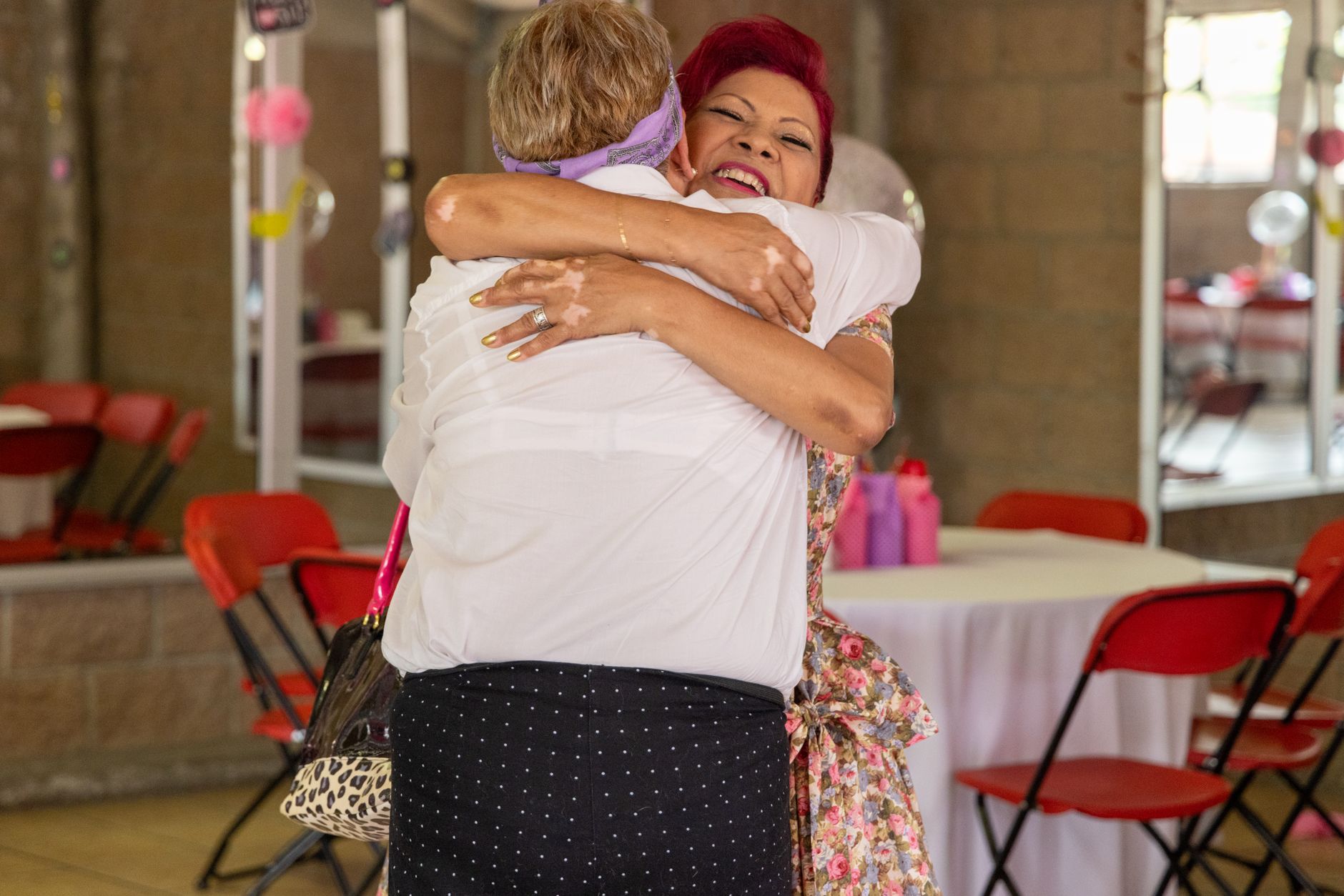
We did not speak first. We just held on to each other, right there in the middle of the Savannah airport, two fifty-one-year-old women sobbing into each other’s shoulders while strangers walked around us, and I remember thinking, in the strange, sideways way your mind works in moments like that, that I finally understood what my own arms were for. I had hugged my husband, my children, my parents, thousands of times across my life and never once felt anything quite like this, the exact same height meeting the exact same height, the exact same shoulder blade under my hand that I knew, somehow, without ever having touched it before.
“You smell like the inside of my own house,” Renee said into my shoulder, which made no sense and made complete sense at the same time, and we both laughed through the tears, right there by baggage claim, drawing a few curious looks from people who had no idea what they were watching.
What Renee brought with her
In the canvas duffel bag Renee had carried off the plane, Bill had packed, without quite explaining why, the old attorney’s file he’d kept boxed up in his attic for forty-nine years. Renee had known it existed but had never once, in her whole life, felt any pull to open it, until the week before her flight, when she’d called Bill and asked him, gently, if he still had it.
We sat together at my kitchen table the second night of her visit, Frank and Judy joining us, along with Mike, and went through that thin folder page by page. Mostly it was the ordinary paperwork of a 1975 private adoption, dry and procedural, but near the bottom, in a plain envelope that had never been opened, Bill had also kept a single handwritten letter, given to the adoption attorney by our birth mother at the time of placement, with instructions that it only ever be passed along if one of us came looking.
Her name was Donna. She had been nineteen years old, a senior at a Savannah high school the year before, unmarried and without the support at home to keep either of us, and from what the attorney’s notes said, she had been told at the hospital, gently but firmly, that placing us with two separate families would give us each the best possible chance at a stable home, given how quickly a healthy adoptive family for a single infant could be found compared to two at once. She had not fought that decision. I do not think, at nineteen, in 1975, she had felt she had the standing to fight anything. But she had asked, before she left that hospital, for one thing: that a letter she wrote be kept on file, for as long as it took, in case either of her daughters ever came looking for the other, or for her.
Renee opened it, since her father was the one who’d carried it all this way, and read it aloud at my kitchen table, her voice catching more than once.
To whichever one of you reads this first, it began. I am so sorry I could not keep you both. I am sorrier still that I could not keep either of you together, if I could not keep you with me. I asked the hospital to write your names down as close to each other as they could, Carla for one, Renee for the other, so that some part of you would always carry a piece of the other, even in that. I hope, if you are reading this, that you have found each other, and that you have had the whole life together I could not give you.
Donna had passed away eleven years earlier, we learned from a brief note the attorney’s office had added to the file sometime after the fact, of an illness neither of us will ever get the chance to ask her about directly. She never married, never had other children, and, according to the one line the attorney’s assistant had added, kept a copy of both our original hospital photographs in her wallet for the rest of her life.
I have read that letter more times now than I can count, and I no longer cry every time, though I did, that second night, along with Renee, along with Judy, along with, to my genuine surprise, Frank, who does not cry at much of anything.
Two families, one table
What has struck me most, in the months since, is how naturally two entirely separate families have folded into one. Bill and Nancy flew down from Ohio for Thanksgiving, and Frank and Judy hosted all of us at the house I grew up in, the same table where I ate every childhood meal, now set for ten instead of the usual four. Bill and Frank discovered, over sweet tea on the back porch, that they had both worked in some capacity around John Deere equipment for most of their careers, one selling it, one servicing it two states over, and spent a solid hour comparing notes on tractor models neither Renee nor I could follow or cared to interrupt.
Nancy and Judy have taken to calling each other on Sundays, two women who raised the same set of features, the same laugh, the same left-handed slant, in two different houses fifty-one years apart from ever meeting, and who now, somehow, talk like old friends. I asked Judy once if it felt strange, sharing me, in whatever sense that means, with another mother, and she looked at me like I’d asked something slightly foolish. “I didn’t lose anything,” she said. “I only ever had you. Now I’ve got a whole extra family at Thanksgiving. Show me the part of that where I’m supposed to feel bad.”
Renee and I talk most days now, sometimes for five minutes, sometimes for two hours, the way I imagine sisters who grew up sharing a bedroom simply take for granted their whole lives. We have started comparing our own children’s baby pictures and finding an unsettling number of them nearly interchangeable. We have discovered we both, independently, hum the same three bars of the same forgotten hymn while doing dishes, a hymn neither Frank and Judy’s church nor Bill and Nancy’s ever actually sang, which neither of us can explain and both of us have decided not to try to.
The vertigo settles into something steadier
People ask me sometimes, gently, careful not to pry too hard, what it is actually like, meeting a stranger who turns out to be your own mirror. The honest answer is that the vertigo never fully goes away, not completely. There is still a small, strange lurch every time Renee laughs at something and I hear my own laugh coming out of a face that is not, technically, mine. But the lurch has changed shape over these past months. It started as disorientation, the ground actually tilting under me the night that email came through. It has settled, slowly, into something closer to wonder. A daily, ordinary kind of wonder, the sort you could get used to living inside of, if you let yourself.
I think about Donna often now, more than I expected to, given that I never once got the chance to meet her. I think about a frightened nineteen-year-old girl in a Savannah hospital in 1975, doing the one thing she had the power to do for two daughters she could not keep, which was to make sure our names would always sound like they belonged to the same sentence, and to leave a letter behind on the chance that one day, decades later, two grown women would sit at a kitchen table together and finally read it out loud.
I do not know if Donna ever imagined this exact Thanksgiving table, ten people deep, two families she never met folded into one, her handwriting still sitting in a plain envelope that finally got opened forty-nine years after she sealed it. I like to think some small part of her hoped for exactly this, even if she never let herself believe it would actually happen.
Renee flies back to Ohio for a week at a time now, and I fly up to Dayton in between, and we have already started planning next year’s holidays so that both families end up together again, this time somewhere in the middle, a rented house on a lake halfway between Millhaven and Dayton that neither of us has seen yet but has already, somehow, started to feel like it belongs to both of us.
I still keep the tube’s little instruction card in a kitchen drawer, the one that told me to spit and seal and mail and expect nothing more than a pie chart. I take it out sometimes and look at it, seventy-nine dollars and six weeks that gave me back fifty-one years of a sister I never knew I was missing, in a package small enough to fit in a mailbox.
I do not know how to end a story like this, because the truth is it has not ended. Renee and I are only a few months into becoming the sisters we should have been our entire lives, and every week seems to bring some new small, uncanny proof that we were always, somehow, still connected, even across two states and five decades of not knowing each other’s names.
What I do know is this. I spent fifty-one years quietly wondering about a woman I never met, and one Tuesday night, an email answered a question I had stopped expecting to ever get answered, by handing me not the woman herself, but the sister she made sure I would always, eventually, find. I got my medical history after all, as it turns out. It came with a sister attached, and I would not trade that particular order of discovery for anything.
This story is a dramatization. Names, characters, and details are invented, and any resemblance to real people or events is coincidental.