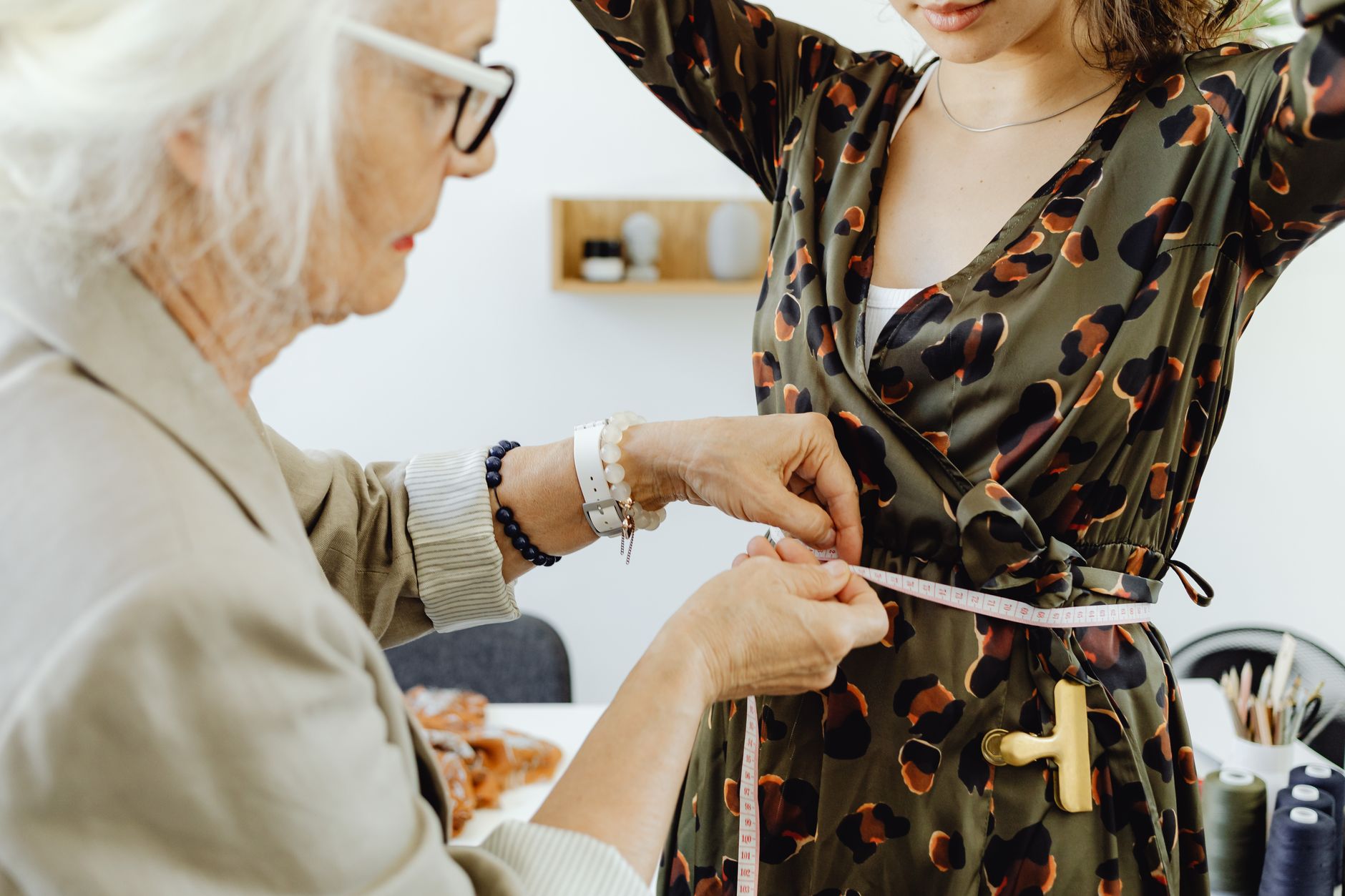
The Seamstress Who Fixed My Dress For Free
The bell over the door at Stitch and Hem is a small brass thing, worn smooth on one side from fifty years of hands pushing it open, and the first time I heard it ring behind me I had a garment bag over my arm and absolutely no idea what I was walking into.
“Bring it Thursday,” she had told me two days before, in the middle of Peggy’s fabric shop, with a button still pinched between her fingers. “Four o’clock. Don’t be late, I’ve got a roast in.”
She hadn’t told me her price. She hadn’t told me her last name. All I had was a time, an address three doors down from the fabric shop on Main Street in Piney Grove, South Carolina, and a dress that had cost me sixty dollars and fit like it belonged to somebody I wasn’t.
I want to back up, though, because if I just tell you about the dress and the shop, you’ll think this is a story about sewing. It isn’t. It’s a story about a woman named Josephine Boykin, and a promise she made to a mirror in 1962, and the particular kind of quiet a person can carry around for sixty years without ever once setting it down in front of anybody, until she decided, for reasons I still don’t fully understand, to set it down in front of me.
But it starts with the dress not fitting. So let me start there.
Five months before that Thursday, I was a twenty-six-year-old kindergarten aide engaged to a man named Caleb Doyle, and my life looked, on paper, like the easiest version of itself I was ever going to get. Caleb worked at the co-op on Highway 11, the one that sells feed and fence posts and, in the spring, baby chicks in a metal stock tank by the register. We’d been together four years. We’d picked a date in October, because October in Piney Grove is the one month where the heat finally lets go of your neck and the whole county smells like somebody’s burn pile and somebody else’s supper. We’d booked the fellowship hall at Piney Grove Baptist, because my grandmother had been married there in 1958 and my mother in 1979 and it felt, to me, like the kind of thing you don’t break just because you could technically get a barn venue in the next county for less.
We had a little over four thousand dollars saved. Not a lot, by the standards of the wedding shows Caleb’s sister watches, but enough, in Piney Grove, for a real dress on layaway at a bridal shop in Greenville, a caterer who did a mean pulled pork, and enough flowers that my mother could stop worrying I’d have nothing but baby’s breath in my hair.
My father is a man named Gary Sutton, and for twenty-two years he worked at Palmetto Yarn, the mill on the river that most of Piney Grove has worked at, at some point, in some capacity, since before I was born. He ran a carding machine. He came home every night of my childhood smelling like machine oil and cotton dust, and some nights, when I was small, he’d let me sit on his knee at the kitchen table and he’d pick lint out of his own eyebrows for my amusement, and it is, still, one of my clearest memories of being a happy child in a house that did not have much money but had enough.
In April, Palmetto Yarn cut back a shift. My father’s name was on the list. He was fifty-four years old, twenty-two years into a job he assumed, the way you assume the ground under your porch, would simply be there, and then it wasn’t, and he came home that Friday and sat down at that same kitchen table and did not say anything for a long time, and my mother put her hand flat on his back the way you’d calm a spooked animal, and nobody blamed anybody, because there wasn’t anybody to blame. A mill in South Carolina cutting a shift in a hard year is not a villain. It’s just weather. It moved through our family like weather does, and we did what people in Piney Grove do when weather moves through, which is tighten up and wait it out.
He was looking for work. He was fifty-four and proud and looking for work in a county that did not have a lot of work to offer a man who’d spent twenty-two years learning one machine, and eleven weeks after the layoff, on a Tuesday morning in June, he went out to get the mail in his own driveway and did not come back in.
My mother found him on the grass by the mailbox. She called 911 with her hands shaking so badly she told the dispatcher the wrong house number twice.
It was his heart. A blockage in three vessels, the doctor in Greenville told us, so bad that by the time they got him stable enough for surgery they were calling it a quintuple bypass, which is a phrase I had never once heard before that week and have heard in my sleep every week since. He was four days in the ICU. My mother and I slept in a waiting room with chairs that did not recline far enough to actually be called reclining, and Caleb drove down every night after his shift at the co-op just to sit with us and hold my hand and not say anything, because there was nothing useful to say.
He lived. I need you to know that first, because I know how these stories can make a reader brace for the worst line, and I am not going to make you wait for it. My father lived, and six weeks later he was walking to the end of the driveway and back twice a day like the cardiac rehab nurse told him to, moving slower than I had ever seen him move, and it was, in its own strange way, one of the best summers of my life, because I got to watch a man I loved come back from somewhere I truly thought he might not.
But he came back to a hospital bill.
The number, after insurance, after the second surgeon’s fee, after the anesthesiologist who was apparently not in-network even though the hospital was, came to just over sixteen thousand dollars. My father had insurance. My father had worked for twenty-two years and paid into every plan the mill ever offered him. It did not matter. His COBRA deductible had reset the day the ambulance pulled into our driveway, because of course it had, because that is precisely the kind of thing that happens to a family that is already down to nothing, the same way a drought always seems to arrive the year the well pump finally gives out too.
I did not have to think about it. Caleb did not have to think about it either. We sat at my parents’ kitchen table, the same table my father had picked lint from his eyebrows at when I was small, and Caleb reached across it and took my mother’s hand and said, “This is what family does,” and he wrote a check for every dollar we had saved for the wedding, all four thousand of it, and I signed my name under his on the memo line because I wanted my father to see both our names when he was well enough to look at it.
I do not regret that decision for one single second of my life, and I want that on the record before anything else in this story, because what happened next could make it sound like I was owed some rescue for a sacrifice, and I wasn’t. We gave the money because it was ours to give and because my father is worth every dollar either of us has ever earned or will earn. But it did mean the dress on layaway went back on the rack at the bridal shop in Greenville for some other bride to find, and it meant that with five weeks to go, I had exactly sixty dollars set aside for the one dress a woman supposedly only wears once.
I found it at a consignment shop two towns over, in a rack between a First Communion dress and somebody’s old bridesmaid gown in a shade of green nobody should ever have agreed to. It was ivory satin, a little yellowed at the hem the way old satin gets, a sweetheart neckline, small buttons up the back, and it was, according to the tag, a size twelve. I am a size six. I tried it on in a fitting room the size of a phone booth, and it gapped two full inches at the back zipper, and it hung off my shoulders in a way that made me look, in the fitting room mirror, like a girl playing dress-up in her mother’s closet.
I bought it anyway. Sixty dollars was sixty dollars, and I told the woman at the register that a good tailor could probably fix the fit, and she said, kindly, the way you’d humor somebody, “Sure, honey, I’m sure they can,” and I drove home with it on the hanger in the back seat and cried exactly once, at a red light on Highway 11, for about ninety seconds, and then I stopped, because crying was not going to take two inches out of a bodice.
I called the one bridal alterations place in the area that did rush work. Three hundred and eighty dollars, they told me, for the amount of work that dress needed, which was, at that point in my life, three hundred and eighty dollars I plainly did not have and was not going to ask my parents for while my father was still doing rehab walks to the mailbox. So I decided I would do what women in my family have always done when there wasn’t money for the proper fix, which is find the cheapest possible workaround and call it good enough. I would take in the back seam myself with a sewing kit from the drugstore, hem it with iron-on tape, and safety-pin the shoulders under a shawl for the ceremony, and I would tell myself, the whole day, that nobody was looking closely enough at a bride’s shoulder seams to notice.
That was the plan when I walked into Peggy’s fabric shop on a Tuesday afternoon for a spool of ivory thread and a roll of hem tape.
Peggy Lindsey has run that shop on Main Street for as long as I have been alive, and she has known my mother since high school, so I did not have my guard up at all when she asked, ringing up my thread, why on earth I needed hem tape for a wedding dress instead of a proper alteration. I told her. I did not mean to tell her the whole thing, the layoff and the bypass and the sixteen thousand dollars and the four thousand we’d given away without blinking, but Peggy has one of those faces that makes you keep talking past the point you meant to stop, and by the time I got to the part about the safety pins under the shawl, my voice had gone thin and a little wobbly, and I was aware, in a distant way, that I was making a scene in a fabric shop over buttons and thread.
I did not notice the older woman two aisles over until she set down whatever she was holding, a card of buttons, I found out later, and started walking toward us like she had already made up her mind about something before she got close enough to say a word.
I had never seen her before. Piney Grove is small enough that I assumed I knew everybody’s face even if I didn’t know their name, and I did not know this one: silver hair pinned back neat, reading glasses on a beaded chain, hands that looked like they had done fifty years of close work, small scars and a permanent groove worn into one fingertip where a needle rides. She stopped in front of me and she did not introduce herself. She asked to see the dress.
I had it in the garment bag over my arm because I’d been planning to drop it at the drugstore for the hem tape aisle comparison, which tells you exactly how much of a plan I actually had. I unzipped it right there between the ribbon spools and the pattern books, too tired by then to feel embarrassed, and she looked at that dress for what felt like a full minute. The gap at the back. The shoulders. The place where I’d already pinned the hem up crooked with an actual paperclip because I hadn’t bought real pins yet.
Then she looked at me.
“Bring it to my shop Thursday,” she said. “Four o’clock.”
I asked what it would cost. She was already turning back toward her buttons.
“Thursday,” she said again. “Four o’clock. Don’t be late, I’ve got a roast in.”
I asked Peggy, once the bell had rung her out the door, who that was.
“That’s Josephine,” Peggy said, like the name should explain something, and when I asked if she always did this, walked up to strangers in a fabric shop and took over their wedding dress, Peggy got a look on her face I did not understand yet and said, “Every year or two. Never the same way twice. You’ll understand when she tells you. If she tells you.”
If she tells you. I did not know, standing there with my hem tape and my thread, that those four words were going to turn out to be the whole heart of this story.
Stitch and Hem sits three doors down from Peggy’s, in a narrow storefront with a hand-lettered sign that has clearly been repainted more than once over the decades and a window display of a single dress form wearing whatever Josephine happens to be working on that season. I walked in at four o’clock exactly, because I did not want to find out what happened if I was late for the roast, and the bell over the door rang that small worn sound, and Josephine came out from a back room already holding a pin cushion strapped to her wrist like a watch.
She did not make small talk. She had me stand on a low wooden platform in front of a three-way mirror that had clearly seen forty years of brides before me, and she circled me once, pinning as she went, the fabric gathering in her hands like she could read it, and she said, around a mouth half full of pins, “Sixty dollars, hm. Somebody didn’t measure you before they sewed this.”
I told her the whole story again, because it turned out I was going to tell it several more times before this was over, and she listened the way she pinned, without stopping her hands, taking in every word and every fold at the same time. When I got to the part about my father and the mailbox and the sixteen thousand dollars, her hands went still for just a second. Then they started again.
“Come back Thursday,” she said, when she’d finished the first round of pins. “Same time.”
“I still don’t know what this is going to cost me,” I said.
“No,” she agreed. “You don’t.”
She would not tell me a number that first day, or the second, or any day after that. Every Thursday for five weeks, at four o’clock, I stood on that platform while Josephine Boykin let out the bodice a full three sizes, took in the shoulders, moved every one of those small satin-covered buttons up the back by hand, and rehemmed a skirt that had been sewn, originally, for a much taller woman than me. She worked from a sewing machine that had to be older than my mother, a black-and-gold Singer with a foot pedal, and a wall of shelves behind her stacked with bolts of lining fabric organized by a system I never did figure out. There was a radio on low, always tuned to the gospel station out of Greenville. There was a percolator that made coffee strong enough to strip paint, and she always poured me a cup whether I wanted one or not, in a mug with a chip on the handle that said WORLD’S OKAYEST COOK, which she told me, the second week, her late husband Harold had given her as a joke forty years ago and which she had never once used for anything but this exact purpose, coffee for the girl on the platform.
By the third Thursday I had stopped being nervous around her and started being curious. I asked her how long she’d had the shop. Fifty-one years, she told me, though she’d learned the trade from a woman named Nell Prater who’d run it before her, going back further than that, back into a Piney Grove I could not picture, one with a working depot and a picture show and a mill whistle that blew three times a day.
I asked her if she had children. She said no, in a voice that closed the subject so cleanly I did not open it again for two more weeks.
I asked her, on the fourth Thursday, standing in my slip while she pinned a stubborn crease out of the hem, whether she’d always known how to sew, or whether somebody had taught her.
That was the question that did it. I did not know, asking it, that it was the one question in the whole five weeks with a door behind it.
She was quiet long enough that I thought she hadn’t heard me. Then she took the pin out of her mouth, set it in the cushion on her wrist, and said, “Somebody taught me. After.”
“After what,” I said.
She looked up at me then, over the top of her reading glasses, and something in her face had changed, gone soft in a way I hadn’t seen on her yet, and she said, “Stand still a minute. I want to show you something.”
She went to the back room, past the shelves of lining fabric, into a little space I had glimpsed but never actually entered, a room with a second, older sewing machine under a dust cloth and a wall I had assumed, from the doorway, was just cluttered with old calendars and clippings. She came back with a small framed photograph, black and white, corners gone soft and rounded from age, and she put it in my hands.
It was a wedding photo. A young woman, maybe twenty, in a dress that did not fit her. I could see it even in the old photograph, even in black and white, the same way I’d have known it looking at my own dress on the consignment rack: the sleeves ran a half inch too long over her knuckles, the hem dipped noticeably on one side, and there was something pinched and careful in the way she held her bouquet, high, like she was trying to hide the waist.
“That’s you,” I said. It wasn’t a question, not really. Something in the eyes was the same eyes that had circled me with pins for four weeks.
“June the ninth, 1962,” Josephine said. “I married Harold Boykin in that dress, and it was the only dress in the world I was ever going to be able to have, and it did not fit me, and there was not one soul on God’s earth who could have made it fit me, because there was not one dollar to pay anybody to try.”
She told me the rest of it slowly, sitting on the little bench by the old dust-covered machine while I sat across from her still in my slip, both of us with cooling cups of that terrible strong coffee.
Her father had died in an accident at the mill when she was nine years old, a piece of equipment that should have been guarded better and wasn’t, and her mother had raised her and two brothers alone on what a widow’s small settlement and a job at the mill cafeteria could stretch to cover, which was not much, and was never quite enough. There was no money, ever, for anything extra, and a wedding dress, in 1962, in a family like that, meant a hand-me-down. Josephine’s cousin Carol had married two years before, in a dress a full size larger than Josephine would ever be, and when Josephine got engaged to Harold, that dress came out of a cedar chest and got handed to her, and her mother did what she could with a needle and a long night of bad light, but her mother had never been taught to sew past a hem and a button, and neither had Josephine, and the dress went down the aisle of Piney Grove Baptist looking exactly like what it was: a dress that had been built for somebody else, worn by a girl who had no other option and no way to fix it and no one in her life who knew how.
“Nobody was cruel to me that day,” she said, before I could ask, because she must have seen the question forming on my face, the reflex every one of us has now to look for the villain in a story like this. “I want you to hear that clear, because I know how these things get told. Nobody said one unkind word to me at that wedding. It wasn’t a person that did it to me. It was just being poor, plain and simple, and being poor doesn’t wear a face you can be angry at. I stood in that dress and I felt, the whole day, like an afterthought in my own wedding. Like I was borrowing somebody’s leftover moment instead of having my own. And there wasn’t a soul to blame for that. That was just the shape of things.”
She said she remembered standing in front of the mirror in her mother’s bedroom that night, after the reception, still in the dress because she hadn’t had anywhere private to change, and looking at herself, at the sleeves too long and the hem dipping on one side, and she said something to that mirror that she had never once repeated out loud to another living person until she said it to me, fifty-eight years later, in the back room of the shop she’d built her whole life around.
“I told myself, if I ever learn to do this properly, really learn it, with my two hands, I am never going to let another girl stand in front of her own mirror on her wedding night feeling the way I feel right now. Not if there’s a single thing in my power to stop it.”
She did learn. Nell Prater, who ran the alterations counter that would one day become Stitch and Hem, took Josephine on two afternoons a week starting the year after her wedding, more out of kindness than need, Josephine suspected, because Nell had noticed a young bride hanging around the shop asking too many questions about buttonholes. Josephine learned to cut a pattern, to fit a shoulder, to take a dress apart at the seams and rebuild it around a body it was never meant for. She learned it slowly, over years, the way most real skills get learned, and when Nell got too old to run the counter alone, Josephine was already good enough to run it for her, and when Nell passed, the shop passed to Josephine along with it, and she had been running it, one way and another, for fifty-one years.
“And somewhere along the way,” I said, “you started doing this. For brides.”
“Every year or two,” she said. “Not every bride who comes in here poor. I couldn’t, and it wouldn’t be fair to try, and besides, most folks who need a little help just need a little help, a hem taken up, nothing that costs them their pride to ask for. I mean the ones like you. The ones who come in already resigned to a dress that’s wrong, already talked themselves into the safety pins, already decided that’s just the shape of things for a girl like them, same as I decided it for myself in 1962. I look for that particular kind of tired. I’ve seen it enough times now I know it the second it walks in my door.”
I asked her how many. She thought about it, counting under her breath, and said she honestly wasn’t sure anymore, somewhere north of two dozen over the years, maybe closer to thirty, though she’d stopped keeping an exact count sometime in the nineties. I asked why she never told the brides why, why she let Peggy say if she tells you instead of just explaining it plain from the start.
“Because it isn’t about me,” she said, simply. “The day is supposed to be yours. If I sat you down on day one and told you my sad story about 1962, you’d have spent the whole five weeks feeling sorry for an old woman instead of thinking about your own wedding, and that’s exactly backward from what I’m after. I tell it when it’s time to tell it, and not one day before, and mostly I don’t tell it at all. You’re only hearing it because you asked the right question on the right Thursday.”
She took me into the back room properly then, past the dust-covered machine, to the wall I had mistaken for clutter from the doorway. It was not clutter. It was photographs, dozens of them, taped and pinned and tacked up over what must have been decades, wedding photo after wedding photo, brides in every era of hairstyle and dress silhouette going back to shots that still had that soft yellow cast of the seventies. Some brides had sent her formal portraits. Some had sent her a snapshot torn a little at the corner. A few of the older ones had handwritten notes tucked into the frame, thank you Josephine, or you’ll never know what you did for me, or, on one that had gone brittle with age, just the words for the dress, with all my love.
“They don’t know each other’s stories,” Josephine said, looking at the wall the way you’d look at your own children. “Most of them don’t know why I did it, not the real why, same as you didn’t until ten minutes ago. But every one of these girls stood in front of a mirror on her wedding day and liked what she saw, instead of feeling like an afterthought. That’s the whole thing. That’s the entire reason. I couldn’t fix it for myself in 1962, so I decided I’d fix it for somebody else, over and over, for as long as my hands hold out, and I never needed anybody to know it was me doing the fixing.”
I did not ask her to add my photograph to that wall. I didn’t have to. I understood, standing there, that it was already understood between us, the way understood things get to be between two people who’ve spent five Thursdays together with pins and strong coffee.
The wedding was on a Saturday in October, the good month, the one where Piney Grove finally lets go of the heat and starts smelling like woodsmoke. My father walked me down the aisle of Piney Grove Baptist at a pace slower than the pace he’d have walked it at a year before, and I could feel, through his arm, exactly how hard-won every one of those steps was, and I have never in my life been prouder to walk slowly beside anyone. Caleb cried before I even got halfway down the aisle, which he will deny to this day and which four separate people have confirmed to me since.
The dress fit. I want to tell you plainly, because it matters more than it sounds like it should: it fit exactly, the shoulders sitting where shoulders are supposed to sit, the back seam smooth and flat, the hem falling even all the way around, no gap, no pin, no shawl hiding anything. I stood in front of the mirror in the little Sunday school room we used for a bridal suite, the same church my grandmother and my mother had married in, and I looked, for the first time in my whole engagement, like exactly what I was: a bride, not an afterthought, not a girl making do, a bride, plain and whole and finished.
I had asked Josephine to come. She almost said no. It took me two Thursdays of asking, because it turns out breaking a fifty-one-year habit of staying invisible is not a small thing even for the person who built the habit, and I understand now that I was asking her for something bigger than a seat in a pew, I was asking her to let one bride, at least once, actually see her do it. She came in a navy blue dress with a small corsage Peggy had put together for her, and she sat with my family, not in the back the way I gather she usually insists on for the handful of weddings she’s let herself attend at all, but in the second pew, next to my mother, and when I came down the aisle I watched her hand go to her mouth the way you’d expect a person’s hand to go, and I understood that she was not only watching me. She was watching, in some way I will never fully know the shape of, a twenty-year-old girl in 1962 finally getting to stand in a mirror and see herself whole.
At the reception, in the fellowship hall, I did what she’d have hated if I’d made a bigger production of it. I did not put her name in a toast. I did not stand up with a microphone and tell three hundred people about a promise made to a mirror in 1962, because that story was not mine to spend on an audience, it was hers, given to me, and I understood by then that the whole reason it had power was that it had been kept quiet for fifty-eight years by a woman who had decided, once, that this kind of giving does not need an audience to be real. I walked over to her table during the first dance, instead, and I knelt down next to her chair so nobody else could hear, and I told her that I knew what June the ninth, 1962 had cost her, and that I was going to spend the rest of my life grateful that a sixty-dollar dress from a consignment rack had ended up, of all the racks in all the shops, close enough to her for her to see it.
She patted my hand the way you’d calm a spooked animal, the same gesture my mother had used on my father the day he lost his job, and she said, “You go on and dance now. That’s what today’s for.”
Two weeks after the wedding, I drove to Stitch and Hem on a Thursday, at four o’clock, out of habit as much as anything, and I brought her our formal portrait, the one where Caleb is looking at me instead of the camera because the photographer had told him to and he never did manage to look away again after that. Josephine took it from me with both hands and studied it a long moment the way she’d studied that dress on the very first day, and then she got up, went to the back room, and pinned it to the wall herself, in a gap between a bride from what looked like the early nineties and one from just a couple years back, and she stood there a second with her hand flat against the corkboard like she was settling something into place.
“There,” she said. “Now you’re one of mine.”
I have gone back most Thursdays since, not for fittings, because there is nothing left of mine that needs fitting, but because I asked her, that same afternoon, if she would teach me. Not out of guilt, and not because I think I owe her a debt that gets paid off in lessons, but because I want, someday, thirty or forty years from now, to be the woman who notices a particular kind of tired walk into a fabric shop and knows exactly what it means and exactly what to do about it. She said yes before I’d even finished asking. I am not very good yet. I have taken apart and rebuilt the same practice pillowcase more times than I want to admit, and my hems still come out crooked when I rush them, and Josephine tells me, every single Thursday, that a needle does not reward being rushed, that it never has and never will, no matter how much a person might wish otherwise.
But I am learning. And somewhere in a back room on Main Street in Piney Grove, South Carolina, on a wall that holds more quiet history than most museums I have ever walked through, my own wedding photo hangs now next to dozens of others, all of us tied together by one woman’s fifty-eight-year-old promise to a mirror, a promise she never once needed us to know about in order to keep it.
I know about it now. That was never the point, and Josephine would tell you so herself if you asked her, probably while pinning your hem and refusing to quote you a price. But I know it now, and I am telling you, because some promises are better for being passed along than kept perfectly silent, and because I think, somewhere out there, there is a girl standing in a fitting room right now looking at a dress that does not fit her, telling herself it is simply the shape of things.
It doesn’t have to be. Sometimes there is a woman two aisles over, setting down a card of buttons, already deciding to walk toward you before you have said a single word.
This story is a dramatization. Names, characters, and details are invented, and any resemblance to real people or events is coincidental.