The Cook Who Watched Over Me
The night I packed my two duffel bags, my mother stood in the kitchen doorway and told me I was overreacting, that Kenneth just got loud when he’d had a few, that every marriage looked ugly from the outside. I was nineteen. I had graduated high school four months earlier with no plan beyond getting through it, and I zipped the second bag shut while Kenneth’s voice carried through the wall about how nobody in this house respected him, and I remember thinking, very clearly, that I would rather sleep in my car than hear him say my name one more time that night.
I did not sleep in my car. My aunt let me have the room over her garage for sixty dollars a month, which in Marsh Ridge, Nebraska, is not generosity so much as arithmetic, because sixty dollars a month is what that room is worth. But it had a door that locked from the inside, and that was the whole of what I was looking for.
What I was not looking for was a job, but a door that locks does not pay for itself, and there is exactly one place in a town of eleven hundred people that was hiring in October, and it was the Section Line Cafe on the corner of Main and the highway, a name nobody in town actually uses because they just call it the diner, the way you’d call the only stoplight the stoplight.
Marsh Ridge is the kind of town where everybody’s business gets known within about a day and a half, whether they want it known or not, and mine was no exception. By the time I filled out the application, half the regulars at that counter already knew whose girl I was and what house I’d left, because my aunt’s neighbor’s sister cuts hair two doors down from the co-op, and that is simply how information moves through a town that size. I remember being embarrassed about that, walking in with my history already sitting on the counter ahead of me like a plate somebody else had ordered. I didn’t yet understand that the same grapevine that carried gossip about me had, for twenty-some years, been carrying a version of the same news about every scared kid who came through that kitchen door, and that at least one person behind the counter had been listening to it a lot more closely than anyone realized.
I want to tell you honestly what I knew about the diner before I ever set foot behind that counter, because it matters for what comes later. I knew Wanda owned it and had owned it since before I was born. I knew the coffee was fifty cents a refill and had been fifty cents a refill since some point in the previous century. And I knew, the way you know things about a small town before you ever confirm them yourself, that the cook was a woman named Dot, and that Dot did not like people, and that you did not want to be the new girl in Dot’s kitchen.
That was the whole of my information. It turned out to be almost entirely wrong, and also, for the first several months, it felt like the only true thing in my life.
—
Wanda hired me on a Tuesday with a handshake and a paper hat and told me to be back Thursday at six in the morning, and Thursday at six in the morning I stood in the alley behind the diner in the dark because I was twenty-five minutes early and too scared to go in.
When I finally did go in, the kitchen light was already on, and there she was.
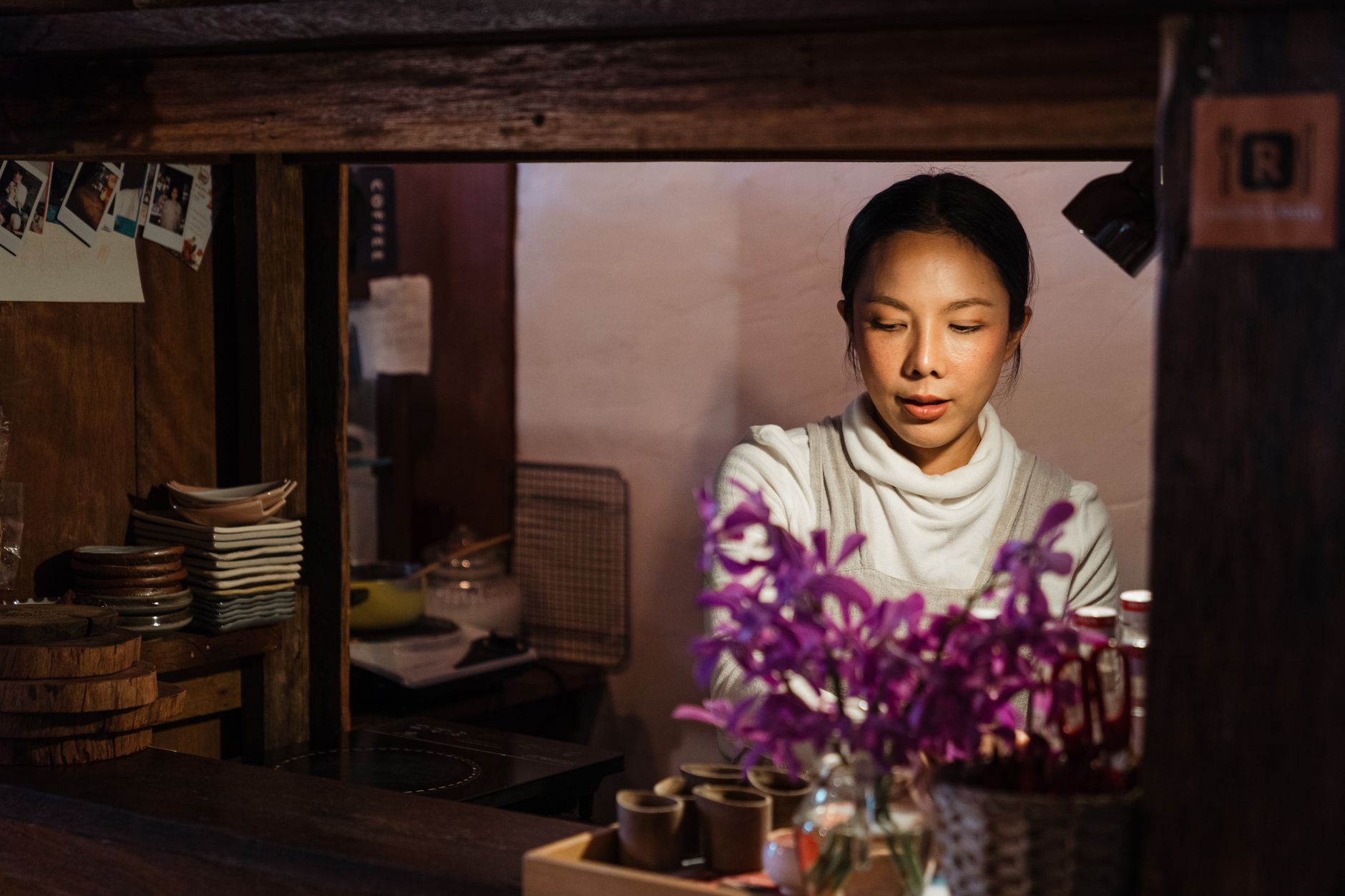
Dot was somewhere in her early sixties, built low and solid the way certain grain silos are built low and solid, like she had been poured rather than raised. She had forearms scarred pale in a dozen places from thirty years of grill splatter, gray hair pinned back under a hairnet she clearly resented, and she was already three eggs into an order when I walked in, and she did not look up.
“You’re the new one,” she said. Not a question.
“Yes, ma’am. Paige.”
“Mm.” She flipped the eggs. “Order pad’s under the register. Marsha’ll show you the floor. Stay out of my kitchen unless you’re calling an order or clearing a plate.”
That was the entire conversation. I would replay it a hundred times over the coming months, turning it over like a coin looking for a mark I’d missed, because at the time I heard it exactly the way the town had trained me to hear it: Dot doesn’t like people, and you are people, so.
Marsha, the other waitress, sixty-some and soft-spoken with a laugh like a screen door, showed me the floor in about four minutes flat and then, once we were out of the kitchen’s earshot, leaned in and said, “Don’t take it personal, hon. She’s like that with everybody. Wanda says she was like that in nineteen ninety-four too.” Marsha said it kindly, like she was doing me a favor, and in a way she was, because it meant I stopped expecting warmth from the kitchen window and started just trying to survive my shifts.
For the first month, survival was the whole job. I dropped a coffee pot my second week and stood there in the wreckage of it with my ears ringing, positive I was about to be fired, and Dot came around the pass with a mop before Wanda even got out of the back office, swept the glass into a dustpan without a word, and went back to the grill like it hadn’t happened. I told myself that was efficiency, not kindness. Dot didn’t want the mess sitting there. That was all.
—
I want to describe what my life looked like outside the diner during those months, because the two halves of it were so different that I sometimes felt like two separate people driving the same beat-up Corolla between them.
At the garage apartment, I was fine. Quiet, mostly, but fine. My aunt worked long shifts at the co-op and we mostly passed like housemates, which suited me. But I still saw my mother sometimes, at the grocery store, at my grandmother’s for Sunday dinner she insisted I still come to, and every time I saw her I saw the version of her that had chosen the path of least resistance with Kenneth, the version that said things like “he’s trying” and “you have to meet people halfway,” and every time it took something out of me that I didn’t have extra of. I was carrying, that whole fall, a low hum of the feeling that nobody was actually looking out for me. That I had aged out of being anyone’s responsibility and into being entirely my own, at nineteen, with a room over a garage and a job I was bad at.
At the diner, I was scared in a different way. Scared of the register, scared of the rush, scared most of all of the woman at the grill who I was sure, with the flat certainty of the young, disliked me specifically and not merely people in general.
So it took me a long time to notice that things kept happening in my favor.
—
The first one I nearly missed entirely.
I had a doctor’s appointment in Kearney, forty minutes away, that I’d already rescheduled twice because I couldn’t get a shift covered, and a nurse on the phone told me, not unkindly but clearly, that if I canceled again they’d have to bump me to a slot six weeks out. I hadn’t told anyone at the diner why I needed the morning off. I’d only asked Wanda, sheepishly, if there was any way to move my Thursday, and Wanda had frowned at the schedule taped to the cooler and said she’d see what she could do.
Thursday morning I came in expecting to work anyway, some half-formed apology already assembled in my head, and Marsha was at the counter in my apron.
“Wanda swapped you,” Marsha said, not looking up from the coffee she was pouring. “Told me last night.”
“Oh,” I said. “Thank you. Tell her thank you.”
“Tell Dot,” Marsha said. “Wanda didn’t move it. Dot did. Came in yesterday and told Wanda she’d cover your side of the counter herself so I could take your shift, on account of you got something Thursday morning you needed.”
I stood there in my coat with my keys still in my hand. “How did Dot know I needed something Thursday morning?”
Marsha shrugged, already moving to the next table. “She hears things. She’s back there with the window open all day. You’d be amazed what carries.”
I decided that was the explanation. Dot overhears the floor, Dot mentioned it to Wanda, Wanda made a scheduling call that happened to also solve Dot’s own morning, because heaven knew Dot liked having Marsha on the floor over me on a slow morning anyway. It fit the story I already had about Dot, which was that she was capable and efficient and did not particularly care about me one way or the other. I did not let myself consider the plainer reading, which was that a woman who did not like people does not volunteer to cover a shift for one.
—
The second one I almost talked myself out of too.
It was a Tuesday in November, a slow night, just me and Dot and Marsha closing, and the meatloaf special had run heavy that day, more made than sold, the way it does sometimes when Wanda misjudges the crowd. At close, Dot was boxing up the leftover portions into the walk-in the way she always did, and as I was untying my apron to leave she set one of the foil containers on the counter in front of me instead.
“Take that,” she said.
“Oh, I’m fine, I don’t need to take your food, I’ll just…”
“It’s going in the trash otherwise,” Dot said, already turning back to the sink. “Portion’s already cut. Nobody’s ordering meatloaf for breakfast tomorrow. Take it or it’s wasted, and I don’t like waste.”
I took it. It was, if I am honest, the best meal I’d had in a week, because a nineteen-year-old living alone on a diner wage does not always prioritize her own dinner the way she should, and I ate it standing at my little kitchenette counter and thought, well, that’s just Dot hating waste. That tracked with everything I knew. Efficient. Practical. Not personal.
It happened again two weeks later. And then, not always with meatloaf, but with something, maybe every ten days or so, there’d be a container waiting on the counter at close with some version of the same four words attached to it. It’s going in the trash otherwise. I never once heard her say that phrase to Marsha, who’d worked there eleven years and could presumably be trusted with the concept of portion control same as me. I noticed that. I filed it away and did not know what to do with it.
—
The third thing was the one that finally cracked the story I’d built.
I was three months in by then, comfortable enough on the floor to be dangerous, which is how I came to write down a to-go order wrong on a night we were slammed, an entire family’s dinner, and hand it back to the kitchen transposed, the ribs where the chicken should’ve been and no correction on the ticket. I didn’t catch it. Dot caught it, cooking off a ticket that made no sense against what she could see through the window of the family sitting at table four, and she fixed it herself, remade the whole order from scratch on a night we did not have five extra minutes to spare, and never said a word to me about it.
I only found out because Marsha mentioned it in passing the next morning, the way you’d mention the weather. “Good thing Dot caught your ticket last night. Wanda would’ve had a fit, we were already in the weeds.”
“Dot didn’t say anything to me,” I said.
“She wouldn’t.” Marsha was wiping down the counter, unbothered. “She doesn’t tell on you. Fixes it and moves on. Always has.”
I stood there holding a rack of clean mugs and felt something shift, quietly, the way ice does before it actually cracks. Always has. Not just with me. I thought about the swapped shift, and the meatloaf, and now this, and for the first time I let myself ask the question directly instead of around the edges of it. What if none of that was chance, or efficiency, or hating waste? What if Dot, who did not like people, who I had been told did not like people since before I could legally order a drink, had been quietly keeping me upright for three months and simply never mentioned it?
I did not ask her. I want to be honest about that too. I was nineteen and terrified of being wrong about it, terrified of walking up to the most intimidating person I had ever worked for and saying I think you might secretly be nice to me, only to be told, flatly, that I had misunderstood a business decision. So I did the only thing a scared nineteen-year-old knows how to do with a feeling that big. I put it away and kept working.
But I started watching her differently after that morning, the way you start watching a locked room once you suspect there’s a light on behind the door. I noticed she kept a small taped-up school photo of a girl with dark hair and Dot’s same square jaw tucked into the frame of the order window, so faded and so ordinary-looking against the grease and the ticket clips that I had walked past it two hundred times without once registering it as anything other than kitchen clutter. I noticed she always, always asked Marsha or Wanda about a new hire’s situation before that new hire had been there a week, quiet questions asked sideways while she worked the grill, does she have people, is she getting herself fed, is somebody looking in on her. I had assumed, when I first heard her ask those questions about the girl who’d come and gone before me, that it was simple management, a cook keeping tabs on the staff for the sake of the shift schedule. I was starting to suspect it was something with a good deal more weight behind it, and I did not yet have the shape of what that weight was.
—
I should tell you about the bad week, because it’s the week that led to the night that led to everything else.
It was early February, the part of a Nebraska winter where the cold stops being weather and starts being a personality trait of the whole state, and it had been a hard stretch for reasons that had nothing to do with the diner. My mother had called to tell me Kenneth wanted to “clear the air” at a family dinner I did not want to attend and felt obligated to anyway, and it had gone the way those things go, which is to say Kenneth talked for forty minutes about his own feelings and nobody asked about mine, and I drove back to the garage apartment that night and sat in my car in the cold for twenty minutes before I could make myself go inside, because I did not, in that moment, feel like I belonged to anyone. I was tired in the particular way that has nothing to do with sleep.
I brought that tiredness to work the next few days. I know I did, because I was slower on the floor, quieter, and twice Marsha asked if I was feeling all right and I said fine in the voice everyone uses when they mean the opposite. I assumed, if I thought about it at all, that Dot either hadn’t noticed or didn’t care, because Dot’s whole face lived behind the pass and I had never once seen her look up from a ticket to check on anybody’s mood.
I was wrong about that too. Thursday of that week I clocked in to find a plate already waiting at the end of the counter, eggs and toast, made before the doors had even opened, before a single customer had ordered anything at all. “Sit and eat that before you start,” Dot said, not turning from the grill. “You’ve been running on nothing three days straight and I’m not watching you go down on my floor.” I ate the eggs. I did not ask how she knew. By then I had stopped being surprised that she knew things, and started being surprised only at how long it took me to notice she’d always known them.
I just didn’t find out why until the storm.
—
The storm came in on a Friday, one of those fronts the radio starts warning about two days early and everybody in a farm town takes seriously, because everybody in a farm town has a relative who didn’t and regretted it. By four in the afternoon the snow had that fine, driven, sideways quality that means the roads are already worse than they look, and Wanda made the call to close two hours early and get everybody home before the county roads went from bad to closed.
Marsha left first, waved off toward her house six blocks away, close enough to walk if it came to that. I was pulling my coat on, keys already out, mentally running the drive: five miles of county road, most of it the flat open stretch along Highway 2 where the wind gets a clean run at you and the drifts build across the blacktop before the plows can catch them.
“You’re not driving that in this,” Dot said. She was still at the grill, wiping it down, not looking at me, which was so much her usual manner that it took me a second to register she’d spoken to me at all.
“I have to get home,” I said. “I don’t have anybody to call.”
“Didn’t ask who you’d call. Said you’re not driving it right now.” She nodded at the stool at the end of the counter, the one the coffee regulars used. “Sit. Give it twenty minutes. County usually gets a truck through by then, or it doesn’t and you wait longer, but either way you’re not going out in it blind.”
I sat. It was easier than arguing, and some tired, wrung-out part of me was, I think, relieved to be told what to do by somebody who sounded certain about it.
Dot poured two coffees, which I had never once seen her do, coffee being Marsha’s department, and set one in front of me, and then, instead of going back to her closing work, she came around the counter and sat on the stool next to mine. I remember that specifically, because in five months I had never seen Dot sit down in that dining room in the daylight hours, not once.
We sat there a minute in the kind of quiet that has weight to it. Outside the window the snow was going sideways under the parking lot light. I was working up the nerve to say something about the schedule swap in the fall, or the meatloaf, some version of thank you I’d been rehearsing for months and never delivered, when Dot spoke first, and her voice had gone somewhere I’d never heard it go, low and even and pointed at the window instead of at me.
“You remind me of my daughter,” she said. “Same age you are now, near enough. Same look you get when you think nobody’s watching how tired you are.”
I didn’t say anything. I had learned by then that the way to get Dot to keep talking was to not talk yourself.
“Her name was Darlene,” Dot said. “She worked the counter here the summer she turned nineteen, same as you’re doing now, same stool you’re sitting on, matter of fact, that used to be where she did her homework between the lunch rush and supper rush.” She turned her coffee cup a quarter turn on the counter, not drinking it. “She was working a shift over in Ogallala the winter she was going with a fella from over there, waitressing at a truck stop on the interstate to save up, and she pulled a late one on a night not so different from this one. Storm came in fast, same as this. She called me from the truck stop, told me she was fine, told me she’d wait it out like you’re waiting it out right now. And then some fool at the truck stop told her the roads were clearing, which they were, along the interstate. Nobody told her Highway 2 wasn’t the interstate.”
She stopped there long enough that I thought that might be the whole of it, and I sat very still, because I understood, the way you understand a held breath, that it was not.
“She went off the road eleven miles from home,” Dot said. “Blew a drift she couldn’t see in her own headlights on a stretch with nobody behind her to notice for two hours. I was up all that night not sleeping, and I told myself it was nothing, and it was not nothing.” She said the last part flat, the way you say a thing you have said to yourself ten thousand times until the saying of it has worn smooth, no jagged edge left for anyone else to catch on. “Twenty-two years ago this March.”
I did not know what to say, so for a long moment I said nothing, and the diner sat there around us with the fryers ticking as they cooled and the wind pushing at the glass.
“I don’t tell people that,” Dot said, after a while. “Wanda knows. Marsha’s known long enough she doesn’t ask. Town mostly forgot, the way towns do, or never knew, since it happened forty miles from here and the paper only ran it the one week. I’m not telling you so you’ll feel sorry for me. I’m telling you because I look at every scared nineteen-year-old that walks into this kitchen and I see her, and I have never once in twenty-two years let one of you drive home tired or hungry or unwatched if I could help it, and I have never told a single one of you why, because it was never about being thanked. It was about there being one less version of that night out there than there could’ve been.”
—
I want to be honest about what I did with that, because it wasn’t graceful. I cried, right there on the coffee-regular stool with the storm going outside, not delicately, and Dot did not reach for me or pat my hand, because that was never going to be her way, but she sat there next to me and let me, and after a minute she said, “Drink your coffee, it’s getting cold,” which from Dot was the same as an embrace, and I understood that completely.
“The shift you swapped,” I said, once I could talk again. “In the fall. For my appointment.”
“Wasn’t going to have you driving to Kearney and back on no sleep because you were too proud to ask twice,” Dot said.
“And the food.”
“Waste is waste,” Dot said, and then, after a beat, allowed the rest of it. “And a girl living alone on a diner wage isn’t always feeding herself right. I know that particular arithmetic better than most.”
“And the ticket. The one you fixed and never told me about.”
“Wasn’t going to have Wanda coming down on you for a bad night when I could just as easy fix it and let you learn on the next one instead of the one where you’re already rattled.” She looked at me then, finally, straight on, the first time in five months I’d had her full attention aimed at me and not at a grill ticket. “I’m not soft, Paige. I want you understanding that plainly. I’m not going soft on you now either. But I am not going to be the adult standing in this kitchen who watched a scared kid drowning and called it none of my business. I did that once already, in a manner of speaking. Told myself it wasn’t my place to worry after Darlene once she was grown and out working her own shifts, and I have had twenty-two years to sit with how wrong that was. So now it’s my place. Every single time. Whether the kid ever knows it or not.”
The county truck came through about twenty minutes later, same as she’d said it would, scraping a clean lane down the middle of the highway, and Dot walked me out to my car herself, checked that it started, stood in the cold with her arms crossed until I’d pulled out of the lot, and only went back inside once my taillights had cleared the turn. I know that because I watched her in the mirror the whole way, this small solid woman standing in a snowstorm making sure a car she had no obligation to watch made it safely onto the road.
—
Things were different after that night, though not in the way you might expect. Dot did not become a different person. She still barked at me if I called an order wrong, still ran her kitchen the way she’d run it for thirty years, still had exactly zero patience for anybody who came in the back door who wasn’t supposed to be there. But something had been named between us that couldn’t go back to being unnamed, and I found I didn’t want it to.
I started staying a few minutes after close some nights, not because anyone asked me to, but because I’d started to understand that the woman at the grill had spent two decades keeping a private, wordless watch over every scared kid who walked into her kitchen, expecting nothing back, and I did not want to be one more person who took that and never once looked her in the eye about it. She taught me to make her pie crust that spring, grudgingly, the way she seemed to do everything, correcting my hands on the rolling pin without softening a syllable of the correction, and I have never in my life paid closer attention to a lesson.
I still live over my aunt’s garage. My mother and I are civil, which is its own kind of peace, arrived at slowly and without a scene. Kenneth and I are what we are, which is not much, and I’ve made a kind of tired peace with that too. But most days now I know exactly where I’m wanted, and it isn’t in the house I grew up leaving. It’s behind a counter in a diner on the corner of Main and the highway, where a woman who buried her daughter twenty-two years ago decided, alone, in a kitchen nobody else was watching, that she would spend the rest of her working life making sure no other scared girl drove home that unwatched again.
I asked her once, that spring, why she’d never told anyone, why a whole town could sit at that counter for two decades drinking her coffee and never once hear the reason behind it. She thought about it longer than she usually thought about anything before she answered, wiping down the same clean stretch of grill twice while she found the words.
“Because the minute you tell people, it turns into a thing they admire you for,” she said finally. “And I never did any of it to be admired. I did it because I couldn’t stand the alternative. Those aren’t the same reason, and I wasn’t going to let anybody confuse the two.” She set the rag down. “You weren’t supposed to find out either, if I’m honest. Storm just caught me at a low hour.” Then she looked at me, and something in her face went almost soft, which for Dot was as close to a smile as the moment was ever going to get. “I’m glad it did, though. Now.”
That’s the part I think about most, when people ask me why I stayed at a diner job in a town of eleven hundred people instead of moving on the way most nineteen-year-olds are told they should. It would have been so easy for her to keep it locked up forever, to let the whole town go on thinking she was simply a hard, private woman who happened to be good with a grill, and to carry Darlene alone the way she’d apparently decided to carry her for twenty-two years running. She let it out instead, on one cold night, to one scared kid on a coffee stool, because some things are too heavy to carry silently forever, even for a woman as solid as Dot.
Last month a new girl started, seventeen and terrified, dropping her first coffee pot in almost the exact spot I dropped mine. I saw Dot come around the pass with the mop before Wanda even looked up, same as she did for me, and I saw the girl’s face do the thing my face must have done, that mix of relief and confusion at being helped by someone she’d been warned not to expect anything from.
I didn’t say anything to Dot about it. I understood, by then, that saying something was never the point. So instead, on my way past the pass window that afternoon, I picked up the coffee pot before Marsha even asked, and I carried it out to the new girl’s station myself, and I refilled a cup she hadn’t asked me to refill, because that, I have come to learn, is simply how it gets passed down in that kitchen. Nobody announces it. Nobody asks to be thanked. You just watch for the next scared kid standing where you used to stand, and you make sure she gets home.
This story is a dramatization. Names, characters, and details are invented, and any resemblance to real people or events is coincidental.