
My name is Diane Whitfield. I am sixty one years old, and for the last forty four Saturdays of every single year, I have set up the same folding table at the Sable Creek farmers market, laid out the same jars of marionberry and blueberry preserves, and stitched the same small bluebird onto every cloth topper before I ever leave the house.
People compliment the birds all the time. A sweet detail, they say. A nice touch for the jars.
They have no idea.
I want to tell this story the way it actually happened, not the way it is easiest to tell. That means starting before the market, before my husband Roy, before my son Mark, before any of the life the good people of this town think they know the whole of. It means starting when I was seventeen years old, at a kitchen table with my parents, making the hardest decision I have ever made in my life.
I was a senior at Sable Creek High that year. Danny Osgood sat two rows over from me in American History and drove a truck that smelled like pine air freshener and cut grass, and for one spring and one summer he was the whole of my world the way a first love is when you are that young. Neither of us set out to become parents. We were seventeen. We were saving up gas money for Friday night football and arguing about whether Fleetwood Mac or the Eagles were better, and then, that August, I understood that my life had just changed in a way no amount of arguing about music was going to undo.
I have read a great many versions of stories like mine since, in magazines, in books, on the kind of television programs that like to paint every birth mother from that era as a frightened girl who was sent away in shame, hidden in some home for wayward girls, and told never to speak of it again. I want to be honest about my own story instead of borrowing somebody else’s, because mine was not that story, and I think the difference matters.
My parents did not throw me out of the house. My father did not stop speaking to me. My church, the small Lutheran congregation two blocks off Main where I had been baptized as a baby and confirmed at fourteen, did not shame me from the pulpit or ask me to sit in the back pew. What happened instead, in a small Oregon farm town in 1982, was quieter than shame and harder to carry than anger would have been. My mother made coffee. My father sat down across from me at our kitchen table, the same table where I had done ten years of homework, and the three of us looked, honestly and without flinching, at what I actually had to offer a baby at seventeen years old.
What I had was love. I want that on the record plainly, because it is true, and because so much of what gets written about girls like I was leaves love out entirely, as if a seventeen year old cannot possibly love a baby the way a grown woman does. I loved her before I ever held her. I loved her enough to lie awake doing arithmetic I had no business having to do at that age, working out whether love alone was going to be enough to keep a roof over a child’s head and food on a table I did not yet know how to set for myself.
What I did not have was a diploma yet, or a job that paid more than babysitting money, or a husband, or a home of my own, or parents with the room or the means to raise a second child at their age when they had just finished raising me. Danny’s family was kind about it, in their way, but Danny himself was as lost and as young as I was, and neither of our families had the kind of money or stability that makes seventeen year olds into ready parents overnight.
My mother told me about a Lutheran family services agency two counties over that placed babies with couples who had been waiting years, sometimes a decade, for a child they could not have on their own. She did not tell me to do it. I want to be clear about that, because I have heard other women’s stories where the choosing was taken out of their hands entirely, and mine was not one of those. My mother told me the option existed. My father told me that whatever I decided, they would stand behind me, and that if I decided to keep the baby and raise her in that house, they would help however they were able. I believe him. I have believed him my whole life since.
I asked to see a file on families waiting. I want that detail remembered too, because it is the whole of the difference between a decision made for me and a decision I made myself. The caseworker, a soft spoken woman named Mrs. Halloran, brought me three folders, and I read every page of all three sitting in a hard plastic chair in an office in Eugene, seventeen years old in a dress my mother had let out at the waist, deciding the entire shape of another human being’s life with a pen in my hand.
I chose a pastor and his wife from a town on the other side of the state. His name was Michael Prescott. Her name was Joan. They had been married eleven years and had tried for nine of them to have a child of their own, through every kind of hope and every kind of heartbreak a couple can go through trying, and Mrs. Halloran told me, without making it sound like a sales pitch, that Joan Prescott had cried in that same office the month before, not from sorrow that time, but because she had just been told there was finally a real chance a baby might come to her after all.
I chose them because I believed, with everything a seventeen year old can believe, that a woman who had wanted a child for nine years and a man whose whole vocation was showing up faithfully for people would build a home sturdier than anything I could build alone at that age. I chose them because I could offer my daughter love, and they could offer her love and a paid off house and two parents and a name on a church directory and a hundred Sunday dinners I would not be there for, and I thought, then and now, that a child deserves both kinds of gift if a mother can arrange it.
Get a new story in your inbox every morning.
Facebook doesn’t show you every story we post. Our free newsletter does. Join 2,500+ readers.
Nobody chose for me. I want that understood before anything else in this story, because the word I hear used most often for what women like me did is given up, and it has always sat wrong in my chest, like something was taken from me rather than something I decided. The true word, the only honest word, is chosen. I chose my daughter’s whole life before she had lived a single day of it, and I have never once regretted the choosing, even on the nights it cost me the most to have made it.
The week before she was born, I sat up three nights running with a needle and a scrap of flannel, sewing a small bluebird into one corner. It was my grandmother Vera’s pattern, the same one I still stitch onto every jam jar topper I sell forty four years later. Grandma Vera taught it to me at her own kitchen table when I was nine years old, said a woman ought to always have one thing she makes with her hands that nobody else makes quite the same way, and I chose the bluebird because Grandma Vera always said bluebirds carry hope on their wings in scripture and in old wives’ tales both, and because I wanted my daughter to carry a piece of hope with her even if she never carried a piece of me.
I was allowed to hold her for six hours in that hospital room. I have never once, in forty four years, forgotten a single minute of it. I counted her fingers. I counted her toes. I told her, out loud, quietly, that I was choosing this because I loved her more than I had ever loved anything in my whole short life, and that I hoped one day, if she ever wondered, she would understand that a mother can give a child away and still be giving out of love rather than out of any lack of it.
Then I folded that flannel blanket with the bluebird stitched in the corner into the bag of her things, and I signed the papers Mrs. Halloran laid in front of me, and I went home to Sable Creek and finished my senior year of high school like nothing in my life had changed, when in fact everything in it had.
The agency sent one letter a year later, as some agencies did back then before closed adoption tightened up entirely. It said only that the baby, whom the Prescotts had named Sarah, was thriving, walking early, laughing often, and deeply loved. I read that letter so many times the creases wore through before I ever thought to put it somewhere safer. I have it still, in a cedar box on my closet shelf, soft as cloth now at every fold.
After that letter, nothing. By design, not by accident. Closed adoptions in Oregon in the early eighties meant exactly that, closed, and I had agreed to it with my eyes open, because I believed then, and mostly still believe now, that a clean closed door gave the Prescotts the chance to raise Sarah as fully and completely their own daughter without a birth mother two counties over complicating the shape of her childhood.
I want to explain now the part of this story that took me the longest forty four years to be honest about, even with myself. I never searched for her. Not once. Not when Oregon changed its law in 1998 and gave adult adoptees the right to request their own original birth certificates. Not when the internet made finding almost anyone a matter of an evening and a little patience. Not on a single one of the forty four birthdays I marked privately and alone.
People assume, when they hear this part, that I must not have wanted to know. That could not be further from the truth. I wanted to know every single day of my life. I wanted to know if she had Danny’s stubborn chin or my mother’s laugh. I wanted to know if the Prescotts had kept her middle name the way the agency told me they intended to, or changed it the way some adoptive families do to make a fresh start feel more complete. I wanted to know if she was happy, if she was loved, if the choice I had made at seventeen with a pen in a hard plastic chair had actually turned out to be the gift I had hoped it would be instead of a mistake dressed up as one.
I did not search because I was afraid of exactly one thing, and it was not rejection, though I have heard other birth mothers say that fear kept them from searching too. My fear was different. My fear was that I would knock on a door somewhere and disturb a life that had turned out whole and happy precisely because I was not in it. I had made a promise to myself in that hospital room, before I ever signed a single paper, that if this family gave my daughter a good life, I would honor that gift completely, and that meant staying out of the way of it. Searching, to me, would have meant deciding my own wondering mattered more than her peace, and I could not make myself believe that math worked out in my favor. So I kept the promise. I kept it for forty four years.
I married Roy Whitfield three years after I gave Sarah up, when I was twenty and finally steady enough on my own feet to build something with somebody. I told him about her on our third date, sitting in his truck outside the Dairy Queen on Main, because I decided early that I would rather lose him over the truth than keep him over a lie. He did not flinch. He asked me her name. He asked if I was at peace with the choice, and when I told him I believed I was, he told me that was good enough for him, and he never once, in thirty eight years of marriage, made me feel smaller for the daughter I carried before I ever carried his name.
We had our son Mark four years into our marriage, and Roy and I agreed, before Mark was even born, that we would raise him knowing the truth rather than stumbling onto it later the way some families let secrets curdle. Mark has known his whole life that he has an older half sister somewhere in Oregon he might never meet, because that was the shape of the promise his mother made before he existed, and to his enormous credit, he never once treated that fact as strange. He used to ask, as a little boy, whether Sarah liked the same cartoons he did, whether she was tall, whether I thought she would like him if she ever met him. I never had a single answer for him. I only ever had the hoping.
Every year, on the date I know and nobody outside this house has ever needed to know, I have baked a small cake. Not a large one, not a celebration anyone else would notice, just a modest yellow cake with white frosting, the kind Grandma Vera used to make. Roy has never once asked me to stop, and some years he has quietly set out two extra plates on the counter without a word, one for himself and one that we both understood was not for eating so much as for remembering. I have done this forty four times now. It has been, in its small private way, the closest thing to church I have outside of the actual pews.
I tell you all of this so that when I tell you what happened three Saturdays ago at my jam stall, you understand the whole weight of the forty four years standing behind it, and not just the five minutes it took to change.
I have run my stall, Meadow and Vine, at the Sable Creek Saturday market for nineteen years, since before Mark left for college, since before Roy’s knees started giving him trouble on the ladder in our orchard. I sell marionberry and blueberry preserves, a little honey from a neighbor’s hives, and every single jar leaves my table with a bluebird stitched onto its cloth topper by my own hand, the same pattern Grandma Vera taught me at nine years old, the same pattern I stitched into a flannel blanket the week before I gave my daughter away.
Three Saturdays ago, a woman began coming to my table who did not buy jam.
She stood at the edge for a long while the first Saturday, not speaking, looking down at the bluebirds stitched into the cloth toppers like she was trying to place a memory she could not quite reach. I assumed she was simply slow deciding on a flavor, the way some customers are, and I let her be. The second Saturday, she came back three separate times over the course of the morning, always circling to the same corner of the table, always looking at the same jar, a small quart of blueberry I keep near the back and rarely sell because it was the first batch I made that year and I have a habit of getting sentimental over first batches.
The third Saturday, this past one, she finally spoke.
She looked to be somewhere in her forties, though something in the careful, uncertain way she held herself made her look, for just one unsettling second, like she might have been seventeen. She asked me, quiet, like the question cost her something real to ask out loud, where I had learned to stitch a bird like that.
I told her the truth, the way I always tell it. My grandmother’s pattern. Mine my whole life.
She nodded slowly at that, the way a person nods when an answer has confirmed something rather than merely informed them of it. Then she reached into a canvas bag hanging at her hip and drew out a small folded square of flannel, yellowed soft at every edge the way only decades of careful keeping can yellow a fabric, and in the corner of it, faded nearly to a whisper but entirely unmistakable to the woman who had stitched it, was a bluebird.
My bluebird. My grandmother’s pattern, worked by my own hand in a hospital room forty four years ago, folded into a bag of a baby’s things I never once expected to see again in this lifetime.
She held that square of flannel out toward me across the table on an open palm, and she looked at me the way a person looks at someone when they already believe they know the answer and are only asking so they can hear it said out loud, the way you might ask a question you have carried for years just to feel the relief of finally letting it leave your mouth.
“I’ve been looking for the woman who made this for a long time,” she said. “Is it you?”
I could not speak. I want to tell you I said something wise or something warm in that first moment, some line worthy of forty four years of waiting, but the truth is my whole body simply went still, the way a held breath goes still, and I stood behind my own folding table with a jar of blueberry preserves halfway lifted in my hand and I could not make a single word come out of me.
She must have read the answer on my face before I ever managed my mouth, because her own eyes filled, and she said, so soft I nearly lost it under the noise of the market around us, “My name is Sarah.”
I set the jar down before I dropped it. I came around the side of my own table, past the cash box and the folding chair I have sat in every Saturday for nineteen years, and I stood in front of my daughter for the first time since a hospital room in 1982, and I said the only true thing I had in me.
“I’ve thought about you every single day of your life.”
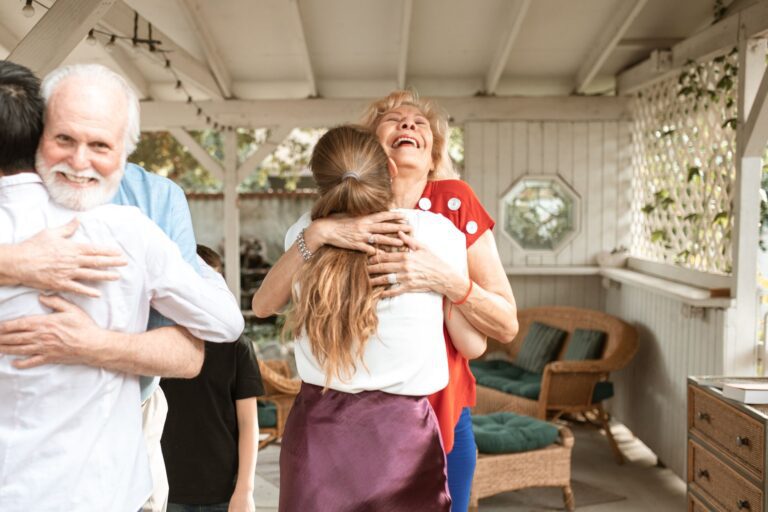
We did not fall into each other’s arms the way it happens in movies, not right away. We stood a foot apart in the middle of a Saturday morning crowd, both of us crying without any sound to it, both of us looking at each other like we were trying to memorize forty four years in a handful of seconds, and it was Ruthann Castillo, two stalls down with the cut flowers, who finally came over, took one look at the two of us, and without asking a single question, covered my table for me and told me to go sit down somewhere quiet before I fell down where I stood.
We ended up on the tailgate of my own truck in the parking lot behind the feed store, Sarah and I, the market noise still drifting over the fence, and we talked for two hours straight while my jam sat unsold and Ruthann fielded questions about marionberry preserves to customers who had no idea what they were interrupting two stalls away.
Sarah told me her story in pieces, the way a person tells a story they have practiced in their head a hundred times but never once said out loud. She grew up in Fallow Ridge, three hours east of Sable Creek, raised by Michael and Joan Prescott exactly the way Mrs. Halloran had promised me she would be. Michael had pastored the same small congregation for over thirty years. Joan had taught piano to half the children in that town at one time or another. Sarah grew up with Sunday dinners and a paid off house and two parents who told her, from the earliest age she could understand the word, that she was adopted and that she was chosen, deliberately, on purpose, by two women who both loved her enough to choose her, her birth mother and her mother both.
She told me she had a good childhood. A whole one. Loved completely, never once made to feel like a consolation prize for two parents who could not have a child of their own by other means. I sat on that tailgate and let those words land in me the way rain lands on ground that has been dry a very long time, because it was the answer to the fear I had carried for forty four years, spoken plainly, by the one person whose word on it actually mattered.
She had always wondered about me. Always, she said, in the quiet way a person wonders about something they have decided not to disturb, the same shape of restraint I had lived inside my whole adult life from the other direction. She had the blanket square, the bluebird one, kept safe her entire life in a cedar box not unlike my own, because Joan had told her, early and often, that whoever made that stitch had loved her enough to send a piece of hope along with her, and that Sarah should keep it always.
Joan Prescott passed away last autumn. Sarah told me this part slower than the rest, and I reached over and took her hand on that tailgate the way I imagine I would have a thousand times over the last forty four years if I had ever been given the chance. In her last weeks, Joan told Sarah plainly that she wanted her to search, that she had always wanted her to search, that the only reason she had never pushed harder was her own old fear that encouraging it might look like she did not consider herself Sarah’s real mother, when the truth was the opposite entirely. Joan told her, near the end, that a girl is allowed two mothers, and that she had spent thirty some years quietly hoping Sarah would one day go find the other one and tell her, if nothing else, that the baby she gave away had grown up loved.
Sarah requested her original birth certificate under Oregon’s adult adoptee law within a month of burying her mother. It gave her my name. The non identifying background information the agency still had on file, thin as it was, mentioned a birth mother’s grandmother who did fine embroidery, and mentioned the town, Sable Creek, where that grandmother had taught her craft.
Sarah took a physical therapy position at the clinic in Sable Creek eight weeks ago, in part, she told me honestly, because it put her in the one town connected to the one detail she actually had. She had not been certain she would ever work up the nerve to look further than that. She told me she came to the farmers market her first Saturday in town simply because a coworker mentioned it was worth seeing, and she saw the bluebirds on my jars before she ever saw my face, and something in her went as still as something in me had gone still three Saturdays later.
She spent three Saturdays working up the courage to ask a stranger where she had learned to sew a bird. I have thought since about how close that question came to never being asked at all, how easily an anxious woman might have decided, on any one of those three mornings, that the risk of an answer she was not ready for outweighed the ache of never asking, and I am endlessly grateful she did not let that fear win the way I let mine win for forty four years.
I told her everything that afternoon on that tailgate, the parts I have told you here, the kitchen table conversation with my parents, the three folders in Mrs. Halloran’s office, the choosing of Michael and Joan Prescott out of genuine belief rather than resignation, the six hours I held her, the bluebird I stitched into that blanket at three in the morning with my hands shaking. I told her about the one letter the agency sent a year later and the cedar box where I still keep it. I told her about Roy, about Mark, about thirty eight birthday cakes she never knew were being baked in her honor three hours away.
She cried harder at that part than any other, and she told me that not knowing, all those years, whether anyone on my side had ever thought of her at all, had been the one wound that never fully closed, worse even than not knowing my name. I understood that completely, because it had been my own wound too, worn into the exact same shape from the opposite direction.
I called Roy from that tailgate before we ever left the parking lot. He drove out within twenty minutes, and when he got there he did not shake Sarah’s hand the way I half expected a nervous man to do. He hugged her, right there by the feed store fence, and told her that he had set out two plates on our kitchen counter every year for thirty eight years, and that he had always hoped, without ever quite letting himself believe it, that one day there would be somebody real to sit down at the second one.
Mark drove in from Portland the very next day, three hours each direction on a Sunday, because he told me over the phone that he had waited his whole life to meet a sister he already loved sight unseen, and he was not waiting one more day longer than he had to. He and Sarah sat at our kitchen table, the same table where my parents once helped me choose her life at seventeen, and traded stories for six straight hours like people who had known each other since childhood instead of since yesterday. Mark, it turns out, does have Danny’s stubborn chin, and Sarah, it turns out, has my mother’s laugh exactly, the same one I have missed since my mother passed eleven years ago, and hearing it come out of my daughter’s mouth for the first time undid me more completely than almost anything else that whole week.
We invited Michael Prescott, Sarah’s father, out to Sable Creek the following month. I will admit I was afraid of that meeting in a way I had not been afraid of meeting Sarah herself, because some old part of me still worried he might look at me as the woman who had complicated the family he and Joan built with such care. Instead he took both my hands at our front door, an old pastor’s hands, dry and steady, and he told me that Joan had prayed for me by name every single night of their marriage, not out of pity, but out of gratitude, because she never once forgot that the family she got to raise had first been a gift I gave away at seventeen with nothing to gain from it but the hope she would be loved. He told me Joan used to say there ought to be a special kind of thank you owed to a girl who chooses a stranger’s love for her own child over her own wanting to keep her, and that he had come to Sable Creek specifically to finally say it to my face on Joan’s behalf as well as his own.
I baked a cake this year on Sarah’s birthday for the first time in forty four attempts with the actual guest of honor sitting at my own kitchen table to eat a slice of it. Roy set out the two plates the way he always has, except this time neither one sat empty. Mark drove in again just for the afternoon. Michael sent a card, and called that evening, and told Sarah he loved her the same way he always had, which is to say completely, and which Sarah told me afterward only made the day feel fuller rather than divided, exactly the way Joan had always hoped it would if this day ever came.
Sarah works most Saturday mornings now, when her clinic schedule allows it, at a folding table set up right beside mine at the Sable Creek market. She does not sell preserves. She sells small embroidered things, pot holders and little cloth pouches, because two months ago I finally taught her, at my own kitchen table, the bluebird pattern my grandmother taught me at nine years old, the same pattern I stitched into a blanket in a hospital room the week before I gave her up, the same pattern that brought her back to that exact table nineteen years and forty four years later.
I still keep that one quart of blueberry preserves near the back of my table, the one Sarah circled three separate Saturdays before she ever spoke. I have never sold it, and I never will. It sits there now beside her folding table instead of mine, a small jar with a slightly crooked bluebird on its cloth topper, the first thing that ever quietly told the truth before either of us was brave enough to say it out loud.
I do not tell this story to suggest that every birth mother’s ending looks like mine, or that forty four years of not knowing was easy simply because it eventually resolved. I carried real grief through every one of those years, real fear, real nights I wondered if I had made a mistake dressed up as a gift. I do not regret the choosing, not for one single day, and I want any woman reading this who made a similar choice at a similarly young and frightened age to hear that plainly from someone on the other side of it. Choosing a harder, better life for your child, even at the cost of your own nearness to her, is not a failure of love. It is very often the fullest shape love is able to take, at seventeen, with a pen in your hand and a whole life you have not yet lived stretched out in front of you.
I sit at my jam stall most Saturdays now with my daughter one table over, both of us stitching the same bluebird my grandmother taught me sixty years ago, and I think about Grandma Vera’s old saying more than I ever expected to, that bluebirds carry hope on their wings. I stitched hope into a blanket forty four years ago and sent it out into the world with no earthly guarantee it would ever come home to me. It came home anyway, on a Saturday morning, in a market full of strangers, folded soft in the palm of a woman who never once stopped being my daughter, no matter how many years or how many miles stood between the choosing and the coming home.
This story is a dramatization. Names, characters, and details are invented, and any resemblance to real people or events is coincidental.