The Birthday Cards My Dad Never Mailed
Three days before my wedding, my father stood on my porch in Birch Hollow, Pennsylvania, holding an old Red Wing boot box against his chest like it might get away from him, and he would not come inside.
“Got something for you,” Tom said. That was it. No hello, no how’s the week going, none of the small talk most fathers use to walk through a door. He held the box out with both hands, the way you’d hand someone a casserole dish you didn’t want to drop, and I remember thinking, even before I took it, that it was heavier than a box that size had any business being.
I am thirty-three years old. I have known my father my whole life, which is a strange thing to say about a man I have spent most of that life trying to get to know. He is not cruel. I want to say that clearly, up front, because stories about difficult fathers usually come with a villain in them, a slammed door or a cutting word you carry around like a stone in your coat pocket, and that was never Tom. My father never raised his voice at me. He never missed a support payment. He never once, in twenty-seven years since my parents split, said an unkind word about my mother in front of me, which I did not fully appreciate until I was old enough to know how rare that is.
What my father did instead was quieter than any of that, and it took me most of my adult life to understand it was its own kind of wound. He simply did not know how to say the thing. Any of the things. I love you. I’m proud of you. I’m sorry. I missed you this week. Whatever it was, it seemed to lodge somewhere behind his sternum and stay there, and what came out instead was a nod, or a line about the weather, or, on my birthday every single year of my life, a phone call that lasted forty seconds and ended with him saying “well, I’ll let you go” before I had said much of anything at all.
I used to think that forty-second phone call was the whole truth of how my father felt about me. I was wrong about that, but I did not find out how wrong until nine days before I got married, when I invited him to walk me down the aisle and he said yes in a voice so quiet I almost asked him to repeat it, and then, three days later, he showed up at my door with a boot box he would not bring inside my house to give me.
He didn’t come in.
I stood there on the porch with the box in my arms, and I asked him if he wanted to sit for a minute, have some coffee, and he shook his head and said he had to get back, the truck was still running in the driveway, he could hear it idling behind him the whole time we talked. He told me to open it whenever I wanted. He said it wasn’t anything. He said that twice, actually, it isn’t anything, like he was trying to talk both of us out of how much it clearly was. Then he got back in his truck and drove the forty-five minutes back to his place outside of Corliss, and I stood on my own porch holding a boot box that smelled, very faintly, of cutting oil and cedar, and I did not open it for six hours.
I want to explain why it took me six hours, because I think the reason matters as much as anything I eventually found inside.
My parents divorced when I was six years old. I don’t remember the marriage itself in any real detail, only fragments, the sound of my mother crying in the kitchen with the water running so I wouldn’t hear it, my father’s hands, which were always stained faintly gray from machine oil no matter how hard he scrubbed them, tucking me into bed on a Tuesday and then not being there on the Wednesday. What I remember clearly is the after. My mother kept the house on Larch Street, in town, close to my school and the Presbyterian church where I sang in the children’s choir. My father moved out to a rented place off Route 44, closer to Corliss Tool and Die, where he had worked the lathe since he was twenty-two years old, and where he would go on working it for thirty-one years straight, through two ownership changes and one near-closure that put half the town on unemployment for a summer.
Every other weekend, I went to my father’s. It was a small, tidy place, always tidy, because I think keeping it tidy was one of the only ways my father knew how to show he was trying. He kept a shelf of my school pictures in the living room, updated every year, the frames dusted. He cooked the same four meals in rotation, grilled cheese, spaghetti with jarred sauce, hot dogs, and on special occasions, a pot roast that took him all Saturday morning and that we ate mostly in silence, the television on low in the next room so the quiet at the table didn’t feel as loud.
He was not a bad father in any way you could point to on paper. He showed up for every custody weekend for eleven straight years, even the ones I know now he did not want to have, because there were women he could have been seeing and friends he could have been drinking a beer with instead, and he chose the folding chair at my Little League games and the metal bleachers at my middle school choir concerts every single time. He clapped when everyone else clapped. He drove me home after and asked if I was hungry. That was usually the extent of the conversation.
The birthdays were the hardest part, and I think that’s because birthdays are the one day a year built entirely around being told, out loud, that you matter to somebody. My mother was wonderful at birthdays. She made pancakes shaped like whatever I was into that year, cassette tapes and Lisa Frank one year, horses the next. My father’s birthday tradition, if you could call it that, was the phone call. He would call at some point during the day, usually early evening, usually while I could hear the television going behind him, and he would say happy birthday, ask how old I was turning even though he knew, say something short about how fast I was growing up, and then, almost every single time, “well, I’ll let you go.”
I was sixteen the year it hurt the most. I had a small party at my mother’s house, nothing big, six girlfriends and a sheet cake from the grocery store, and I remember standing by the phone in the hallway for most of the evening, checking it, because my father usually called by seven and it was already eight-thirty. My mother found me out there around nine and asked if I was waiting on something, and I told her no, I was fine, and I went back to the party and blew out candles I did not really want to blow out anymore. He called at eleven-forty that night. My mother answered first and I heard her tell him, in a voice that was trying hard not to be sharp, that the party was over, that I’d gone to bed. I hadn’t gone to bed. I was sitting on the stairs listening. I heard her hang up, and I went to my room, and I decided something that night that I would go on believing for the next seventeen years. I decided my father simply did not think about me enough, on the day that was supposed to be about me, to remember to pick up a phone before it was almost midnight.
I carried that decision into my twenties the way you carry any old grievance, mostly quietly, occasionally surfacing it to a boyfriend or a therapist, always with the same shape to the story. My dad tries, technically. My dad shows up, technically. But my dad has never once made me feel like the most important thing in a room, and I stopped expecting him to sometime around high school graduation, where he sat in the fourth row of folding chairs on the football field in a collared shirt that still had the store fold-creases in it, and clapped, and drove me home, and asked if I was hungry.
I moved thirty minutes away for college and then stayed in the area after, close enough to visit but far enough that visiting became a choice rather than a given, and the choice I mostly made was Sunday dinners a few times a year, Christmas at my mother’s with my father invited separately for an hour on Christmas Eve because that was the arrangement that hurt the least for everyone, and birthday phone calls that had, over seventeen more years, extended themselves from forty seconds to maybe ninety, the length of a call that includes exactly one follow-up question about my job and one about the weather where I lived.
I met the man I am marrying four years ago, at a mutual friend’s cookout, and when I brought him to meet my father for the first time, at a diner off Route 44 because my father does not love hosting, my father shook his hand for what felt like a full ten seconds too long, looked him directly in the eye, and said, “Take care of her.” That was the whole speech. My fiance told me in the car afterward that he thought that was one of the more intense things anyone had ever said to him, and I remember laughing and saying, welcome to my father, that’s about as much as you get, and not thinking twice about it, because I had spent my whole life training myself not to expect more.
When we set the wedding date, I went back and forth for two full weeks about whether to ask my father to walk me down the aisle. It felt, in a way I was embarrassed to admit even to myself, like handing him one more chance to be quiet at the exact moment I most needed him not to be. I asked him anyway, over the phone, on a Tuesday evening, and there was a long pause on the line, long enough that I almost filled it the way I always did, and then he said, “I’d be honored to,” in a voice that cracked slightly in the middle of the word honored, and I remember sitting very still afterward, because in twenty-seven years I do not think I had ever heard my father’s voice do that.
I did not think much more about it until three days before the wedding, when he showed up at my door with a boot box and would not come inside, and told me twice that it wasn’t anything, and drove away with his truck already running.
I sat with the box on my kitchen table for six hours before I opened it. My fiance asked, gently, twice, if I wanted to open it together, and both times I told him not yet, because some old, tired part of me was bracing for it to be nothing. A stack of old photographs, maybe, or some paperwork about a savings bond he’d set up when I was born, practical things, the kind of things my father gave instead of feelings, and I did not think I had the emotional room that week, three days before my wedding, to sit with one more version of my father trying and falling short in his own particular way.
When I finally opened it, the lid came away smelling like cedar and, faintly, like the inside of his truck, and the first thing I saw was color. Dozens of small colored rectangles, standing on their sides, packed tight and neat the way everything my father owns is packed neat, and it took me a full ten seconds looking at them before I understood what I was looking at.
They were birthday cards. Greeting card envelopes, standing upright in rows like index cards in a library drawer, and in the corner of every single one, in my father’s small, careful pencil printing, was a number.
1.
2.
3.
I sat there at my kitchen table and counted, and there were thirty-three of them. One for every year of my life. Every single birthday I have ever had, going back to the year I turned one, a card my father bought and, judging by the dust on some of the older envelopes, had been sitting in a drawer or a box for a very long time.
My hands were not steady when I pulled the first one. Card number one had a cartoon teddy bear on the front holding a single candle, the kind of card you’d find at a pharmacy rack in 1993, and I opened it expecting nothing and found, in ink so faded I had to hold it to the window, three lines in my father’s handwriting.
Happy first birthday, Melissa. Your mother says you laugh at the dog every time he sneezes. I hope you always find something that funny.
Love, Dad
It was never mailed. There was no stamp on the envelope, no postmark, no evidence it had ever left whatever drawer it had lived in for thirty-two years. I checked the second card, and the third, and by the tenth I had stopped checking and started simply reading, because a pattern had already declared itself and I needed, badly, to understand it. Every single card was addressed, in his same careful pencil printing, to me, at whatever address my mother and I had lived at that year. Every single card had a few lines written inside in his hand. And almost none of them, I would come to learn as I went through the whole box that night, had ever been sent.
Card number six, the year I started kindergarten: Six years old today. Your mother tells me you already read better than some of the third graders. I always knew you were smart. I should tell you that more.
Card number nine: I know the divorce has been hard on you. I don’t have the words for how sorry I am about that. I’m trying to find them. I will keep trying.
Card number eleven, and this one stopped me cold, because it was the only card in the whole box with visible corrections, words crossed out hard enough to nearly tear the paper, and beneath the crossing-out, in different ink, a shorter, simpler line that had clearly replaced something longer and harder to say. I held it up to the lamp and could just make out a ghost of the original underneath the crossed-out lines, something that started I wish I could tell you the reason your mother and I, before it disappeared into scratched-out ink entirely. What replaced it was four words. I love you always.
I want to tell you what I felt, sitting at my kitchen table three days before my wedding with thirty-two years of my father’s unsent handwriting spread out in front of me, but the honest answer is that I did not feel any one thing. I felt the sixteen-year-old on the stairs, listening to her mother hang up the phone at eleven-forty, and I felt something entirely new arriving right alongside her, something that had no business making room for itself that fast, but did anyway. I kept reading.
Card number thirteen was written the year of the mill’s near-closure, the summer half of Corliss Tool and Die got laid off and my father worked a second job loading trucks at the feed store at five in the morning before his regular shift, a summer I remembered mostly as the summer my father seemed even more tired and even quieter than usual, and I had resented that quietness at the time without ever once wondering what was underneath it. The card that year said: Thirteen. Some hard months right now, but nothing that touches how proud I am of you. I hope you never have to work as hard as I have this year, but if you do, I hope you handle it half as well as your mother handles everything. Which is to say, better than me.
Card number sixteen was the one that undid me completely, because I found the date written in the corner, in his hand, next to the number, a habit he apparently kept every year that I hadn’t noticed until then. It was dated the same day as my sixteenth birthday. The day of the sheet cake. The day I sat by the phone in the hallway until eight-thirty and then went back to a party I no longer wanted to be at, the day he called at eleven-forty and my mother told him, not unkindly but not gently either, that the party was over and I’d gone to bed.
Inside, in handwriting shakier than his usual careful print, like it had been written and rewritten several times before he settled on these words, it said:
Sixteen today. I sat in the truck outside your mother’s house for almost forty minutes tonight trying to figure out how to come in and just be part of the party instead of calling like I always do. I never figured it out. I’m sorry. You deserved a father who knew how to walk through that door instead of one who could only manage a phone call, and I don’t know how to be that yet, but I am going to keep this card, and I am going to keep trying, because you are worth trying for every single year, even the years I get it wrong. Especially those.
I had believed, for seventeen years, that my father forgot me that night, or at best remembered too late to matter. I had built an entire understanding of him around that belief, had explained his every subsequent short phone call and every stiff Christmas Eve visit through that same lens. Sitting there at my kitchen table, I understood for the first time that he had not forgotten anything. He had sat outside my mother’s house in his truck for forty minutes on my sixteenth birthday, trying and failing to make himself walk through a door, and then he had gone home and written the truest, most vulnerable words I would ever read from him, and put them in a card, and put the card in a drawer, and called me instead at eleven-forty because a phone call was the only version of himself he trusted enough to send.
I went through the rest of the box slowly after that, no longer bracing for nothing, bracing instead for how much all of it was going to cost me to read. Card twenty-one, the year I graduated college: I watched you cross that stage and I have never in my life been so proud of anything as I am of you, and I could not find one single word to tell you that when you hugged me after, so I am writing it now, hoping that someday you will understand why I go quiet at the moments that matter most. It is not because they do not matter. It is because they matter too much for me to trust my own voice.
Card twenty-six, the year I met the man I am marrying, though we had only been dating a few months by his birthday that year and I had mentioned him just once, in passing, on a Sunday dinner: Your mother tells me there’s someone new. I hope he is patient with you the way you deserve, and I hope, if it becomes serious, he is a better talker than your old man. Somebody in this family should be.
Near the bottom of the box, beneath the run of birthday cards, I found a smaller bundle held together with a rubber band gone brittle with age, and inside it were things that were not cards at all. A ticket stub from my eighth-grade choir concert, the one where I sang a solo verse of a song I no longer remember the name of, folded in quarters and worn soft at the creases from being handled many times. A folded program from my high school graduation with my name circled in the same pencil he used on the envelopes. A photograph I had never seen, taken from the far side of a Little League field, of me at bat, my father’s own thumb visible at the edge of the frame where he must have been holding the camera at an angle he didn’t quite get right, more interested, it seemed, in getting the moment than in getting it perfectly. On the back, in pencil: The day she hit the double. Best day of that whole summer.
I sat with all of it laid out across my kitchen table until almost midnight, thirty-three birthday cards and a handful of ticket stubs and one crooked photograph, representing, as far as I could tell, every year of a life my father had apparently been paying far closer attention to than I had ever once given him credit for. I counted again, twice, to be sure. Thirty-three cards for thirty-three years, one for every single birthday I have ever had, and of those thirty-three, only one had ever actually been mailed. The one for my twenty-fifth birthday, the year I moved into my first apartment alone, arrived with an actual stamp and a real postmark from Corliss, Pennsylvania, and I remembered receiving it, a plain card with a simple happy birthday printed on the front, and being a little surprised at the time that he’d bothered, and reading the two polite lines inside and thinking, there it is, that’s about all you get from Tom, and putting it in a drawer without a second thought. I found it again that night in the boot box, tucked in with its unsent siblings, and understood that it must have been the one time in thirty-three years his courage and his follow-through had lined up on the same afternoon, and I had not recognized what a rare alignment that was when it happened.
There was one card left in the box that I had not yet opened; a thirty-fourth envelope, set slightly apart from the rest at the very bottom, newer than the others, the paper crisp instead of soft with age. This one had a stamp on it. This one had been sealed with tape along the flap, the way you seal something you have checked and rechecked and are afraid might come open before it is meant to. Written on the front, instead of my old address or my current one, were four words in my father’s careful pencil printing.
For your wedding day.
I did not open it that night. I want to be honest about why, because I think it matters as much as anything else in this story. I had just spent six hours learning that my father had spent thirty-three years trying, in the only language he trusted, to tell me things he could never quite manage to say to my face, and something in me understood, sitting there at midnight with that last sealed envelope in my hands, that I was not ready to read whatever he had finally finished writing. I wanted to give it the kind of attention it had clearly been given. I wanted to open it on the day it was written for, not the night before, exhausted and crying at my own kitchen table with wedding seating charts still spread across the other half of the surface.
I called him the next morning. I do not remember exactly what I said, only that I told him I had opened the box, and that I was not going to try to summarize what that had done to me over the phone, because some things, I was learning, could not survive being said quickly. There was a long pause on the line, the same kind of pause from the night I asked him to walk me down the aisle, and then he said, in a voice that had gone rough, “I should have given those to you a long time ago. I kept thinking I’d find a better time, and there wasn’t ever a better time, there was just less time.” I told him I understood, and for the first time in my life, I meant it completely.
My wedding was small, held at a converted barn about twenty minutes outside Birch Hollow, string lights strung between the rafters, folding chairs set up in rows on the gravel outside for the ceremony because the weather held that morning the way it doesn’t always in Pennsylvania in October. I got dressed in a back room with my mother and two friends, and at some point, alone for a few minutes while the others stepped out, I took the last envelope out of my bag, where I had been carrying it all week like something fragile, and I finally broke the tape along the flap.
Inside was a single card, plain, cream-colored, no cartoon animals or printed sentiment on the front, the kind of card you buy when you have decided this one is not going to hide behind somebody else’s words. And inside, in handwriting steadier than any of the other thirty-three cards, my father had written the longest thing I have ever seen him write in my life.
Melissa,
I have started this letter more times than I can count, in more of these cards than I ever sent you, and every time I got partway through, I convinced myself the words weren’t good enough yet, that I would try again next year and get it right. I understand now that I was never going to get it right, because there isn’t a right way to say this, there is only saying it, and I am done waiting for the version of myself who finds the perfect words. That man was never coming.
I have loved you since before you could hold your own head up, since the first night in the hospital when your mother was asleep and I sat in the chair beside your bassinet because I could not make myself put you down. I do not know how to say things like that out loud. I never learned how. My own father barely spoke to me growing up except to correct my work, and I promised myself I would be different, and then I grew up and found out that promises like that are easy to make and hard to keep when you don’t have a model for how the different version is supposed to sound.
So I wrote it down instead. Every year. I bought the card early, usually the week before, and I sat with it at the kitchen table some night after work with the radio on low, and I tried to say the thing, and most years I couldn’t send it, because sending it would have meant admitting how much I had failed to say it any other way, all year, every year, and some part of me thought that admission would hurt you more than the silence did. I know now I had that backward. I am sorry it took me this long to understand it.
I kept every one of those cards because I could not bear to throw away a single attempt at telling you I love you, even the attempts that fell short, even the years I couldn’t finish the sentence and had to cross it out and try something smaller instead. I told myself I was saving them for someday. I did not let myself think too hard about when someday was supposed to arrive, because I think I was afraid it might be too late before I found the nerve.
Today is not too late. Today, you are marrying a man I believe will walk through doors for you that I never learned how to walk through myself, and I am going to stand beside you at the front of that aisle and I am going to say, out loud, in front of everyone, the words I spent thirty-three cards failing to send. I love you. I am proud of every single year of your life, the easy ones and the hard ones, the ones I showed up for and the ones I only managed from a truck parked outside in the dark. You were never anything less than everything to me. I only ever had the wrong words for how much.
Love, always,
Dad
I read that letter standing in a back room of a converted barn in my wedding dress, and I cried in the particular way you cry when a hurt you have carried for seventeen years finally sets itself down. My mother came back in and found me like that and asked, gently, if I was all right, and I told her, for the first time in my life, that I was completely all right, that I had never been more all right, and I handed her the letter to read while I fixed my mascara in the mirror.
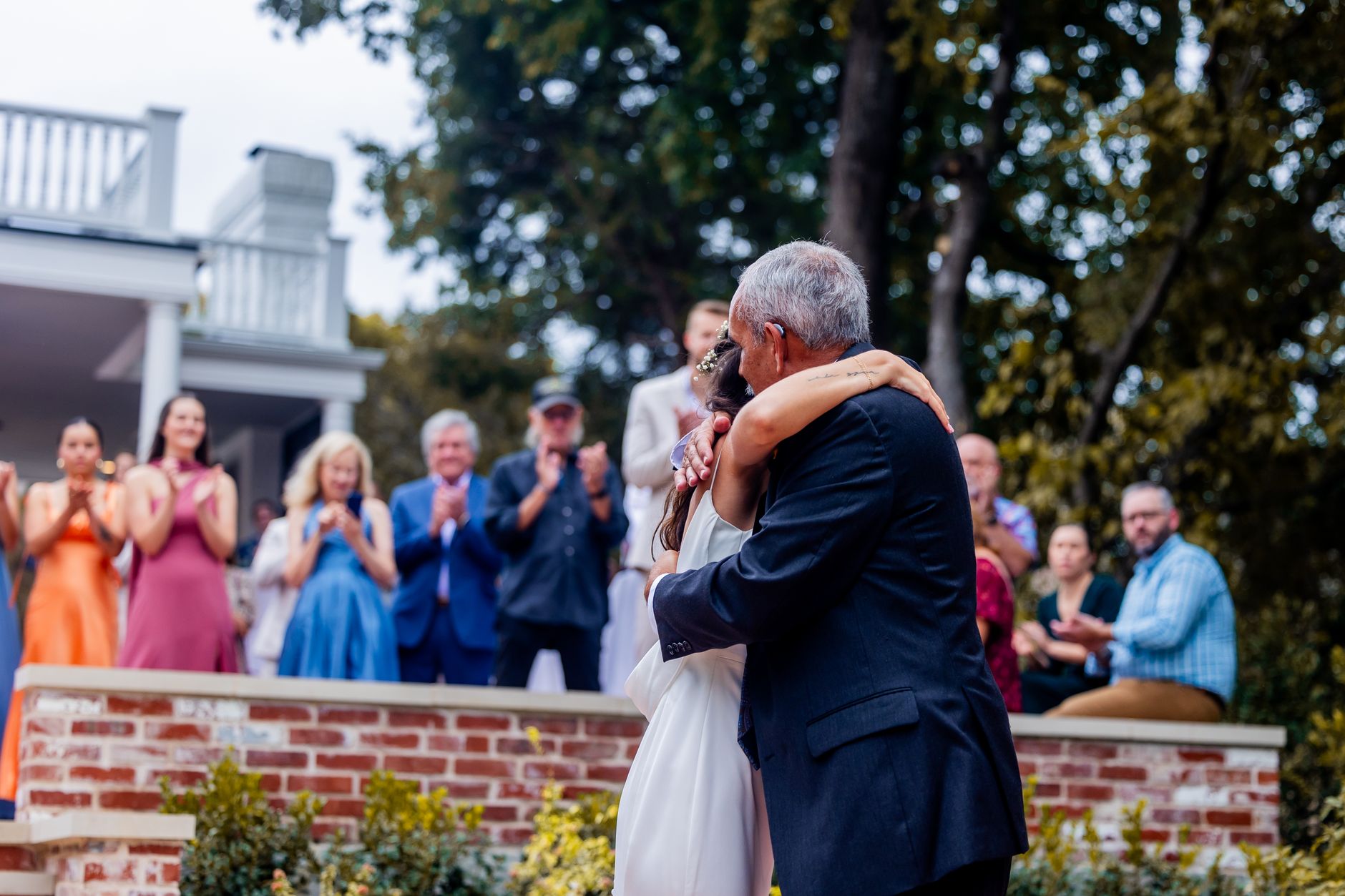
My father walked me down the aisle forty minutes later. He did not say much on the walk itself, which did not surprise me anymore, and did not hurt the way it once would have, because I finally understood what the silence had always been carrying. At the top of the aisle, before he let go of my arm, he leaned in and said, quietly, just for me, “Every year, Melissa. I meant every single card.” And then he took his seat in the front row, next to my mother, the two of them sharing a single tissue between them like the divorced parents of a bride in every wedding movie ever made, and I married a man who has already, in four years, said more out loud than my father managed to send in thirty-three, and who will, I hope, teach our own children a different rhythm than the one I grew up learning.
At the reception, during the toasts, my father stood up without anyone asking him to, which every person at that reception who knew him will tell you was itself a small miracle, and he held a note card in his hand, the same careful pencil printing visible on it from three tables away, and he read four sentences about how proud he was, how sorry he was that it had taken him so long to say so, and how grateful he was that I had given him one more chance to try. He sat back down before anyone could clap for too long, the way he always does, uncomfortable in a spotlight even one he had chosen to step into. But he had stepped into it. That was the whole difference.
I keep the boot box on the top shelf of my closet now, all thirty-three original cards back inside it in order, plus the thirty-fourth, which I have read probably twenty times since my wedding day and expect to read many more times over the years I have left with my father. I have started my own version of his habit, in a smaller way. I bought a card for his birthday this year, and instead of the usual two lines I might once have written out of obligation, I sat with it for a while and wrote him something closer to true, and I mailed it, on time, with a real stamp, because I decided that if he was finally learning how to send the words, the least I could do was make sure mine kept arriving too.
My father is not, and will probably never be, a man who says I love you easily over the phone or across a kitchen table. But I know now, in a way I will never again let myself forget, that he has been saying it every single year of my life, in pencil, in a boot box, in a drawer, waiting for a day he was brave enough to hand it over. He found that day three days before my wedding. I am only sorry it took both of us thirty-three years to meet each other there.
This story is a dramatization. Names, characters, and details are invented, and any resemblance to real people or events is coincidental.