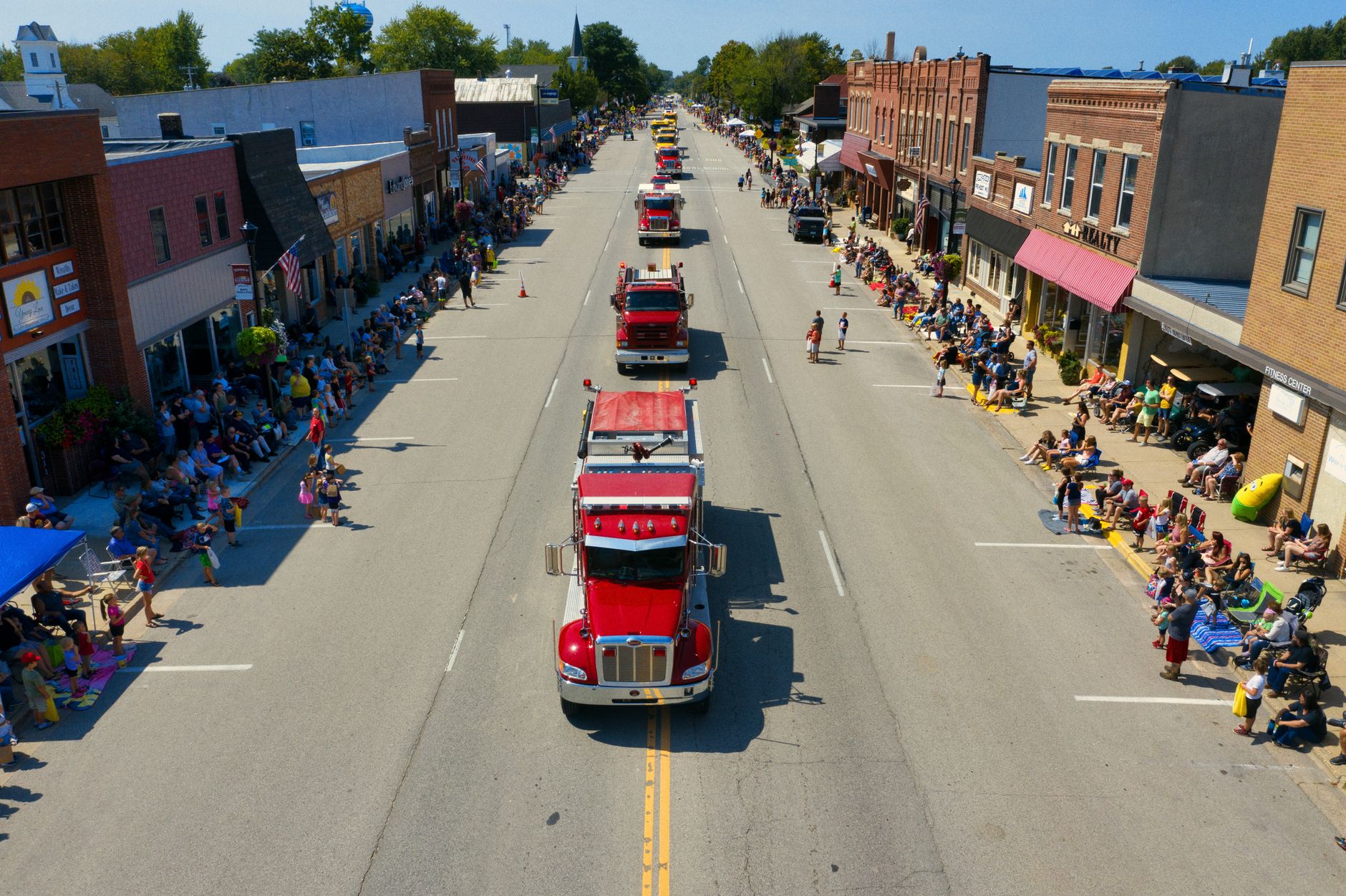
The Parade That Would Not Roll Without Her
My name is Judy Hargrove, and I am seventy four years old. I have lived in Cedar Bend, Iowa my whole life, in a town small enough that the water tower still has my graduating class year painted on the side, faded now, but nobody has ever bothered to paint over it. I buried my husband Walt nine years ago, and I buried my mother and father in the same cemetery long before that, and I thought by this point in my life I understood most of what grief and pride and stubbornness could teach a person.
I did not know a parade could teach me something new about all three in the same June morning.
This is the story of the Cedar Bend Founders Day parade, the flood that started it, the thirty years I spent building it into something this whole county looked forward to every summer, and the Tuesday morning a new festival chair named Bonnie Talbot decided I was too old to be part of it anymore. It is also the story of what eleven parade floats did about that, all on their own, without me asking a single one of them to.
I want to start at the beginning, because you cannot understand what that fire engine seat meant to me without knowing what came before it.
*Part One: The Water*
The spring I turned forty four, the river came up faster than anyone in Cedar Bend had ever seen it rise. It crested two feet over the old flood line, and it sat there, brown and patient, for six days. By the time it went back down, half of Main Street was ruined. The hardware store lost every board on its lower shelves. The bakery lost its ovens. My father’s old insurance office, the one he had run for thirty years before he passed and I kept renting out to a young accountant, sat under four feet of water long enough that we had to gut it down to the studs.
Walt and I did not lose our house. We were up on the rise past the Lutheran church, high enough to stay dry, and for the first few weeks after the water went down I felt a strange, guilty kind of gratitude that curdled fast into something closer to grief. I would drive down Main Street and watch grown men standing in front of their ruined shops with their hands on their hips, not saying anything, just looking, the way you look at a friend in a hospital bed when you are not sure what to say.
People started talking about Cedar Bend the way you talk about something that might not make it. A few families packed up and moved to Ottumwa or Des Moines where the work was steadier. The high school enrollment dropped two years running. I remember standing in the Piggly Wiggly parking lot listening to two women I had known since grade school talk about whether the town was even worth staying in anymore, and something in me went hot and stubborn in a way I did not fully understand until years later.
I did not have money to rebuild anything. Walt and I were raising two kids on his mechanic’s wage and whatever I brought in substitute teaching, and there was no envelope in our budget marked “save the town.” What I had was a folding card table, a stack of index cards, and, according to my late husband, a stubborn streak that could crack a walnut without a nutcracker.
So I did the only thing I knew how to do. I went door to door.
I asked the hardware store, still gutted, still smelling of river mud, if they would build a float for a parade that summer. I asked the bakery the same thing, and the feed store, and the volunteer fire department, and the tiny VFW post above the old bank building, and the garden club, and every church in town that would return my calls. I told them all the same thing. I told them Cedar Bend was not finished, and I wanted proof of it rolling down Main Street where everybody could see.
Most of them thought I was out of my mind. A parade, that summer, with the bakery still gutted and the hardware store’s shelves still warped from the water. But enough of them said yes that by the middle of June, we had four floats and one borrowed tractor lined up at the edge of the fairgrounds, ready to roll down a Main Street that was still half boarded up.
I rode in front of that first parade on the back of my father in law’s old pickup truck, holding a hand painted banner that said Cedar Bend Founders Day across two bedsheets sewn together, because we did not have money for a real banner yet either.
People cried watching that parade. I cried driving it. It was four floats and a tractor and a bedsheet banner, and it was the most important thing I had ever built in my life up to that point, prouder even than the house Walt and I paid off eleven years later.
*Part Two: Thirty Years of Sashes*
That first Founders Day parade became a second one the following June, and then a tradition nobody in Cedar Bend seriously questioned again. Every year, the week before the parade, I would sit at my kitchen table with the same stack of index cards, calling every business and club in town, asking who wanted a spot in the lineup, sketching out the route on the back of an envelope the way I had the very first year.
I sewed my own sash the week before that first parade, out of a length of red fabric left over from a church quilting project, with Cedar Bend Founders Day stitched across it in gold thread that my mother helped me get straight. I wore that same sash every year after, mending it twice when the stitching wore thin, because it never once occurred to me to replace it with something new. It did not need to be new. It needed to be mine, and it needed to remember what it had seen.
The town grew the parade around me more than I ever grew it myself, if I am honest. By year five we had the high school band. By year ten the fire department had restored an old 1951 fire engine specifically to serve as the lead vehicle, chrome polished, siren silent, room enough on the running boards for me to stand and wave the whole route. By year twenty we had eleven floats most summers, sometimes twelve, businesses and clubs and churches from three counties competing for a spot in the lineup because being in the Cedar Bend Founders Day parade had become, in its small way, something to be proud of.
I rode that fire engine every single year for thirty years, right behind the color guard, wearing that same red sash, waving to people I had taught in Sunday school, people whose children I had taught in Sunday school, people whose babies I had rocked at the church nursery back when my own kids were small enough to need rocking themselves.
Walt used to stand on the corner by the bank with a thermos of coffee and watch me go by every year, and every year he would tell me the same thing when I got home that night, that I looked exactly like I did the first year, minus the bedsheet banner. He died nine years ago, a heart attack on a Sunday morning while he was out checking on our old dog in the yard, and the first Founders Day parade after that was the hardest one I ever rode. I almost did not go up on that fire engine at all that June. But I told myself Walt would have wanted the corner by the bank to have someone standing there waving back at me even if it was not him, and I rode it anyway, and I have ridden it every June since.
Thirty years. Thirty sashes’ worth of wear on the same piece of fabric, mended twice, never replaced.
*Part Three: The Chamber Brings in Bonnie*
Last winter, the longtime chamber of commerce director, a good man named Pete Voss who had worked alongside me on that parade committee for almost twenty years, retired to be closer to his grandchildren down in Cedar Rapids. The chamber board, younger now than it used to be, hired a woman named Bonnie Talbot to take over as the new festival chair, on top of her other chamber duties.
Bonnie was not from Cedar Bend originally. She had spent years doing marketing for a chain of car dealerships over in the Quad Cities before she and her husband moved out here for what she called “the small town lifestyle,” and I want to be fair to her where fairness is due. She was organized. She showed up to meetings with binders and spreadsheets, and she truly believed, I think, that the parade needed what she kept calling “a fresh brand” to keep pulling in the crowds it always had.
At the first planning meeting that spring, she stood in front of the committee with a laptop and a projector and walked us through a new logo, a color coded sponsorship tier system with bronze, silver, and gold banner placements on the floats, and a plan to livestream the whole parade on the chamber’s social media accounts.
Some of it, honestly, was not a bad idea. I have never once believed a town has to stay small minded just because it stays small in size, and I told her so at that first meeting, that I was glad to have some fresh energy on the committee after so many years of doing things the same way.
What I did not expect was for the fresh energy to eventually turn its attention to me.
It started small. Bonnie mentioned, at the second meeting, that she thought the parade needed “a more contemporary face up front for the photos,” and I did not think much of it at the time, because I assumed she meant somewhere further back in the lineup, maybe a new banner design, not the actual lead position I had held for three decades.
By the third meeting, in early May, she brought her niece to sit in on the committee. Kayla Vance was twenty four, worked in real estate over in the county seat, and had built up a modest following on her phone taking videos of houses for sale set to music. Bonnie introduced her as “someone who really understands how to reach a younger audience,” and I clapped along with everyone else, because I had no reason yet to think Kayla’s presence on the committee had anything to do with me.
I found out exactly what it had to do with me at the final planning meeting, two weeks before the parade.
*Part Four: The Meeting*
We met that Tuesday evening in the back room of the library, the same room the committee has used for planning meetings for as long as I can remember, twelve folding chairs around three long tables pushed together, a coffee urn that has been older than some of the committee members. Bonnie stood at the front with her laptop, same as always, walking us through the finalized lineup order, the route map, the volunteer assignments for the barricades.
Near the end, she pulled up a slide with a photograph of the restored fire engine on it, and she said she wanted to talk about “refreshing the lead vehicle experience this year.”
I remember smiling, thinking she meant new decorations, maybe new bunting for the fire engine, and I said something like that sounds nice, what did she have in mind.
“We’re going to give the lead position to Kayla this year,” Bonnie said, not quite looking at me directly. “She’s got the reach for the photos, and honestly, I think it’s time we had a fresh face up front.”
I sat there for a second not understanding what she meant, because in my mind the lead position had never once been separate from me in thirty years. I asked her, as evenly as I could manage, whether she meant Kayla would be riding alongside me on the fire engine this year, or in the second spot in the lineup.
Bonnie set down her laptop remote. “I mean instead of you, Judy,” she said. “No offense, but you’ve had thirty years up there. I think the town’s ready for someone else to represent it.”
I asked her, and I will admit my voice was not entirely steady by then, why now, after everything, and what exactly had changed.
She looked at me the way you look at someone you have already decided not to argue with. “You’re seventy four,” she said. “I just think we need a fresh face. Someone who represents where this town is headed, not just where it’s been. No offense, but you’re too old to represent this town anymore.”
Nobody at that table said a word. I looked around at faces I have known my whole life, Sharon from the garden club, Frank from the VFW post, Danny from the volunteer fire department that restored that engine with their own hands and their own money over three winters, and every one of them looked down at the table or out the window, the way people do when a thing has been said out loud that everyone can feel but nobody yet knows how to answer.
I did not argue. I have never much been a person who argues in front of a room. I nodded, and I told Bonnie that I appreciated the thirty years the town had let me be a part of this, and I gathered my index cards and my purse and I drove home.
*Part Five: The Kitchen Table*
I want to be honest with you about that night, because I think honesty is the only thing worth offering after a story like this one.
I cried in my kitchen, at seventy four years old, over a parade. I am not embarrassed to tell you that, though I will admit I felt foolish while it was happening, sitting there at the same kitchen table where I had once spread out index cards for four floats and a borrowed tractor, thinking about a red sash sewn out of leftover quilting fabric that I would not be wearing this June for the first time in thirty years.
It was never really about riding on a fire engine. I want to be clear about that. It was about a promise I made to a drowned town when I was forty four years old, standing in a parking lot listening to two women wonder out loud if Cedar Bend was even worth staying in anymore. The promise was that we were not finished. Every June, for thirty years, riding that fire engine down Main Street was how I kept renewing it, out loud, in front of the whole town.
I did not call anyone that night to complain. I did not post anything on the chamber’s Facebook page, though I will admit I thought about it. I made myself a cup of tea, and I looked at that mended red sash folded in the bottom drawer of my dresser, and I decided the only thing I had any control over was whether I was going to show up anyway.
So I decided I would go. I would stand on the curb like every other resident of Cedar Bend, and I would watch a parade I had built roll past me for the first time in thirty years from the sidewalk instead of the front seat.
*Part Six: The Curb*
Parade day came up bright and clear, the kind of blue sky June morning that makes Main Street look like it was built for exactly this. I put on a clean yellow dress, the kind Walt always liked, and I drove down to Main Street early, same as I always had, except this time I parked two blocks away and walked to the start line like anybody else in town.
I found a spot on the curb outside the bank, right at the corner where Walt used to stand with his thermos every year, and I stood there with my hands folded, watching the color guard step off right on schedule, the high school band tuning up behind them, the whole familiar machinery of a parade I had built from a bedsheet banner turning over exactly the way it always had.
Bonnie’s convertible pulled into the lead position where the fire engine always sat. Kayla rode in the back seat, waving, wearing a sash that I could see even from the curb still had a small paper tag folded and pinned under the clasp, the kind that comes from the store.
The convertible rolled forward past the color guard, past the bank, past me, and Kayla waved in my direction with a smile that told me she had no real idea what had happened at that library meeting, or what that sash represented to the woman standing on the curb watching her wear it.
Behind the convertible came the floats, in the exact order they had rolled in for thirty years, because I had staged that lineup with my own two hands two weeks earlier, before I knew I would not be leading it. The fire department’s ladder truck decorated in red white and blue bunting. The VFW Post 214 float with its honor wreath and its folded flag display. The 4-H club’s hay bale float with the kids waving from the top. The garden club’s flower covered trailer that Sharon and her volunteers had spent two full days wiring by hand. The Rotary Club. The feed store. The historical society’s antique tractor. Eleven floats in all, exactly the count I had written on my index card two weeks before, back when I still expected to be sitting on the fire engine in front of all of them.
The convertible rolled on past the start line and kept going, alone, toward the rest of the route.
And then, one by one, the eleven floats behind it stopped.
*Part Seven: What Eleven Floats Did*
I did not understand what was happening at first. I thought there had been some kind of mechanical trouble, a stalled engine, a barricade out of place. But then I saw Danny Kessner, chief of the volunteer fire department, climb down off the ladder truck he had spent three winters restoring with his own crew, and start walking straight toward me on the curb.
Behind him, Frank Delgado climbed down off the VFW float, the same Frank who has stood beside me at that folding table every single planning meeting for the last fifteen years, a Vietnam veteran who has never once missed setting up that honor wreath by hand.
Behind him came Sharon from the garden club, and then the 4-H leader, and then, one after another, drivers and volunteers off nearly every float in that lineup, engines still idling, floats sitting parked at odd angles across Main Street, until half the parade had come to a dead stop in front of a crowd of a few hundred people who had suddenly gone very quiet trying to figure out what they were watching.
Frank got to the curb first. He is not a man who wastes words, so he did not waste any then. “We built these floats for Founders Day,” he said. “Judy is Founders Day. We are not rolling one more foot down this street without her.”
I stood there with my hand over my mouth, and I could not have spoken even if I had known what to say.
Danny said something close to the same thing, that the fire department did not restore that engine for a stranger’s niece to ride in it, they restored it because it was the vehicle Judy Hargrove had ridden in every June for thirty years, and if the chamber wanted their engine in the parade, it was going to have Judy Hargrove on it or it was going to stay parked at the fairgrounds.
Sharon hugged me before she said a single word, and when she finally did speak, she said the garden club had wired six hundred silk flowers onto that trailer over two full days thinking about the woman who talked them into building their very first float twenty two years ago, and she was not about to let that woman watch it roll by from a sidewalk.
By then, word had traveled far enough down the line that Bonnie’s convertible had come to a stop up ahead too, and Bonnie herself came walking back down Main Street, heels clicking against the pavement, her face somewhere between confused and furious, demanding to know why half her parade had stopped dead in the road in front of two counties worth of visitors and a livestream camera she herself had set up on a tripod near the reviewing stand.
Frank Delgado turned to face her before I could say a word. “We’re not moving,” he told her, plain as anything, “until Judy’s back where she belongs.”
I wish I could tell you Bonnie apologized right there on the spot, gracious and immediate, the way you would write it if you were making the story up instead of living it. She did not. She stood there for a long moment, looking at eleven parked floats and a crowd of a few hundred people now filming the whole thing on their phones, and something in her face shifted from anger to a kind of calculation, the look of a person doing math on how this was going to look on the very livestream she had set up herself.
“Fine,” she said, finally. “Fine. Get her on the engine.”
Danny did not wait for a second invitation. He walked me straight to that fire engine himself, helped me up onto the running board the same way he had every June for the last decade, and somewhere behind us, somebody, I still do not know who, had pulled that same mended red sash out of a box in the fire department’s supply closet, where it turned out Sharon had quietly stashed a spare copy years earlier, “just in case,” she told me later, without ever explaining what she thought the case might have been.
They pinned it on me right there on Main Street, in front of the whole town, and when Danny climbed back into the cab and the engine rolled forward again, every single float behind it started rolling too, right on cue, exactly the way they had for thirty years.
I rode the rest of that parade with tears running down my face the entire route, waving at people I could barely see clearly, past the corner by the bank where Walt used to stand with his thermos, past the rebuilt hardware store and the rebuilt bakery, past the spot where my father’s old insurance office once sat gutted under four feet of river water.
*Part Eight: What Happened After*
Kayla, to her credit, came and found me at the fairgrounds after the parade ended, and she looked truly shaken. She told me she had no idea about the library meeting, that her aunt had simply told her the town wanted fresh energy up front and she had believed it, and she apologized in a way that felt real to me, young and a little embarrassed and entirely sincere. I told her there was nothing for her to apologize for. She had not asked to be handed a sash that belonged to someone else. I told her Cedar Bend could use young energy like hers in plenty of other places in this parade, and I meant it, and this year she is helping run the 4-H float instead, by her own request.
Bonnie stayed on with the chamber through the summer, though something had clearly shifted in how the committee treated her after that morning. By the fall planning meeting, she resigned from the festival chair position, citing, in an email to the board, “a difference in vision for the event’s direction.” Pete Voss, our old chamber director, came out of retirement for one season to help transition a new chair, a younger man named Curtis Boyd who grew up three streets over from me and asked, at his very first meeting, whether the committee thought I would consider staying on as Founders Day chair emeritus for as long as I wanted the job.
I am seventy five now. I rode that fire engine again this June, same sash, a little more mended than it was last year, right behind the color guard, past the corner by the bank, past eleven floats that this time nobody had to stop and argue for.
The Cedar Bend Sentinel ran a photograph on the front page the week after that first parade, eleven floats parked at odd angles across Main Street, Frank Delgado standing on the curb with his arms crossed, and underneath it a caption that simply read, “The Parade That Would Not Roll Without Her.” Sharon had it framed and hung it in the fire department’s break room, where it still hangs today, next to a photograph of that very first parade thirty years ago, four floats and a borrowed tractor and a woman on the back of a pickup truck holding a bedsheet banner she had sewn herself.
I think about that morning often, standing on the curb in my yellow dress, certain that thirty years of Junes had come to a quiet, dignified end. I did not know that the town I had spent three decades building a parade for had been quietly building something back the whole time, something sturdier than a sash or a seat on a fire engine, something that showed up, engines running, the very first time anybody tried to tell them Cedar Bend did not need me anymore.
I still keep that first bedsheet banner folded in a cedar chest in my hallway, next to Walt’s old thermos. Every June, before the parade, I take it out and look at it for a minute before I put my sash on, just to remember where this whole thing started, four floats and a stubborn woman who refused to believe a drowned town was finished.
Eleven floats told a new festival chair otherwise on a Tuesday morning in June, and I do not think Cedar Bend will ever need to have that argument again.