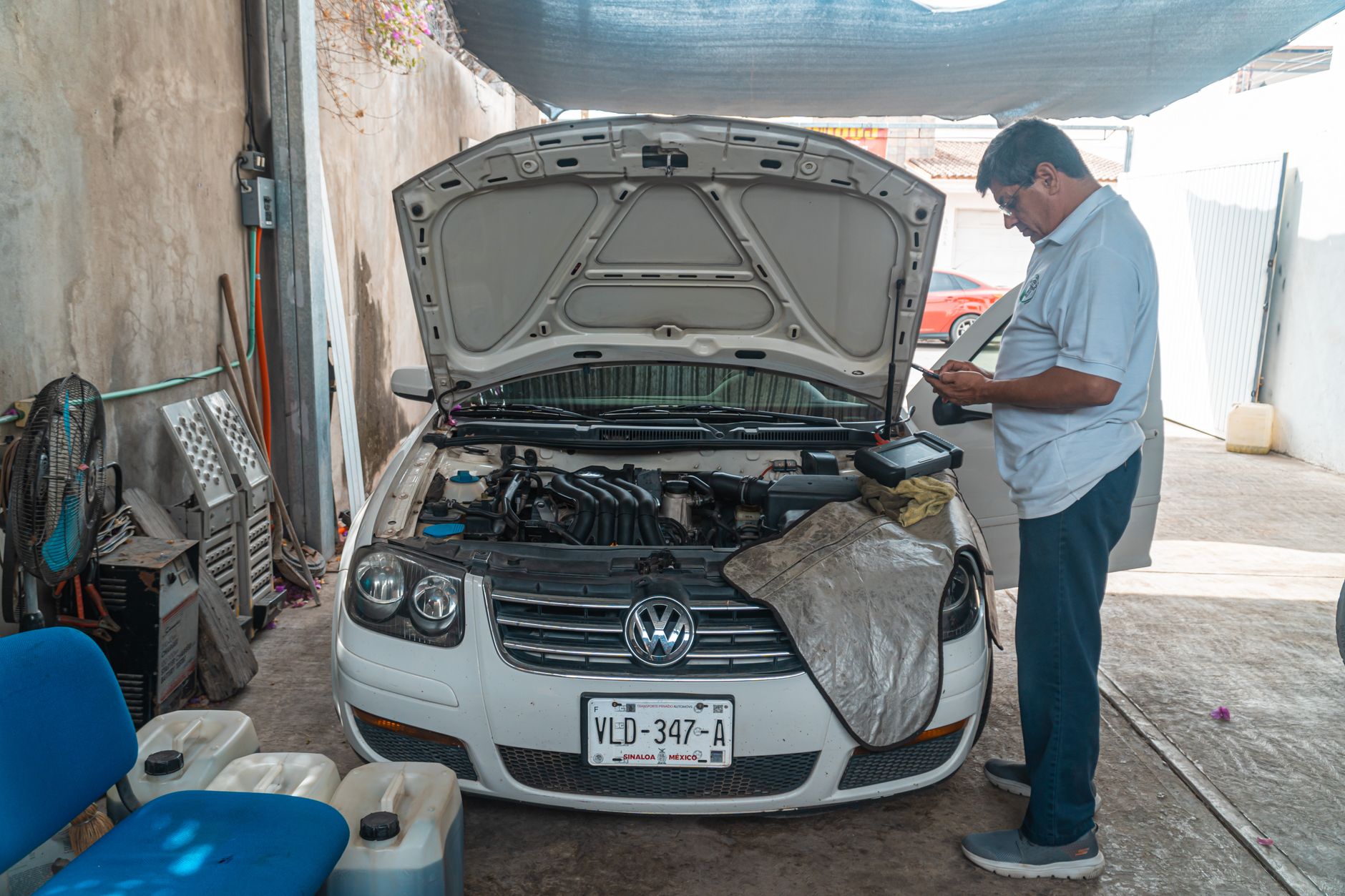
The Mechanic Who Showed Her the Truth
My name is Arlene, and I am sixty-eight years old. For forty-one years I was married to a man named Roy who could fix anything with an engine in it, and who never once let me stand at a parts counter or a service desk and get talked into something I did not need. I did not know, when he died, that I was going to have to learn how to do that for myself, at my age, alone.
Roy passed two springs ago, in March, on a Tuesday morning while I was making his coffee in the next room. Heart, the doctor said, quick and quiet, the kind of death people tell you to be grateful for because it did not drag on. I have never quite managed to be grateful for it. I have managed to get up every day since and keep going, which is a different thing, and some days it is the only thing.
This is a story about a Tuesday like that one, a year and a half after Roy died, and about a car, and about twenty-nine hundred dollars, and about a young man I had never met before that morning who changed how the whole thing ended.
The first year after Roy died, I did not drive much of anywhere. My son-in-law came by and checked the oil and the tire pressure without me having to ask, and my neighbor Ilene, who has been widowed longer than I have, taught me how to read the gauges and what the little lights on the dashboard meant, one at a time, over coffee at her kitchen table, the same way you might teach a child the alphabet. I was not proud of needing to learn it that late in life. I was proud, some, of learning it at all. Roy would have been proud of that too, I think, though it took me a long while to be able to think that without it turning into grief instead.
There is a particular kind of loneliness that comes from being the one left holding all the decisions. Roy decided which mechanic to trust, which insurance agent to call, which of our two vehicles to keep when we finally sold the truck. He was not controlling about it. It was simply how our marriage had settled after forty-one years, each of us carrying certain rooms of the house so the other one did not have to think about them. When he died, every room in that house became mine to carry, whether I knew the first thing about what was in it or not.
I want to tell you about the drive I was getting ready for first, because it matters to what happened.
My daughter Renee lives two hundred and forty miles from me, out past the county line and into the next state, in a little town with one stoplight and a good school and a house with a yard big enough for my two grandbabies to run themselves tired in. Wyatt is seven. Della just turned four. I make the drive out to see them every six weeks or so, and I had a trip planned for that Friday, because Della’s dance recital was Saturday morning and I had promised her, cross my heart, that Grandma Arlene would be sitting in the third row.
Roy always did the car before a long trip. He would spend a Saturday morning with the hood up, checking this and topping off that, and I would bring him coffee and stand in the kitchen window and watch him work, and never learn a single thing about what he was doing, because why would I need to. That is the honest truth of it. I was not stupid. I was married to a man who did not want me to have to be anything but happy, and so I never had to be capable, not in that particular way, and when he died I found out all at once how many particular ways there were.
So that Tuesday I did what I have learned to do since Roy passed, which is drive the car to a shop and ask them, plainly, to look it over before I trust it with two hundred and forty miles of highway and my grandbabies waiting at the other end.
I chose Draper’s Automotive because it has been on the edge of our town since before I was married, a low brick building with four bay doors that stay open in good weather, and because everybody I have ever known has taken their car there. Gene Draper built that shop with his own two hands back in the sixties, starting with one bay and a hand-crank lift, and grew it up slow and honest over forty years. My father took his truck there. Roy took our cars there. It never occurred to me, walking in that morning, to wonder whether anything at Draper’s had changed.
The waiting room still had the same cracked vinyl chairs I remembered from years back, the same coffee maker that had probably brewed a thousand pots of coffee nobody complained about because it was free and hot, the same corkboard by the door with flyers for a lost cat, a church rummage sale, a Little League sign-up sheet gone yellow at the corners. It smelled like it always had, motor oil and rubber and the particular dust that collects in a garage no matter how often you sweep it. I sat down and felt, for a moment, something close to comfort, the kind of comfort that comes from a place staying exactly as you remember it.
There was another woman in the waiting room when I came in, younger than me, maybe fifty, thumbing through her phone with her purse in her lap. I did not think anything of her at the time. I only remembered her afterward, when Gene pulled up the ticket history and I realized she might have been the very last customer Merle had upsold before it was my turn.
Something had changed, and I did not know it yet, and it was standing behind the counter in a company polo shirt with his hair combed flat and shiny, holding a tablet like it was a Bible he was about to read from.
His name was Merle. I did not catch a last name that morning, though I would learn it soon enough, along with a good deal more about him than his name.
A young man in coveralls took my keys first, before Merle ever came out front. He introduced himself as Dean, told me it would be about twenty minutes for the once-over, and pulled my Buick into the second bay himself, whistling something under his breath as he went. I remember thinking he had a kind face, the kind of open, unguarded face you do not see as much as you used to on young men, and I thought nothing more of it than that. I sat down in one of the plastic chairs along the front window and waited, watching the bay doors, watching my car go up on the lift, watching Dean crouch down under it with a little flashlight in his teeth.
Twenty minutes later, it was not Dean who came out to talk to me. It was Merle.
He did not sit down across from me. He stood, which I have thought about since, because standing over a seated person is a way of making yourself taller than you already are, and I do not think that was an accident. He held the tablet where I could half see it and started talking before I had even fully looked up at him.
The control arm was cracked, he said. That was fourteen hundred dollars.
The brake lines were worn through, corroded, he said, dangerous, and that if I did not get them done before a long highway drive I was taking a real risk. Nine hundred dollars.
The serpentine belt tensioner was failing, he said, and could seize up and strand me on the interstate with no warning at all. Six hundred dollars.
He added it up out loud for me, the way you would for a child doing arithmetic. Twenty-nine hundred dollars. He turned the tablet toward me for just a second, a photo of some grease-blackened, dented piece of metal that could have been anything, could have been off any car in any junkyard in the state, and then he turned it back before I had gotten a real look. I did not know a control arm from a coffee can. I had no way to argue with a man in a company shirt holding a screen and talking that fast, throwing numbers at me like he was daring me to catch one.
I asked him, as steady as I could manage, whether the car was safe to drive at all right that minute, thinking maybe I could put the bigger repairs off a week or two and save for them properly the way Roy and I always used to save for anything that cost real money. Merle shook his head slow, like the question pained him on my behalf. He said a control arm that far gone could let go without warning, that brake lines in that condition were the kind of thing that made the evening news, and that he would not feel right sending a woman my age out onto the interstate in a vehicle he personally would not put his own mother in. He said that last part with his hand pressed flat over his chest, like it cost him something to say it.
I want to be honest about how well it worked. It is easy, hearing this story secondhand, to think you would have seen through it in a minute. I did not see through it. I sat there doing the math on my savings account in my head, thinking about which certificate of deposit I would have to break early, and feeling grateful, actually grateful, that a stranger in a company polo shirt seemed to care whether I made it to my granddaughter’s dance recital in one piece.
And then he said the thing I have not been able to stop turning over since. He looked at me, not unkindly exactly, the way you look at someone you have already decided cannot follow you, and he said it was not safe for a woman my age to be driving a car in this kind of condition. Two hundred and forty miles, alone, with brakes like that.
I felt my whole face go hot, the particular kind of hot that is shame and fear braided together so tight you cannot tell which thread is which. I thought about Della in her little recital costume, waiting on Grandma Arlene in the third row. I thought about breaking down on the shoulder of some highway in the dark with nobody but me to call, because there is no more Roy to call, there has not been a Roy to call in a year and a half, and some days that fact still lands on me new. I opened my purse. I got out my checkbook. My hand was not quite steady, and I remember being embarrassed about that too, on top of everything else.
I had the pen uncapped when I heard a voice, low, off to my left.
It was Dean. He had come around the side of a rolling toolbox near the second bay, and he was not calling out, he was waving, small, almost secretive, the kind of wave you give someone when you do not want to be seen giving it. I looked at Merle. Merle was already turned toward his little office, pulling up something on the shop computer, an invoice screen, not paying either of us any mind.
I do not fully know why I got up and walked over. I think some old instinct in me, the one that used to watch Roy work on Saturday mornings and pick up more than I realized I was picking up, told me to go.
Dean did not say much at first. He led me back to his own bay, where my Buick still sat up on the lift, and he pointed to his workbench. There was a part sitting there, gray metal, a curved arm with a bushing at each end, and it still had a manufacturer’s tag zip-tied to it, still had a strip of factory plastic wrap that had not even been cut open.
I asked him what it was.
He glanced back toward the office, where Merle was still bent over the computer, and then he said four words to me, quiet, almost apologetic, like he hated being the one to say them.
That’s your control arm.
I did not understand at first. I told him I thought mine was cracked, that was what Merle had said, fourteen hundred dollars worth of cracked.
Dean shook his head. He said that part on his bench had never been on my car or anyone’s car. It had come out of a box on the parts shelf that morning, one of a dozen just like it, standard stock for a Buick that age. He said Merle’s photo, the grainy one he’d flashed me for two seconds and pulled away, was not a picture of anything underneath my car. It was a stock photo Merle kept saved on that tablet, the same photo, Dean said, he had personally watched Merle show to at least four other customers in the six months since Gene had hired him on, always customers who came in alone, always older, always women.
Dean walked me back to the lift and got down on one knee, and shined his flashlight straight up onto the actual control arm still bolted onto my actual car, still coated in the same factory undercoating as the day it left the plant, dusty, a little road grime, not one crack anywhere on it. He showed me the brake lines too, original, intact, nothing corroded through. He showed me the serpentine belt, worn some the way any belt on a nine-year-old car is worn some, with maybe eight or ten thousand miles left in it and not one thing wrong with the tensioner.
He explained it to me slow and plain, the way you would explain something to somebody you respected rather than somebody you were trying to get past. He said a cracked control arm does not sit quiet. It clunks over bumps, it pulls the steering to one side, it announces itself long before a mechanic ever needs a photo to prove it. My car had none of that. He said the same about the brake lines, that a line worn through enough to be dangerous would already be leaving a wet stain on the concrete under the car, and there was no stain anywhere under mine, not a drop.
He told me he had clocked it inside the first five minutes of the inspection, because he does the same walk-around on every car, and he already knew, before Merle ever came out front, that there was nothing on my invoice that matched what he had actually found underneath. He said this had happened enough times since Merle started that he had begun quietly keeping his own mental list, though he had never worked up the nerve to say anything to Gene directly, worried it would come down to his word against a service manager’s and he would be the one who ended up let go for causing trouble.
My car needed an oil change. That was the whole truth of it. Forty-two dollars.
I stood there under my own car with a twenty-four-year-old mechanic’s helper holding a flashlight, and I felt something in my chest that I can only describe as the ground coming back up under my feet after a long time of not quite being sure it was there. I had spent a year and a half believing that being alone meant being an easy mark, that every counter I stood at from now on would require me to somehow already know what I did not know. Dean’s flashlight beam on that clean, uncracked piece of metal told me something different. It told me the truth does not actually hide. It only waits for somebody willing to point a light at it.
I asked Dean why he was telling me this. He could have said nothing. He could have let Merle write the ticket, let me sign the check, and gone on with his day, and nobody would have known any different, least of all me.
He told me his own grandmother had been sold a transmission she did not need at a shop two towns over, three years back, before he ever got into this trade, and that it was part of why he had gotten into it at all, so he could be the kind of mechanic who did not do to anybody’s grandmother what had been done to his.
I asked him if he was worried about his job.
He said he was more worried about what kind of man he would be if he watched it happen and said nothing. He was young enough to still talk like that and mean it all the way down, and I believed him.
That was when Gene Draper walked in.
I did not know it was him at first. He was an older man, seventy or close to it, in a faded shop shirt with his name stitched on the pocket, walking slower than he used to, I would learn later, because his wife Doris was six months into chemotherapy and he had been splitting his days between the shop and the hospital in the county seat, which was exactly why he had hired Merle on as a service manager in the first place, to run the front counter while he could not be there every hour the way he always had been.
Dean did not wait for me to decide what to do. He walked straight up to Gene, right there in the bay, and told him what he had just shown me, plainly, without hedging, in front of me.
I watched something go across Gene Draper’s face that I recognized, because I had felt a version of it myself an hour earlier. Shame is not too strong a word for it, though it was not his shame to carry. It was the look of a man realizing that while he was doing right by his sick wife, something had crept into the business his own father had started, something he would have to answer for whether he liked it or not.
He did not raise his voice. He asked me to come sit in his office, and he pulled up the shop’s ticket history right there on his own computer, going back six months, ever since Merle had started. He found four other tickets with that same control arm line item, that same nine hundred dollar brake line charge, that same six hundred dollar belt tensioner. Every single one of them billed to a woman. Every single one of them over sixty. One of them was Verna Pruitt, who lives two streets over from me and had complained to her daughter about a car repair bill back in the spring, and her daughter had told her that’s just how shops are now, and Verna had paid it and never thought to ask anybody else.
Gene called Merle into that office while I was still sitting there. I will not repeat everything that was said, because a good deal of it was not meant for me to hear and Gene did lower his voice for that part, out of some old-fashioned instinct not to humiliate a man in front of a customer even when the man had earned every bit of it. But I heard enough. I heard Gene ask him how many more tickets there were going to be if he pulled the history back further than six months. I heard Merle start in on an excuse about upselling being standard practice everywhere, that every shop in the state padded a ticket here and there and he was only doing what kept the doors open while Gene was away half of every week at the hospital. I heard Gene’s voice go very quiet at that, quieter than shouting, and he said there was a difference between upselling a filter and inventing a cracked part off a photo he kept saved on a tablet for exactly this purpose, and that difference was the difference between a business and a con, and that he would not have his father’s name over a door that ran the second one.
Merle tried, from what I could hear, to make it about the shop’s numbers, said margins on oil changes and tire rotations barely covered the lights, that a service manager was supposed to find revenue where he could. Gene told him revenue found on a sixty-eight-year-old widow’s fear was not revenue, it was theft with a company shirt on, and that he would rather close every bay door in that building for good than keep a man on the payroll who thought the two were the same thing.
Merle was gone by the time I left the shop that day. Gene walked him out to his car himself and did not shake his hand. I watched through the front window as Merle backed out of the lot too fast, and I noticed Dean standing a little ways off, arms crossed, watching too, not gloating, just making sure it actually happened.
He voided my invoice on the spot, the whole twenty-nine hundred dollars of it, and did my oil change himself, free, out back, while I sat with a cup of coffee and talked with his wife Doris, who had come by the shop that afternoon between treatments and sat with me a while, the two of us widow and almost-widow together, comparing notes on kinds of tired that do not show up on any test.
He also did something I did not expect. He pulled the names off those four other tickets and called every one of those women personally over the next week, refunded every dollar Merle had taken from them, and drove the refund checks out to their houses himself rather than mailing them, because he said a wrong like that deserved to be made right face to face, not through the mail like a bill.
I went with him to Verna’s, at his invitation, because she is my neighbor and he thought it might go easier with a familiar face in the room. Verna Pruitt is seventy-three and lives alone since her husband died the year before Roy did, in the little blue house two streets over with the wraparound porch. She had paid nine hundred dollars back in the spring for what Merle told her was a failing water pump, money she had pulled out of the fund she kept for her grandson’s college, and she had never told a soul because she was embarrassed, the way you are embarrassed about anything that makes you feel like you got the better of yourself instead of the other way around. When Gene handed her that refund check on her own front porch and told her exactly what had been done to her, she cried, and then she laughed, and then she made us both come in for coffee and pie, because that is what you do in this town when something finally gets set right.
He filed a report with the state’s consumer protection division too, on his own, without anybody making him, because he said if Merle had done this at four other shops the way he suspected, somebody needed a paper trail before a fifth widow somewhere lost twenty-nine hundred dollars she could not spare. Gene printed out every ticket, every photo Merle had saved on that tablet, every name, and mailed the whole packet in himself rather than waiting to be asked. I heard later, through Verna, that the state’s board pulled Merle’s repair certification while they looked into it, and that word travels fast enough in three counties that no shop within driving distance would take him on afterward. I do not know where he ended up. I have stopped wondering.
Doris came by the shop again a few weeks after all of it, further along in her treatment, thinner than she’d been that first afternoon but with more color in her face, and she told me Gene had not slept well for nearly a week after he found those tickets, turning over in his mind every customer who might have walked out of his shop shortchanged while he was sitting in a hospital chair holding her hand. I told her that a man losing sleep over four strangers he had never even met was exactly the kind of man I wanted fixing my car from here on out, and she squeezed my hand and said that was Gene all over, had been since the day she married him.
Dean got a raise that same week, and Gene made him lead technician before the month was out, young as he was, because Gene said a shop is only as honest as the least honest person left standing in it, and he intended his shop to be run by the most honest one instead.
I still drive out to Draper’s for everything now, oil changes, tire rotations, all of it, and I always ask for Dean by name, and he always comes out front himself to walk me through whatever the car needs, plain and simple, no tablet, no photo, no talk about what is or is not safe for a woman my age. Gene put a new sign up in the waiting room not long after, small, hand-lettered, nothing fancy: ask to see the part. He said if he was going to run an honest shop he wanted it written down somewhere a customer could see it before they ever needed to ask.
I made it to Della’s recital that Saturday, third row, exactly like I promised. She wore a little yellow costume with a ribbon in her hair and lost her place twice in the middle of the routine and found it again both times, and I do not think I have clapped that hard for anything in a long while. Wyatt sat next to me the whole time explaining, very seriously, that he was going to be a firefighter and also possibly a mechanic, and when I asked him why a mechanic, he said because mechanics get to know true things about cars that other people don’t, and I laughed until Renee asked me what was so funny and I told her I would explain when he was old enough to hear the whole story.
I drove every one of those two hundred and forty miles each way without a single worry, because for the first time since Roy died, I knew for certain that the car under me was telling the truth.
I think about that four-word sentence Dean said to me sometimes, quiet, in a bay that smelled like motor oil and cut grass drifting in through the open door. That’s your control arm. Four words from a twenty-four-year-old that did more to put the ground back under my feet than anything anybody had told me in the year and a half since I became a woman who has to figure these things out alone.
I am not alone in it anymore, not entirely. I know now that there are Deans out there, quiet ones, waving you over before you sign something you should not sign. I hope every woman reading this finds hers before her checkbook is all the way out. And if you have not found him yet, I hope you at least remember this: ask to see the part. Ask them to show you, not tell you. A shop with nothing to hide will always walk you back to the car.