
I have thought a hundred times about how to start telling this, and I keep landing in the same place, which is the ticket booth at the Larkspur County Fair, the summer I turned twenty-two.
I was working the 4-H barn gate that year, taking tickets and stamping hands, wearing a straw hat that did nothing against the August heat. A young man came through the line, paid his dollar, walked the whole length of the barn, and came back around to buy another ticket just so he could talk to me again. He had grease under his fingernails from the tractor pull and a grin like he already knew something good was about to happen to him.
That was Dale Whitfield. He was twenty-four, working for his father at the family implement dealership on the edge of town, and by the end of that fair week he had asked me to the diner on Route 9, the one everybody in three counties calls the Wagon Wheel, for coffee and pie. I said yes. I have never once regretted it, not in thirty-four years, not even on the hardest days, and there were hard days, plenty of them, most caused by the same person.
I need to tell you about Colleen before I tell you about anything else, because Colleen is the reason I am writing this at all.
Colleen Whitfield was Dale’s older sister by six years. When I met the family that first Thanksgiving, Dale’s mother Irene pulled me into the kitchen within twenty minutes and had me peeling potatoes and laughing at her stories like I’d been doing it my whole life. Dale’s father, Vernon, a quiet man who ran the dealership with a soft voice and a firm handshake, told me before dessert that Dale had good taste. Colleen sat at the far end of the table and watched me the way you’d watch a stray dog that had wandered onto the porch. Polite. Distant. Waiting to see if it would need to be shooed off.
I never understood exactly why. I have turned it over in my mind for three decades. My family was not poor, but we were not the kind of family that had a name people in the county recognized either. My father worked the grain elevator over in Milford, the next town east, six days a week, and my mother cleaned houses on Tuesdays and Thursdays to help make ends meet during the years my father was laid up with his back. The Whitfields had owned that dealership since 1961. They had a pew at Larkspur Community Church with a little brass plate on it from a memorial donation. They were, in the way small towns keep score without ever saying so out loud, an old family. I think Colleen had decided long before I ever walked through that door what kind of woman should be standing next to a Whitfield man, and a grain elevator worker’s daughter from Milford was not on the list.
Dale never cared about any of that. He used to tell me, usually with his arm around my shoulders on the porch swing his father built, that the only inheritance that mattered to him was watching his mother laugh so hard at something I said that she had to sit down. He married me on a Saturday in June at Larkspur Community Church, the same sanctuary his own parents had married in twenty-eight years before us, and Colleen stood up as maid of honor because it was expected of her, and she did not smile once in a single photograph from that day. I have the album. I have looked.
For the first several years of our marriage I tried everything I knew to win Colleen over. I brought a green bean casserole to every holiday, the one with the crispy onions on top that Irene had taught me to make, and Colleen would take a small spoonful and set her fork down without another bite. I asked about her children, Mark and Denise, remembered their birthdays, drove two hours each way for Denise’s high school graduation. I never once, in all those years, heard Colleen say my name out loud if she could avoid it. I was “Dale’s wife.” At the hardware store, at church, in the receiving line at funerals. Dale’s wife, like a job title rather than a person.
Dale saw it. He was not blind to his sister, and more than once, usually after a holiday dinner where Colleen had made some comment about how he used to be closer to the family before he got married, he would find me in the kitchen doing dishes with my jaw tight and put his hands on my shoulders. “She’ll come around, honey,” he’d say. “Give her time.” I gave her time. I gave her thirty-four years of time, actually, and I want to tell you plainly, because this story deserves the truth in it: she never came around. Not on her own. Not until the day I am about to describe.
I remember one Easter in particular, maybe our eighth or ninth year married, when I brought a new dish to the potluck table at the church fellowship hall, a strawberry pretzel salad my own mother used to make. Colleen picked up the serving spoon, looked at it, and set it back down without taking any, loud enough for the women standing near her to hear, and said she preferred to stick with recipes that had “always been in the family.” Irene, Dale’s mother, caught my eye across the hall and gave me a small, tired shake of her head, the look of a woman who had spent decades running interference between her daughter’s pride and everyone that pride had ever wounded. I drove home that day with the pretzel salad untouched in the back seat and cried in the driveway before I went inside, and Dale sat with me in the truck until I was ready.
There were other moments like that one, small and sharp, scattered across three decades. Colleen leaving my name off the return address on Christmas cards she sent to our own house. Colleen introducing me at Denise’s confirmation as “Dale’s wife” to a room full of people I had known for twenty years by then. None of it was the kind of thing you could point to and say, here, this is cruelty, look at it plainly. It was smaller than that, and slower, the kind of erosion that wears a person down a grain at a time until one day you realize the ground under your feet has shifted without you ever seeing the moment it happened.
There is one part of those thirty-four years I have never spoken about publicly, and I am only telling it now because of what happened at the funeral, and because I think Dale would want the truth to finally have its say.
Fourteen years ago, Colleen’s husband Ray lost his job when the plant two towns over shut its doors. Colleen never told anyone in the family how bad it got, because pride was the one thing she and I actually had in common, even if we never once admitted it to each other. But I found out, because a woman named Peg who worked the church prayer chain let it slip to me during a quilting circle that Colleen and Ray were three months behind on their mortgage and the bank had sent a letter.
Get a new story in your inbox every morning.
Facebook doesn’t show you every story we post. Our free newsletter does. Join 2,500+ readers.
I did not tell Dale right away. I want to be honest about my reasons. Part of it, God forgive me, was that some small mean part of me thought, well, now she’ll know what it feels like to need somebody’s help and not be sure it’s coming. But that part of me did not win. I sat with it for two days, and then I drove to the bank myself, on a Thursday morning while Dale was at the dealership, and I paid off the arrears on Colleen and Ray’s mortgage. All of it. I told the loan officer, a kind man named Fenwick who had known my father, that I did not want my name mentioned to anyone, not even to Colleen.
When I told Dale that night, sitting at our kitchen table, he was quiet for a long moment, and then he took my hand across the table and said something I have carried with me every day since. He said, “Susan, you are the best of every Whitfield that ever lived, and none of them know it yet.” I asked him please, please, not to tell Colleen it was me. I did not do it so she would owe me something or think better of me. I did it because she was struggling and I could help, and because some things you do for family, real family, quiet, and you let them keep their pride. Dale told Colleen only that “some money came through” from a life insurance policy of his father’s that had been overlooked, a story he made up on the spot to protect me the way I’d asked him to. Colleen believed it. She thanked God, thanked Ray’s cousin who worked at the courthouse for supposedly finding the paperwork, and never once thanked me, because she never knew.
Dale kept that secret for fourteen years. He never told anyone else, not his mother before she passed, not his best friend and business partner Tom Halvorsen, until the very end.
Dale and Tom had run Whitfield Farm Equipment together for thirty years by the time Dale got sick. Tom came to Larkspur fresh out of the Army in his twenties, a mechanic with a good head for numbers, and Vernon Whitfield had hired him on the spot. When Vernon retired, Dale and Tom bought the dealership together, fifty-fifty, shook hands on it at the Wagon Wheel over coffee, and never once had a contract dispute in thirty years because their word was the contract. Tom’s wife Ellen had passed six years back, and after that Tom moved four hundred miles away to Fairview, Ohio, to be closer to his daughter and grandkids, though he and Dale still talked every single week on the phone, sometimes for an hour, about the business, about the Cardinals, about nothing at all.
Dale was diagnosed with pancreatic cancer eighteen months ago. Stage three, the kind of diagnosis where the doctors talk to you gently and the word “aggressive” comes up more than once. He fought it as hard as a sixty-one-year-old body can fight something like that. Chemotherapy through that summer, a surgery in the fall that bought us a little time, and then the slow decline through the winter that anyone who has sat beside a hospice bed will recognize without me needing to describe it further.
I did not leave his side. I slept in the recliner they wheeled into his hospital room, and later, when we brought him home under hospice care, I slept on a cot beside our bed for the last eleven weeks of his life. I learned to manage a morphine pump. I learned how to turn a man who could no longer turn himself so he would not develop sores. I learned what it sounds like when someone you have loved for thirty-four years starts to breathe differently, and I would not trade a single one of those nights, hard as they were, because I would not have let anyone else have them.
Colleen came to see her brother exactly four times in those eleven weeks. Each visit ran about twenty minutes. She would sit stiffly in the chair by the window, ask Dale how he was feeling in a voice that never quite settled into softness, and leave before things got difficult, before the harder conversations, before the moments that actually meant something. I do not say this to be cruel about her. I say it because it is what happened, and because it matters to what came later.
The neighbors were different. Half the county seemed to know, without being asked, that a household with a dying man in it needs casseroles and mowed lawns more than it needs sympathy cards. Men from the VFW post where Dale had been a member for twenty years, though he’d never served himself, his own father had, took turns clearing our long gravel drive after the two big snows that winter. The women from Larkspur Community Church kept a schedule on the fellowship hall bulletin board, and there was rarely a Tuesday or Friday that somebody didn’t show up at the door with a casserole dish and a quiet hug and no expectation of being invited in to talk. I remember thinking, more than once during those eleven weeks, that whatever Colleen believed about who belonged to this family and who did not, this town had already answered the question for her, every single week, without saying a word about it.
I learned things in those eleven weeks I never wanted to learn. How to keep a mouth moist with a little sponge on a stick when swallowing gets too hard. How to read the particular stillness that means pain is building before a person can even say so themselves. How to sit in a dark room at three in the morning and simply hold a hand, not talking, not needing to, because sometimes presence is the whole of what love has left to give. I would not trade a single one of those nights. I have heard people say caregiving breaks you, and maybe it does, some, but it also built something in me I did not have before, a kind of quiet steadiness I lean on still.
Eleven days before Dale died, Tom drove the four hundred miles from Fairview to sit with him. I remember because it was the last good conversation Dale had the strength for, the two of them laughing about a tractor Tom had sold back in 1998 to a man who tried to return it eight months later claiming it was defective, when really he’d just run it dry of oil and burned the engine. Dale laughed so hard that day he had to catch his breath, and it was one of the last times I heard him laugh at all.
At some point that afternoon, Dale asked me to step out and get coffee so he could talk to Tom alone. I did not think much of it at the time. Men have their own conversations, especially two men who had built something together for thirty years and both knew, without either one saying it, that this was likely the last real conversation they would have. I did not learn what was said in that room until the day of the funeral, standing in that same sanctuary where Dale and I had married.
Dale died on a Tuesday morning in March, a little after seven, with my hand in his and the late winter light coming pale through the bedroom curtains. I will not pretend the weeks after are anything I remember clearly. Grief does something to time. I know I picked out the casket. I know I chose the hymns, “Great Is Thy Faithfulness” and “In the Garden,” the two Dale had always said he wanted, half joking, half not, whenever the subject came up over the years. I know Colleen called twice about funeral arrangements, both times to ask, in a tone that was not quite a question, whether I had considered that the family plot at the cemetery had certain traditions about placement, as though I might not understand where my own husband was to be buried.
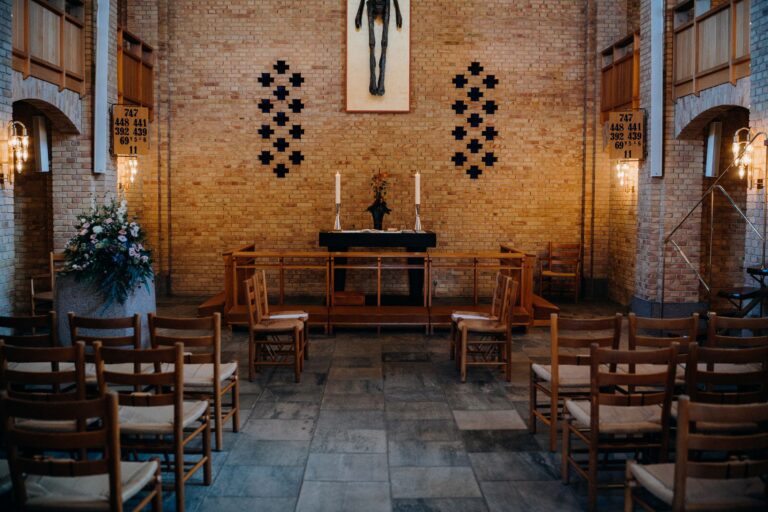
The funeral was held at Larkspur Community Church on a Saturday in late March. It was full. Fuller than I expected, though I should have known better, because Dale had spent thirty years selling and servicing equipment for half the farms in the county, had coached Little League for a decade when our nephew played, had never once, in all the years I knew him, turned away a neighbor who needed a hand with a stuck combine or a broken-down truck, day or night. Two hundred people, easily, filled that sanctuary, the sun coming bright and gold through the tall windows on the east side the way it does in that building in the late morning, the same light that had come through those windows on our wedding day.
Colleen asked, the week before, if she could say a few words at the service. I did not think twice about saying yes. She was his sister. Whatever had passed between us over thirty-four years, she had lost her brother, and I believed, I truly believed, that grief might soften even the oldest grudges.
She started well enough. She talked about Dale as a boy, about him following their father around the dealership floor at six years old with a toy wrench in his back pocket, about a fishing trip the two of them had taken as kids that had ended with Dale falling in the pond and Colleen having to pull him out by his shirt collar. A few people laughed softly. I remember feeling something in my chest loosen, just a little, thinking maybe this was the moment, maybe grief had finally done what thirty-four years of green bean casseroles could not.
And then Colleen’s voice changed. I have replayed it enough times now that I can hear the exact shift, like a door closing somewhere in another room. She said that Dale’s real family, the family that mattered, was the one he was born into, the Whitfields, the ones who had built that dealership and sat in that pew for three generations, not the family he had “married into.” And then she looked straight down the pew at me, in front of two hundred people, in the same sanctuary where I had married him, and said that I had never really been part of this family. That I had married in and stayed an outsider the whole time. That whatever Dale and I had built together did not count the way blood counted.
I sat there in my black dress, my hands folded so tightly in my lap that my knuckles had gone white, and I did not have a single word in me. Thirty-four years of holidays, of caregiving, of every ounce of love I had poured into that family, and in front of the whole county, I had nothing to say back. I remember staring at the hymnal in the rack in front of me and thinking, so this is how it ends, this is the last word anyone will speak over Dale’s family before we bury him.
That is when I heard the side door at the back of the sanctuary open, and the sound of it, quiet as it was, made half the church turn along with me.
Tom Halvorsen was standing up from the last pew. He had come in during the second hymn, late, having driven through the night from Fairview after a delayed flight and a car rental mix-up that I would only hear about afterward. He was in a dark suit that still bore the fold creases from the suitcase, and he stood there a moment, not moving toward the front, just standing, the way a man stands when he has decided something and is giving himself one last second before he does it.
“Colleen,” he said, and his voice carried clean through that sanctuary because it is an old building with good acoustics and because two hundred people had gone dead silent. “I need to say something, and I think Dale would want me to say it now, not later.”
He walked up the center aisle slowly, and I remember thinking, absurdly, in the middle of everything, that he looked older than the last time I’d seen him, that grief ages a man’s face even when the grief is not his own to carry alone.
He stopped near the front, not at the pulpit, just standing in the aisle where everyone could see him, and he looked at Colleen first, and then at me, and then out at the church.
“I’ve known Dale for thirty years,” he said. “We built that dealership together from a two-man operation into the biggest equipment dealer in three counties, and in thirty years I never once heard that man raise his voice at me, and I never once heard him say an unkind word about his sister, even when she gave him plenty of reason to.” He paused there, and I watched Colleen’s face go from confusion to something tighter. “But eleven days ago, when I drove down to see him for what we both knew was going to be the last time, Dale asked Susan to step out of the room so he could talk to me alone. And I want to tell you what he told me, because he made me promise I would, if the day ever came that anyone in this family tried to say Susan wasn’t truly part of it.”
The sanctuary was so quiet I could hear the old radiator ticking somewhere behind the choir loft.
“Fourteen years ago,” Tom said, “when Colleen and Ray were about to lose their house, somebody paid off the mortgage arrears at the bank and asked that their name never be mentioned. Dale told Colleen at the time it was insurance money from their father’s overlooked policy. That wasn’t true. Dale made that story up because the person who actually paid it asked him to, because she didn’t want Colleen to feel indebted, she just wanted her to keep her home. That person was Susan.”
I heard someone gasp, one clear sound in that silence, and I think it might have been Denise, Colleen’s own daughter, sitting three rows up.
“Dale told me because he was dying,” Tom went on, “and because he said if Colleen ever, even once, tried to say Susan wasn’t real family, he wanted somebody left standing who knew the truth and would say it out loud. He said, and I’m quoting him as close as I can remember it, ‘Susan carried that family through the hardest winter it ever had, and she never once asked for credit. If Colleen tries to say she wasn’t family, you tell her the truth, Tom. You tell her Susan is more Whitfield than any of us, because she loved us without asking to be loved back.'”
I want to tell you what the sanctuary looked like in that moment, because I will remember it for the rest of my life. Colleen’s face had gone the color of chalk. Her hand had come up to her mouth. Ray, sitting beside her, had turned to stare at her, his own face working through something I could not name from where I sat, shock, maybe, or fourteen years of unasked questions finally answered. Denise was crying openly. And two hundred people who had spent the last several minutes watching a widow be publicly shamed in her husband’s funeral were now watching the truth arrive, late, but arriving all the same.
I did not stand up. I did not need to. Tom had said what needed saying, and I have never in my life been so grateful to another human being as I was to that man standing in the aisle in his travel-creased suit, keeping a promise to his dying friend.
Colleen did not finish her remarks. She sat down, and I watched her shoulders shake, and for the first time in thirty-four years I saw my sister-in-law cry in front of me without it being about something she’d lost that had nothing to do with me.
The service went on. We sang “Great Is Thy Faithfulness” and “In the Garden,” and Pastor Whitlow gave a eulogy about a man who had spent his whole life fixing things, engines and fences and, apparently, without any of us quite realizing it until that morning, his own family, one quiet act of loyalty at a time.
At the graveside, after the crowd had mostly cleared to head to the fellowship hall for the luncheon, Colleen found me standing alone by the flowers. She did not say she was sorry right away. Colleen has never been a woman who apologizes easily, and I did not expect thirty-four years of coldness to melt in one afternoon. But she stood beside me for a long moment, looking down at the fresh dirt, and then she said, “I didn’t know.”
“I know you didn’t,” I said. “I asked Dale not to tell you. I didn’t do it so you’d owe me anything.”
Colleen was quiet for a while longer. Then she said, so soft I almost missed it, “You could have let me keep thinking it was nothing to do with you. Even after everything I said today, you could have let Tom’s words be enough and never explained yourself further.”
“I’m not explaining myself,” I told her. “I just don’t want you carrying this the wrong way. I didn’t do it to win a war with you, Colleen. I did it because you were struggling, and I could help, and that’s what family does. I always thought that was true even when you didn’t.”
I will not pretend everything healed instantly in a churchyard on a Saturday afternoon in March. Grudges that deep do not dissolve in a single conversation, and I would be lying to you and to myself if I said Colleen and I became close in the months since. But something shifted that day that has not shifted back. She calls me now, every few weeks, sometimes just to talk about nothing, the way Dale and Tom used to. She asked me, this past May, if I would come to Denise’s baby shower, and when I walked in, she introduced me to her side of the family, out loud, in front of everyone, as “Dale’s wife, Susan.” My name. After thirty-four years, my name.
Tom still calls me too, every Sunday evening, same as he used to call Dale. We talk about the dealership, which he sold last year to a young couple from over in Preston County who Dale had always liked, about his grandkids, about nothing at all sometimes, and I think we both understand that we are keeping something alive between us, a promise Dale made and Tom kept, and a friendship that outlasted the man who built it.
I visit the cemetery most Sundays after church, and some weeks now Colleen comes with me. We do not always talk much. Sometimes we just stand there together, two women who loved the same man in very different ways for very different reasons, finally standing on the same side of something after thirty-four years of standing across from each other instead.
I think about what Dale said to me at our kitchen table fourteen years ago more than I think about almost anything else now. That I was the best of every Whitfield that ever lived, and none of them knew it yet. I did not do what I did to be known for it. I did it because it was right, and because loving people well does not always come with an audience or a thank you.
But I am glad, in the end, that somebody knew. I am glad Dale carried that truth all those years like something precious he was keeping safe for the exact day it would be needed most. And I am glad that a man who had driven four hundred miles through the night, in a suit still creased from the suitcase, loved his friend enough to keep a promise made to a dying man, even when it meant standing up in a packed church and telling a hard truth to a grieving family.
I was never really part of this family, Colleen said, standing in that sanctuary in front of two hundred people.
She was wrong. And by the time the service ended, everyone in that church, Colleen most of all, finally knew it.