
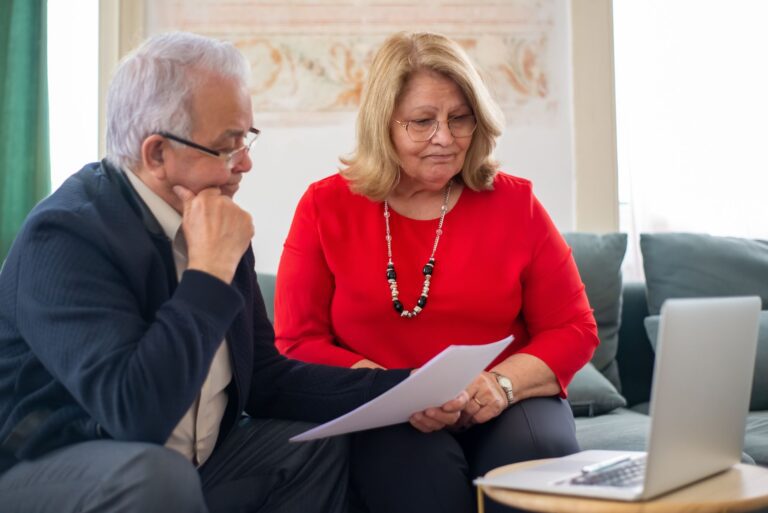
The bank’s conference room smelled like burnt coffee and new carpet glue, and I remember thinking, right before my whole marriage came apart on that table, that I should have worn a different blazer.
That is the kind of thing your mind does to you in the seconds before it understands what it is actually looking at. It reaches for something small and manageable, a blazer, a coffee smell, anything but the truth sliding toward you on a stapled printout.
We were there to refinance. Nothing dramatic about that on its own. Russell and I had been married nineteen years, we owned a modest three bedroom house on Larkin Road outside Bellhaven, and interest rates had finally dropped enough that our loan officer, a brisk, kind woman named Janet Osei who had handled our first mortgage back when our daughter was still in elementary school, told us we’d be foolish not to look into it. We sat across from her on a Tuesday afternoon in April, holding hands under the table the way we still did sometimes after almost two decades, and I felt, if anything, good about our life. Steady. Earned.
Janet needed our full financial picture for underwriting, which meant pulling more than the usual statements. She wanted to verify what she called our recurring obligations, the debts and regular transfers that would factor into how much house we could responsibly refinance into. She printed out twenty six months of our joint savings account history, tapped the stack square against the table the way people do with paper, and slid it across to both of us with the kind of cheerful efficiency that comes from doing this exact motion forty times a week.
I started reading it out of boredom more than suspicion. You do that with bank paperwork. Your eyes drift down the page waiting for something to matter.
Something mattered on the third line.
There was a transfer, out of our joint savings, going to the same account number, every single month, sometimes twice a month. Not a mortgage payment. Not a utility. An external transfer, personal, recurring, going back as far as the printout showed.
I asked Janet, as evenly as I could, what that particular line was.
She glanced at her screen and told me it looked like a standing transfer to an external account, the kind people set up for a family member’s rent or a shared expense. She said it without a flicker of anything, because to her it was just a line item, one of a hundred she’d look at that week. She had no idea she had just handed me a printout that was about to take my marriage apart in a room with beige carpet and a bowl of peppermints on the table.
I looked at Russell. Russell was looking at his hands.
Twenty six months.
I asked Janet if she could pull further back, because the pattern didn’t start on page one of what she’d printed, it was already running when the statements began. She tapped a few keys, apologized for the wait, and came back with an older record. The transfers went back at least two full years. Almost to the month of our last refinance, four years earlier, though the older records were thinner and harder to follow.
I did the arithmetic in my head sitting in that chair, because arithmetic was easier than looking at my husband. Call it eleven hundred dollars a month, sometimes more, for twenty four months. Just under thirty three thousand dollars. Out of an account with both our names on it. An account I had deposited my own paycheck into every other Friday for nineteen years, from a job at Bellhaven Family Clinic where I schedule appointments and file insurance claims and have never once in nineteen years taken a dollar out of that account without at least mentioning it to Russell first, because that was the deal we made a long time ago, out loud, more than once. No secrets about money. We’d said it to each other the way people say vows.
On paper, we looked fine. We were not.
I recognized the account number before Russell said a word. I’d seen the last four digits once before, years earlier, on an envelope Russell left on our kitchen counter and told me not to worry about. I had worried about it anyway, quietly, the way you worry about things your husband asks you not to.
His brother Vernon’s account.
Vernon is Russell’s younger brother by three years, and if you asked anyone in Bellhaven to describe him they would use the word likable before any other word, which has been Vernon’s whole method of moving through the world for as long as I’ve known the family. He is easy in a room. He remembers your birthday. He also has not held a steady job longer than fourteen months at any point in the eleven years I’ve known him, has been “between opportunities” since a warehouse position ended under circumstances nobody discusses directly, and has, twice that I knew of before that Tuesday, needed family money to cover what everyone in Russell’s family calls, in the softened language families use, “a rough patch.” The rough patches were always gambling. Sports betting that started as harmless money on the Reds and the Bengals with his buddies, then an app on his phone that made it easier, then, according to a cousin who let it slip at a funeral years back, actual trips to a casino two hours south, the kind where you come home and don’t mention the trip at all.
Russell’s mother covered the first rough patch, eight years ago, quietly, out of her own retirement savings, and made both her sons swear never to speak of it again. I only knew the outline of it at all because Russell told me himself, years after it happened, sitting on our back porch one summer night when a beer or two had loosened something in him: that Vernon had run up almost nine thousand dollars on sports betting apps and a credit card cash advance, that their mother had sold a small parcel of land their father left her to cover it without telling their father’s side of the family why, and that both brothers had promised her, standing in her kitchen, that it would never happen again. She passed three years ago, of a stroke, fast and without much warning, and at the funeral Vernon cried harder than anyone, harder than Russell, harder than I did, and I remember thinking at the time that grief looked good on him, softened him, made him seem like a man who had learned something. I had honestly believed, because Russell told me directly, more than once, that whatever had happened with Vernon and money had ended with her, that her death had somehow closed the account along with everything else.
Get a new story in your inbox every morning.
Facebook doesn’t show you every story we post. Our free newsletter does. Join 2,500+ readers.
I asked him, sitting there with the printout square in front of both of us and Janet very carefully finding something on her computer screen that required her full attention, whose account that was.
He didn’t deny it. That was almost worse than if he had. He rubbed his eyes the way he does when he’s tired of a conversation before it’s even started, and he said, quiet enough that only I could hear it, that it was Vernon’s account, and that Vernon had needed help again, and that he’d been meaning to tell me.
Meaning to tell me. Twenty six months of meaning to.
We finished the appointment somehow. I do not remember agreeing to the new rate, though the papers I signed later confirm that I did. I remember standing up, thanking Janet with a voice that did not sound like mine, and walking out to the parking lot in April sunshine that felt like an insult.
I asked him in the car, before either of us had turned the key, what exactly Vernon had needed help with this time.
Gambling debts. Sports betting that had gotten, in Russell’s own words, “out of hand again,” and then an actual bookie, not an app, an actual man Vernon owed real money to, the kind of debt that carries the specific fear that makes grown men accept a brother’s help without ever quite explaining what the alternative was. Russell had been sending money since the debt first surfaced, then again when it grew, then on a schedule, every month, because Vernon told him the debt was structured that way, so much a month until it was paid down, and Russell, apparently, decided the smartest thing to do was hand over the money quietly and never bring it home to me at all.
I asked him the only question I had breath for. Why our savings. Why the account with my name on it too, the one I’d been putting my own paycheck into every single pay period for nineteen years believing every dollar in it belonged to both of us equally.
He looked at me, and I want you to understand I am not exaggerating the coldness of what came out of his mouth next, because I have replayed it enough times since that I could recite it in my sleep.
“You’ll never even miss it, Patricia. It’s not like all of it was ever really yours to begin with. I’ve always earned more than you have.”
I have thought about that sentence more than I have thought about almost anything else in my adult life. Not like it was ever really mine. Nineteen years of my own paycheck, informed to me in a bank parking lot as though it had been sitting in that account on loan.
I did not scream. I want to tell you I calmly explained community property to him right there and drove us home in composed silence, but that would be a lie in the other direction. What actually happened is that I sat very still in the passenger seat for what felt like ten minutes, staring at the dashboard, while he tried to explain that Vernon had promised this was the last of it, that he only had a few more payments left, that he’d handled it, as though handling something meant hiding it from the one other person whose name was legally attached to the money.
I asked him to drive me home. Neither of us said another word for the rest of the ride.
I want to tell you about who I was before that Tuesday, because it matters for what I did after. I am forty five years old. I grew up two towns over from Bellhaven, the daughter of a man who ran the parts counter at the John Deere dealership for thirty one years and a mother who kept a coffee can of grocery money on top of the refrigerator that both of them could see into any time they wanted, no locks, no secrets, because that was how they’d been raised to run a household. I married Russell at twenty six, a machinist at the plant outside town, steady, funny, good with his hands, the kind of man who fixed our daughter’s bike before she’d even finished crying about the flat tire. We built a life the ordinary way. A modest house. A daughter, Ashley, now twenty two and finishing her degree at the state college two hours north. Two decades of Sunday dinners, a shared checking account, a joint savings account we opened the year we got married and had never, not once in nineteen years, kept separate from each other.
I called my sister that first night, not to gossip, but because I needed one other person to tell me I hadn’t imagined the coldness in his voice. She listened to the whole thing without interrupting, which is not like her, and then she said something that stuck with me through everything that came after. She said, Patricia, you are allowed to be furious and still want to fix this. Those are not opposite things. Figure out which one you actually want before you do anything you can’t undo.
I decided, lying awake that night with Russell sleeping, or pretending to, in the next room, that I did not want to burn the house down. I wanted the truth. All of it, not the version Russell had been rationing out to me in twenty six months of silence.
The next morning I called Janet directly, not as a wife asking a favor but as a joint account holder with a legal right to a complete transaction history, and I requested the full statement record going back five years, every transfer, every date, every dollar amount, in writing. It took her three days and one internal approval, and when it arrived I sat at our kitchen table with a yellow legal pad and I built what I came to think of as the ledger.
It was worse than the number I’d done in my head in that parking lot. The transfers to Vernon’s account did not begin twenty six months ago. They began four years and two months ago, shortly after Russell’s mother passed, in smaller, more irregular amounts at first, then settling into the steady monthly pattern the mortgage printout had caught. Total, over four years, thirty eight thousand four hundred dollars. Not thirty three. Nearly forty.
I also found something Russell had never mentioned at all. Fourteen months into the pattern, there was a single transfer of six thousand dollars, larger than any of the others, that had come not from our savings but from an account I hadn’t looked at closely in years, the modest custodial fund we’d opened for Ashley the year she was born, meant for the gap her scholarship didn’t cover. Russell had moved money out of it, replaced most of it within two months from his own paycheck before I ever would have noticed a shortfall, and never told me either transaction had happened. He had, in effect, borrowed from our daughter to cover his brother, then quietly paid himself back before I could catch it, the same way you might return a tool to a shed before anyone knows it was gone.
That was the piece that changed what I wanted from all of this. I could have argued with Russell forever about what counted as his money and what counted as mine inside our own marriage. I could not accept that our daughter’s account had been used as a bridge loan without either of us being told.
I called Ashley that same week, not to alarm her, but because I have never in her life kept a real problem from her once it touched our family directly, and I was not going to start now over money that had once had her name on it. She was quiet on the phone for a long moment, the kind of quiet that told me she was doing her own arithmetic, and then she asked the question that stayed with me longer than almost anything else in this whole ordeal. She asked if Uncle Vernon knew whose college fund he’d borrowed from. I told her I honestly didn’t know whether Russell had told him that detail or spared him it. She said, in a voice much steadier than mine had been in that parking lot, that she hoped he did know, because she thought people should have to feel the actual shape of what they take, not just a number on a page. I have thought about that sentence of hers more than once since, because at twenty two she understood something about accountability that had taken her father most of two decades to relearn.
I asked Russell to sit down with me on a Saturday, printout spread across our own kitchen table this time, five years of numbers laid out in the yellow legal pad’s careful columns. I did not yell. I had done enough of that in the four days between the bank and that Saturday, and yelling had gotten me nothing but a husband who went quiet and defensive. I laid out the ledger instead, month by month, and I told him what I needed to happen next, not as a request, as a condition.
I needed a complete, honest accounting of every dollar that had gone to Vernon over four years, confirmed against the bank’s own records, no more “I think that was around.”
I needed Vernon in a room with both of us, in person, to hear directly what his brother had done to make his debts disappear, because I no longer trusted a single secondhand account of anything involving Vernon’s money.
And I needed Russell to understand, out loud, in his own words, that the moment he told me it was “not really mine to begin with” was the moment that mattered more to me than the money itself, because a marriage where one person can decide unilaterally what belongs to the other is not a marriage I was willing to keep living inside of.
Russell cried at that kitchen table in a way I had seen him do exactly twice before in nineteen years, once at his father’s funeral and once when Ashley was born. He said he was ashamed, that he’d told himself for four years he was one payment away from being able to tell me everything at once, cleanly, so it would look like something already handled instead of something ongoing, and that every month that story got harder to tell instead of easier. He said the line about the money not being mine had come out of panic and shame, not belief, though I told him, and still believe, that panic tends to say what a person actually thinks underneath the version they’d prefer to be true.
Vernon did not want to come to that meeting. It took Russell three phone calls and, on the third, a sentence I was proud of my husband for saying out loud for the first time in his life: that if Vernon wanted his brother’s help again in the future, he would show up and account for the help he’d already gotten, in front of the person whose money it actually was.
I spent the days before that Sunday doing something I hadn’t expected to do, which was cleaning my own kitchen the way I clean it before holidays, wiping down the table Vernon would sit at, setting out the good coffee instead of the everyday can, because some old habit in me still wanted to receive my husband’s brother properly even while I was preparing to hand him a ledger that would humiliate him. I mention this only because it tells you something true about how families like ours actually work. You can be furious at a man and still put out the good coffee. Both things live in the same house at the same time, and neither one cancels the other out.
He came on a Sunday evening, sitting at the same kitchen table, in the same chair Russell’s mother used to sit in for holiday dinners, and for the first twenty minutes he tried the same easy charm that has carried him through every other reckoning in his life, the jokes, the deflection, the “you know how it is” shrug aimed at Russell like the two of them were still boys covering for each other in front of their mother. I let him run out of that charm on his own. I sat with the ledger in front of me and I did not laugh at a single joke.
When he finally understood that the evening was not going to go the way his other family reckonings had gone, something in him deflated, and underneath the charm was a much smaller, much more frightened man than I had ever seen at a family dinner. He told us the debt had started with a bookie two towns over, escalated when he tried to bet his way back to even instead of stopping, and that he had been too afraid of what that man might do to simply stop paying, so he had leaned on the one person in his life who had never once turned him down.
I asked him the number. The real number, start to finish, everything Russell had ever sent him, everything his mother had sent him before that.
Fifty one thousand dollars, across eight years, once his mother’s contribution was added to the ledger.
I told him what I needed, and I want to be honest that I surprised myself with how calm I was able to say it, because by then the anger had settled into something harder and steadier than rage. I needed a full written accounting of every dollar, with dates, going back to his mother’s first check. I needed a real repayment plan, in writing, with a schedule and an actual signature, not a family understanding that evaporates the moment the discomfort passes. And I needed him to get himself into some kind of help for the gambling itself, because a repayment plan without that was just a slower version of the same hole.
Vernon argued, at first, that this wasn’t how families operated, that turning a brother’s help into paperwork was cold, was petty, was Russell’s wife inserting herself into something between the two of them. Russell, for the first time in this entire story, did not let that argument stand. He told his brother, in front of me, that it had stopped being between the two of them the moment it came out of an account with my name on it, and that if Vernon wanted to keep calling this family instead of a debt, he could start by treating the woman at that table like family too.
The financial counselor was a soft spoken man named Harold Reyes who worked out of a small office above the credit union on Main Street, the kind of office with a fake ficus tree and a whiteboard he actually used. He met with all three of us once, at my insistence, before the ledger was finalized, and he did something I hadn’t expected. He didn’t lecture Vernon about morality or family loyalty. He simply took the ledger I’d built, checked it against the bank’s own printouts line by line on his whiteboard, circled the total in red marker, and turned to Vernon and asked him a single question: could he look at that number, out loud, and tell the room what it actually represented in his own life, not in the softened language families use for it.
Vernon sat with that question longer than he had sat with anything all evening. He finally said it represented eight years of him being unable to say the word “help” to anyone except his brother, because saying it to a stranger, a counselor, a hotline, felt like admitting something he wasn’t ready to admit, while asking Russell for money always felt, to him, like something closer to family business than failure. Harold told him, gently but plainly, that the two of them had built a system together that let both of them avoid exactly that admission for eight years, and that the repayment plan on the whiteboard would only hold if Vernon also got himself into an actual gambling recovery program, not just a payment schedule. Vernon agreed to it that night, in that small office, in front of a man he’d never met before, in a way he had never quite agreed to anything in front of his own family.
It took three more weeks, one more uncomfortable sit down back at our own kitchen table, and one night where Vernon called the house at eleven o’clock, drunk, angry, saying we were humiliating him, before he finally signed it. A real document, drawn up plainly enough that a notary at our credit union was willing to witness it: an acknowledgment of fifty one thousand dollars owed, jointly to Russell and me, and a repayment schedule of four hundred dollars a month, automatic, starting the first of the following month, for as long as it took. Not fast. Not painless for him. But real, on paper, with his signature under it, in a way that eight years of family understanding never had been.
He has missed one payment since, in October, and called ahead of time to say so, and made it up the following month with an apology that did not sound like his old easy charm. He has also, and this surprised me more than the payments themselves, gone to six meetings of a gambling recovery group that meets in the basement of a church two towns over, the same church, oddly enough, where his and Russell’s mother’s funeral was held. He mentioned it to me once, almost sideways, standing at our stove waiting for coffee, saying it was harder to sit in a circle of strangers and say the actual words out loud than it had ever been to ask his brother for money in private, and that maybe that difficulty was the whole point he’d been avoiding for eight years.
It is not everything. Fifty one thousand dollars at four hundred a month is a decade of payments, and I know I may never see the last of it collected in full. But I see the four hundred dollars land in our account on the third of every month now, and I see something I did not see for eight years before that Tuesday in April: a number I can actually count on, instead of a silence I had no idea I was supposed to be worried about.
Russell and I are still married. I want to say that plainly, because I know a story like this one could go the other way, and there were nights in that first month when I honestly did not know which way ours would go. What kept us in the room together was not forgiveness handed out cheaply. It was Russell doing the harder, slower thing: six months now of financial counseling every other Tuesday evening in Harold Reyes’s small office with the fake ficus tree, a joint account we both check weekly instead of trusting on faith, and a new rule between us, spoken out loud this time instead of assumed, that no transfer over two hundred dollars happens without both of us seeing it before it happens, not after.
Those Tuesday evenings were not easy, especially at first. Harold made us do an exercise in the second session that I did not enjoy at the time and have come to be grateful for since: he had each of us write down, separately, what we believed we were entitled to decide alone in a marriage, without consulting the other person, and what we believed required both signatures, so to speak, before it happened. Russell’s first list was longer than mine on the “decide alone” side, and seeing it in his own handwriting, laid next to mine on Harold’s little table, did more to change how he thought about our money than any argument I could have made at our own kitchen table. He has told me since that the exercise embarrassed him in a useful way, the kind of embarrassment that actually changes a person instead of just making him defensive for an evening.
He has said the sentence back to me since, unprompted, more than once. That everything in that account was always mine as much as his, that he knew it the whole time he was moving money out of it in secret, and that the version of himself who said otherwise in that parking lot is not a version he is proud to have been. I believe him more now than I did the first time he said it, because he has spent six months proving it in small, unglamorous ways instead of one large apologetic speech, and at forty five years old I have learned that the small, repeated proof is worth more to me than any single grand gesture ever could be.
I think about that stapled printout sometimes, the one Janet slid across a conference table without any idea what it would do to the rest of my year. I think about how close I came to signing that refinance without reading past the first page, the way I had read a hundred bank documents before it without incident. I think about how a marriage can run for nineteen years on trust that both people assume is mutual, until one ordinary Tuesday afternoon shows you, in black and white, exactly how much of it was actually being kept from you the whole time.
I do not know if Vernon will ever fully pay us back. I do know that the ledger sits in a folder in our filing cabinet now, updated every month, and that for the first time in eight years, every single dollar that leaves that account has both of our names attached to the decision, not just to the balance. That is not the marriage I thought I had at twenty six. It is, I have come to believe, a stronger one than the one I thought I had, because this one was actually tested, and this one is actually mine.
This story is a dramatization. Names, characters, and details are invented, and any resemblance to real people or events is coincidental.