
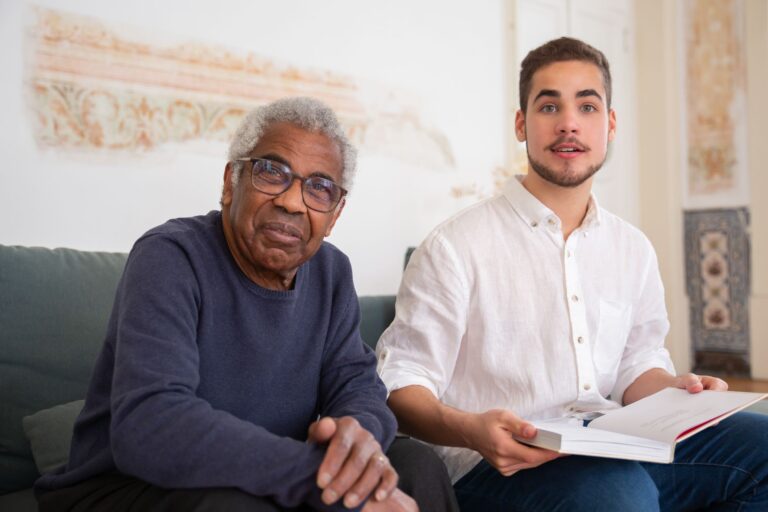
My name is Stanley. I’m sixty-six years old, and until one particular Saturday morning last spring, I would have told anyone who asked that there wasn’t much left in my own family that could still surprise me. I had run a hardware store on the same corner of Main Street for thirty-one years before I sold it and retired. I had raised one son, buried both my parents, watched my hair go from brown to gray to mostly gone, and settled into the kind of life where the biggest surprise most weeks was whether the Tuesday paper came late. I thought I understood my family. I thought, more than anything, that I understood my grandson.
I was wrong about that in ways I am still working through, more than a year later, and I want to tell it the way it actually happened, not the way I wish it had, because the way it actually happened is the part that changed me.
Cole is my grandson, my son’s boy, and he came to live with my wife and me the spring he turned seventeen. His parents were going through a separation that had gotten loud in the wrong way, the kind of loud that isn’t dangerous so much as exhausting, two people who loved each other once trying to divide a house and a life and a kid all at the same time, and none of it going quietly. Cole never said much about it. He wasn’t a talker even then. But he came to us with one duffel bag and a fishing rod his other grandfather had given him, and he took the back bedroom, the one that used to be my workshop before my knees stopped letting me stand at a bench all day, and he never once complained that the room still smelled faintly of sawdust and machine oil no matter how many times my wife aired it out.
For the first year, he was about as easy as a teenage boy could be. He did his homework at the kitchen table where I could see him, which I think he did on purpose so I wouldn’t worry, and he did the dishes most nights without being asked twice, and he was home by ten on school nights and eleven on weekends, and if you had asked me back then what kind of young man Cole was turning into, I would have said a good one, a steady one, the kind of grandson a man is lucky to get handed in the middle of his own retirement.
Then, right around the time he turned eighteen, something in him changed, and it took me the better part of a year to understand what it actually was.
It started small enough that I almost missed it. A Saturday morning, early spring, and I came downstairs for coffee to find his truck already gone from the driveway. No note. He hadn’t done that before. I told myself he’d probably gone to a friend’s, or out to get gas, or any of a dozen ordinary things a nineteen-year-old does on a Saturday, and I didn’t think much of it until the next Saturday, when the same thing happened. And the Saturday after that. And then Sundays too, so that within about a month, every single weekend, both days, Cole was gone before I woke up and didn’t come back until well after dark.
I asked him about it, of course. The first few times, I asked easy, the way you’d ask about anything, “Where’d you get off to today?” and I’d get one word back. “Out.” I’d ask who he’d been with and get a shrug, or “just some people,” which told me exactly nothing. He wasn’t rude about it. That’s the part that used to confuse me most. He wasn’t sullen or defiant the way you picture a kid being when he’s hiding something bad. He was just quiet, closed, like the question itself was one he didn’t especially want to answer, and after a while I stopped pushing, because I told myself a nineteen-year-old is entitled to a piece of his life I don’t get to see all of.
I told myself that for months. But a man notices things, even when he’s decided not to make an issue of them. I noticed that Cole came home some Saturday nights with dirt under his fingernails, sometimes something that looked like it might have been shoe polish smudged on his cuffs, once what I could have sworn was the faint smell of hospital soap on him, the harsh, clean, institutional kind, though I told myself I was imagining that last one, because I couldn’t think of a single reason a nineteen-year-old boy would smell like a hospital on a Saturday night unless something was wrong.
I noticed he’d started keeping his phone face down on the table, which he never used to do.
I noticed he stopped inviting friends over the way he had that first year, so that after a while I couldn’t have told you a single name of anyone he was spending his weekends with, not one.
And I noticed, most of all, the toll it was taking on how I saw him. I want to be honest about that part, because it’s not flattering. Somewhere in that year, without ever deciding to, I stopped assuming the best about my own grandson and started assuming the worst, the way people do when someone they love won’t give them a straight answer for long enough. I run into people constantly in a town this size, at the feed store, after church, standing in line at the pharmacy, and they ask after my family the way people do, and for the better part of a year I had no honest answer to give them when they asked about Cole. I’d say he was “figuring things out,” which is the phrase you reach for when you honestly don’t know and don’t want anyone to see that you don’t know. I started dreading the question. I started to feel, underneath all of it, a low simmer of embarrassment, that my own grandson, the one living under my own roof, was somehow becoming a stranger to me, and that everyone in town could probably tell.
I assumed drugs, somewhere in there. I’m not proud of that, but it’s the truth, and I promised myself I’d tell this the way it happened. I assumed a bad crowd, some group of kids running around out past the county line getting into things I didn’t want a name for. I assumed, on my worst nights, that I was watching history try to repeat itself, that whatever ground his own father had lost with him during that separation, I was losing it too, one silent Saturday at a time, and that no matter how much my wife and I had tried to give him a stable place to land, it wasn’t going to be enough to keep him from drifting.
I assumed the worst.
I was wrong. But I didn’t know that yet, and the not knowing ate at me for the better part of a year, until it finally came to a head over something that, on its own, would have seemed small to anyone standing outside our family.
It was my wife’s sixty-fourth birthday. I’d asked Cole three separate times that week to be there for the little dinner we were planning, told him the time, told him plainly that it mattered to her, that she asked about him more than she let on and that showing up would mean something. He said he’d try to make it, which even then struck me as a strange thing to say about your own grandmother’s birthday, like attendance was optional in a way it hadn’t ever been before in our house. Saturday morning came and his truck was gone before seven, same as every other Saturday for a year, and I told myself, hoping, that he’d be back well before six that evening.
Get a new story in your inbox every morning.
Facebook doesn’t show you every story we post. Our free newsletter does. Join 2,500+ readers.
He wasn’t. We ate the meal without him. My wife blew out her candles with her son and daughter-in-law and a few old friends around the table, and she smiled the whole time the way she does, but I watched her eyes go to that empty chair more than once, and she never said a single word about it, which somehow made it worse than if she had. A woman doesn’t have to complain for you to know she’s hurting. I sat there through the whole dinner with something hardening in my chest, and by the time the last guest left and the dishes were done, I had decided, rightly or wrongly, that I wasn’t going to let it go this time.
He came home around nine. I was sitting on the porch steps waiting for him, and I want to be honest about my state of mind in that moment: I wasn’t waiting to have a conversation. I was waiting to lay into him, and I did.
“You missed her birthday,” I said, before he’d even gotten the truck door shut behind him.
“I know,” he said. “I’m sorry. Something came up.”
“Something always comes up,” I said, and I could hear my own voice climbing even as I tried to hold it level. “Every single weekend for a year, something comes up, and you have never once told me what it is.”
He stood there in the driveway with his hands shoved in his jacket pockets, and I kept going, because once I started I couldn’t seem to stop. I told him that I hadn’t raised his father to raise a son who couldn’t hold onto a direction in life, and that I wasn’t going to stand by quietly in my own house and watch that pattern repeat itself with him. I told him I loved him too much to keep my mouth shut while he threw away one unexplained Saturday after another, that a young man his age ought to be building something, working toward something, not disappearing into thin air twice a week with nothing to show for it and no one willing to say where he’d been.
“You’re wasting your life,” I told him, “and I won’t stand here and watch you do it anymore.”
I expected him to yell back. Some part of me, if I’m honest, wanted him to, because at least then it would have felt like an argument between equals instead of whatever it actually was. He didn’t. That’s the part I’ve turned over in my mind more times than I can count since. He just stood there in the porch light and let every word land, and when I finally ran out of breath, he looked at me steady, the exact way his grandmother looks at me when she’s already made up her mind about something and is only waiting, patiently, for the rest of the room to catch up.
“Fine,” he said. “You want to know so bad. Come with me tomorrow morning. Six a.m. You’ll see for yourself.”
I almost said no. I want to admit that plainly, because it would be easy now, knowing how the story ends, to pretend I agreed right away out of some wise, open-minded instinct. I didn’t. Some part of me was truly afraid of what “seeing for myself” might mean. I lay awake half that night next to my wife, picturing a dozen different things Cole might be doing every weekend, and not one of the things I pictured was good. I imagined the worst kind of friends. I imagined trouble with the law, quietly handled so far, waiting to catch up with him. I imagined, at my lowest point around three in the morning, that I would spend Sunday finding out my grandson had built an entire secret life I would have no idea how to fix.
None of what I pictured was even close to right.
Six a.m. came in cold and gray, mist still sitting low over the fields on either side of the county road. Cole was already in the truck with the engine running when I came out the front door, and he didn’t say much as I climbed in beside him, and I didn’t push it. We drove in near silence for about twenty-five minutes, past the co-op, past the last stoplight before the town limit, out along a stretch of road I hadn’t had much reason to drive in years. And then he slowed, and turned into a parking lot I must have passed a hundred times without ever once pulling in, and I sat there in the passenger seat for a second too long, working out what exactly I was looking at.
It was a low brick building with a flag snapping in the wind out front, and a sign near the entrance drive that read Meadow Ridge Veterans’ Home.
“This is where you go,” I said slowly. “Every Saturday. Every Sunday. For a year.”
He didn’t answer me directly. He just cut the engine, got out, and walked toward the front doors like a man who belonged there, which, I would come to understand over the next hour, he very much did. I followed him in, still half convinced there had to be more to the story than a nursing home, still bracing for whatever the real explanation was going to turn out to be.
The moment we came through the front doors, everything I’d spent a year assuming about my grandson started coming apart.
A woman behind the front desk looked up and her whole face lit when she saw him, the way you light up for someone you’re always glad to see. Two residents sitting near the window of the common room called his name across the room before he’d even finished crossing the lobby, both of them raising a hand, and Cole raised his back and grinned like it was the easiest thing in the world. An old man in a wheelchair near the far window lifted one hand, slow and a little shaky, and Cole crossed straight to him and took it in both of his and bent down to say something low that made the old man laugh, a real laugh, the kind that comes from somewhere deep.
I stood in the middle of that lobby feeling about as useless and out of place as I have ever felt in my life. My grandson clearly had an entire world here that I had known absolutely nothing about, a world where people knew his name and lit up at the sight of him and reached for his hand like he was already family, and I had spent the better part of a year assuming the worst of him instead of once, even once, asking him a single honest question about where he went.
I didn’t know what to do with my hands or my eyes while Cole disappeared down the hallway with the man in the wheelchair, so I wandered toward the front desk, and that’s when I saw the binder.
It was an ordinary three-ring binder, the kind you’d find in any office, sitting open on the counter with a printed sign-in sheet inside, columns for name and date and time in and time out, the plain paperwork of a place like this that tracks who comes and goes. I had nothing better to do with myself, so I picked it up and started flipping back through the pages, half out of nervous habit and half out of something closer to hunger, a need to understand what I was looking at.
Page after page, I saw his name. Cole. Every Saturday. Every Sunday. I flipped back further than I expected to have to, past Christmas, past Thanksgiving, back into the fall, back further still into the previous summer, and his name was on every single page, sometimes logged for four hours, sometimes for seven, once, I noticed, for nearly nine, a whole Sunday given over entirely to that building and whoever was inside it. I did the arithmetic without meaning to. Over a year of weekends. Somewhere well past four hundred hours, though I wouldn’t learn the exact number until later that morning. I stood there holding more than a year of my own grandson’s life, written down in his own hand, one Saturday and one Sunday at a time, and I had never once thought to ask to see it.
I was still standing there, binder open in my hands, when a woman walked up beside me. Gray cardigan, kind, tired eyes, a laminated badge clipped to her collar that read Volunteer Coordinator, and underneath that, a name: Bonnie.
“You must be Cole’s grandfather,” she said, and there was warmth in it, not suspicion. “He talks about you. Says you ran the hardware store on Main for years.”
I didn’t know what to say to that, so I set the binder down carefully, the way you set down something you feel you’ve been caught holding.
“I didn’t know any of this,” I admitted. “Any of it. I’ve been driving myself half crazy for a year wondering where he goes every weekend, and I never once thought it might be here.”
Bonnie looked down at the open page under my hand, then back up at me, and something moved across her face, not quite a smile, more like she was deciding how much of the story was hers to tell and how much belonged to Cole.
“Has he told you,” she said carefully, “what happened here last spring?”
I told her honestly that he hadn’t told me anything at all, about last spring or any other week of the past year, and she nodded slowly, like that confirmed something she’d already suspected about the kind of quiet young man Cole was, and then she told me the story.
Cole had first come to Meadow Ridge, Bonnie explained, not through any program or church group or school requirement, but because of me. I want to be clear that I did not expect my own name to come up in this story, and it knocked the wind out of me a little when it did. A little over a year before that morning, I’d had a health scare, nothing that made the local paper, nothing anyone outside the immediate family paid much attention to, but a night in the hospital with chest pains that turned out, thank God, to be nothing lasting, just a bad scare and a warning from a cardiologist about my blood pressure. Cole had been the one who drove me to the emergency room that night, because my wife’s car was in the shop and he was the only one home. He’d sat in that waiting room until four in the morning, not knowing yet whether his grandfather was going to be all right, and Bonnie said he had told her, months later, that those hours in that waiting room were the first time in his life he had really understood, all the way down, that the people he loved were not going to be around forever, and that somewhere out there, right at that moment, other people’s grandfathers were sitting in rooms exactly like that one with nobody in the waiting room for them at all.
A few weeks after I was cleared and back to my ordinary life, still not thinking much more about that scare than a man does once the doctor says he’s fine, Cole had driven out to Meadow Ridge on his own, on a Saturday, and asked if they needed volunteers. Bonnie told me she nearly turned him away that first day, because nineteen-year-olds who show up wanting to help usually last two or three visits before life gets in the way and they stop coming, and she’d learned not to get her hopes up. Cole did not stop coming.
He started, she said, spending his Saturdays with the man in the wheelchair I’d seen him greet in the lobby, a veteran who had been at Meadow Ridge for going on six years with almost no visitors of his own, his wife gone, his only son living clear across the country and calling maybe twice a year. Cole learned to play the card games the old man liked. He learned to sit through the same three war stories without ever once looking bored, because, he told Bonnie, the stories weren’t really the point, the company was. When the old man’s eyesight got too poor to read his own mail, Cole started reading it to him. When his hands got too unsteady to write back, Cole started writing the letters for him, in the old man’s own words, exactly as he dictated them.
And then, Bonnie told me, quieter now, last spring, the man had taken a bad turn, a stretch of pneumonia that the staff truly feared might be the end of him, and for eleven straight days, Cole had come every single day after his shift at the gas station, not just his usual weekend hours, sitting with him deep into the evening, holding a cup of water steady for him when his own hand couldn’t manage it, telling him he wasn’t alone in that room even on the nights it looked like he might not make it through until morning. The man pulled through. He was, Bonnie said, sitting right there in the common room that very morning, the one who’d raised his hand to Cole the second we walked in.
“In the fourteen years I’ve coordinated volunteers here,” Bonnie told me, “I have never once seen anyone, of any age, log the hours your grandson has logged this year. Not close. He has more hours than any other volunteer we have had, by a wide margin, and most of ours are retired folks with nothing but time on their hands. He’s nineteen. He works a full-time job. And he still shows up here every single weekend, and plenty of weekdays besides, because he told me once that he wasn’t going to let anyone in this building feel the way he felt in that waiting room the night his grandfather scared him half to death.”
I stood there in that lobby and could not have spoken a full sentence if my life had depended on it.
I had spent a year building a story in my head about a grandson coming apart at the seams, running with a bad crowd, throwing away whatever future he might have had, and the truth, the actual truth, was that he had spent that entire year quietly becoming one of the most devoted people I have ever heard of, giving away his weekends to strangers who had nobody else, because a scare with his own grandfather had cracked something open in him that none of the rest of us had noticed. He had never once tried to make it about himself. He had never once used it to defend himself against my accusations, not even that night on the porch when I stood in front of him and told him he was wasting his life. He could have said, at any point over that entire year, “I’m not wasting anything, I’m at a nursing home helping people,” and ended every argument on the spot. He never did. He let me believe the worst of him rather than trade on something he clearly considered too private, too important, to use as a defense in an argument.
I found him a few minutes later, down the hall, sitting beside the same old man’s bed, the two of them laughing about something I couldn’t hear. I stood in the doorway for longer than I meant to, just watching, and when Cole finally looked up and saw me standing there, something in his face went careful, braced, like he was waiting to find out whether I’d come to drag him back out to the truck and lecture him the rest of the way home.
I didn’t. I walked in, and I introduced myself to the old man, and I sat down in the chair across from the bed, and for the first time in over a year, I let my grandson show me his actual life instead of guessing at it.
We didn’t talk about the night before, not really, not until we were back in the truck heading home a few hours later, both of us quieter than usual, the radio off. I was the one who finally broke the silence.
“I owe you an apology,” I said. “A real one. Not the kind where I say it fast and we move on.”
He didn’t say anything right away, just kept his eyes on the road, and I made myself keep going, because I owed him that much.
“I spent a year assuming the worst about you,” I said. “Drugs. Bad company. I told myself you were throwing your whole life away, and the truth is you were doing something most grown men I know wouldn’t have the patience or the heart to do even once, let alone every single weekend for a year. I judged you instead of asking you. That’s on me, not you.”
He was quiet a moment longer, and then he said, simply, “I didn’t want you to think I was doing it because of what happened with you. I didn’t want it to feel like pity, or like I was trying to pay you back for something. I just wanted it to be mine.”
I told him I understood that better than he probably realized, and that I was proud of him in a way I didn’t have adequate words for yet, and that I hoped, if he’d let me, I could come along sometime and see it properly instead of stumbling into it the way I had.
He looked over at me then, and for the first time in longer than I could remember, he smiled the easy way he used to before all this started, before either of us understood what the silence between us had actually been protecting.
“Six a.m. Saturday,” he said. “I’ll wake you up myself this time.”
I told the whole family what I’d learned that same week, at Sunday dinner, and I watched the story land on each of their faces the same way it had landed on mine, first confusion, then disbelief, then something that looked almost like grief for how wrong we had all been about him without ever once saying so out loud. My son sat there for a long moment after I finished, and then he got up from the table without a word and went into the other room, and when he came back his eyes were red, and he didn’t try to hide it. Cole’s mother cried outright, the kind of crying that comes from relief as much as pride. Nobody in that room had known. Nobody had asked the right question, not once, in an entire year.
I have gone with Cole to Meadow Ridge almost every Saturday since. I’ve learned the names of a dozen residents who light up the same way that first man did, and I’ve come to understand, the way Cole clearly understood a full year before I did, that showing up regularly for a person who has almost nobody left is one of the most valuable things a man can do with a Saturday morning, more valuable, if I’m honest, than most of what filled my own weekends before I started going. Bonnie tells me now that between the two of us, we’ve become something close to a fixture out there, and she says it with a laugh, but I don’t think either of us minds being teased about it.
The family’s whole view of Cole changed after that Sunday dinner, and it has stayed changed. He isn’t the grandson people quietly worried about anymore. He’s the one people brag about, the one my wife tells her friends about at church without me even having to prompt her, the one my son now calls “the best of all of us” without a trace of the old worry in his voice. I think about that year of silence often, and about how close I came to letting my own fear and embarrassment convince me of a story that was the exact opposite of the truth. I think about how he never once defended himself, even when I gave him every reason to.
Mostly, though, I think about that morning in the lobby, holding a binder full of my grandson’s own handwriting, discovering that the boy I had accused of throwing his life away had quietly been giving more of it away, one Saturday at a time, than any of us had the sense to notice. I was wrong about him for a year. I intend to spend a good deal longer than that making up for it, one Saturday morning at a time, right alongside him.
This story is a dramatization. Names, characters, and details are invented, and any resemblance to real people or events is coincidental.