
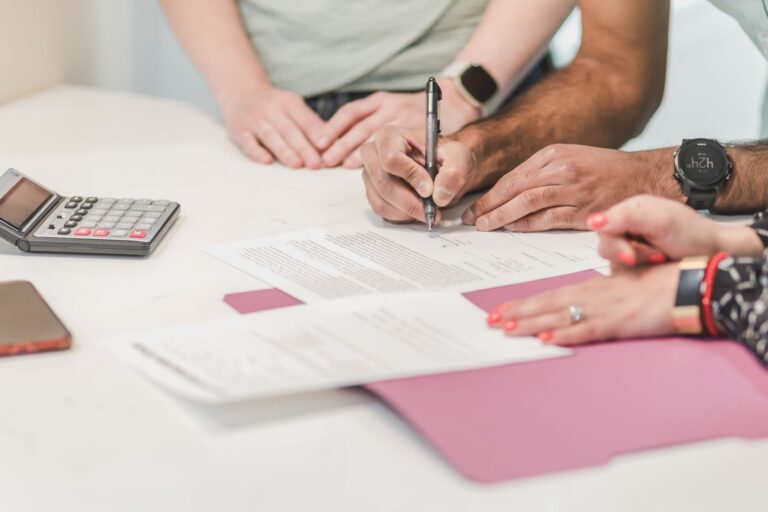
The woman on the phone worked for a loan servicing center in Ohio, and she wanted to know if I would like to enroll my new home equity account in autopay so I would never miss a due date. I told her she had the wrong file. She read my address back to me anyway, slow and patient, the way people read things back when they think the customer is the confused one. Four-seventeen Cutler Road, Wilder Creek, Kansas. My house. The house I finished paying off four years ago, the week I turned forty eight, after twenty two years of writing the same check on the first of every month at the same kitchen table I was sitting at when she called.
There was no new loan. I told her that twice. She was kind about it, the practiced kind of kind that comes from a script, and she said she understood, but the account had closed nine weeks earlier for one hundred and thirty four thousand dollars, secured against a property at that same address, and the first payment was already thirty one days late. She asked if perhaps my husband had handled it without mentioning it to me. My husband has been gone seventeen years. I did not say that part to her. I just asked her to hold everything, every letter, every call, until I could get down to my own bank and look at whatever it was she was looking at.
I am fifty two years old. I have kept the books for the grain co-op on the east side of Wilder Creek for going on twenty three years, and before that I balanced my own household ledger to the penny every week the whole time my son was growing up, because there were years when a penny mattered and I never forgot what that felt like even after it stopped mattering as much. I know what a mortgage statement is supposed to say. I know what my own signature looks like on eleven different lines. And I am telling you all of that up front because I need you to understand that I am not a woman who misplaces one hundred and thirty four thousand dollars. Somebody put it in my name without me.
Twenty-two years on Cutler Road
I bought the house on Cutler Road with my husband the year we married, a low white farmhouse two miles outside town with a sagging porch and a barn we never used for anything but storing our son’s outgrown bicycles. My husband worked the co-op elevator until his heart gave out on a Tuesday morning when our son was fourteen, quick and without warning, the kind of death that leaves you standing in a hospital hallway trying to remember what you were doing an hour earlier when everything was still ordinary. I kept the mortgage going by myself after that, on a bookkeeper’s salary, because the alternative was selling the only stable thing either of us had left, and stability was the one thing I had decided my son and I were not going to lose on top of everything else.
Twenty two years is a long time to make a single payment every month without missing one. I want to say that plainly, not to brag on myself, but because it matters to what happened later. I skipped vacations. I drove a car nine years past when I should have traded it in. I worked a second set of books for the diner on Saturdays for cash money during the years my son was in high school, because a growing boy eats more than a grown woman ever budgets for, and I was not going to be the reason he went without a letterman jacket or a decent pair of cleats. Every one of those Saturdays went, in some small way, toward a mortgage payment, until the January four years ago when the co-op’s own loan officer called me at my desk to tell me the payoff had cleared and the house was mine, free and clear, no bank holding any piece of it anymore.
I cried at my desk that morning. Not because I was sad. Because for the first time in my adult life I had a floor under me that nobody else could take away, not a bank, not bad luck, not anything, as long as I kept paying the taxes and kept the roof from caving in. I told people that story for years afterward, the way you tell a story you are proud of. I did not know yet that the one person I trusted most with that floor was already looking at it and doing his own kind of math.
I want to describe the house itself, because it matters to what came later. It is not a grand place. It is a two-story farmhouse with a porch that leans slightly to the east, a kitchen with the same laminate counters we put in the year we married, and a barn out back that has not held an animal in twenty years but still holds every bicycle, every crib, every folding chair my family has ever owned. I repainted the porch railing myself two summers ago, on a ladder, at fifty years old, because I did not want to pay a contractor forty dollars an hour to do something my own hands could still manage. That house is not just an asset on a piece of paper to me. It is the physical proof that I made it through the worst year of my life and kept going anyway, one payment at a time, long after anyone would have blamed me for giving up and renting a smaller place in town.
My son is thirty one now. He was the kind of boy who could talk his way out of almost anything, not in a cruel way, just quick, the way some people are quick with a hammer or quick on their feet in a fight. He ran a small engine and tractor repair shop out on the highway, inherited half the customer list from a retiring mechanic and built the other half himself over six years, and for a long time I was proud of that too, proud that he had built something with his hands in a town that does not have many somethings left to build. I did not know, when I was proud of him, that the shop had been bleeding money for the better part of a year, or that he had borrowed against its inventory twice already with a private lender out of Wichita who did not send friendly reminder letters when a payment was late.
The kitchen table
I found all of that out on a Thursday evening, at his own kitchen table, with the closing package from the mortgage company spread out between us the way you would spread out a hand of cards you already know you have lost. Every page had my name typed at the top. Every signature line had my signature, or close enough to it that I understood immediately why nobody at any bank had questioned it. I did not raise my voice. I want to be honest about that, because I think people picture yelling when they hear a story like this, and that is not what happened in that kitchen. I asked him one question. How.
Get a new story in your inbox every morning.
Facebook doesn’t show you every story we post. Our free newsletter does. Join 2,500+ readers.
He did not reach for the pages first. He already knew every line on them better than I did, because he had built them. He looked at me the way you look at someone who is being difficult about something he has already decided is simple, and he said the sentence I have not been able to put down since. “You would have said no, so I made sure you never got the chance.”
I sat with that for a long moment before I understood it was not an apology. It was a strategy, spoken out loud, in his own kitchen, over the same table where I used to sit and help him with fractions. He told me the rest of it without much prompting after that, almost relieved to finally say it to someone, the way people get relieved once the worst part of a secret is already out in the air. The shop had needed inventory money it did not have. The private lender in Wichita wanted a payment he could not make. He had known, the way children always seem to know things about their parents that parents never told them directly, that the house on Cutler Road had no bank left on it, no lien, nothing standing between that equity and whoever could get their hands on it. He told himself it was borrowing. He told himself he would pay it back before I ever noticed, quietly, the same way he used to slip a twenty back into my purse after taking it out for gas money in high school.
One hundred and thirty four thousand dollars is not a twenty. I said that to him at the table, and he did not have an answer for it, because there was not one.
I asked him why he did not just come to me and ask. I want to be honest that I have asked myself that question more than I have asked him, because I think I already know a version of the answer that has nothing to do with money. If he had come to me and asked for help with the shop, I would have wanted to see the books first. I would have wanted to know how bad it really was, and I would have wanted some say in whatever came next, the way I have always had some say in his life, because that is what a mother who raised a son alone on a bookkeeper’s salary has earned the right to ask for. He did not want my say. He wanted my equity without my questions attached to it, and forging my name was, in his mind, a way of getting the money without ever having to sit across from me and admit how far he had let things slide. He told me that much himself, in a quieter voice than the one he used for the first sentence, once the anger had gone out of both of us and all that was left in that kitchen was two people looking at a stack of paper that had already changed everything.
Nine weeks earlier
What made all of it possible, what he had counted on more than anything, was something that had happened to me nine weeks before that kitchen table conversation, something I did not connect to any of this until much later, because at the time it was simply the worst night of my adult life for reasons that had nothing to do with paperwork.
I woke up at two in the morning with a pain under my right ribs so sharp I could not stand up straight, the kind of pain that makes you understand, all at once, that this is not indigestion and this is not going to pass on its own. The county has a small clinic but no surgeon on call after hours, and the ambulance crew told me, while they were loading me in, that the nearest hospital with a general surgeon available that night was in Wichita, two hundred miles from Wilder Creek. I remember the drive in pieces. I remember the fluorescent lights of the emergency bay. I remember a nurse writing my name on a wristband and asking me to confirm my date of birth three separate times before anyone would touch me, the way hospitals do, the way that felt tedious in the moment and turned out, months later, to be the single most important paperwork trail of my life.
My gallbladder had to come out that night, emergency surgery, not the kind you schedule two weeks out with a preferred surgeon and a good breakfast beforehand. I was under anesthesia by four in the morning. I did not leave that hospital in Wichita for three days. My son knew all of it. He drove down the second afternoon, sat by my bed for two hours, brought me a magazine I never opened, and told me not to worry about anything at home, that he had it handled. I remember being grateful for that sentence at the time. I have thought about it differently every day since.
I did not know, lying in that hospital bed with a fresh incision and a catheter and a chart that recorded my vital signs every fifteen minutes in the handwriting of nurses I never got the names of, that a mobile signing agent was driving out to a kitchen table two hundred miles away that same afternoon to complete a full loan closing in my name. I did not know that somewhere in a folder at a title company, a notary’s own official journal, the kind every notary in this state is legally required to keep, was recording a date, a time, and a physical description of the woman who signed those pages. I did not know any of it until a woman named Edna had to explain it to me herself, months later, with her own log open on the desk between us like evidence she almost did not want to hand over.
Everything checks out
My first stop, the morning after the servicing company called me, was my own bank in town, the branch where I have kept my checking account for three decades. The loan officer there was sympathetic and useless in the same breath, the way people are when a problem is real but outside their authority to fix. He could see the loan on record. He could confirm it had closed through a national mortgage lender, not through his own bank, using a title company out of the county seat to handle the closing. He could not undo any of it from his side of the counter, and he told me, not unkindly, that from where he was sitting, everything in the file looked properly executed. Signature, notarization, ID verification, all present and accounted for.
I want to tell you what that sentence does to a person, hearing that the fraud committed against you looks, on paper, exactly like the truth. For about a week I understood, in a way I had never had to understand before, why so many people give up on fighting things like this. Every office I called wanted a police report before they would investigate further, and every police report request wanted more documentation than I had yet gathered, and in between all of it the collections calls kept coming, polite and relentless, about a debt that was legally, on paper, mine.
What got me through that week was the same thing that got me through twenty two years of mortgage payments. I do not quit a ledger halfway through. I started keeping my own file, the way I would for the co-op if a shipment came in short, and the first thing I wrote at the top of a blank legal pad was the date of the closing, nine weeks and one day before the phone call that started all of this. I stared at that date for a long time before it meant anything to me. Then I remembered where I actually was that day, and I went and found the folder of hospital discharge papers I had shoved in a kitchen drawer and never looked at again once I felt well enough to forget about being sick.
What the log said
The title company that had handled the closing was required, under Kansas law, to use a licensed notary for the in-person signing, and that notary was required to keep her own separate record of every signing she performed, independent of whatever the bank’s file said, including the date, the exact time she began and completed the notarization, and a description of the identification presented to her. Getting access to that log took a fraud complaint, a state investigator, and six more weeks of waiting than I want to describe in any detail, but eventually a woman named Edna, the notary herself, sat across a conference table from me and the investigator with her own journal open, and she read her own entry out loud in a voice that got quieter with every line.
According to Edna’s log, she had completed the signing at a kitchen table on Cutler Road at two fourteen in the afternoon, verifying a Kansas driver’s license with my name and my date of birth on it, watching a woman she was told was me sign eleven separate pages, and pressing a thumbprint into her journal per her state’s requirements. She had no reason at the time to doubt any of it. The license looked real. The woman answered to my name. My son was present the entire time, calm and helpful, the kind of son who makes small talk with a notary and offers her coffee while his mother signs away a third of her equity.
At two fourteen that same afternoon, I was thirty six hours out from surgery, in a hospital bed in Wichita, two hundred miles from that kitchen table, with a chart that recorded a nurse checking my vitals at two ten and again at two forty, both entries eight minutes apart, both entries with a real timestamp printed by a hospital computer system that has no reason on earth to lie for me. I could not have been in two places at once. No version of that afternoon allows for both records to be true. Only one of them is.
Edna closed her journal after she read that entry. She did not defend it. She told the investigator, and then she told me directly, that in twelve years of mobile notary work she had never once had a signing collapse this completely, and that she had believed, in the moment, that she was watching me. She had been shown a license with my name and my photograph on it. It was not until the investigator later pulled the state driver’s license database that we learned the photograph on that license had been altered, a different woman’s face printed over my information, good enough to pass a glance across a kitchen table but not good enough to survive a forensic comparison once someone finally thought to run one.
The woman at the table
It took the investigator another two weeks to identify her, a woman my son had been seeing on and off for about eight months, someone I had met exactly once, at a diner, introduced to me as a friend from the shop’s supply distributor. She had agreed to sit at that kitchen table and sign eleven pages with my name because my son told her, according to her own statement once she was brought in for questioning, that his mother had already agreed to the loan but could not be there in person that day and had asked him to handle it so she would not have to take more time off work than she already had. She said she believed that story completely. She said she had no idea, sitting at that table with a coffee Edna never got to finish, that the woman she was pretending to be was under anesthesia two hundred miles away at that exact hour.
I do not know if I believe every word of her statement. I know that my son is the only person in this whole account who knew, with total certainty, both what was actually happening in that kitchen and where I actually was. He is the only one who built the license. He is the only one who chose the date. He told the investigator, once there was no more room left to maneuver, that he had picked that particular week on purpose, because he knew I would be out of town for my surgery and follow-up, and because a signing scheduled while I was recovering meant nobody at the title company would think to call me directly to confirm anything before the closing went through. My own hospital bed was not an inconvenience he worked around. It was the plan.
What a felony charge does to a kitchen table
Kansas does not treat mortgage fraud gently once a prosecutor has a notary’s sworn journal, a hospital’s timestamped chart, and a forged license all sitting on the same table, and my son was charged with forgery and identity theft within a month of the investigator closing her file. I will not pretend the months after that were simple. There were nights I sat in my truck in my own driveway for twenty minutes before I could make myself go inside, because the house I had spent twenty two years protecting had become, for a while, the physical proof of exactly how far my own son had been willing to go against me.
The lender, once the fraud was confirmed through the county attorney’s office, voided the loan entirely and released the lien against my property. That part came faster than I expected, once the paperwork caught up to the facts, because no title company wants to be the one still holding a fraudulent lien on a hospital patient’s home once the timestamps go public. What did not come fast was any real reckoning with what my son had already done with the money, most of it gone into the private lender in Wichita, some of it into shop inventory that had already been repossessed anyway once his other debts caught up with him, a small amount into a truck I later learned he had bought for the woman who sat at my kitchen table in my name.
The restitution order, when it finally came down alongside his sentence, required him to repay the full one hundred and thirty four thousand dollars, structured against whatever he still owned and whatever he would ever earn going forward, with the shop’s remaining equipment liquidated first and the balance following him as a judgment that does not expire quietly the way some debts do. He took a plea that kept him out of the state’s longest sentencing range in exchange for full cooperation and a restitution schedule the judge could enforce for years if it needed to. He will be paying some part of what he stole from me well into his forties if the schedule holds, and the county attorney told me directly, in a hallway outside the courtroom, that judgments like his rarely get walked away from quietly in a county this size, where everyone eventually needs a bank, a lease, or a line of credit that a public judgment will follow.
The day I stood in front of a judge
I did not enjoy the sentencing hearing. I want to say that plainly, because there is a version of this story people expect where I felt triumphant watching my own son stand up in a county courtroom in a shirt I ironed for him more times than I could count. I did not feel triumphant. I felt like a woman who had spent twenty two years building a floor for her family to stand on, watching the one person that floor was built for try to sell it out from under her while she was unconscious two hundred miles away.
What I did feel, when the judge read the restitution order into the record, was something closer to relief than anything else, the specific relief of watching a system that is not supposed to care about you personally still manage to land on the actual truth. The judge said, almost as an aside, that the timeline in this case was as clean as she had ever seen in a forgery matter, a hospital’s own equipment placing the victim on an operating table at the exact minute a notary’s own journal placed her signature on a loan. She said it mattered that the proof had not come from my word against his. It had come from two separate institutions with no reason to lie for me, agreeing with each other by accident, because I happened to have been somewhere real that afternoon and somebody wrote it down.
A few people from the co-op came to sit with me that day, women I have worked beside for two decades who did not say much beyond showing up and sitting on the hard wooden bench behind me, and I understood, watching them, that this is what a small town actually offers a person in a moment like that. Nobody in Wilder Creek needed the details explained twice. Half of them had already heard some version of it at the diner before the hearing was even scheduled, and not one of them treated me differently for it, the way I half expected people might, as though a forged signature were something I should have somehow prevented by being a more suspicious mother. They understood, the way people in a farming county understand almost anything that involves a family and a piece of land, that you can do everything right for twenty two years and still get blindsided by the one person you never thought to lock your door against.
What Edna said to me afterward
I ran into Edna once more, months after the sentencing, at a county clerk’s office where I had gone to confirm the lien release had actually posted against my deed. She recognized me before I recognized her. She told me she had gone back over every signing she had done in the six months before mine, cross-checking every license against a state database she had never bothered to use before, because she said she could not stop thinking about how close she had come to notarizing a fraud she had no way, in that kitchen, of detecting with her own two eyes.
I told her the truth, which is that I do not blame her. She did her job the way her job is designed to be done, by looking at a license and a face and trusting that the two matched, because that is the entire system everyone in this state relies on for a closing to happen at all. What saved me was not her judgment in that kitchen. It was the fact that she is legally required to keep a record independent of anyone’s memory, a plain, boring, mandatory journal entry with a time on it, the kind of paperwork nobody thinks about until the one day it turns out to be the only thing standing between a woman and losing her house to her own son.
The floor under me now
The house on Cutler Road is mine again, free and clear, the lien released, the loan voided as if it never existed on paper, though it will never stop having existed in my memory. I still work the same desk at the co-op. I still balance a ledger to the penny for people who trust me with their numbers, and I have thought more than once about the particular unfairness of being the most careful bookkeeper most people in this town have ever met, and still being the one whose own name got forged on the largest debt of her life.
My son is three years into a restitution schedule that will likely follow him into his late thirties. We speak sometimes, briefly, mostly logistics, mostly through a lawyer at first and now, slowly, through short phone calls that neither of us have figured out how to make comfortable again. I do not know if I will ever trust him with anything that matters the way I used to. I do know that I no longer sit at my own kitchen table wondering what else might already be signed in my name that I have not found yet, because I go looking now, every quarter, the way I taught myself to look at every other ledger in my life.
I think most about the timing of it, still, more than the money. He built a plan around the one week he was certain I would not be paying attention, a week I nearly did not survive without a surgeon two hundred miles from home, and he never once accounted for the fact that hospitals write everything down, that notaries are required to write everything down, and that somewhere between two careful, boring, mandatory records, the truth was going to be sitting there in plain black ink, waiting for someone to finally lay the two pages side by side. I was the one who finally did. I intend to keep looking that closely at everything with my name on it for the rest of my life.
This story is a dramatization. Names, characters, and details are invented, and any resemblance to real people or events is coincidental.