
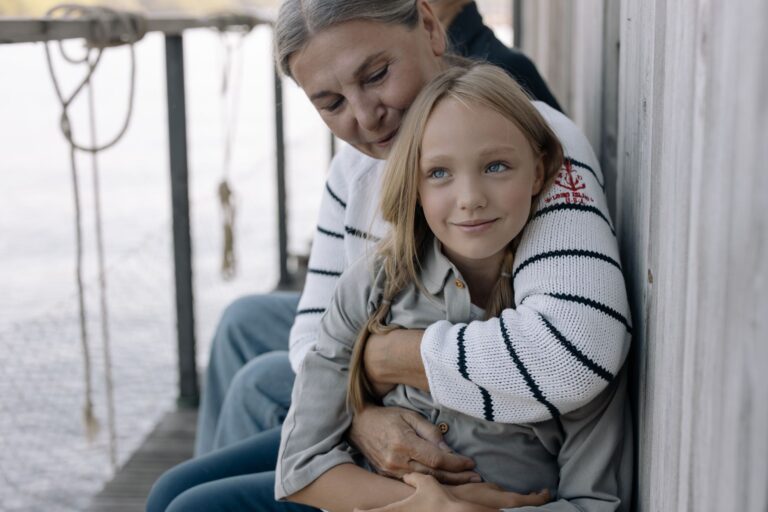
I heard the gravel shift under tires before I saw the car, and some old instinct in me stood up straight at the kitchen sink and knew, before my eyes ever confirmed it, that whoever was pulling into my driveway on that Saturday afternoon in September was not going to be one of the usual visitors. Not the mail carrier. Not the church ladies dropping off a casserole because word had gotten around about my hip. Not my neighbor come to borrow the wheelbarrow again.
I am Wanda. I am sixty eight years old, and I have lived in this farmhouse for forty four years, long enough that the settling of the old floorboards feels less like a house creaking and more like breathing. I raised one son in this kitchen, buried a husband out of it six years ago, and for ten years I had lived here with a silence in it shaped exactly like my granddaughter.
Her name is Paige. I had not laid eyes on her since she was sixteen years old, and on that September afternoon she was twenty six, stepping out of a car I did not recognize, standing at the bottom of my porch steps like she was not entirely sure her own feet were still permitted to climb them.
I want to tell this whole story the way it actually happened to me, not the tidied up version, because the tidied up version leaves out how frightened I was standing at that sink with my hand still wet from washing a coffee cup, watching a grown woman I used to bathe in this very kitchen sink stand at the bottom of my steps like a stranger asking permission to exist in my life again.
But to understand what happened on that porch, and what I would not learn until a full month later, you have to understand what happened ten years before it, and everything in between.
The Quilt
My grandmother made a quilt in the winter of 1952, working by lamplight after her own six children were down for the night, out of scraps from every dress she had ever sewn for them and a few from dresses that had belonged to her own mother before that. It is not a fancy thing. The stitches are uneven in places where her hands must have been tired, and one corner carries a burn mark from a coal that popped out of the stove one night while she worked. But it has been handed down in our family for four generations, always to the oldest granddaughter, always given on her sixteenth birthday, always with the same words spoken over it: this was made by hands that loved you before you were ever born.
My own mother gave it to me when I turned sixteen. I gave it to my son’s daughter, or I tried to, the week Paige turned sixteen.
Paige was the only granddaughter I had, and from the day she was born she and I were close in the particular way that skips a generation sometimes, the way a grandmother and a granddaughter can understand each other without needing to explain themselves the way a mother and daughter do. Her parents both worked, my son at the grain co-op and his wife at the county clerk’s office, and for years I was the one who picked Paige up from school on the days her parents could not, the one who taught her to can tomatoes and to fish off the low bridge on Miller Creek, the one who let her stay up too late on Friday nights watching old movies and eating popcorn with too much butter on it.
I loved that girl the way you love something that reminds you every single day that your life meant something.
So when her sixteenth birthday came, I did what four generations of women in my family had done before me. I wrapped my grandmother’s quilt in tissue paper and brought it to her birthday dinner, and I stood up in front of the family, the way it is supposed to be done, and I started to say the words that get spoken over that quilt every single time.
I did not get past the first sentence.
My son’s wife stood up from the table so fast her chair nearly went over, and she said, in front of everyone, in front of Paige, in front of my own son, “That quilt is not yours to be handing out like you’re the one who raised her.” I tried to explain that it was tradition, that it had nothing to do with who raised anyone, that it was simply what was done in our family, but she was not interested in what I had to say. She had been carrying something against me for longer than I understood at the time, some feeling that I had always positioned myself as more of a mother to Paige than she wanted me to be, some resentment that had been building through every school pickup and every canning lesson and every Friday movie night that she had not been the one to give her daughter.
I did not know all of that yet, standing there holding a folded quilt in front of a room gone completely silent. I only knew that she looked at me the way you look at someone you have decided is your enemy, and she said the words I have not been able to unhear in ten years since.
“You will not see this child again unless it is over my dead body.”
My son did not defend me. He stood over by the stove with his hands in his pockets and he did not say one single word, not to his wife, not to me, not to his own daughter who was standing there watching her whole family come apart over a piece of stitched fabric. I have turned that moment over more times than I can count, wondering what would have happened if he had said something, anything, in that silence. He did not. And in the silence that followed, I understood that whatever happened next was not going to go in my favor.
Get a new story in your inbox every morning.
Facebook doesn’t show you every story we post. Our free newsletter does. Join 2,500+ readers.
I left that dinner still holding the quilt.
Ten Years of Silence
The calls stopped within the week. I would dial the house and get my son’s voice on the answering machine, and eventually the number changed and I did not have the new one. I wrote letters, real letters on paper, the kind you put a stamp on, because I did not trust myself not to say the wrong thing over the phone even if I could have reached anyone. Most of them came back to me unopened, my own handwriting on the front, a stranger’s rejection stamped across it in ink. A few I never heard back about at all, which was somehow worse, because at least a returned letter told me it had arrived and been refused. The ones that simply vanished into silence left me wondering if they had even made it to the right house.
I tried once, about two years into it, to drive over unannounced. I sat in my car outside their house for twenty minutes working up the nerve to knock, and when I finally did, my son answered the door, looked at me with an expression I had never seen on his face before, and said, quiet enough that the neighbors would not hear it but firm enough that I understood there was no room to argue, that it was better for everyone if I did not keep trying. He did not raise his voice. He did not need to. I got back in my car and I did not try again, because I understood by then that my son had chosen the peace of his own house over the truth of what his wife had done, and there was nothing I could say that was going to change that particular arithmetic.
I kept the quilt folded in the cedar chest at the foot of my bed for ten years. I took Paige’s school picture, the last one I had, a sweet gap toothed photo from when she was maybe eleven, and instead of putting it up on the wall with the rest of the family photographs, I kept it in the hall closet, tucked inside an old hymnal, because I could not stand to look at her face every single day and be reminded of what I had lost. Once a year, usually near her birthday, I would take it out and sit with it for a while, and then I would put it back and close the closet door and go on with my life, because that is what you learn to do when grief does not have an ending date attached to it.
My husband was still alive for the first four years of the silence, and he grieved it almost as hard as I did, though in his own quiet way. He used to say that some doors close because somebody slams them, and some close because everybody just stops walking through them, and ours had closed the first way, hard and fast, and there was not much a person could do about a door like that except learn to live in the room they were left standing in. He died six years ago, a heart that gave out on an ordinary Tuesday morning while he was out checking the fence line, and I remember standing at his funeral thinking that my son was there, my son held my hand at the graveside, but Paige was not, because by then she was twenty and however her mother had explained our estrangement to her over the years, it had clearly been enough to keep a young woman away from her own grandfather’s funeral.
I did not blame Paige for that. I want to be honest about that part. Whatever she believed about our family, whatever version of the story she had been told across ten years of growing up, she had been a child when the door closed, and then a teenager, and children do not generally get to override the decisions their parents make about who they are and are not allowed to see. I understood that even while it broke my heart fresh every single year on her birthday, every Christmas, every ordinary Tuesday when I would think of some small thing I wanted to tell her and remember all over again that I had no way to reach her.
The Fall
Fourteen months ago, in January, I went out to bring in firewood during an ice storm and my feet went out from under me on the porch steps before I even understood I was falling. I broke my hip clean through, the kind of break that does not heal on its own, the kind that puts a woman my age into surgery within a day and into a rehabilitation facility for six weeks afterward, learning to walk again on a leg that did not want to cooperate.
I will not pretend the surgery and the rehab were the hardest part, though they were hard enough some days that I cried in front of physical therapists half my age. The hardest part came home with me in the form of envelopes. Medicare covered a good deal of it, the surgery itself and most of the hospital stay, but there is always a share that falls to the patient, and between the ambulance ride, the surgeon’s fees that ran separate from the hospital’s own charges, the rehabilitation facility’s portion that Medicare did not fully cover past a certain number of weeks, and months of physical therapy twice a week in town afterward, the bills arrived steadily all spring and summer like a slow tide that never went back out.
By the time June came around I owed the hospital just over sixteen thousand dollars, a number that sat on top of my chest at night the way the ice on those porch steps had sat under my feet, invisible until it had already taken me down. My pension from thirty one years of cooking hot lunch at the elementary school is a modest one. I had some savings, the kind a careful woman puts away over a working lifetime, but they were never meant to absorb a bill of that size, and watching them shrink month by month while the hospital bill barely moved was its own particular kind of fear, quiet and constant, the sort you do not mention to anyone because there is nothing anyone can do about it except worry alongside you.
I called the hospital billing office more times that spring than I could count, working out a payment plan I could actually manage, eighty five dollars a month, an amount that still stretched my budget thinner than I liked to admit but that I could send without missing a mortgage payment or a light bill. I got to know the woman on the other end of that phone quite well over those months. Her name is Fern, and she has worked in that billing office for going on fifteen years, and she has the particular gift some people have of making a person feel less ashamed of owing money than they have any reason to feel. She never once made me explain myself. She would just pull up my account, adjust what needed adjusting, and tell me she would see me next month, the same way you would talk to a neighbor rather than a debtor.
I sold my husband’s old truck that summer, the one he had kept running past any sensible year for a vehicle to still be on the road, because I did not need two vehicles and the money it brought in covered nearly two months of payments at once. I took in mending work from a few families in town, hemming pants and letting out waistbands and fixing zippers, because my hands still worked fine even if my hip did not, and every ten dollar job felt like a small victory against that number that would not stop growing.
I was not asking anyone to feel sorry for me. I want to be clear about that. I was managing, the way a person manages when there is no other choice available to her, one careful month at a time.
The Porch
Which brings me back to that Saturday afternoon in September, standing at my kitchen sink, hearing gravel shift under tires I did not recognize.
I dried my hands on the dish towel hanging from the oven handle and walked to the front window, and there in my own driveway was a young woman getting out of a car, and something in my chest simply stopped functioning the way it usually functions, because I knew her before I had consciously identified a single feature. I knew the way she moved. I knew the shape of her shoulders. Some part of a grandmother’s memory does not need ten years and a grown woman’s height to recognize the child she raised on Friday nights and fishing trips.
Paige stood at the bottom of my porch steps, and for a moment neither of us moved. She had her mother’s coloring but her father’s build, my son’s build, tall the way he had been tall at that age, and she was wearing a coat too warm for the weather, the kind of coat you put on when you are nervous and dressing for a version of the day that has already gone cold in your imagination before it happens.
“Grandma,” she said, and her voice cracked on the single word, “I’m so sorry it took me this long.”
I do not remember deciding to move. I remember my hand finding the porch rail and gripping it because my legs, still not entirely trustworthy since the surgery, did not feel steady enough to carry me down those steps on their own, not with my heart doing what it was doing. She came up the steps instead, closing the distance I could not close fast enough myself, and then we were simply holding onto each other on my own front porch, ten years compressed into an embrace that neither one of us seemed willing to be the first to end.
We talked for three hours that afternoon at my kitchen table, the same table where the whole trouble had started a decade earlier, and it felt like we had barely scratched the surface of everything there was to say. She told me about the job she had taken with an insurance company two counties over, the small apartment she had moved into on her own the year before, the two cats she had adopted from a shelter because the apartment finally felt like somewhere worth making a home. She told me, carefully, in pieces, about growing up in a house where my name had become something close to forbidden, where questions about me were met with a particular kind of silence that taught a child faster than any lecture could that this was not a subject that was safe to raise.
She did not explain everything that afternoon, and I did not push her to. I had spent ten years learning to be patient with things I could not control, and I was not about to spoil the first afternoon I had with my granddaughter in a decade by demanding she account for every year of it in one sitting. It was enough, more than enough, to have her sitting across from me again, asking about the garden, remembering the smell of the kitchen, reaching for the same chipped blue mug she had always claimed as hers when she was a little girl.
Before she left that evening she hugged me again on the porch, longer this time, and she said she would come back the following Saturday, and she did. And the Saturday after that. Slowly, over the weeks that followed, we began building something that was not quite the relationship we had lost but was becoming its own kind of good, careful and new, like a garden replanted after a hard freeze.
What Fern Told Me
What I did not know during any of those Saturday afternoons was that Paige had already been taking care of me for months before she ever pulled into my driveway.
In October, about a month into our reunion, I called the billing office to set up my regular payment, the same eighty five dollars I had been sending faithfully every month since spring. Fern answered, the way she always did, and I gave her my account number out of habit, and there was a pause on the line longer than her usual pauses.
“Wanda, honey,” she said, “you don’t owe anything this month. You haven’t owed anything since May.”
I told her that could not possibly be right. I keep careful track of my own bills, careful enough that I would have noticed if I had somehow overpaid by that much, and I had sent every payment exactly as we had arranged it, nothing more.
“I’m looking right at the account,” Fern said. “There have been payments coming in every month since May, online, through our patient portal. Somebody’s been paying this down alongside your own payments. You’re actually ahead on the balance now.”
I asked her who. I remember my voice sounding strange to my own ears, thin, like it belonged to someone standing at the edge of something.
Fern read off the name attached to the online payments, and it was Paige’s name, the same name I had watched grow from a child’s careful cursive into a grown woman’s signature over the years I missed, and I sat down hard in the kitchen chair because my legs simply would not hold me anymore. Fern told me the first payment had gone through in May, four full months before Paige ever appeared in my driveway, and that the payments had continued steadily every month since, on top of whatever I was sending, quietly closing the gap between what I owed and what I could actually afford to pay.
Four months. My granddaughter had been paying down my hospital bill for four months before she ever knocked on a single door, before she ever said a single word to me, before I even knew for certain she remembered I existed.
I sat at that kitchen table with the phone still in my hand long after Fern and I had said our goodbyes, doing the arithmetic over and over, trying to understand how a young woman I had not spoken to in ten years had known about my hospital bill in the first place, let alone decided, all on her own, to start quietly erasing it.
What Paige Told Me
I did not call her that afternoon. I sat with it for two days, turning it over, trying to find the right way to ask a question that felt too large for an ordinary conversation. When she came the following Saturday I waited until we were both settled at the kitchen table with our coffee, and then I told her what Fern had said.
She went very still. Then she told me the whole thing, start to finish, and I am going to tell it to you now the way she told it to me.
A cousin of mine, my late husband’s niece, had posted something on a community page that spring, the kind of local page where church suppers get announced and lost dogs get found, mentioning that the ladies’ auxiliary at our church was putting together a small fundraiser dinner to help with my medical expenses after the fall. She had not asked my permission and I had not known about it until well after the fact, but small towns do that sort of thing without waiting to be asked. Paige, it turned out, was still connected to that cousin online, one of the last remaining threads tying her to a family she had otherwise lost entirely, and she saw the post.
She told me she read it standing in her apartment kitchen and had to sit down on the floor, because in ten years of silence she had never once let herself imagine me as someone who could be struggling, someone who could fall and break a bone and need help. She had built her whole understanding of our estrangement around the idea that I was the one who had done something wrong, because that had been the story told in her house for a decade, and seeing that post shattered something in that story all at once.
She wanted to call me immediately. She told me she sat with her phone in her hand for over an hour that night, her thumb hovering over a number she still somehow remembered by heart, and she could not make herself press it. Ten years of being told, in ways spoken and unspoken, that I was not safe to reach out to, had built a wall in her that a single Facebook post was not enough to knock down in one evening, however much it wanted to.
So she found another way. The hospital’s billing portal allowed a payment to be made against any account if you had the account number, which the fundraiser post had included so people could donate directly rather than through the church, and Paige started sending money every month, quietly, anonymously as far as she knew, telling herself she was helping without asking anything of me in return, without risking the rejection she was terrified she still deserved.
She said the strangest part was that paying my bill became a kind of practice for her, a way of proving to herself, one month at a time, that she still loved me enough to act on it, before she trusted herself enough to actually show up. She spent those four months in something like a private negotiation with her own fear, working up the courage in small installments the same way she was working down my hospital bill, until finally, in September, she got in her car on a Saturday morning and drove to my house without calling ahead, because she was afraid if she called first she would talk herself out of it before she ever arrived.
“I didn’t know how to knock on your door and ask you to forgive ten years of silence,” she told me, sitting at my kitchen table with her coffee gone cold in front of her. “So I started paying the bills instead. I thought maybe that could say the thing I didn’t know how to say out loud yet.”
I asked her, gently, why she had never told me, even after she started coming around every Saturday. She said she was afraid that if I knew, I would think the money was the reason she had come back, that it would cheapen the reunion somehow, turn it into a transaction instead of what it actually was, which was a granddaughter who had missed her grandmother every single day for ten years and finally found the nerve to say so.
The Quilt, Finally
I told my son what I had learned. I do not know exactly what passed between him and Paige after that conversation, and some of it is not mine to share, but I know that within a few weeks he came to my house himself for the first time in a decade, standing on that same porch, looking older than the ten years should have made him, and he told me he was sorry, plainly, without excuses, in a way he had never managed to be in all the years the silence stretched between us.
His wife has not come. I do not know if she ever will, and I have made my peace with the possibility that some doors close in a way that does not reopen easily, if at all. But my son is trying now, in small ways, showing up for Sunday dinner every few weeks, sitting a little too carefully at the same table where the whole thing started, and I have decided that a slow beginning is still a beginning, and I intend to meet it as one.
Two weeks after I learned about the payments, I took my grandmother’s quilt out of the cedar chest where it had waited for ten years, still folded the way I had folded it after that terrible birthday dinner, and I gave it to Paige at my kitchen table on an ordinary Saturday afternoon, no audience, no ceremony beyond the two of us. I told her the same words that get spoken over that quilt every time it changes hands, the ones I never got to finish saying ten years ago.
This was made by hands that loved you before you were ever born.
She cried, and so did I, and neither of us tried very hard to stop.
I still owe a little on that hospital bill, not much, a few hundred dollars that I am chipping away at the old fashioned way, eighty five dollars a month, though Paige still insists on sending her own payment alongside mine every time, and I have stopped trying to talk her out of it, because I understand now that it is not really about the money for either of us. It never really was. It is about a young woman who spent four silent months proving to herself that she still knew how to love her grandmother, before she ever trusted herself to say so out loud.
Ten years is a long time to lose. It is not, I have learned, too long to find your way back from, if somebody is willing to start paying down the distance one quiet month at a time, long before anybody else even knows they have started.
We have Sunday dinners again now, most weeks, sometimes just the two of us and sometimes with my son at the table too, and Paige keeps the chipped blue mug on a shelf in my kitchen now instead of packing it away in the cupboard, because she says she plans on using it every single Saturday for as long as I will let her.
I intend to let her for a very long time.
This story is a dramatization. Names, characters, and details are invented, and any resemblance to real people or events is coincidental.