
I still made two cups of coffee that morning. Eight months after Catherine died, I hadn’t broken the habit, and some mornings I didn’t even notice I’d done it until I saw the second cup sitting there on the counter, going cold, steam curling up and disappearing like it had somewhere else to be.
I carried mine out to the back step the way I always did, barefoot on the cold concrete of our patio, and that’s when the light caught the side of the house wrong. Something about the angle of it made my stomach drop before my brain even understood why. I looked through the kitchen window toward the driveway and I stood there for a second not breathing.
The garage door was wide open.
If you didn’t know Catherine, that sentence means nothing to you. If you did know her, you’d already be standing up out of your chair.
In thirty-eight years of marriage, my wife never once left that garage door open overnight, let alone all morning with the fog still lifting off the lawns on our street. We live in a quiet development outside Sacramento, the kind of place where the mail carrier knows your dog’s name and half the houses fly a flag on the Fourth of July, and everybody on the block could set a watch by Catherine Lawson’s garage door. Up at seven when she went in to work on the car. Down and locked by six when she came in for dinner. She was a high school history teacher for thirty-one years, patient with teenagers, precise with test dates, gentle with anybody who asked her a real question. But in that garage, she was something else entirely. She was the most disciplined mechanic I ever watched work, more careful with a torque wrench than most surgeons are with a scalpel.
I walked out there in bare feet, coffee still warm in my hand, and stood in the open doorway like a man walking into a memory that had rearranged itself while he wasn’t looking.
The walls hadn’t changed. She’d traced every tool in permanent marker years ago so she’d know at a glance if something wasn’t hung back in its place, and the outlines were all still there, faithful and empty in some spots, filled in others. Her wrenches. Her sockets, organized by size the way some people organize spice racks. The impact driver I’d given her for our thirty-fifth anniversary because she’d mentioned once, almost embarrassed, that she wanted one and didn’t think it was a normal anniversary gift to ask for. She used it more than the diamond earrings I’d also gotten her that year, and she told me so more than once, laughing.
Her creeper, the little wheeled platform mechanics use to slide underneath a car, sat against the far wall exactly where she’d left it, waiting on a Saturday that was never going to come.
The smell hadn’t left either. Motor oil and old leather and that citrus hand cleaner she kept in an orange tub by the utility sink, the one that used to make our whole downstairs smell like a garage no matter how many candles I lit trying to cover it. I used to complain about that smell. I would give a year of my life to walk into that garage right now and have it hit me in the face again.
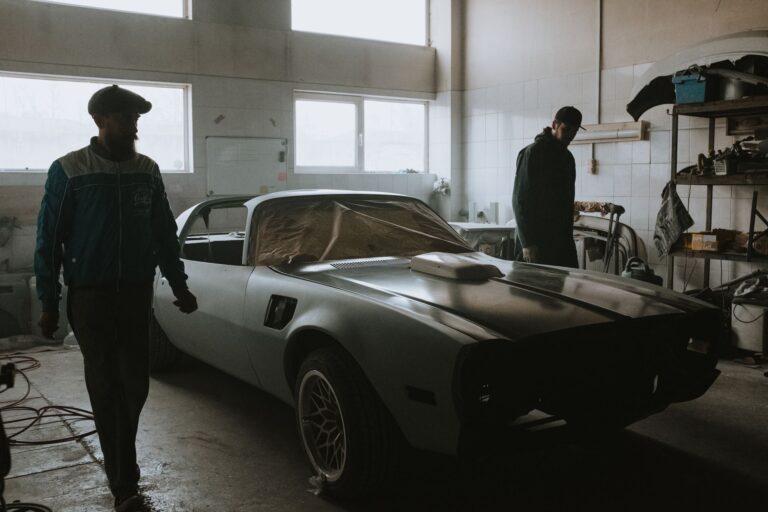
But the middle of the floor, the spot where an oil stain shaped almost exactly like the boot of Italy had lived for twenty-three years, soaked so deep into the concrete that no degreaser Catherine ever tried could lift it all the way out, was just an empty rectangle of gray.
The Charger was gone.
I want you to understand what that car was, because to anybody who didn’t live inside our marriage it might sound like a hobby, an old man’s toy, sheet metal and chrome. It wasn’t. It was a 1968 Dodge Charger that Catherine hauled home in pieces back in the early nineties, loaded onto a flatbed trailer behind my brother-in-law’s truck, more rust than car, missing an engine, one door held shut with a bungee cord. I remember standing in the driveway that day thinking my wife had lost her mind. She spent twenty-three years proving me wrong one bolt at a time. Weekends. Vacation days. Money she earned tutoring on the side and grading AP essays over the summer, money she funneled quietly into engine parts and upholstery and, eventually, a numbers-matching 440 she tracked down through a guy in Fresno who’d been sitting on it for a decade. She used to tell me, every single summer without fail, that this was the year we’d finally drive it up to Lake Tahoe with the windows down and the radio loud enough to hear over the wind. Every single summer, something got in the way. And then there wasn’t going to be another summer at all.
My pulse was going like a fire alarm. For one stupid, hopeful second I told myself maybe she’d moved it, forgotten to mention it, left it at a friend’s for some reason that made sense. Catherine had been gone eight months. My mind still did things like that to me sometimes, offered up an explanation with her alive inside it, before reality caught up and slapped the thought back down.
“Dad?”
I turned around. My daughter Lauren was standing in the doorway between the kitchen and the garage in yoga pants and an oversized sweatshirt, hair still knotted up from sleep, and something in her face told me she already knew exactly what I was looking at.
“I was going to tell you,” she said, quiet, not quite meeting my eyes. “I just didn’t know how.”
“Where’s the car, Lauren?”
She swallowed hard enough that I heard it. “I sold it.”
The word didn’t land right away. It just sort of hung there in the cold garage air. Sold. Like it was a couch. Like it was a treadmill nobody used anymore.
“You did what?”
“I sold it, Dad.” Her voice cracked on the second word. “Ethan and I need the money for our trip. He already put a deposit down on Dubai. The car was just sitting here, Dad, taking up space, nobody was ever going to drive it again.”
Get a new story in your inbox every morning.
Facebook doesn’t show you every story we post. Our free newsletter does. Join 2,500+ readers.
Just sitting here.
Twenty-three years of my wife’s Saturdays reduced to four words by our own daughter, standing in the same doorway Catherine used to stand in with a rag over her shoulder and grease under her nails, smiling at me like she’d just solved a puzzle only the two of us understood.
Behind Lauren, in my driveway, sat a black BMW with paper dealer plates still taped in the back window, gleaming like a bad joke under the morning sun.
We ended up at the kitchen table because that’s where hard conversations in our family have always happened, for better or worse. Lauren sat in Catherine’s chair without seeming to notice she’d done it. Ethan leaned against my kitchen counter with his phone in his hand, thumb moving over the screen even while his father-in-law was standing three feet away trying to hold himself together, a watch on his wrist that cost more than most people’s first car catching the light every time he shifted his weight.
“It’s only a car, Scott,” he said, not even looking up. “Catherine’s gone. You can’t keep living back there.”
I looked at my daughter instead of answering him. “How much.”
She glanced sideways at Ethan first. He gave her the smallest nod, the kind of nod you give someone when you’re coaching them through a sentence you already rehearsed together.
“Twenty five thousand five hundred,” she said, barely above a whisper.
Twenty-three years. Every free weekend her mother had. Every side job Catherine picked up so she could afford one more part, one more gasket, one more trip to a swap meet three hours away chasing a taillight housing that was exactly right. Sold for less than the price of a mid-range SUV, to somebody neither of us had ever met, in what I would later learn was less than forty-eight hours from listing to sale.
“The buyer said it was fair,” Ethan added, like that settled something. “It’s fifty-some years old. Who even knows what’s under the hood at this point.”
“She always said family mattered more than things,” Lauren said, and now she was crying, the kind of crying that comes when a person is trying to convince themselves as much as anybody else in the room. “Mom would want me to be happy, Dad. She would.”
“She did say that,” I told her, and I meant it, because it was true, and because for one second I let myself hope that would be the end of it, that we could sit with the truth of her mother’s generosity and let it be enough. Then I kept talking, because the rest of it needed saying too. “She also told you, more than once, that this exact car was the last piece she had of her own father. That he sold his car to put her through college, and she swore she’d never let anyone in this family do the same thing to something that mattered. You stopped hearing that part of the story around the time you turned sixteen, Lauren. I don’t think you ever heard it again.”
Nobody said anything for a long moment. The refrigerator hummed. Somewhere down the block a dog barked twice and quit.
I didn’t raise my voice. God knows some part of me wanted to. Instead I got up, walked to the junk drawer where Catherine’s garage notebook had lived for as long as I could remember, and I flipped it open to the last page she’d ever written on. I slid it across the table to Lauren without a word.
Her eyes moved over the lines. I watched her read it, and I watched something in her face come apart while she did.
Adjusted the carburetor today. She’s running smoother than she has in years. Can’t wait to finally teach Scott how to drive a stick shift the right way. I keep picturing his face when we take her up to Tahoe this summer, windows down, that stretch past Placerville where the pines start.
A single tear hit the page and blurred the ink at the corner of the word Tahoe.
“We should go,” Ethan said, fast, his hand already back on Lauren’s shoulder like he was steering a shopping cart. “He needs some space right now.”
I watched their taillights pull out of the same driveway Catherine used to fill with parts runs from the auto store on Watt Avenue, boxes of gaskets and bolts riding shotgun in her old Subaru like passengers.
That night the house felt heavier than it had at the funeral. I don’t know how to explain that to somebody who hasn’t lived it. At the funeral there had been people, casseroles, a folding chair beside me at every hour so I never had to sit with the silence alone. That night there was nobody, just the tools still hung in their outlines and the stain still on the floor where a car used to sit and a wife used to hum along to the radio while she worked underneath it.
I opened the notebook again around eleven, not looking for anything, just wanting to be near her handwriting a little longer before I tried to sleep. That’s when I noticed something I’d skimmed past the first time. In smaller writing at the very bottom of that last page, almost an afterthought, almost a doodle in the margin of a life:
note to self, call gary mitchell about the B5 touch up, he’ll know the right mix.
I didn’t recognize the name. I’d heard Catherine mention a dozen guys over the years, parts suppliers and swap meet regulars and a retired machinist two towns over who bored out her cylinders for cost because he liked her enthusiasm. Gary Mitchell wasn’t a name that rang any bell at all. But something about the way she’d written it, small and almost private, made the hair stand up on my arms. B5 is a factory Mopar blue, the kind of detail only somebody who actually knew that car would think to write down. Somebody who mattered enough to trust with the paint code.
I didn’t sleep much. At 6:45 the next morning my phone rang with a Sacramento number I didn’t recognize.
“Mr. Lawson?” A voice on the other end, rough around the edges, the voice of a man who’d spent his life around engines and cigarettes and cold mornings in an open bay door. “This is Gary Mitchell. I need to talk to you about your wife’s car.”
For one furious second I assumed he was the buyer, calling to gloat or negotiate some further discount on a deal that had already gutted me. “You bought it,” I said, and I didn’t try to keep the ice out of my voice.
“I did,” he said. “But not for the reason your daughter thinks I did. Mr. Lawson, I don’t think she had any idea what she was actually selling. I need you to come see something, and I need you to come alone.”
I sat on the edge of my bed with the phone against my ear and said nothing for a second, because something in the way he said it, careful and a little shaken himself, told me this wasn’t a scam or a sales pitch.
“I was at Catherine’s service,” he said, softer now. “Back row, over by the door, so nobody would have to ask who I was. How exactly does a man walk up to a grieving husband and tell him his wife saved his life twenty-five years ago? I didn’t have the words that day. I think I might have them now.”
“What are you talking about,” I said, and I meant it as a demand, but it came out more like a plea.
“She left something for you,” he said. “In the car. Come to my shop on Auburn Boulevard. Please.”
Thirty minutes later I was standing outside a low, faded blue cinderblock building with an old porcelain Gulf sign still hanging above the bay doors, chipped at the edges, the kind of sign that survives decades because nobody ever gets around to taking it down. Half a dozen classics in various stages of restoration sat around the gravel lot, and under a fitted canvas cover near the back bay, I could see the unmistakable shape of a fastback that made my chest hurt before I even confirmed it was her.
Gary Mitchell met me at the door himself. He was maybe seventy, silver stubble, hands that looked like they’d been introduced to a wrench before they were introduced to much else in life. He didn’t offer small talk. He led me straight back to a cramped office off the main bay, and the first thing I noticed were the photographs covering nearly every inch of the walls, curling at the corners, decades of cars and customers and one particular photo, framed and centered above his desk, of a much younger Catherine standing beside a much younger Gary in front of that same shop, both of them laughing at something outside the frame, her hair longer, his overalls newer.
“She made this place possible,” he said, following my eyes to the photo. “Every board in this building, in one way or another, she had a hand in.”
He walked me back out to the bay and pulled the cover off the Charger himself, careful, the way you’d uncover something in a museum. She gleamed under the shop lights, every panel exactly the way Catherine had left her, the B5 blue paint she’d never gotten around to touching up still a shade darker in one small patch near the rear quarter panel where she must have been planning that final detail before whatever came next stopped her.
“She came to see me about a week before she passed,” Gary said. “Sat right there where you’re standing. Asked me for one last job. Said it wasn’t for her.”
He opened the driver’s door, reached under the dash near the radio housing, and pressed something I couldn’t see. A panel I would never have known existed clicked loose in his hand.
Behind it sat a sealed envelope with my name written across the front in Catherine’s handwriting, and behind that, a folder thick enough that it had needed the extra space to fit.
Gary stepped back and let me have the moment alone.
“She told me if anybody ever tried to sell this car,” he said quietly from a few feet away, “I was to buy it, no matter the price, no questions asked, and make absolutely sure you saw what was behind that panel before your daughter’s husband ever got the chance to.”
I stood there with my wife’s handwriting in my hands and understood, for the first time since the hospital room where I’d held her fingers as they went cold, that I might not have known the whole story of my own marriage.
I sat down on an overturned tire in the corner of that bay because my legs weren’t entirely trustworthy anymore, and I opened the envelope.
Catherine’s handwriting filled four pages, dated three weeks before she died, written in the careful, deliberate hand of a woman who knew exactly how little time she had left and had decided to spend some of it on this.
My Scott, it began, if you’re reading this, it means Lauren finally did the thing I’ve been afraid of since the day she brought Ethan home for Thanksgiving and I watched him ask three separate times what our house was worth.
She went on to explain, gently but without flinching, that she had watched Ethan for two years with the same clear eyes she used to catch a teenager’s plagiarized essay from three sentences in. She’d noticed the way he steered every family conversation toward money, the vacations he couldn’t quite afford but somehow always took, the way he’d once asked her, almost casually, what a car like the Charger might be worth on the open market. She told me she’d never said any of this to Lauren directly, not wanting to plant seeds of doubt in her daughter’s marriage that Lauren would have to be the one to pull up herself, in her own time, in her own way. But she’d made a decision. If anything ever happened to her before that car found its rightful place, she wasn’t going to let Ethan’s fingerprints be the last thing on it.
So twenty-five years earlier, she wrote, long before Lauren was even born, before you and I had our first house, I made Gary Mitchell a promise, and he made me one back, and it’s time you knew what that promise was.
The story, once Gary told it to me in full sitting across his cluttered desk with two cups of gas station coffee going cold between us, was this. Twenty-five years ago Gary had been a young mechanic drowning, his father’s shop three payments from foreclosure, his marriage already gone, his own hands shaking too badly some mornings from drink to safely torque a lug nut. One night on a rain-slick stretch of I-80 outside Sacramento, half out of his mind with grief and whiskey, Gary put his truck into the center divider doing sixty. Catherine Lawson, a twenty-nine-year-old first-year teacher driving home from grading papers at her mother’s house, was three cars back. She was the one who pulled over. She was the one who climbed down into that ditch in her church clothes and held a stranger’s head still and talked to him in a steady voice until the paramedics arrived, refusing to let him close his eyes even once.
She visited him twice in the hospital. On the second visit she brought a check for twelve thousand dollars, nearly everything she had from a small inheritance her own father had left her, and she put it in his hand and told him one thing: pay the shop’s debt, get sober, and don’t ever pay me back a dime. Instead, she said, spend the rest of your life doing for somebody else what nobody ever did for you.
Gary kept that promise for twenty-five years. He built Mitchell’s Classic Restorations into a shop known across three counties for two things: the quality of its work, and the fact that it quietly restored, at cost or for free, cars belonging to widows, veterans, and single mothers who’d otherwise have had to sell a piece of family history to strangers for pennies on the dollar. Every one of those jobs, he told me, he did in Catherine’s name, whether she ever knew about a particular one or not. And every single year, on the anniversary of the night she pulled him out of that ditch, he set aside a portion of the shop’s profit into an account he never touched, in case the day ever came that her own family needed it.
That day had come. The folder behind the envelope held two things that changed everything.
The first was a certified appraisal Gary had commissioned himself two years earlier at Catherine’s quiet request, once her diagnosis had already started narrowing her future down to months instead of years. Numbers-matching, factory-correct, documented from the frame up: the Charger wasn’t worth twenty-five thousand dollars. It was worth one hundred and forty-eight thousand dollars, a figure a specialist auction house in Scottsdale had confirmed in writing.
The second was a printed email thread Gary had pulled, at Catherine’s instruction, from a public classic car forum three days after Lauren posted the listing. In it, under a username I didn’t recognize, Ethan had been quietly corresponding with a flipper in Reno for over a week before Lauren ever told me the car was gone, negotiating a resale of the Charger, sight unseen by the Reno buyer, for ninety-five thousand dollars, more than triple what he was letting my own daughter believe it was worth. Gary had outbid that entire arrangement in under six hours the moment the listing went live, paying Lauren’s asking price in full without haggling a dollar, because Catherine had told him exactly what to watch for and exactly what to do the moment he saw it.
He’d known before I did. He’d acted before I even walked into that empty garage.
I sat in that bay a long time with all of it laid out in front of me, my wife’s steady handwriting, a stranger’s twenty-five-year gratitude, and the plain arithmetic of what my son-in-law had been quietly planning to pocket off a dead woman’s life’s work.
I called Lauren that afternoon and asked her to come to the shop, alone. She hesitated when I said the word alone, and I told her that was exactly why it needed to be that way. She showed up an hour later in the same BMW, and when she stepped out and saw the Charger sitting there gleaming in Gary’s bay, whole and cared for and clearly not for sale, something in her face broke open before I’d said a single word.
I let her read the letter herself. I watched her get to the part about the Reno buyer and the ninety-five thousand dollars, watched her hand go up to her mouth, watched twenty-six years of trusting the wrong person’s math collapse in real time on a woman’s face in a mechanic’s garage on Auburn Boulevard.
“He told me twenty-five five was a good price,” she said, and her voice had gone very small. “He said he already had a buyer lined up who’d take it as-is. I thought he was helping me move fast so it wouldn’t hurt as much.”
“He had a buyer lined up,” I said. “Just not the one he told you about.”
She didn’t defend him. I want that on the record, because it matters. My daughter is not a bad person. She is a grieving woman who married a man skilled at making other people’s grief convenient for him, and when the evidence was finally sitting in her hands in her mother’s own handwriting, she didn’t reach for an excuse. She sat down on that same overturned tire and cried in a way I hadn’t seen since she was seven years old and her hamster died, and I sat down next to her and let her.
The conversation with Ethan, two nights later, was shorter than I expected and colder than I’d planned for. Confronted with the printed forum thread, he tried first to claim it was a misunderstanding, then that he’d been planning to split the extra money with Lauren all along as a surprise, a story that fell apart the moment Lauren herself pointed out he’d never once mentioned Gary’s forty-eight-hour cash offer to her at all, had in fact pushed her hard to accept it fast before she could shop the listing further or ask her father’s opinion. Lauren asked him to leave that same night. As of the writing of this, they are separated, and Lauren has moved back into her childhood bedroom while she and a lawyer sort out what happens next, this time with her own eyes open.
Gary wouldn’t take a dime back for the car. He told me the twelve thousand dollars Catherine handed him in a hospital room a quarter century ago had already been repaid a thousand times over just by the chance to finally hand her family the truth. What he would take, and what I let him do, was help me finish the last small job on her list: the B5 touch-up on that rear quarter panel, matched so perfectly you’d never know it wasn’t original, a final Saturday’s worth of work that Catherine never got to finish herself.
Three weeks ago, on a Saturday morning, Lauren and I drove that Charger up Highway 50 past Placerville, right where the pines start crowding in close to the road, windows down the whole way, the old 440 finally getting to breathe the way Catherine always promised it would. I’d never learned to drive a stick properly in thirty-eight years of marriage. My daughter, it turns out, had, taught by her mother in an empty church parking lot the summer she turned seventeen, and she talked me through every clumsy, grinding shift the whole way up the grade, laughing at me the way her mother used to, until somewhere past the Sierra summit I finally got a clean one and the both of us went quiet for a second, just listening to the engine settle into the gear like it had been waiting twenty-three years for exactly that moment.
We reached the lake in the late afternoon, parked at a pullout Catherine used to point to every summer and say that’s the spot, and we sat on the hood in the last of the sun with the windows still down and the radio playing something neither of us chose, and for the first time in eight months, the silence between us didn’t feel like something either of us needed to fill.
The Charger lives in that garage again now, tools hung back in their outlines, the oil stain shaped like Italy slowly reclaiming its patch of concrete. Some mornings I still pour two cups of coffee out of habit. Most mornings now, though, my daughter’s the one who drinks the second one, sitting on the workbench stool her mother used to use, learning the difference between a socket wrench and a box end the same patient way she was taught to drive stick, one careful lesson at a time, in a garage that finally belongs, the way it always should have, to the people who were meant to keep it.