
The morning I finally walked out to that garage to have it out with my son, I had a whole speech ready. I’d been building it for weeks, adding a line here and there while I did dishes or drove to work, the way you sharpen something you plan to use. I was going to tell William that twenty-four is not eighteen, that a mother’s patience is not a bottomless well, and that whatever he thought he was doing out there instead of holding down a real job, it was going to stop that day. I had the whole thing memorized. I never got to say a word of it.
I remember exactly what that morning looked like, because I have gone over it in my mind more times since than I can count. It was cool for June, the kind of morning where the dew sits heavy on the grass past nine and the sky over the bean field to the east had that flat gray light that means it might rain by noon and might not. I had coffee in one hand and my resolve in the other, and I told myself I would not let either one go cold before I made it out to that garage.
I need to back up, because none of what I found in that garage makes sense unless you understand what our life looked like before it, and what our life looked like after his father died.
I live on eleven acres outside a little crossroads town in eastern Iowa, the kind of place where the grain elevator is the tallest thing for ten miles and everybody at the co-op knows whose truck is whose. My husband, William’s father, was career Army, twenty-two years in, two deployments before William was even old enough to remember them clearly. He came home from his last one changed in a way that took us years to fully understand, and by the time William was in high school, his dad’s knees and back had failed enough from all those years of gear and jumps and bad roads that he needed a wheelchair to get any real distance, especially toward the end.
I want to say the va took good care of him. Some of it, they did. But the wheelchair itself, the actual machine that let him leave this house, was a different story. It broke down more than it worked in his last two years. A cracked axle. A motor that groaned like it was dying itself. A footplate that came loose and nearly threw him once in the kitchen doorway. Every single time it broke, we were told to file a request, wait for approval, wait for a technician to drive out from two counties over, wait for a part to ship. Sometimes that wait was six weeks. Once it was four months, and for four months my husband did not leave this house except to be carried to a car for a doctor’s appointment, because the chair that was supposed to be his legs sat in the corner of our living room with a wheel that would not turn.
William watched all of that. He was sixteen, then seventeen, then eighteen, watching his father go quiet in a way I have never fully been able to describe to anyone who didn’t live in this house with us. His father was not a complainer. He never once raised his voice about the chair, not even the time it failed at church and two men from the congregation had to carry him to the truck in front of half the town. He’d just get that look, and go quiet, and ask for his book.
I still remember the Sunday it happened, because I do not think I have ever felt smaller in my life than I did standing in that parking lot afterward. The wheel locked up right as we came out the side door after the service, and my husband sat there working the joystick with both hands like a man trying to start a stubborn mower, while half the congregation filed past pretending not to look and the other half stood too close, offering help he did not want and could not use. Two men from the deacon board ended up carrying him bodily to the truck, one under each arm, while I held the door and tried to keep my own face from doing anything at all. William was seventeen that day. He stood off at the edge of the lot the whole time, not helping, not because he didn’t want to, but because his father had waved him off with one sharp look that said this was not a thing a son should have to do for his own father in front of the whole town. I have thought about that particular look more times than I can count since. I believe now it is the look that built everything I found in that garage years later, long before either of us knew it.
He passed three years ago, in the spring. Congestive heart failure, not the chair, not directly, though I have never once stopped believing that four months of barely leaving this house didn’t help him any. William was twenty-one. He did not cry at the funeral, not where anyone could see, and he did not talk about his father much after that, and I let him have his grief the way he wanted it, quiet and private, because that is how the men in this family have always done it, and I did not know yet that his quiet had turned into something.
For almost two years after that, William worked at the implement dealer in town, selling and servicing tractors and combines, and he was good at it, and I was proud of him in the plain, unremarkable way you’re proud of a son who shows up to work on time and pays his own truck insurance. Then this past spring, he quit. No warning, no fight about it, he just came home one Friday and said he’d given his notice, and when I asked him why, all he said was that he needed his hands and his time for something else. I asked what. He said he’d tell me when it was ready to be told. I have never in my life let an answer like that sit quiet in a house, but somehow, that time, I did. I think some part of me knew it had to do with his father, and I did not want to be the one who made him say so before he was ready.
That was the beginning of the garage.
At first it really did look like nothing. A few tools moved out there that used to live in the shed. Then a folding table. Then, over the following months, more and more, until the garage door started staying down during the day, which it never had before in twenty years of living on this place, and extension cords started running out from under the gap at the bottom, day and night, winter and summer. I would hear the grinder going out there at nine at night. I would see his truck gone at odd hours, sometimes gone overnight to Cedar Rapids, sometimes to Waterloo, and he’d come back with things in the truck bed under a tarp that he’d carry straight into the garage without a word.
He was spending money too. Not wild money, not anything that would ruin him, but steady money, the kind that adds up. I do his laundry, so I do the math whether I want to or not, and I watched his savings account, which he’d shown me proudly not two years before, the down payment start on a place of his own someday, shrink and shrink and never grow back. I told myself it was a phase. I told myself a lot of things a mother tells herself when she is more scared of an answer than she is of the silence.
Get a new story in your inbox every morning.
Facebook doesn’t show you every story we post. Our free newsletter does. Join 2,500+ readers.
By early summer, people had started asking me about it directly, which is its own kind of misery in a town this size. A woman I have known since Sunday school pulled me aside after the Wednesday potluck and asked, gently, the way you’d ask about a diagnosis, whether William was “doing all right for money.” Another neighbor asked if he’d gotten mixed up in something out of state, the way young men sometimes do when nobody’s watching close enough. I told all of them the same thing, that he was working on a project and I trusted him, and I said it with more confidence than I actually owned, because the truth was I had started rehearsing my own worst-case explanations at night instead of sleeping, and none of them were as generous as the truth turned out to be.
What finally broke me was smaller than you’d think. Three weeks ago, on a Tuesday, I was standing at my kitchen window with a cup of coffee going cold in my hand, and I watched William carry an old aluminum wheelchair frame out of the truck bed and into the garage, holding it the way you’d carry something breakable, rust flaking off the frame onto his shirt. And I thought about his father’s chair sitting broken in our living room corner for four months, and I thought, is that what this is, is my son out there hoarding broken wheelchairs in some kind of grief nobody has let him work through, and something in me that had been holding steady for a year just gave out.
I decided that day I was done being patient. I decided I was going to walk out there, and I was going to make him tell me the truth, whatever it cost either of us to hear it.
It took me three more weeks to actually do it, because deciding a thing and doing a thing are not the same, and some part of me kept finding reasons to wait one more day. But three Saturdays ago, with William gone into town for what he said was an hour and turned into three, I finally walked across the yard, past the chicken run, past the old hay wagon we never use anymore, and I put my hand on the garage door.
I did not knock. I have never in my life had to knock on my own garage door, and I was not going to start out of some kind of respect for whatever he was hiding in there. I pulled it open, ready with every hard word I had built over the past month, and the words simply stopped in my mouth, because what I saw was not what I had built myself up to see.
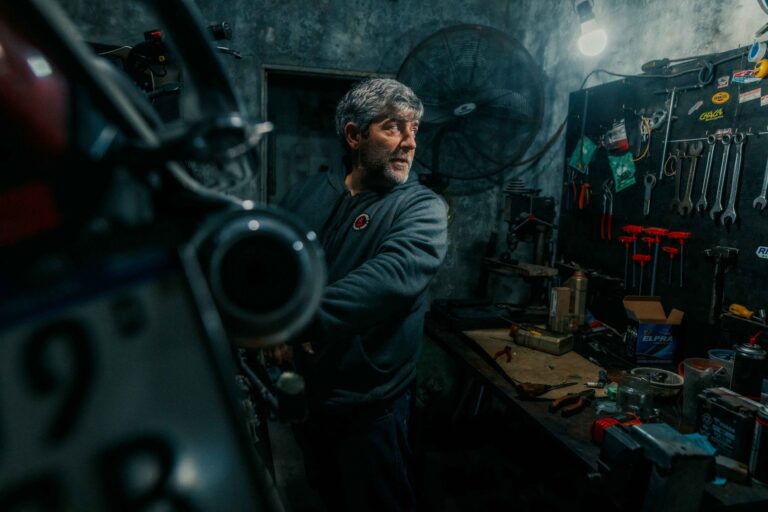
It was not a mess. I want to say that plainly, because I had convinced myself for a year that it was one, that my son was out there drowning in clutter and secrecy and shame. It was the opposite of a mess. There was a workbench built the whole length of the back wall, real lumber, screwed and braced, not thrown together. Above it hung a full rack of tools on pegboard, outlined in marker so every wrench had its place and you could tell at a glance if one was missing. Along the side wall were plastic bins, labeled in William’s own handwriting, sorted by size and part: wheels, casters, armrests, footplates, batteries, motor brushes, upholstery. It looked less like a garage and more like the back room of a proper repair shop, the kind you’d find in a city three times our size.
And above the workbench, taped edge to edge across almost the whole wall, was a sheet of paper longer than my arm, printed and then ruled by hand in pencil into columns. I stood there and read it, and I could not stop reading it, and the longer I read the less air seemed to be in that garage.
The columns were simple. Date. Name. Branch. Repair. Hours. And under those headings, going back fourteen months, were rows and rows of entries, more than I could count standing there, though I counted them properly later, alone, and came up with forty-seven separate names. Forty-seven veterans from this county and the two counties beside it, each one with a date beside their name, sometimes more than once, a repair spelled out in William’s neat square print. Replaced axle. Rebuilt motor, no charge. New batteries, no charge. Reupholstered seat, no charge. Every single line ended the same way, in those same three words, no charge, all the way down that long sheet of paper, month after month after month.
The branches on that sheet ran the whole span of this county’s service, which is its own kind of history lesson if you stand there long enough to read it. Army. Navy. Marine Corps. A few Air Force. One entry near the top marked simply Korea, 1952, beside a name belonging to a man I did not recognize and have since learned lives two counties over and rarely leaves his house anymore. Most of the rest were Vietnam era, men in their seventies and eighties I have passed at the feed store my whole life without ever once knowing what sat folded up in their trunks or waiting broken in their garages. A handful were younger, Gulf War and the two wars after it, men not much older than William himself, missing a hand or a foot or carrying something that didn’t show at all but showed plenty in the way they held themselves at the counter.
I recognized names. A widow from two roads over, who I knew had a bad hip and used a scooter to get around her garden. A man I’d sold eggs to at the Saturday market for years, who I’d always assumed just liked walking slow with a cane out of habit and never once thought to ask why. A woman who used to run the Sunday school before her hip gave out, whose grandson I’d gone to school with. And near the middle of the sheet, a name I stopped on longest of all: Walter, entered four separate times over the past year, each time a different repair, the last one dated barely six weeks earlier.
I did the math standing right there in that garage, and I hated every part of what it added up to. Fourteen months. Forty-seven veterans. All of it done for nothing, on my son’s own dime, using money I’d watched drain out of his savings account and assumed was going toward something shameful, something I was ready to shame him for.
I thought about every conversation I’d had about him over the past year, every time I’d let a neighbor’s careful question about “how William was doing” sit in the air a beat too long before I changed the subject, every night I’d lain awake constructing shameful explanations for a secrecy that had never needed explaining at all. I thought about the down payment fund I’d watched drain out of his account and had assumed, with a certainty I am not proud of now, meant something was going wrong in his life rather than something going right in somebody else’s. Standing there doing that math, I understood that the worst thing I had done as his mother in the past fourteen months was not any single accusation. It was simply failing, for over a year, to ask him one generous question instead of a hundred suspicious ones.
William came in behind me while I was still standing there with my hand over my mouth. I don’t know how long I’d been reading before he found me. He went quiet the second he saw what I was looking at, the particular quiet I had come to know as his father’s quiet, and for a moment neither of us said anything at all.
I finally asked him how long. He said longer than I’d believe, and told me it started the winter after his dad passed, when an older veteran down the road, who’d served two tours and lost most of the use of his left leg to a training accident stateside, mentioned at the feed store that his scooter had died and the VA repair request was going to take until spring. William didn’t say much to him that day. He just went and looked at the scooter that weekend, on his own time, figured out it was a burnt-out motor and a bad battery, ordered the parts himself, and had the old veteran riding again inside four days. That veteran told one friend. That friend told another. Within two months William had three more veterans showing up at our mailbox asking, quiet, almost embarrassed, whether it was true a young fellow out this way could fix a chair without all the paperwork.
He said yes every single time. He never once turned a veteran away, never once asked for a dollar, and when a repair needed a part he didn’t have, he paid for it himself rather than make an old man wait on a form. That was why he quit the implement job. Not because he didn’t love it, but because he could not do both, and once word had truly spread, this had become the thing he could not walk away from.
“I didn’t do it to hide anything from you,” he told me, standing there with a wrench still in one hand like he’d forgotten he was holding it. “I did it because every time I got ready to explain it, I had to explain Dad first, and I wasn’t ready to do that out loud yet. I’m still not sure I am.” I asked him if he was ashamed of what he’d been doing. He looked at me like I’d said something in a foreign language. “No,” he said. “I’ve never been less ashamed of anything in my life. I just didn’t know how to hand you the reason without handing you the worst part of losing him all over again.”
I asked him why. Not why he did it, I understood that part the second I saw his father’s face flash somewhere behind his eyes when he told me who it was for. I asked him why he never told me, why I had to find out standing alone in a garage with my hand over my mouth instead of hearing it from him across our own kitchen table.
He didn’t answer right away. He walked to the workbench and pulled a folded piece of notebook paper out from under a stack of invoices, the kind of paper that had clearly been folded and unfolded more times than it could take much longer, soft at the creases. He handed it to me without a word, and I understood then it had been tucked under the bottom corner of that long roster the whole time, out of sight unless you went looking, which I never had, because I had never once believed there was anything worth looking for out there besides evidence of my son wasting his life.
I want to tell you exactly what that note said, because I have read it more times now than I can count, and every time it undoes me a little more than the last.
It said that he started fixing that old veteran’s scooter because he couldn’t fix his father’s chair in time, and he never wanted another family in this county to sit in a living room watching someone they loved go quiet because a wheel wouldn’t turn and a form was still sitting on somebody’s desk two counties over. It said he never told me because every time he tried, he pictured his dad’s face the day the chair failed at church, and the words wouldn’t come, and it was easier to just go do the work than to explain why he needed to do it. It ended with one line I will not try to improve on by paraphrasing, because his own words say it better than mine could: I couldn’t save Dad’s legs in time. I can save somebody else’s.
I stood in that garage and I cried in a way I had not cried since the funeral, and William, my quiet son who never once asked for comfort even as a boy, put his arm around me and let me.
I want to tell you about Walter, because his name on that roster is the reason the rest of this county found out what my son had been doing, before I ever had the chance to tell a soul myself.
Walter is seventy-eight, a Vietnam era veteran who lives alone since his wife passed, out past the old grain elevator on the north road. He has used a motorized wheelchair for going on six years, since a stroke took most of the strength from his right side. Six weeks before I found that garage, Walter’s chair failed two days before his granddaughter’s wedding, the one where he was set to walk her partway down the aisle himself, slow, on his own power, a thing he had been talking about at the feed store for a month beforehand to anyone who’d listen. The motor seized entirely. Walter called the VA line and was told the earliest a technician could look at it was nine days out, four days after the wedding would already be over.
Somebody, I still don’t know who, mentioned William’s name to Walter’s daughter. William drove out that same evening, found a burnt motor bearing, drove to Cedar Rapids himself the next morning because the part wasn’t sitting on any shelf closer, and had Walter’s chair running again by the following afternoon, two full days before the wedding. He would not take a dollar for the part or his time. Walter’s daughter told me later that when she tried to press money into his hand anyway, William told her the only payment he wanted was a photograph from the day, Walter rolling his granddaughter partway down that aisle under his own power, and she gave him one, and I found it later tucked behind the roster on that same wall, the only thing on the whole wall that wasn’t a repair record.
Walter told me himself, weeks later, sitting in my own kitchen with a cup of coffee he’d insisted on doctoring himself, cream and three sugars, same as he’d apparently always taken it. He said when that motor seized two days out from the wedding, he had already resigned himself to sitting it out entirely, to watching from a folding chair at the end of the aisle instead of rolling his own granddaughter down it the way he’d promised her at Christmas. He said William showed up at his door that evening without being asked twice, still in his work boots from the implement job he hadn’t yet quit, and worked under a shop light in Walter’s own machine shed until past midnight, and never once acted like there was anywhere else in the world he’d rather have been. “That boy gave me back a promise I’d already made peace with breaking,” Walter told me, and had to stop and clear his throat before he said anything else.
Walter told that story to everyone who would listen after the wedding, the way proud grandfathers do, and within two weeks half the county knew a young man out on the old home place was fixing veterans’ equipment for nothing, though nobody, including me, knew it was my son they meant until I stood in that garage myself and put the pieces together.
Once I knew, I could not sit on it the way William had. I am not built for his kind of quiet, and frankly, after fourteen months of him carrying this alone, I did not think he should have to carry the telling of it alone either. I drove into town the next morning and told the post commander at our county VFW hall what I had found, showed him a photograph I’d taken of that roster on my phone before I could talk myself out of it, and watched a grown man who had buried more friends than I could count go quiet himself, reading down that same long list of names.
Word moved fast after that, the way it does in a place this size. The VFW hall held a meeting inside a week and voted to start supplying William with parts directly from a standing fund, rather than have him paying for every battery and motor out of his own pocket. The hardware store in town donated a full set of new tools to replace the ones he’d been buying secondhand. A woman two towns over who owns a machine shop offered her equipment on weekends for anything William’s own garage couldn’t handle. The county paper ran a piece on him that he did not want to sit for and only agreed to because the post commander asked him to, for the sake of the other veterans who still didn’t know help like his existed.
The paper’s write-up ran under a small headline on page four, easy to miss unless you knew to look, but I have since read it enough times to know it by heart. It said the county had, without any fanfare or funding, been sitting on an entire second wheelchair repair service for over a year, run out of a home garage by a twenty-four-year-old with no formal training beyond what he’d taught himself from manuals and forums late at night, and that in fourteen months he had done for free what the nearest commercial repair shop, ninety minutes away, would have billed out at several thousand dollars total. It quoted the post commander calling it “the kind of thing you hope your county has and never actually expect to find,” and it quoted William exactly once, four words long, when asked why he’d started: “Somebody had to catch it.”
Three weeks ago, the VFW hall held a small ceremony, nothing grand, folding chairs in the gravel lot and a sheet cake from the grocery store, and gave William a plaque recognizing what he’d built. He stood up front looking like he wanted to be anywhere else on earth, the same way his father used to look whenever anyone tried to thank him for his service, and Walter stood beside him the whole time, one hand on William’s shoulder, not saying much, not needing to.
The plaque itself was simple, engraved at the print shop two doors down from the VFW hall: For Quiet Service to the Veterans of This County, With Gratitude That Cannot Be Repaid In Kind. The post commander stood up in front of maybe sixty folding chairs and told the room that in thirty-one years of running that hall, he had signed off on a lot of fundraisers and a lot of thank-yous, but he had never once had to go looking for a young man who was already doing the work before anybody thought to ask him. He said William had done, quietly and for nothing, what a fair number of institutions with far more funding had failed to do at all, and that the only fitting response the post could offer was to make sure he never again had to pay for a part out of his own pocket to keep doing it. William stood up when they called his name, said maybe four sentences total, thanked the room more than he let them thank him, and sat back down so fast I don’t think half the crowd caught his face turning red before he ducked it toward his shoes.
I keep that photograph of Walter and his granddaughter now, the one William wouldn’t take money for, framed on my own kitchen wall where I can see it every morning. Underneath it, I put a copy of the note William wrote himself, the one about his father and the chair that wouldn’t turn, because I never want to forget how close I came to shutting down the truest thing my son has ever done in his life, out of nothing but my own fear and my own failure to ask a gentler question before I asked a hard one.
Some nights now I sit on the back step where I used to sit with my husband before his legs stopped letting him make the trip down two porch steps unassisted, and I watch the light still on out in that garage past ten o’clock, and I do not feel the old worry anymore. I feel something closer to the way I felt watching William as a boy learn to back a truck up to a gate without me holding my breath the whole time, proud in a way that still has some fear folded into it, because the work he chose is not easy and will never really be finished. There will always be another axle, another motor, another old soldier whose chair gives out on a Tuesday with nowhere else to turn.
The garage is still a garage. It still smells like grease and hot metal, and the roster on the wall is longer now than it was the day I found it, closing in on sixty names as of this week. But it is not the thing I thought it was for a year, and I am not the woman who marched out there ready to end it. I am only the woman lucky enough to be his mother, standing quietly at the door now instead, watching him do, with his own two hands and his own two years of grief, exactly what his father would have wanted done for every man and woman like him in this county, no charge, every single time.
This story is a dramatization. Names, characters, and details are invented, and any resemblance to real people or events is coincidental.