
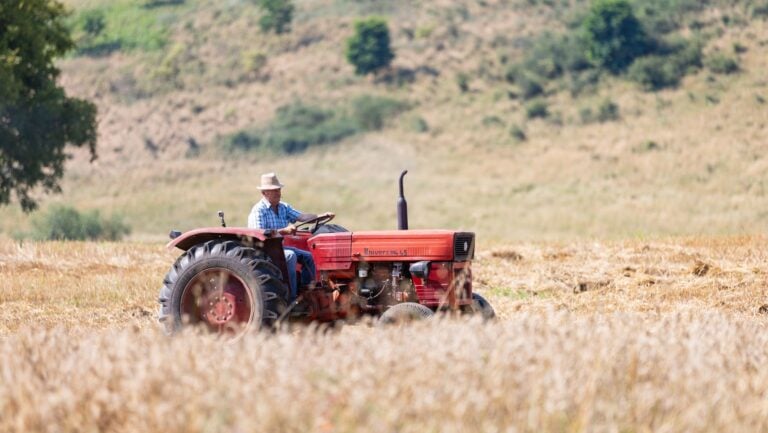
The concrete pad in my machine shed was empty, and I stood in the doorway for a long time before I let myself believe what I was looking at.
There was an oil stain shaped exactly like the machine that used to sit there, front wheels narrow, back wheels wide, a dark shadow of fourteen years soaked into the concrete same as a photograph. The pegboard on the far wall still had its outline of tools drawn in marker, the ones my husband kept just for that tractor and nothing else, a torque wrench, a set of feeler gauges, a little tin of peppermints wedged behind the vise because he liked one in his cheek while he worked. The tools were gone too. Somebody had taken the trouble to clear out everything that went with it, which is not what a man does when a machine dies where it stands. That is what a man does when he is covering his tracks.
My name is Betty Renner. I am sixty-seven years old, and before any of this happened I would have told you my family was not the kind that lies to each other, not about anything that mattered. I have farmed this ground outside Ellsford, Kansas for forty-four years, since I married a nineteen-year-old boy from three sections over who used to find any excuse at all to drive his father’s tractor down our road just so he could see me out hanging wash. We had forty-one years together. He built a life out of hard red winter wheat and milo and a herd of cattle that never got big enough to make us rich and never got small enough to make us give up, and somewhere in the middle of all that ordinary work he fell in love with one particular machine the way some men fall in love with a hunting dog or a boat.
That machine was a 1952 Farmall Super M, and it did not come to him whole. It came to him as scrap iron sitting in a fence row on the Hollenbeck place two farms over, sunk to its axles in Johnson grass, a wasp nest built into the exhaust stack, one headlight glass shattered clean through. Nobody wanted it. The Hollenbecks were glad to have somebody haul it off for the price of a case of beer and a promise to clear the fence line where it sat. My husband was thirty-one years old when he dragged that wreck home behind our old flatbed, and I remember standing on the porch watching him back it into the shed and thinking, well, that is going to sit there and rust for the next twenty years and take up space we do not have.
It took him fourteen.
Fourteen years of Sunday afternoons and winter evenings after chores, sourcing parts from salvage yards in three states and mail-order catalogs before there was any such thing as finding a part on a computer screen, teaching himself to read the timing marks and rebuild a magneto and match the original International Harvester red down to the exact pigment because he refused to let anybody tell him close enough was good enough. He kept a spiral notebook on a nail by the shed door the whole time, and it is still there, still hanging on that same nail today, because whatever else Ryan took out of that shed, he did not think to take the notebook. Every part number. Every hour logged. Every oil change dated in his handwriting, which got smaller and neater the older he got, like he was trying to leave less room for error the less time he had left to make any.
By the time he finished it, that tractor did not look like a machine that had ever known a fence row. It looked like it had rolled straight off a factory floor in Rock Island, Illinois in the spring of 1952. He entered it in the Ellsford County Fair Parade of Power the summer he turned forty-five, and it took Best Restoration. He entered it again eleven years later and it took Best Restoration a second time, against machines owned by men who had spent real money instead of just time. He used to drive it in that parade every August until his knees would not let him climb up anymore, and after that he still went every year just to stand at the rail and watch somebody else drive it past him, grinning like a boy the whole way down the fairgrounds.
We had that tractor insured for twenty-six thousand dollars. Not because we thought we would ever sell it. Because the insurance man came out one year to look over the place and about fell down when he saw what was sitting in that shed, and he told my husband flat out that if anything ever happened to it, a fire, a flood, a theft, he wanted the paperwork to reflect what it was actually worth, not what a rusted 1952 Farmall usually goes for at auction. My husband liked that. He liked that somebody outside the family finally understood it was not a tractor sitting in that shed. It was fourteen years of a man’s life, made visible, something you could point to and say, that. I did that. I made that whole again with my own two hands.
He died four years ago this coming November, standing in our kitchen doorway with a cup of coffee in his hand, his heart just stopping between one step and the next the way some men’s hearts do after seventy years of hard work and hard weather. I found him when I came in from the henhouse. After the funeral, after the calls stopped coming and the casseroles stopped arriving and the house went quiet in the particular way a house goes quiet when it used to hold two people and now holds one, I went out to that shed more evenings than I want to admit and just stood next to that tractor with my hand flat on the fender, because it still smelled like him. Motor oil and canvas and those peppermints. I never once thought about selling it. Selling it would have felt like selling him.
I want to tell you about my nephew Ryan before I tell you what he did, because I do not think this story is fair to him if I only tell you the ending.
Ryan is my younger brother’s boy, thirty-three years old this spring, and I have loved him since the day he was born feet first and screaming in a hospital in Salina, my brother pacing the hallway so hard the nurses made him sit down. Ryan grew up two farms over from us his whole life, and every summer of his childhood he spent half his days out at our place, following my husband around the shed asking to hand him tools, sitting on the tractor seat making engine noises with his mouth before it even ran. My husband taught that boy to drive a stick shift in our east pasture when he was eleven years old, sitting him up on his lap behind the wheel of an old flatbed, both of them laughing so hard I could hear it from the porch. There is a version of Ryan’s childhood where that tractor is the center of everything good that ever happened to him out at our place, and I do not think that is a small thing, and I do not think it excuses what came later, but I want it said plainly, because it is true.
Get a new story in your inbox every morning.
Facebook doesn’t show you every story we post. Our free newsletter does. Join 2,500+ readers.
Ryan grew into a man who never quite got his footing the way the rest of the family did. He went two years to community college in Hays and did not finish. He worked construction for a while, then a tire shop, then construction again. He married young and it did not last. He has had a truck repossessed once already, back when he was twenty-six, and my husband, God rest him, quietly paid off the balance so it would not follow Ryan onto his credit for the next seven years, and never once mentioned it to another living soul in the family, not even to me until the year before he died, when he told me almost like a confession, like he was worried I would think less of Ryan for needing it. I did not think less of Ryan for needing it. I think less of him now for what he did with the trust my husband spent a lifetime building in him.
In February of this year I went out to the woodpile in the dark, the way I have gone out to that woodpile in the dark a thousand times in forty-four years, to bring in an armload of split oak for the stove because the furnace was acting up and I did not want to wait until morning to deal with it. My boot caught the edge of ice on the bottom porch step that I could not see in the dark, and I went down hard, and I heard the sound before I felt the pain, a sound like a green branch snapping, except it was my hip. I lay there on that step for eleven minutes before I got my phone out of my coat pocket, because the fall had knocked the wind clean out of me and I could not make my arms work right away. I remember looking up at the stars the whole time, thinking, well, Betty, this is a fine mess, and thinking about my husband, and wondering if this was going to be the thing that finally took me to wherever he had gone.
An ambulance took me to Salina Regional. I had broken my hip in two places, and the surgeon who put the pins in told me I was lucky it was not worse, and I did not feel lucky, I felt like a woman who had spent forty-four years hauling wood and hay and calves and had finally been reminded, hard, that a body only holds up so long. I spent nine days in the hospital and then five weeks in a rehabilitation wing in Salina, learning to walk again on a metal frame, a physical therapist half my age counting my steps out loud like I was a toddler. It was the hardest and loneliest six weeks of my life since my husband died, and the one thing that got me through most days was knowing my farm was being looked after by somebody I trusted.
My brother’s boy Ryan showed up at the hospital the second day I was there and told me, sitting in that plastic chair by my bed, not to worry about one single thing out at the place. He would feed the hens. He would check the water lines so nothing froze. He would keep an eye on the cattle we still ran on the back forty. I cried when he said it, actual tears, because I had been lying in that bed running through every chore in my head that nobody but me knew how to do right, and here was my sister’s boy, my husband’s shadow all through his childhood, telling me he had it handled. I told the nurses about him. I told my physical therapist my nephew was looking after my farm while I learned to walk again, and I said it with more pride than I have said almost anything in the four years since my husband died. I believed, all the way down, that I had raised a family that showed up for each other when it counted.
While I was on that metal frame learning to put one foot in front of the other, Ryan was making calls I did not know about.
I did not learn the whole shape of what happened during those six weeks until much later, and some of the exact details I only pieced together afterward from things people let slip once the truth was already sitting on the table in front of them, but here is what I now know for certain. On my ninth day home from the hospital, before I was even out of the rehab wing, a truck came down our lane, driven by a man Ryan knew through a friend of a friend, a fellow who ran a salvage and consignment lot two counties over near Beloit, the kind of place that buys and sells everything from combines to scrap fence wire, no questions asked as long as the paperwork gets signed. Ryan met that truck at the shed door himself. He helped load the tractor onto the trailer with his own two hands, the same hands my husband had once folded around a gearshift in our east pasture and taught to find third gear without looking down. He signed a consignment ticket that day, the kind of receipt a salvage lot keeps for its own protection as much as the seller’s, describing exactly what he was handing over.
I have since held a copy of that ticket in my own hands, and I will tell you exactly what it says, because it is the piece of paper that changed everything for me. It says, in block letters filled out by the lot’s own clerk with Ryan standing right there watching him write it: 1952 Farmall Super M. Restored condition. Running, no mechanical defects noted. Complete, no missing components. And at the bottom, in Ryan’s own handwriting, his signature, the same signature I have watched him sign birthday cards with since he was nine years old.
He was paid three thousand six hundred dollars in cash that day for a machine insured at twenty-six thousand, a machine that had just won its second Best Restoration ribbon less than two years before, a machine with a spiral notebook on a nail by the shed door proving in fourteen years of handwriting that it had never once failed to start. He took that cash, and within the week, from what I have since learned, most of it went straight to a title loan company in Salina that was three days from repossessing his own truck, a loan he had never told a single person in the family he had taken out, on top of debts he already carried from a divorce and two years of underemployment that none of us had asked him hard enough about, because we loved him, and love sometimes looks a great deal like not asking questions you are afraid to hear the answers to.
Then he drove out to the hospital, and later to the rehab wing, and sat with me in that plastic chair, and told me the hens were fed and the water lines were fine and everything at the place was just as I had left it.
When I finally came home in March, on a walker, moving slower than I had moved in my whole adult life, the very first place I went before I even set my travel bag down inside the door was that shed, because some part of me needed to see that tractor sitting there to feel like I had actually come home. I stood in the doorway and looked at bare concrete, at an oil stain shaped like a ghost, at a pegboard with the outline of missing tools drawn in marker, and something in my chest went very cold and very still, the way it does right before you understand a thing you are not ready to understand yet.
Ryan told me the engine had seized while I was in the hospital, a rod through the block, the kind of failure that cannot be fixed, only replaced, and that a scrapyard fellow he knew had come and hauled it off as a favor, no charge, because it was not worth anybody’s time to try selling a dead machine for scrap value. He said it standing in my own kitchen, drinking coffee I had made for him, not quite meeting my eyes, which I told myself at the time was grief on his face, since my husband had taught him everything he knew about engines and it must have hurt him to watch one finally die.
My brother, Ryan’s father, told me the same week to let it go, Betty. It is just a piece of metal. Be grateful the boy handled anything at all while you were flat on your back in that bed, instead of making him feel bad for it now. My sister-in-law told me almost the same words a few days later, in almost the same tone, the particular tone a family uses when they have already decided among themselves which version of events is easier to live with and they need you to stop disturbing it.
I sat with their story for three weeks, and it never once sat right, no matter how many times I tried to make it fit. I went out to that shed some evenings, the way I used to go out and stand beside the tractor after my husband died, except now there was nothing there to stand beside, and I would take that spiral notebook down off its nail and read through his handwriting one more time. Oil changed March the eleventh. Belt replaced the following October. Ran two hours plowing the north forty on the Sunday before I fell, no issues noted. A machine a man logs that carefully does not throw a rod eleven days later out of nowhere, not without some kind of warning written down first, and there was no warning written down anywhere in fourteen years of his handwriting.
I called the sheriff’s non-emergency line once, quietly, and asked what a person does if they suspect a family member sold something that was not theirs to sell, and the deputy who took the call, kindly enough, told me that without any proof at all, without so much as a photograph or a receipt, there was not much anybody could do, and that family disputes over property were usually a civil matter, not a criminal one, and that I might want to talk it through with the family first before I did anything that could not be undone. I hung up that phone feeling like a crazy old woman chasing a ghost, and for the first time since my husband died I let myself cry about something other than missing him, because I was starting to believe I had lost my mind along with my hip.
Then, on the second Saturday in April, a neighbor of mine named Frank drove two counties over to a farm equipment swap meet outside Osborne, the kind of gathering where half of north-central Kansas shows up to sell tools and trade parts and look at other men’s tractors the way some men look at other men’s trucks. Frank had helped my husband haul that Farmall to the county fair every single August for as long as I can remember, because his flatbed was bigger than ours and he never once asked for gas money. He knew that tractor the way you know a neighbor’s dog, by sight, without having to think about it.
He called me from the parking lot of that swap meet before he had even climbed back into his own truck, and his voice on the phone was doing something I had never heard it do in twenty years of knowing him. It was shaking.
“Betty,” he said, “I need you to sit down.”
He had walked past a row of vendors selling everything from harrow discs to hand tools, and near the back of the lot, parked at an angle where the morning sun was hitting the hood just right, he had seen a fully restored 1952 Farmall Super M with a hand-lettered sign propped against the front tire reading NINE THOUSAND FIVE HUNDRED, FIRM. He said his stomach dropped before his brain had even finished putting the pieces together, because there is a small mark on the underside of that left fender, a tiny hand-painted wheat sheaf my husband put there the year he finished the restoration, a private joke between the two of them about the crop that paid for every part on that machine, and Frank is one of maybe three living people who ever knew it was there. He got down on one knee in the middle of that swap meet lot and looked underneath the fender, and there it was, faded but unmistakable, a little painted wheat sheaf no bigger than a silver dollar.
He asked the vendor selling it, a broker who runs the salvage and consignment lot near Beloit, where the tractor had come from. The broker, a heavyset man Frank described as friendly enough right up until the questions got specific, said it had come in on consignment a few weeks back, an estate situation, nothing unusual, and that he had cleaned it up and was asking a fair price for a machine in that kind of condition. Frank pushed harder than he probably had any right to, told the man he thought he recognized the tractor, asked to see the paperwork on it, and the broker, more out of habit than suspicion, more because record-keeping was simply how he protected his own business from exactly this kind of dispute, pulled a battered ledger book out of the cab of his own truck and flipped it open to show Frank the consignment ticket, the same kind of ticket that lot uses whether a thing comes in on pawn or straight sale, proof of where every piece of equipment on that lot had come from and who had signed it over.
Frank took a photograph of that ticket with his phone before the broker even fully realized what he was doing, and it is that photograph I am looking at right now as I write this. 1952 Farmall Super M. Restored condition. Running, no mechanical defects noted. Complete, no missing components. Three thousand six hundred dollars, paid in cash. And at the bottom, in handwriting I would know anywhere on this earth because I have watched it fill out birthday cards and school permission slips and a wedding guest book, my nephew Ryan’s own signature, dated the ninth day I was lying in a hospital bed in Salina believing he was home feeding my hens.
I sat at my own kitchen table with my walker parked beside my chair and looked at that photograph on Frank’s phone for what felt like an hour, though he tells me now it was probably closer to five minutes. I want to be honest about what I felt in that moment, because it was not only grief and it was not only anger, though God knows there was plenty of both. What I felt, underneath everything else, was a strange and terrible clarity, the kind that comes when a story you have been forcing yourself to believe finally cracks open and shows you the true shape underneath. My husband’s tractor had not died. It had never once been sick a day in fourteen years. It had been driven onto a trailer by a boy he taught to drive a stick shift, sold whole and running for cash, while I lay broken in a hospital bed trusting that same boy with everything I had left of the man I loved.
I called Ryan that same evening and asked him to come to the house. I did not tell him why. I set that photograph, printed out on a sheet of paper from the library in town because my own printer had not worked in years, face down on the kitchen table, in the same spot where he had stood drinking my coffee and telling me about a rod through the block.
He came in the way he always comes in, easy, a little too casual, dropping into the chair across from me like he had done a hundred times since he was a boy. I asked him to tell me again exactly what happened to the tractor while I was in the hospital, and he told me the same story, word for word, the scrapyard, the seized engine, the favor, no charge. I let him finish the whole thing. Then I turned that piece of paper over and slid it across the table.
I have never in my life watched a grown man’s face do what Ryan’s face did in that moment. It went through about four different expressions before it landed on something that finally looked like the truth, and what it landed on was not defiance. It was something closer to relief, the particular relief of a person who has been carrying a lie so heavy for so long that having it finally set down in front of him, even by someone else’s hand, felt almost like being allowed to put down a sack of feed he had been hauling on one shoulder for two months straight.
He told me everything then, sitting at that table, his voice breaking about halfway through. The title loan on his truck. The threats from the lender that had started the week before I fell, threats he had been too ashamed to tell his own father about, let alone me. The three days he had before repossession when the swap meet contact called him about the salvage lot near Beloit that bought and sold anything without asking too many questions. He said he told himself it was temporary, that he would find a way to buy it back before I ever came home, that he truly believed for about a week that this could be undone before anyone had to know, and that the longer the lie held, the harder it became to say anything true at all. I do not think he is a wicked person. I think he is a frightened one who made a choice a frightened person makes, the easy wrong thing instead of the hard right one, and then discovered, the way people always seem to discover too late, that a lie you tell to protect yourself for one week has a way of needing to be told again every single day after that, indefinitely, forever, until somebody with a good memory for a hand-painted wheat sheaf happens to walk past the right row at a swap meet two counties over.
My brother came to the house the next morning, because I called him first thing and told him what I now had proof of, and I want to say this plainly. He did not defend Ryan a second time. He sat in my kitchen with his cap in both hands and looked as old and as sorry as I have ever seen him look, and he apologized to me for telling me to let it go, for choosing the easier story over his own sister’s word, and he said something I will carry with me for the rest of my life, which is that he had spent so many years making excuses for his son that he had trained himself not to notice when the excuses stopped making sense.
The dealer near Beloit had already put money into cleaning that tractor up for resale and had it listed at nine thousand five hundred dollars, a price he was not legally required to come down from, since as far as the law was concerned he had bought it in good faith from a man who had every appearance of authority to sell it. Ryan had no way to buy it back himself. What little of that three thousand six hundred dollars had not gone straight to the title loan company was long since spent on the interest and fees that had piled up around it in the weeks since, the way debt always seems to multiply faster than the money meant to pay it down. I did not want to take my own nephew to court over it, and I told the family so, plainly, at that kitchen table. I wanted my husband’s tractor home. That was the whole of what I wanted.
Frank would not let it rest there, and I will love that man until the day I die for it.
He went to the Ellsford Co-op first, told the manager the whole story standing at the counter where every farmer in three townships stops at least once a week, and by that Friday there was a coffee can with a slot cut in the plastic lid sitting next to the register with a handwritten sign taped to it. He went to the VFW post the following Tuesday night and stood up during old business and told the room, and three men who had known my husband since before I married him each wrote a check on the spot. The Ladies Aid at church heard about it from my sister-in-law, who by then had turned into one of the fiercest advocates I have ever seen, and they organized a pie and potluck supper in the fellowship hall two Sundays later that raised better than eleven hundred dollars on its own, mostly in small bills folded into a mason jar, from families my husband had helped for free over forty years, a stuck transmission here, a borrowed welder there, favors he never once wrote down or expected paid back.
It took five weeks. Frank drove the final number to the salvage lot near Beloit himself, in cash and cashier’s checks from more than sixty different households across Ellsford and two neighboring towns, and negotiated the broker down four hundred dollars simply by laying the whole true story out on his own counter, consignment ticket and all, and letting the man decide for himself what kind of business he wanted to be known for running. The broker, to his credit, took the four hundred off without much of a fight once he understood exactly what he was holding onto and where it had really come from.
They brought it home on the last Thursday of July, the same week our own wheat harvest started, and Frank timed the delivery on purpose, because he said a homecoming ought to happen on a day that already felt like something worth celebrating. I did not know it was coming. I was out checking the header on my hired man’s combine when I heard the sound of a diesel engine turning up our lane that did not belong to any truck I knew, and I looked up and there it was, riding on the back of Frank’s flatbed same as it had ridden home the very first time in 1952, and behind that flatbed, in a line stretched clear back to the county road, came pickup trucks and combines and a church van and I do not know how many people on foot, walking up our lane in the late July heat because they wanted to be there when the wheels touched the ground.
They lowered it down that ramp onto the exact same concrete pad in the exact same shed, the oil stain still faintly visible underneath it after all these months, like the tractor had simply stepped back into its own shadow. Somebody had already fixed the little scuff on the fender the broker’s cleanup crew had left behind. The hand-painted wheat sheaf under the left side was still there, faded, private, exactly where my husband had put it.
Ryan was standing at the back of that crowd, near the road, not pushing his way forward, and I want to tell you I walked straight to him because some part of this story deserved that. I did. I put my hand on his arm in front of everybody and told him I forgave him, and that forgiving him did not mean forgetting what trust is worth or what it costs when you spend somebody else’s without asking. He has since started paying back, in small amounts, every month, into a savings account I opened at the same bank in town where my husband did business his whole life, and it will take him years at the rate he can manage, and I have told him that is exactly right, because some things ought to take years to make whole again, the same way that tractor took fourteen.
I climbed up onto that seat myself that afternoon, hip and all, with Frank’s hand steadying my elbow, and I turned the key, and it started on the first try, same as it always had, same as it always will as long as somebody keeps that notebook current on the nail by the shed door. I drove it in a slow circle around our own yard while sixty people from three townships stood in the July heat and cheered like we had won something bigger than a piece of farm equipment, and I suppose in a way we had. My husband spent fourteen years teaching that machine to run like new again. It took his neighbors five weeks to teach the rest of us that some things a family breaks, a community can still mend, if enough of them care to try.
We ran that tractor in the county fair Parade of Power again this August, the first time in five years anyone but a memory has driven it down that fairgrounds stretch, and when we came past the rail where my husband used to stand and watch, I swear I felt him there the whole way down, grinning like a boy, same as always. The wheat is in the bin now. The tractor is back on its concrete pad, right where it belongs, and some evenings I still go out and stand beside it with my hand flat on the fender, the same as always, and it still smells exactly like him.
This story is a dramatization. Names, characters, and details are invented, and any resemblance to real people or events is coincidental.