
My father, Walter Hutchins, was nineteen years old when he came home from the war in the spring of 1946. He had spent two years in Europe as a Staff Sergeant with the United States Army, and he came home to Miller’s Creek, Missouri, thinner than he’d left, with a Purple Heart in a box he never once showed anyone and a habit of standing very still in doorways that my mother said took him almost a decade to shake.
The house he came home to was the one his own father had built, a plain white farmhouse on four acres at the edge of town, with a fence line that ran along the back property where the Hutchins land met what was then just open pasture. My father told me the story so many times growing up that I could recite it in my sleep. He got off the bus in town, walked the two miles home carrying his duffel bag, and before he even set the bag down inside the door, he walked out to the back fence with an acorn he’d picked up somewhere between the bus station and the house, and he pushed it into the dirt with his thumb.
“I wanted something in this ground that was going to outlast me,” he told me once, when I was maybe twelve years old and asking him why he cared so much about one tree out of all the trees on our property. “Everything else I did over there, I couldn’t control whether it lasted. This one, I could plant myself. I could watch it grow. I figured a man ought to have one thing like that.”
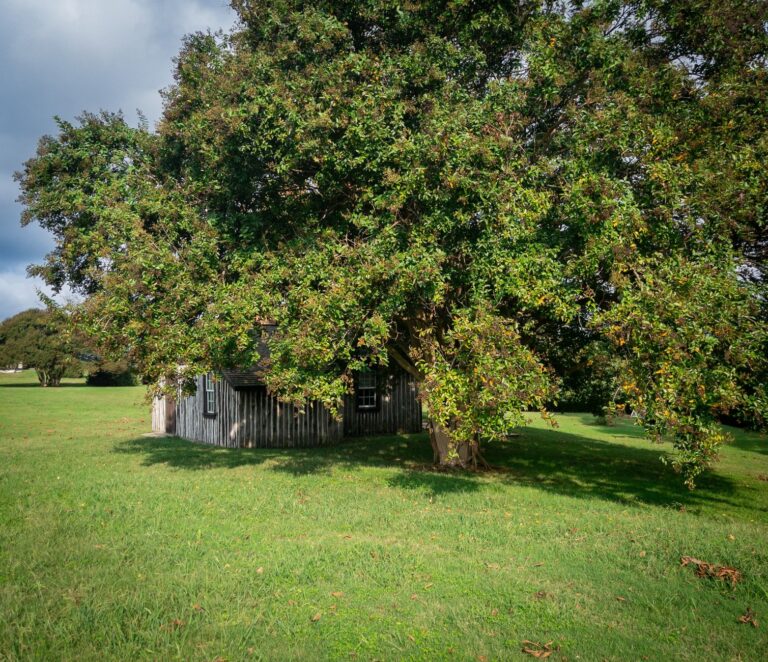
That acorn became an oak that, by the time I am telling you this, stood eighty feet tall with a canopy that shaded almost a third of an acre. Three of us kids, my brother Danny, my sister Ruth, and I, used to try to link hands around the trunk when we were small, and we never once made it all the way around, not even when we were teenagers and our arms were long enough that we thought for sure that would be the year.
I got married under that tree in 1987. My father walked me from the back porch across the grass to a spot beneath its branches where my husband, Ray, was waiting with the minister, because my mother had insisted the wedding happen “under Walter’s tree” and nobody in my family ever argued with my mother about tradition. My own children played beneath it every summer of their childhoods. When my father died eleven years ago, at eighty-four, my brother and sister and I stood under that tree the night before the funeral and told stories about him until it was too dark to see each other’s faces.
I inherited the house. Ray and I had already been living there for the better part of two decades by then, helping my father in his last years, and it only made sense that we’d stay on afterward. I never once thought of the oak as needing to be inherited separately, the way you might a piece of furniture or a set of dishes. It was just there. It had always been there. I assumed, the way you assume about mountains and rivers, that it would outlast me too.
The last two years of my father’s life, I moved a recliner into the front room and slept in it more nights than I slept in my own bed, because his heart had gotten weak enough that Ray and I didn’t like the idea of him being alone in the house overnight, even with a nurse coming three mornings a week. Some of those nights were hard in the ordinary ways that caring for an aging parent is hard, medications at odd hours, a fall in the bathroom at two in the morning that put my back out for a week, arguments about whether he really needed to see the cardiologist again or whether he could put it off one more month.
But some of those nights were the best of my whole life, in a way I didn’t expect and still find hard to explain to people who haven’t sat up with a parent at the end of things. He’d wake around four in the morning some nights, clear-headed in a way he wasn’t always during the day, and he’d ask me to help him to the back door so he could look out at the oak in the dark. I’d get his robe and his cane and we’d stand together at the screen door, not even stepping outside most nights, just looking at the black shape of it against a slightly less black sky, and he’d tell me things about the war he’d never told me before, things about the men he’d served with, things about what it felt like to come home to a country that mostly wanted to forget the whole thing had happened and move on to something easier. He told me once, standing at that door at four in the morning maybe six months before he died, that the tree was the only thing he’d ever built that never once asked him to explain himself. I’ve thought about that sentence more times than I can count in the years since.
Vance Pruitt bought the house on the other side of our back fence line six years ago.
I want to be fair to him, or at least I want to try, because I think the reader deserves to know I did try, for a long time, to be a decent neighbor to a man who made that very difficult. When Vance and his wife moved in, I brought them a casserole the way my mother had taught me to do for every new family on our road since I was a girl. Vance thanked me politely enough at the door and told me, unprompted, that he intended to have “the best lawn in the county” within two years.
He was not exaggerating about his intentions. Within that first year, Vance had torn out the modest fescue lawn the previous owners had kept and replaced it with a variety of zoysia grass that he researched, by his own account to anyone who would listen at the hardware store, for the better part of six months before choosing. He installed an in-ground sprinkler system on a timer. He mowed in alternating diagonal stripes that he adjusted weekly so the pattern never repeated. He entered the county fair’s “Yard of Merit” competition and won it two years running, and both years he mentioned it to me at the fence, unprompted, within about a day of the ribbon being awarded.
I don’t begrudge a man his hobbies. Ray has spent thirty years restoring a 1967 Ford truck that has never once, to my knowledge, been fully finished, and I’ve never resented him a minute of it. What I minded about Vance’s lawn obsession was the way it turned my father’s tree, a thing that had stood on that property line since before Vance was born, into an enemy in his mind.
It started small. A comment here and there about “all that mess” every fall when the leaves came down. A suggestion, offered as if he were doing me a favor, that I ought to “think about having that thing topped” so it wouldn’t drop so much debris. When I told him, gently the first few times and less gently as the years went on, that the oak had been my father’s and that I had no intention of touching it, Vance would go quiet and walk back toward his sprinkler heads without another word.
Get a new story in your inbox every morning.
Facebook doesn’t show you every story we post. Our free newsletter does. Join 2,500+ readers.
By the fourth year, the comments had an edge to them that I didn’t like. He started keeping a leaf blower running along the fence line every weekend morning starting around seven, which Ray always suspected was less about tidiness and more about making a point. Twice, I found trash bags of leaves he’d collected from his own yard sitting just inside our fence, as if to remind me whose fault he considered the mess to be. I raised it with him once, calmly, standing at the fence with my hands in my coat pockets, and he told me, and I remember this exactly because it stung enough that I wrote it down in the notebook I keep by the kitchen phone, “It’s just a tree, Carol. It’s been dropping its garbage on my lawn every fall for six years, and I’m done cleaning up after your father’s mess.”
I didn’t say anything back. I went inside and I cried a little, which embarrassed me, because I was sixty-one years old crying over a man’s rudeness about a tree. But it wasn’t really about the tree. It was about hearing my father, a man who’d survived a war and raised three children and never once raised his voice at any of us, reduced to “your father’s mess” by a man who had lived next door for four years and never once asked what that tree meant to anybody.
I want to tell you exactly what happened next, because the order of events matters.
In the second week of June this year, I was out deadheading the roses along the back fence when I noticed something wrong with the oak’s lower branches. The leaves weren’t the deep, full green they should have been at that point in the summer. They were yellowing, curling slightly at the edges, and there were more of them on the ground beneath the tree than there should have been in the middle of June, when every other tree on our road was still putting out new growth.
I told myself it might be the dry spring we’d had. I told myself a lot of things over the next week, because none of the true explanations were ones I wanted to consider. But by the third week of June, entire lower limbs had gone bare, and there was something I hadn’t noticed at first: a rough, scorched-looking ring in the grass circling the base of the trunk, maybe four feet out in every direction, where nothing was growing at all.
I called Diane Ostrowski, a certified arborist who works out of the county extension office and who had, coincidentally, done a health assessment on the same oak eight years earlier when we were having it pruned. Diane came out on a Thursday afternoon, knelt down at the base of the trunk, scraped a little bark away with a pocketknife the way arborists do, and got very quiet.
“Carol,” she said, “this isn’t drought stress and it isn’t disease. Look at this dieback pattern, how it’s concentrated on the side facing your neighbor’s yard, and look at this ring where nothing’s growing at the base. This looks like a soil-applied herbicide. Something strong. Somebody put a chemical in this ground on purpose.”
I remember standing there in my own backyard, in the shade of a tree I had known my entire life, being told by a professional that someone had tried to kill it, and not being able to say a single word for what felt like a full minute.
“Who would do something like that?” I finally asked her, even though some small, cowardly part of me already suspected the answer and didn’t want to hear it confirmed by someone else’s mouth.
Diane didn’t answer that question. It wasn’t her job to. But she recommended I have a soil sample tested, and she recommended, gently, that if I had any kind of security camera on the property, I might want to check it.
That was when I remembered the trail camera.
Ray had mounted a wildlife camera on the shed two summers earlier, after something, we assumed a deer, had been getting into the vegetable garden overnight and helping itself to the tomatoes. The camera was cheap, motion activated, and after we’d caught the deer on film a handful of times and confirmed our suspicions, we’d more or less forgotten about it. It was still running. It had been running the entire time.
I sat down at the kitchen table that Thursday night with a cup of coffee I never drank, because it went stone cold while I worked through the footage on the little memory card, week by week, going back through May and into June.
Most of it was nothing. Raccoons. The neighbor’s cat. Ray taking out the trash at odd hours. A possum that seemed to have taken up residence somewhere near the compost pile.
Then, in a clip timestamped five nineteen in the morning on a Tuesday near the end of May, I saw Vance.
He was walking along our shared fence line in the gray half-light before sunrise, dressed in a jacket I recognized from seeing him wear it while he mowed on Saturdays, carrying a gallon jug in both hands the way you’d carry something heavy and something you didn’t want to spill. He set the jug down at the base of my father’s oak, knelt, and spent almost four full minutes doing something at the base of the trunk that the angle of the camera didn’t let me see clearly, though I didn’t need to see it clearly to understand what I was watching. Then he picked the jug back up, glanced once toward my house, and walked back the way he’d come.
There were two more clips like it over the following ten days. Always before dawn. Always the same jug.
I sat at that table a long time after the last clip ended. I want to be honest about what I felt, because I think honesty is the only thing that makes a story like this worth telling. I did not feel rage, not at first. I felt something quieter and colder than rage, something closer to grief, watching a man methodically kill a piece of my father in the dark because it had inconvenienced his lawn.
I thought about walking over to Vance’s house the next morning and putting that footage in front of him myself. I thought about it seriously enough that I lay awake most of that night working out what I’d say. But somewhere around three in the morning, staring at the ceiling, I thought about my father instead, about the version of him who came home from a war and never once, in thirty-eight years that I knew him, raised his voice at another human being to get what he wanted. He solved problems quietly. He wrote letters. He made phone calls to the right people and let institutions do what institutions were built to do.
So that’s what I did.
The first call I made was back to Diane at the extension office, who confirmed that she would file an official report of suspected chemical injury and would coordinate soil testing on both sides of the property line, since herbicide of the strength she suspected doesn’t respect fence lines once it’s in the ground. The second call was one I hadn’t expected to need to make in my life: to the Bellwether County Prosecuting Attorney’s office, where I learned something about my father’s tree that even I, who had loved that oak my entire life, hadn’t fully understood.
In 1998, the county had passed what’s called a Heritage Tree Ordinance, protecting any tree within county limits that met certain thresholds of trunk diameter, age, and historical or community significance from being removed, damaged, or destroyed without a permit. My father, it turned out, had registered the oak himself back in the late 1990s, not long after the ordinance passed, along with a handful of other longtime residents whose families had planted trees of note across the township. I found the original registration card in a folder of his old papers years after his death and never fully understood what it meant until Diane explained it to me on the phone that week. My father’s oak, at a trunk diameter well over sixty inches, easily qualified. It had been sitting on the county’s Heritage Tree Registry, quietly protected by law, for close to thirty years.
Which meant that whoever had deliberately damaged it hadn’t just been unneighborly. He’d broken the law, twice over, once under the county ordinance protecting the tree itself, and once under the state’s regulations governing the application of restricted-use pesticides, because the chemical Diane’s lab identified in the soil sample, once the results came back two weeks later, was a soil sterilant strong enough that its legal application requires a licensed applicator and very specific conditions that a residential backyard, six feet from a neighboring property line, does not remotely meet.
The county investigator who took over the case, a soft-spoken man named Deputy Whitfield who works the code enforcement side of things, came out to walk the property with Diane the following week. They took soil samples along the fence line at staggered distances, all the way out to fifteen feet from the trunk, in both directions, mine and Vance’s. I stood on my back porch and watched them work, and I remember thinking that whatever came of this, at least the truth of it would exist somewhere official now, in a file, with a case number, whether or not it ever changed a single thing about the tree itself.
Three weeks after that first trail camera clip had been recorded, on a Wednesday morning, a county vehicle pulled into the street. Not into my driveway. Into Vance’s.
I watched from my kitchen window, the same window I’d watched from a thousand mornings while that oak threw its long shade across my yard, while two men in county vests walked Vance’s ribbon-winning zoysia lawn with soil probes, kneeling every few feet to take samples, photographing something near his own fence line that I couldn’t see clearly from that distance. Vance stood on his porch in his robe, arms crossed, watching them the way you’d watch a slow-moving disaster you didn’t yet understand was heading straight for you.
Here is what those soil samples showed, and here is the part of this story that I did not expect, even after everything else.
An eighty-year-old oak does not keep its root system politely contained inside a fence line. Diane explained it to me the way she explains most things, patiently and without condescension: a tree that size typically has a root spread one and a half to two times the width of its canopy, which meant my father’s oak’s roots extended not just across our own yard but well under Vance’s property too, tangled invisibly beneath the very lawn he’d spent six years perfecting. The soil sterilant Vance had poured at the base of the trunk hadn’t stayed obediently on my side of the property line the way his complaints about falling leaves always had. It had moved through the soil, through the shared water table, through an old drainage tile my father and the previous owner of Vance’s property had installed together back in 1952 to keep both yards from flooding every spring, a small kindness between two long-dead men that neither of their heirs had ever known still connected their properties underground.
By the time the county tested Vance’s own lawn, a chevron-shaped patch of dead zoysia nearly nine feet across had opened up along his side of the fence, exactly where the drainage tile ran closest to the surface. The same poison he had used to kill my father’s tree had traveled home to kill the thing he loved most.
Vance did not know that yet, standing on his porch in his robe. I didn’t know the full shape of what was coming either. But over the following month, as the case moved through the county prosecuting attorney’s office, I learned the rest of it in pieces, mostly from Deputy Whitfield, who called me periodically to update me because I was, technically, the victim of record.
The restitution for the oak itself was calculated using something called the Trunk Formula Method, a standard the International Society of Arboriculture uses to appraise the monetary value of large, established trees, factoring in trunk diameter, species, condition, and location value. For a tree the size and age of my father’s oak, situated where it was, that appraisal came back at forty-six thousand four hundred dollars. On top of that, the state Department of Agriculture cited Vance separately for unlicensed application of a restricted-use pesticide, a violation carrying its own fine, which came in at just over eleven thousand dollars.
And then there was the remediation order.
Because the soil sterilant hadn’t just killed a tree and a patch of grass, it had contaminated ground on both properties that sat above a shared water table the county has an interest in protecting, the environmental compliance office required a full remediation of the affected soil, on both sides of the fence, at the responsible party’s expense. For my yard, that meant Diane’s office would oversee treatment and monitoring of the soil around what remained of the oak, at Vance’s cost, to see whether the tree could be saved at all. For Vance’s own yard, it meant something considerably more drastic. The contaminated soil beneath his zoysia, the very lawn he had spent six years perfecting down to the mowing stripes, had to be excavated to a depth of eighteen inches across nearly the entire back half of his property, hauled away as regulated waste, and replaced with certified clean fill, all of it done under county environmental supervision, all of it billed to him.
By the time every figure was added together, fines, restitution, remediation, and the cost of the excavation itself, Vance was looking at a bill north of eighty-eight thousand dollars.
I was not in the room, of course, when Deputy Whitfield or the prosecuting attorney’s office delivered that number to Vance directly. But I didn’t need to be in the room to know roughly what it looked like, because I watched the aftermath from my own kitchen window over the following six weeks, the way you’d watch weather move across a valley.
First came the excavation crew, a Tuesday in late July, with equipment considerably larger than anything Vance had ever used to maintain that lawn himself. They worked for four days, tearing up the zoysia in wide swaths, digging down eighteen inches across a stretch of ground that had once been the pride of the county fair, loading truck after truck with soil that had to be hauled somewhere else entirely because it wasn’t safe to leave on his property or anyone else’s.
By the second day, what had been the best lawn in the county was a raw, churned field of exposed dirt, crisscrossed with tire ruts, bordered on our side by a fence Vance had once stood at complaining about falling leaves.
I won’t pretend I felt nothing watching that. I’m not going to sit here and tell you I didn’t stand at my kitchen window some mornings with my coffee and feel something that, if I’m honest with myself, wasn’t far from satisfaction. My father spent two years of his life in a war so that men like Vance could come home to a country where they got to stand on their own dirt and do whatever they pleased with it, and it would be a lie to say some tired, quiet part of me didn’t take a certain grim comfort watching the county walk across that man’s ruined lawn with a clipboard, cataloging exactly what his own choices had cost him.
But that isn’t where this story ends, and it isn’t the part I want you to carry away from it either, because my father didn’t raise me to find my peace in somebody else’s ruin, even a man who deserved a portion of what came to him.
The oak itself, it turned out, could not be saved. Diane’s office monitored it through the rest of that summer, treating the soil, watching for any sign of recovery in the canopy, but the damage to the root system was too extensive and too old by the time we’d caught it. In late September, a county-approved arborist crew came and took the tree down in sections, working from the top branches inward over the course of a single long day, the same kind of careful, methodical work my father would have respected even as it broke my heart to watch it.
I asked the crew foreman if I could keep a section of the trunk, and he cut me a round slab about three feet across, still showing all eighty rings, which I have standing against the wall of my back porch now, sanded and sealed, with my father’s dog tags resting in a small dish on top of it.
But before the tree came down, back in July, before the excavation crews had even started on Vance’s yard, Diane had done something I hadn’t asked her to do and didn’t find out about until weeks later. Knowing the tree’s chances weren’t good, she had collected a small handful of acorns from the healthiest remaining branches and started them in pots at the extension office nursery, the way you’d try to save a piece of something you suspected you were about to lose.
In October, on a cool, bright Saturday morning, Diane brought three healthy young oak saplings, each about two feet tall, out to our property. My son and daughter drove in for the weekend. My brother Danny and my sister Ruth came too, along with a handful of neighbors from up and down the road who’d known my father, and a few members of the local VFW post, since it turned out one of them had served alongside my father decades earlier and had wanted, for years, to do something to mark what that oak had meant to the men who’d known him.
We planted the largest of the three saplings in almost the exact spot where my father had pushed that acorn into the ground with his thumb in 1946, eighty years and one poisoning later. My son dug the hole. My daughter held the tree steady while Ray filled the dirt in around the roots. Diane knelt beside it afterward and staked a small bronze marker into the ground next to it, the kind the county uses for its registered Heritage Trees, engraved with my father’s name, his years of service, and the date, 1946, that the first oak had gone into the ground.
Vance did not come to the planting. I don’t know if he was invited to, honestly, since it wasn’t my ceremony to control who showed up to it, but I noticed his curtains move once that morning, and I noticed, in the weeks that followed, that he never once mowed what was left of his replanted lawn without glancing over the fence at what we’d put in the ground on our side of it.
He sold the house the following spring. I don’t know where he and his wife went, and I’ve made a point of not asking. The people who bought the place, a young couple with two small kids and a dog that likes to sit at the fence line staring up into the branches of the new oak, have already asked me twice about the story behind the little bronze marker, and both times I’ve told them, plainly, without much embellishment, because I think my father would have wanted the truth of it told plainly more than he’d have wanted it told with any bitterness in it.
The new tree is not eighty years old. It won’t be, not in my lifetime, not even close. It stands maybe six feet tall now, thin and a little crooked the way young trees are, nothing like the giant that used to throw its shadow clear across two backyards. Some mornings I stand at the same kitchen window I watched everything unfold from and I think about how strange it is that a thing my father started with his thumb in the spring of 1946 could travel this whole distance, through eighty years of weddings and funerals and family dinners under its branches, through one bitter neighbor with a jug of poison and a grudge about fallen leaves, all the way to a young couple’s dog sitting patient and hopeful beneath a sapling that has decades of growing left to do.
My father used to say a man ought to have one thing in the ground that was going to outlast him. I think, in the end, this one did exactly that. It just needed a little help getting there, the same way most things worth keeping usually do.