
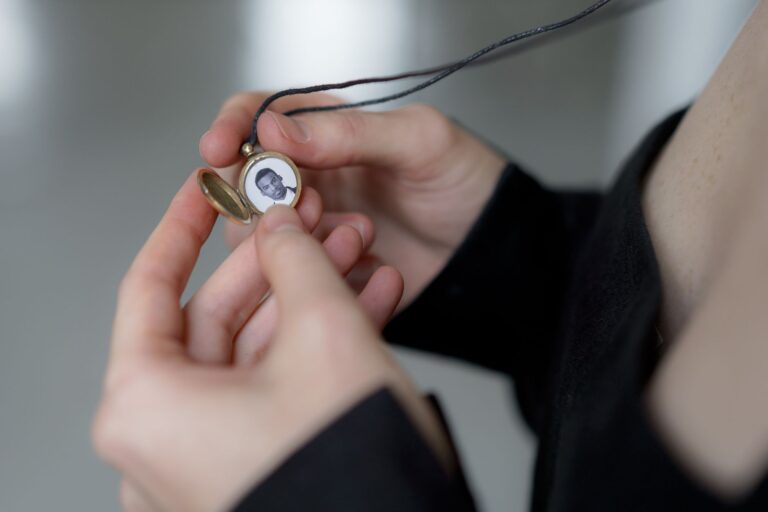
I am forty-seven years old and I have lived in the same small Midwest town my entire life. I know which stoplight sticks on Route 9. I know the diner waitress who has called me “hon” since I was in high school. I know that the church potluck sign-up sheet still lives on the same clipboard it has for thirty years, and that if you bring anything less than a full casserole dish, somebody’s mother will notice. I tell you all of this because I want you to understand the kind of place this happened in. Nothing dramatic happens here. Nobody expects it to. Which is exactly why, on an ordinary Thursday evening in early spring, when I looked into the window of the consignment shop on Main Street and saw my dead mother’s locket lying on a strip of black velvet with a sixty dollar price tag clipped to its chain, I did not, for a full three or four seconds, believe my own eyes.
I want to start further back, though, because you cannot understand what that locket meant to me without understanding my mother, and you cannot understand what I did after I found it without understanding my daughter-in-law, Melissa, and the six years I spent trying to make room for her in a family that had, until she arrived, only ever been the three of us.
My mother married my father in 1971 in the same church I still attend. She was not a woman who wore jewelry often. She had a wedding band she never took off, a pair of clip-on pearl earrings for funerals and weddings, and the locket. That was it. That was her entire collection, and she wore the locket to church every single Sunday of my childhood, tucked under the collar of whatever modest dress she’d sewn or bought on clearance, so that most Sundays you would not have even known it was there unless you sat close enough beside her in the pew to see the chain catch the light through the stained glass window during the second hymn.
The locket was gold, oval, a little smaller than a quarter, and worn almost silky smooth along one edge where her thumb had rubbed it, I later realized, during every sermon she ever half listened to while her mind wandered to whatever she was worried about that week: the grocery bill, my father’s knees, whether I was going to marry well or marry at all. Inside it was a photograph, black and white, cut down to fit the oval frame, of my mother and father in 1969, two years before they married, sitting on the tailgate of his truck outside a lake I have never been able to identify, both of them laughing at something the camera never caught. My mother told me once that she did not even remember what the joke was. She just remembered that it was the first photograph anyone ever took of them together, and that my father had the locket made for her out of his first real paycheck from the grain elevator, and that when he gave it to her he’d said, “Now I’m stuck to you the way that picture’s stuck in there,” which she thought was the least romantic and most romantic thing anyone had ever said to her, both at once.
She wore it until the week she died. I was the one who unclasped it from around her neck at the funeral home, at my own insistence, because I could not stand the thought of it going into the ground with her when it was the only tangible piece of my father’s twenty-nine years of marriage to her still hanging around anywhere in this world. My father passed six years before she did. The locket was, by the time she died, the closest thing to both of them I had left.
I did not cry at my mother’s funeral. I have never been a woman who cries in front of people, a trait she passed down to me along with her stubbornness and her habit of thumbing at things when she’s thinking. I cried three days later, alone in my kitchen at eleven at night, holding that locket for the first time as mine and not hers, turning it over and over in my hands until the hinge caught the light exactly the way it used to catch the light through the stained glass. I put it in a cedar box on my dresser that had also been my mother’s, and it has not left that box, except to be worn on the anniversary of her death and on Mother’s Day, for the four years since.
Now I need to tell you about Melissa.
My son married her six years ago, in a wedding I helped pay for and cried through, this time in front of people, because it was the good kind of crying. Melissa is thirty-one, works part time at the elementary school as a teacher’s aide, and for most of those six years I would have told you, if you’d asked, that she was a good wife to my son and a good daughter-in-law to me. She remembers my birthday without being reminded. She learned to make my mother’s sauerkraut recipe, badly at first and then, after three tries, almost exactly right. She calls me on Sunday afternoons just to talk, not because she needs anything, which is more than I can say for some of the other women in this family who married into it.
But I would be lying if I told you there was not always a current running under the surface of my relationship with Melissa, something neither of us ever named directly. She grew up with almost nothing, the youngest of four kids raised by a single mother two towns over who worked two jobs and still could not always keep the lights on. Melissa has never said this to me in so many words, but I have pieced it together over the years from small things, the way she flinches slightly when a bill gets mentioned at the dinner table, the way she always insists on paying for her share of anything even when it clearly stretches her, the pride that sits just under her skin like a bruise you learn not to press on.
I did not know, until the week all of this happened, how bad things had actually gotten for her and my son.
It was an ordinary Thursday. I had worked a full shift, come home, changed out of my work clothes, and driven into town to pick up a prescription and a few things from the hardware store for a leaky faucet that had been dripping for two weeks. I parked on Main Street, the way I have parked on Main Street my whole life, and I walked past the consignment shop, the way I have walked past it a thousand times without a second glance, because it is the kind of shop you walk past on your way to somewhere else, full of other people’s old lamps and chipped china and, occasionally, something truly beautiful mixed in among the clutter.
I do not know what made me look into the window that particular evening. I have turned that question over more times than I can count since, whether it was some kind of instinct, whether some part of me already sensed something was wrong before I had any evidence of it. I do not believe in signs, as a rule. But I looked, and there, on a strip of black velvet under the glass, angled just so under the shop’s track lighting, was my mother’s locket.
I knew it before I consciously registered what I was looking at. I knew it the way you know your own child’s voice in a crowded room, before your mind has caught up to the recognition. The worn place along the edge. The particular way the hinge sat slightly crooked, from a repair my father had done himself decades ago with tools from his own shed rather than pay a jeweler. The chain, which my mother had replaced once in the eighties with one that did not quite match the original, a detail so small that only someone who had held that locket in her own two hands hundreds of times would ever notice it.
Get a new story in your inbox every morning.
Facebook doesn’t show you every story we post. Our free newsletter does. Join 2,500+ readers.
My knees actually buckled. I put my hand flat against the brick of the building next door to steady myself, and a woman walking her dog gave me a concerned look and asked if I was all right. I told her I was fine. I do not think I was fine. I think I stood there for close to a full minute before I could make my legs carry me to the shop door.
The bell over the door rang the way it always does. Gary, who has owned that consignment shop for thirty years and who buried his own wife two years ago and has run the place mostly alone since, looked up from behind the counter and greeted me by name, the way he greets everybody, because in a town this size the shop owner knows you and your mother and probably your grandmother too.
I did not say hello back. I walked straight to the display case, pointed at the locket, and asked him where it had come from.
Gary is not a man who rattles easily, but something in my face must have told him this was not an idle question. He asked me to wait a moment, went into the back room, and came out with a laptop, which he set on the counter and opened to the shop’s online consignment portal, the same system he uses to list items on the local marketplace site where half the town buys and sells secondhand furniture and tools and, apparently, jewelry.
He turned the screen toward me. There was the listing. A photograph of the locket, laid open, the hinge visible, my father’s picture still inside it. A description: “Vintage gold locket, oval, minor wear, includes photo insert, estate piece.” A price: sixty dollars. And a timestamp in the corner of the listing, the exact date and time the item had been submitted through the shop’s online intake system, which lets sellers photograph an item at home and upload it themselves before ever bringing it in, so Gary can approve it for consignment without them having to wait around the counter.
The timestamp was from nine days earlier. A Tuesday. Two in the afternoon.
I asked Gary if he could tell me who had submitted it. He hesitated, the way an honest man hesitates when he is weighing a customer’s privacy against the look on another customer’s face, and then he turned the laptop a few more degrees toward me and pointed at the account name attached to the submission.
I am not going to pretend I did not already suspect, somewhere underneath the shock, what I was about to see. But there is a difference between suspecting something and having it confirmed in black and white on a stranger’s laptop screen in the middle of a consignment shop on a Thursday evening.
The account belonged to Melissa.
And there was more. Because the photograph she had submitted through the online listing had not been taken by Gary, in his shop, under his track lighting. It had been taken at home, on a kitchen counter I recognized instantly as my own, the one with the small chip near the sink that I have meant to have fixed for three years. In the very corner of the frame, barely visible, was a hand holding the locket open to photograph the interior, a hand with a small scar across two knuckles from a kitchen accident years ago, a hand I have watched set my table, wash my dishes, and pass plates at Sunday dinner for six years.
I knew that hand before I ever needed the account name to confirm it.
Nine days earlier. A Tuesday, two in the afternoon, when I was at work and my house was empty except for whoever had a key. Melissa has had a key to my house since the week she married my son, because I gave it to her myself, because I wanted her to feel like she belonged here, like this was her family too, like she never had to knock.
She had let herself in. She had gone into my bedroom, the room I have slept in for twenty-three years. She had opened the cedar jewelry box on my dresser, the one that had been my mother’s, and she had taken the one object in it that meant anything at all, photographed it on my own kitchen counter before she left, and listed it for sale to a stranger for sixty dollars.
I bought it back that same evening. I paid Gary in cash, sixty dollars, and he did not charge me a commission on top of it, which I understood even then was his own quiet way of saying he was sorry this had happened, though neither of us said the word sorry out loud. I drove home with the locket sitting in my car’s cup holder because I could not bring myself to put it in my purse where I could not see it, as though it might vanish again the moment it was out of my sight.
Here is the part I need you to understand, because I have turned it over in my mind more times than almost anything else in my life, and I still do not have a tidy explanation for it. I did not drive straight to Melissa’s house. I did not call my son. I did not tell anyone what I had found. I drove home, I put the locket back in the cedar box, exactly where it belonged, and I sat at my kitchen table for a long time in the dark, not crying, just sitting, feeling something that was not quite anger and not quite grief but had pieces of both twisted together with something else I could not name yet.
I did not say anything for four days.
I want to be honest about why, because I think it matters more than the discovery itself. Underneath the disbelief that someone I have tried for six years to love as my own daughter had walked into my bedroom and taken the most sacred object I own, there was another thought that kept surfacing, over and over, no matter how hard I tried to push it back down in favor of righteous anger. Melissa is not a thief. I have watched her insist on paying her share of a restaurant bill she clearly could not afford rather than let anyone think she needed help. I have watched her wear the same three sweaters every winter for six years, always clean, always mended at the elbow rather than replaced. Something had to have gone very wrong for a woman like that to do what she did.
So instead of confronting her, I started paying attention, really paying attention, to the four days between finding that locket and deciding what to do about it.
I noticed that Melissa had stopped buying the good coffee she used to bring to Sunday dinner, the kind in the red bag, and started bringing the store brand instead, a detail so small I would never have registered it if I had not been looking for exactly this kind of small thing. I noticed that when my son mentioned, almost in passing, that their truck needed a new transmission, Melissa’s face did something quick and controlled, a flash of something close to panic smoothed over so fast that if I had blinked I would have missed it. I noticed that she had started declining invitations to things she used to never miss, a girlfriend’s birthday dinner, a work function, always with some version of the same excuse, that she was tired, that she had a headache, that she just did not feel like getting dressed up.
I am a mother. I raised a son on very little money myself, in the years right after my own husband and I separated, before I got back on my feet. I know what it looks like when a woman is drowning quietly and trying very hard to make sure nobody sees the water. I had simply never imagined I would see it in Melissa, because Melissa has always seemed, to me, like the strong one, the one who held things together, the one whose pride was so fierce it read as competence.
On the fourth day, I called her and asked if I could come by on Saturday morning, just the two of us, before my son got back from his early shift. I told her I wanted to talk about something. I did not tell her what.
I drove to her house that Saturday morning with the locket in my coat pocket, not in a box, not wrapped in anything, just resting against my palm the whole drive over the way I used to hold my son’s hand crossing the street when he was small. Melissa let me in, and I could see, the moment she opened the door, that some part of her already suspected why I had come. There was a stiffness in her shoulders, a brightness in her voice that did not match her eyes.
We sat at her kitchen table, the same kind of table I have at my own house, the kind every family in this town has, scarred a little at the edges from years of homework and holiday meals. I did not say anything at first. I reached into my coat pocket, took out the locket, and set it down on the table between us, gently, the way you set down something that has already been broken once and repaired.
I watched her face change. It was not the face of a woman caught. It was the face of a woman who had been carrying something so heavy for so long that having it finally set down in front of her, even in the worst possible way, came almost as a relief.
She did not deny it. She did not try to explain it away or claim she had only meant to borrow against it, sell it back later, some story to make it smaller than it was. She put both hands over her face and she said, in a voice I had never heard her use before, thick and cracked in a way that had nothing to do with performance, that she was ashamed. That word, ashamed, came out of her three separate times in the next ten minutes, as though it was the only word large enough to hold what she was feeling and she needed to say it more than once to make sure I understood she meant it all the way down.
What came out after that, slowly, in pieces, was the truth about the last eight months of her and my son’s marriage that neither of them had told me, that neither of them had, it turned out, even fully told each other until that morning.
My son had taken a pay cut at work in the fall, a restructuring at the plant that neither of them had wanted to worry me with, because I have my own health to manage and they did not want to add to it. Melissa’s hours at the school had been quietly reduced the same season, budget cuts, nothing personal, but it landed at the worst possible time. Between the two of them, they had fallen behind on the truck payment, behind on a medical bill from an emergency room visit the winter before that insurance had only partly covered, and three weeks before I found the locket in that shop window, they had received a notice that they were two months behind on rent on the small house they lease on the edge of town, with a deadline before things escalated further.
Melissa told me she had gone through her own jewelry box first, sold what little she had of value, a bracelet from her late grandmother, a pair of earrings from her wedding shower, and it had not been enough. She told me that she had stood in my bedroom that Tuesday afternoon with the cedar box open in her hands for what felt like ten minutes before she made herself take the locket, that she had told herself, in the moment, a story she needed to believe to go through with it: that I barely wore it anymore, that I would not notice for months if at all, that she would find a way to buy it back before I ever knew it was gone. She told me she had chosen the online listing specifically, rather than bringing it into the shop in person, because she could not have looked Gary in the eye handing it across his counter, but somehow a photograph submitted through an app from her own kitchen felt one degree removed, one degree easier to live with, even though she knew, even as she was doing it, that it was not.
I did not raise my voice. I want to be honest that I wanted to, that some old, sharp part of me wanted to ask her how she could possibly have thought this was an acceptable solution to anything, wanted to remind her exactly what that locket meant and demand she understand the weight of what she had done. But sitting across from her, watching her hands shake around a coffee mug she was not drinking from, I understood that she already knew every one of those things better than I could ever explain them to her. What she needed from me in that moment was not another person telling her how badly she had failed. She had been telling herself that every day for nine days already.
What I asked her instead, once she had run out of the word ashamed, was why she and my son had not told me any of this sooner. Why two people I love had been quietly drowning three miles from my own kitchen table without ever once letting me know they needed a hand.
Her answer is the part of this that has changed the way I think about my whole family, and I suspect it will stay with me longer than the shock of finding the locket ever did. She said that in the six years she had been part of this family, she had absorbed, without either of us ever meaning to teach it to her, an unspoken rule that struggling with money was something to be ashamed of, something you handled quietly and alone, because that is exactly how my own mother had handled every hard season of her life, and how I had handled mine after my divorce, and how, without realizing it, I had modeled for my son and by extension for Melissa. Nobody in this family talks about money trouble until it is already a crisis. We would rather sell something quietly, or take on an extra shift, or simply go without, than sit at a table and say the words out loud: we are struggling, and we need help.
I sat with that for a long moment, because it was true, and because I had never once seen it named so plainly before.
We talked for almost two hours that Saturday morning, longer than Melissa and I had ever talked about anything in six years of Sunday dinners and holiday gatherings. I told her about the year after my divorce, when I had gone three months paying the electric bill two weeks late every single time, when I had sold my own engagement ring, the one from my first marriage, to a jeweler forty minutes away where nobody would recognize me, rather than ask my own mother for a loan I was too proud to admit I needed. I had never told anyone that story, not even my son. Telling Melissa, watching her realize that the woman she had been so afraid of disappointing had done something not so different herself at her lowest point, did something to the space between us that I do not think either of us expected.
We did not solve the money problem that morning, not really, not in any way that mattered by dollar amounts. But we agreed, together, that the silence was the thing that had actually done the damage, more than any single bill or missed paycheck. I told her that from now on, if things got tight, I wanted to know before it reached a point where she felt she had to take something out of my bedroom to fix it. Not because I expected to bail them out every time, my own retirement account does not stretch that far, but because a family that cannot say the word struggling out loud to each other is not actually as close as it looks at Sunday dinner.
Two weeks later, Melissa knocked on my front door on a Wednesday evening, unannounced, which she has never once done in six years. She was holding an envelope. Inside it was two hundred dollars in cash, money she told me she had saved from picking up extra shifts covering for another aide at the school. She told me it was not the full value of what the locket meant to me, that she knew no amount of money ever could be, but that she wanted me to have it anyway, as a start, and that she wanted to keep paying a little back every month until she felt like the debt, not just the sixty dollars but the trust, was settled between us.
I did not take the money. I told her to keep it, to put it toward the rent, and that the only payment I actually wanted from her was exactly what she had just done, showing up at my door and telling me the truth before I had to go looking for it myself. She cried at that, standing on my front porch, and I put my arms around her the way I have not really let myself do in six years, careful, a little formal, always keeping something back. I did not keep anything back that evening.
My mother’s locket is back in the cedar box on my dresser, exactly where it has sat for four years. I still wear it on the anniversary of her death, and on Mother’s Day, the same as always. But something has shifted in how I hold it now. It used to be, for me, only a piece of my parents, sealed shut, unchanging, a photograph of two people laughing at a joke nobody remembers anymore. Now it is also, somehow, the reason my daughter-in-law and I finally learned how to tell each other the truth.
My son does not know the full story, not all of it, and Melissa and I have agreed, together, that some of the details are hers to share with him in her own time and her own words, not mine to hand over in a story. What I can tell you is that the next time money gets tight in this family, and it will, because it always does eventually, for every family, nobody is going to have to walk into a jewelry box alone in the middle of a Tuesday afternoon to solve it in secret. We know how to say the hard sentence out loud now. We are struggling, and we need help.
I think about that Thursday evening sometimes, standing on Main Street with my hand against the brick wall, my knees gone soft under me, staring at my mother’s locket lying under glass with a price tag clipped to the chain. I have wondered more than once what would have happened if I had not glanced into that window at all, if I had walked straight past the way I had a thousand times before. I do not know the answer. What I do know is that the locket did not just find its way home. It found its way home and brought something else back with it, something I did not even know we had lost until the day I got it back.
This story is a dramatization. Names, characters, and details are invented, and any resemblance to real people or events is coincidental.