
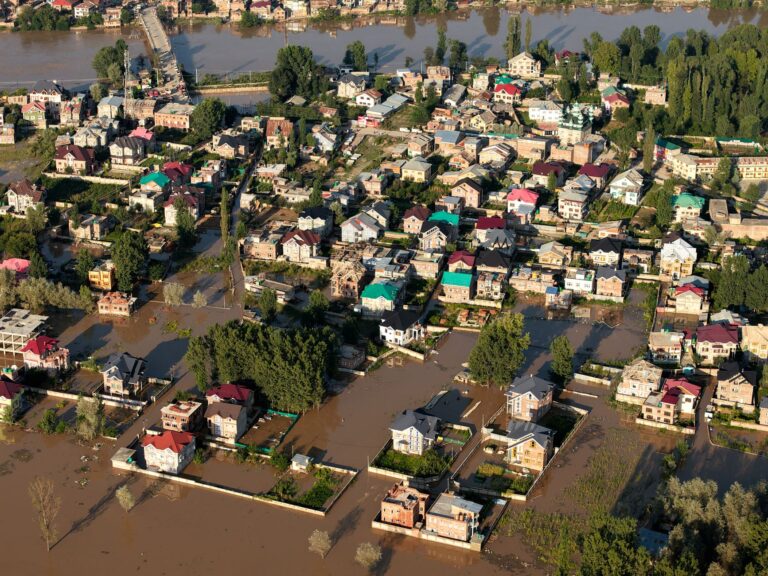
I have lived on Miller Creek Road my whole life, and until three weeks ago the worst thing that had ever happened on it was a hailstorm in 2019 that put dents in every hood on the street and took out my mother in law’s tomato plants two years running. I bring that up because I want you to understand what kind of place this is. Nothing happens here. We have a feed store, a Dollar General, a VFW post that still does a fish fry every second Friday, and a church that has stood on the same corner since before my grandfather was born. It is not a place that makes the news.
It made the news three weeks ago.
I want to start you where I started, which is on the steps of Caldwell Creek Baptist Church, eight days after the water came up, with a man named Grady Vance standing above a crowd of people who had nothing left but the clothes on their backs and the boots on their feet, telling us he had cash offers ready to sign.
But to understand why that moment mattered, and why it very nearly went a different way than it did, you have to go back further. You have to go back to the rain.
First, though, you should know what Miller Creek Road actually is, because it is not much to look at and that is exactly the point. It is a mile and a quarter of chip seal running parallel to the creek it is named for, eleven houses on our side and nine on the other, a scattering of mailboxes that lean the same direction the wind usually blows. The Pattersons have been two doors down from us since before Dale and I got married. Ellen Whitfield is across the road with her mother, who is ninety three and has not left that house since her husband passed, not for a doctor’s appointment, not for a hospital stay, nothing. The Hendersons are at the end near the culvert, three generations of them raising cattle on ground that has been in that family since it was a land grant.
We are not wealthy people. Most of the mortgages on that road are older than some of the children living in the houses they cover, worked down slow over twenty and thirty years the way farm families and factory families do it. What equity most of us have is not sitting in a bank account. It is sitting in the walls, in thirty years of a roof that does not leak and a foundation that does not shift, in the fact that when you finally do pay a house off, it is yours, free and clear, and nobody can ever take it from you.
That is what was standing on those church steps eight days later, waiting to be taken.
*The water*
It started raining on a Thursday and it did not really stop until the following Sunday afternoon. Nineteen inches over three days, the weather service told us afterward, though anybody who lived through it will tell you that number does not capture what it felt like. It felt like the sky had simply decided to empty itself out over Caldwell County and see what was left when it was done.
My husband Dale farms sixty acres his father left him, corn and soybeans mostly, and by that Saturday night he had stopped watching the radar and started watching the creek itself, walking down to the culvert at the end of our drive every hour with a flashlight to check the water line against a fence post he uses as his own private gauge.
At eleven o’clock that night the water was at the third rail of that fence. By one in the morning it was over the top of it. By three, Dale was standing in our own living room in water up to his shins, trying to get the good rug rolled up and onto the dining table before it was ruined for good. It was already too late. He just did not know it yet.
Caldwell Creek rose twenty two feet in fourteen hours. I have lived beside that creek my entire life and I did not know a creek that size could rise twenty two feet in fourteen hours, and neither did anyone else on our road, because it never had before. Not in living memory. Not in my grandfather’s memory, and he was ninety one when he passed and used to talk about every flood back to 1957.
By dawn, eleven houses on Miller Creek Road had water over the windowsills. Ours took four feet in the living room. The water line, when it finally went down four days later, sat exactly at the height of the seat cushion on my late mother’s rocking chair, which had been sitting in that living room since 1988 and which I could not save.
The Pattersons two doors down lost their refrigerator entirely. It floated out through their back door, across their yard, through a gap in the fence, and came to rest against a fence post two lots over, standing upright, door shut, like it had simply decided to go for a walk in the night and picked a strange place to stop. People still point at where it landed. Somebody took a picture of it and it has been shared more than anything I have ever seen come out of this town.
You do not know what mud smells like, real flood mud, until it has been sitting inside your walls for six days in July heat. It is not a smell I will ever be able to explain to somebody who has not lived it, and I hope you never have to learn it the way we did.
Across the road, Ellen Whitfield was fighting a battle none of us knew about until the sun came up. Her mother, ninety three years old, will not sleep anywhere but her recliner, has not for years, and by the time Ellen understood how fast the water was actually coming, it was already past the recliner’s legs. She could not lift her mother out of it by herself, not with the woman’s hip the way it is, and the phone lines were already down on that stretch of road.
Get a new story in your inbox every morning.
Facebook doesn’t show you every story we post. Our free newsletter does. Join 2,500+ readers.
Dale heard her hollering from our porch a little after four in the morning and waded across what used to be a road and was by then a moving brown river up past his thighs. Between the two of them they got Ellen’s mother up onto the kitchen counter, the only dry surface left in the house, and held her there, both of them soaked to the chest, until first light when three of the Henderson boys came through in a jon boat and got her out to the church. Ellen’s whole ground floor went under before they were done, every photograph she had of her late husband sitting in a box on the floor of a closet that filled with four feet of creek water before anybody could reach it.
She has not found a single one of those pictures dry.
*The church*
Caldwell Creek Baptist sits on the high corner of town, or what we always thought was the high corner, and for as long as anybody can remember it has been the place this community goes when something goes wrong. When the Hendersons’ barn burned in 2011, the potluck to help them rebuild was in that fellowship hall. When we lost three boys to a car wreck out on Route 9 in 2015, the funeral suppers for all three families were laid out on those same folding tables.
This time, the fellowship hall itself took eighteen inches of water, and the volunteers who came to help clean it out found the same brown waterline the rest of us were staring at on our own walls, a stripe about knee height running along the white clapboard siding on the outside of the building where the flood had kissed the church the same way it had kissed every house on our road.
Nobody had gotten around to power washing that stripe off yet, eight days later, because there were still fourteen families whose houses needed the hose worse than the church did.
By that Tuesday, half of Miller Creek Road was sleeping on cots under the fellowship hall’s basketball hoop. The Baptist disaster relief trailer had come up from two counties over and was running a kitchen out of the parking lot. Every day the yard around the church filled up with people in rubber boots hauling ruined furniture and waterlogged drywall out onto the grass to dry, or to be hauled off, sofas and mattresses and dressers lined up in rows like a yard sale nobody wanted to hold.
That is the scene Grady Vance drove his truck into.
*The offer*
I did not know who Grady Vance was before that morning, though I would come to learn plenty about him in the days that followed. What I knew, standing there with mud dried into the creases of my hands, was that a stranger in a blazer and dress shoes had parked a truck with the dealer sticker still in the back window at the top of our church lot and was walking down among us like he had somewhere important to be.
He climbed the three steps at the church entrance, which put him a good foot and a half above the rest of us, and I understood even before he opened his mouth that the height was not an accident. He wanted to be seen. He wanted to be heard. And he wanted, more than anything, to be above us while he said what he had come to say.
He introduced himself as a developer, said he represented a group with cash ready to move, and said he understood how hard this was for all of us. He said he wanted to make it easy. No inspections required. No waiting six weeks on an insurance adjuster who might not even show up. No repair estimates, no contractor bids, no bank appraisals. Just a number, cash, same day closing.
The number, when he finally said it, was thirty cents on the dollar of the county’s own assessed value from the year before, the number printed right there on our tax bills. On my house, which the county had valued at sixty three thousand dollars the previous spring, that came out to eighteen thousand nine hundred dollars. On the Pattersons’ place, which had three bedrooms and a wraparound porch Mr. Patterson built himself the summer his son came home from his second deployment, the offer was twenty six thousand on a place worth eighty seven.
“Before the mold sets in,” he said, and smiled like he had just done every one of us a favor.
I want to tell you that somebody shouted him down right then. That is not what happened. What happened is that a crowd of exhausted people who had already lost their homes once stood there in silence, doing the math on what thirty cents on the dollar meant for a family with a mortgage still owed at full value, and some of them, God forgive me for saying it, some of them looked like they were considering it. When you have not slept in a bed in eight nights and you do not know where the money for a new roof is coming from, thirty cents can start to look like something instead of nothing.
I watched Linda Combs, three houses down from us, a widow who has lived alone since her husband died of a heart attack out in the soybean field six years ago, actually reach into her coat pocket for the pen Vance’s assistant was holding out. She told me later she was not doing the math on what her house was worth. She was doing the math on what a motel room costs for a family of one with no income coming in until the insurance company got around to calling her back, which by that point had already been eight days of silence.
That is what thirty cents on the dollar is built to do. It is not really an offer to a homeowner. It is an offer to exhaustion, and exhaustion will sign almost anything if you hand it a pen at the right moment.
That is the moment Walter Briggs stood up.
*Colonel Briggs*
I have known Walter Briggs my entire life. He sits three rows back on the left side every single Sunday, has for as long as I can remember, and up until that morning the most remarkable thing I could have told you about him was that he still had every one of his own teeth at seventy four years old and could out walk men half his age.
What I did not think about often, because he never made a show of it, is that Walter Briggs is a colonel. Colonel, United States Army, retired, thirty one years of service, the last six of them commanding flood control projects for the Army Corps of Engineers on rivers considerably larger and meaner than our own Caldwell Creek. He does not wear the rank anymore. He wears a faded ball cap from a fishing tournament he won in 2009 and walks his old bird dog, a black lab named Scout, along the creek path most mornings before the rest of the road is even awake.
That morning, he was not carrying a Bible, though he’d come dressed for church same as the rest of us who had one dry shirt left to wear. He was carrying a manila folder, and it was thick enough that he had it under his arm like a man carrying a stack of firewood.
“Grady,” he said, and his voice did not rise above a normal speaking register, not once, the whole time. “Before anybody signs anything, I think this town ought to see what I’ve got in here.”
I watched Vance’s face. His smile did not move. But something behind his eyes did, and I have thought about that look more than once since, the exact moment a man realizes the ground has shifted under him and he has not yet figured out how far he is going to fall.
*What was in the folder*
Walter opened the folder there on the church steps, and he did not raise his voice to tell it. He did not have to. The photographs did the raising for him, and by the time he was three pictures in, you could have heard a pin drop in that churchyard.
Here is what Walter Briggs had been doing for the better part of a year, without a single one of us knowing it. Upstream from town, on a bend of Caldwell Creek about two and a half miles above where Miller Creek Road runs closest to the water, there is an old flood control berm. It was built in 1974, after the last bad flood this county ever saw, a raised earthen ridge about eleven feet high and nearly a quarter mile long, engineered specifically to hold back a surge of water and steer it around the low ground where our road and half of downtown sit.
Grady Vance’s company had been developing a piece of land directly behind that berm for almost two years, a project called Caldwell Overlook Estates, thirty two lots marketed as waterfront property with private lake access. Walter had walked past the construction site most mornings on his dog walk, same as he’d walked that stretch of creek for decades, and back in the fall he had noticed something that stopped him cold. Heavy equipment cutting directly into the old berm itself, carving out a section of it nearly forty feet wide to create what the site plan called a “scenic overlook and private boat launch” for the development’s showcase lots.
Walter knew what that berm was for. He had spent thirty one years of his professional life learning exactly what structures like that are for. And he knew, standing there watching a bulldozer chew through a chunk of federally designed flood protection, that whoever had approved this had either not understood what they were looking at, or had understood perfectly well and decided the lake view was worth more than the town downstream.
So he started taking pictures. Dated, timestamped, the same angle every visit so you could watch the gap in the berm widen over the following months. He went to the county floodplain office in November and was told the permits on file did not require any alteration to the flood control structure, that whatever he thought he’d seen must have been routine grading. He went back in February with a fresh set of photographs, clearer this time, showing the cut had grown from forty feet to nearly seventy, and was told the same thing.
Nobody in that office wanted to hear it from a retired colonel with a camera and a bird dog. Grady Vance’s name carried weight in that building. Walter Briggs’s did not, not yet.
So he kept documenting it. Not because he expected a flood. He told me later, weeks after, sitting on his porch with Scout at his feet, that he honestly thought the worst outcome would be a slow erosion problem twenty years down the road, something for the next generation to deal with. He never imagined it would matter inside of a single season. He just knew, the way a man who has spent his career on rivers knows, that you do not cut a hole in a flood berm and expect nothing to come through it.
Something came through it.
*The night the creek found the gap*
The flood investigators who came out from the state two weeks later confirmed what Walter already suspected the moment the water started rising faster than it should have. The seventy foot gap in the old berm, cut to give thirty two lake view lots a private boat launch, had become the exact channel through which the overflow from Caldwell Creek’s record crest found its fastest path downhill. Instead of the surge being slowed and spread wide the way the 1974 engineers designed it to be, it funneled straight through the gap Grady Vance’s crew had carved, gathered speed across open ground that used to be a natural floodplain buffer, and arrived at Miller Creek Road faster and higher than it ever would have with the berm intact.
The report used careful language, words like “contributing factor” and “materially altered flow characteristics.” Walter Briggs, standing on those church steps with his photographs, used plainer words.
“This flood didn’t have to take our houses the way it did,” he said. “It found the hole you cut.”
*The crowd*
I wish I could tell you Grady Vance apologized right there. He did not. What he did was reach for the same tone he’d used at the start, that easy, reasonable voice men like him use when they think a room can still be talked back into their corner. He said the berm work was routine, permitted, unrelated. He said Colonel Briggs was an old man with a grudge who didn’t understand modern floodplain engineering.
That might have worked on a room that did not have a retired flood control engineer with thirty one years of federal service standing in the middle of it holding a dated, timestamped paper trail. It did not work on us.
Somebody in the back, I never did find out who, had already pulled out a phone and was recording. By that afternoon the county sheriff’s office had a call. By that evening, a reporter from the television station two counties over was standing in our churchyard asking Walter Briggs to repeat, on camera, exactly what he had told the crowd that morning.
Grady Vance’s truck, dealer sticker and all, was gone from the church lot before dark.
*What came after*
I will tell you plainly that the following eleven days were some of the strangest of my life, because they were the days our town stopped being a place things simply happened to and became a place that did something back.
The county floodplain administrator, the same office that had waved Walter off twice, could not wave off a state investigator standing in his lobby with the Colonel’s full file and a television crew waiting in the parking lot. Within three days, Caldwell Overlook Estates had a work stop order posted at the site entrance. Within a week, the state’s environmental enforcement division had opened a formal review into whether the berm alteration had been permitted at all, and it turned out, once somebody with real authority went looking, that it had not. The application on file described routine erosion control grading. Nothing in it authorized cutting nearly seventy feet out of a federally designed flood control structure.
Grady Vance was not arrested that week, and I want to be honest with you that some people in this town were disappointed by that. But he was named in a state referral for unpermitted alteration of a flood control structure, a charge that carries real fines and the real possibility of restitution owed directly to every household that could show damage traceable to the breach. His development company’s remaining permits for Caldwell Overlook Estates were suspended pending review, and the lots he had already sold, the same lake view lots the cut in the berm was built to serve, are sitting untouched behind an orange construction fence as of the writing of this story, because no contractor in the county will touch the site until the review is finished.
He has not been back to Caldwell’s Bend since that Tuesday. If he tries, I can tell you there is a long line of people ahead of the county who would like a word with him first.
The Sunday after the investigation opened, Pastor Dwayne held what he called a town meeting instead of a sermon, right there in the same fellowship hall that had been full of cots two weeks earlier. He stood up front and said he was not going to tell anybody what to do with their own property, that was not his place, but he wanted every family on Miller Creek Road to hear straight from the state investigator, who had driven up special to be there, exactly what the review had found so far.
The investigator, a quiet woman named Deputy Director Alvarez who I do not think had slept much more than the rest of us that week, laid it out plain. The unpermitted cut. The date stamps that matched Walter’s photographs almost to the week. The flow modeling the state’s own engineers had already run showing the breach point correlated directly with where our road took the worst of the surge. She did not tell anybody how to feel about it. She just told us what was true, and let a room full of people who had been doing math on thirty cents on the dollar do a different kind of math instead, the kind where you count up what restitution and a state referral against Grady Vance’s company might actually be worth compared to what he was offering to make us go away quietly.
Nobody signed anything that Sunday either. But I watched something change in that room, the exact moment a town of tired people stopped feeling like victims of a flood and started feeling like witnesses to something that was going to get made right.
*The town that did not sell*
Here is the part I am proudest of, and the part I most want you to understand, because it is the actual heart of this story and not the part about a developer getting what was coming to him.
Not one family on Miller Creek Road took Grady Vance’s offer. Not one. Even the families who had been standing there doing the math on thirty cents on the dollar before Walter stood up, even they said no once they understood what that offer had actually been built on. Linda Combs put that pen back in Vance’s assistant’s hand without ever uncapping it. She told me afterward she was more embarrassed about how close she’d come than about anything else that whole flood put her through, and I told her she had nothing to be embarrassed about. A tired woman doing math in a parking lot is not the same thing as a person who wanted to sell her home for eighteen thousand dollars. It is a person who did not yet know help was coming.
But saying no to a bad offer does not put a roof back over your head, and this is where Caldwell’s Bend did something I will be telling my grandchildren about.
The church took the lead, the way it always has here. Pastor Dwayne set up a rebuilding fund through the fellowship hall inside of forty eight hours, and within the first week churches from four counties over had sent volunteer crews, box trucks of donated lumber, and enough casseroles that we could have fed the whole county twice over. The VFW post organized a work rotation so that every house on the road had at least four able bodies on it every single Saturday. A contractor two towns over who lost his own uncle’s home to the flood donated his crew’s labor for three straight weekends and would not take a dime for it.
Walter Briggs, for his part, did something nobody asked him to do. He offered, free of charge, to consult on the berm repair itself, working alongside the state engineers the county brought in to redesign the flood structure properly this time, wider, higher, with a permanent barrier around the section that had been cut, so that no future development, no matter who is behind it, can touch it again without triggering an automatic state review. The county commission, in a vote that took about four minutes and had not one single no, named the rebuilt section the Briggs Levee.
He told me he didn’t want his name on it. Nobody listened to him. He is on the county commission’s Christmas card this year whether he likes it or not.
They held the little dedication out at the berm on a Saturday morning two weeks back, folding chairs set up in the grass and a sheet cake from the Piggly Wiggly that Pastor Dwayne cut himself. It had rained the night before, one last hard shower that had every one of us glancing sideways at the sky before we remembered the berm was rebuilt now, wider and higher, with a permanent barrier around the cut Vance’s crew had made so nobody could ever open that gap again without the whole state coming down on them for it. By the time the ceremony started the clouds had broken up completely, blue sky clear over the rooftops, sun coming up warm over a piece of ground that eleven weeks earlier had nearly taken everything we had.
The Henderson boys, the same three who ran that jon boat through the dark to get Ellen Whitfield’s mother off her kitchen counter, stood at the back in their good boots. Ellen was there too, front row, holding one photograph of her late husband that a neighbor two counties over had found floating in a drainage ditch three weeks after the flood, warped and faded but his face still just visible, and had mailed to her without ever being asked.
Walter Briggs stood up when the county commissioner called his name and said about four sentences total, something about how a levee is not supposed to be interesting, it is only supposed to do its job quietly for fifty years so nobody has to think about it, and that the only reason anybody in this county knows his name at all is because somebody stopped letting it do that. Then he sat back down, put his ball cap back on, and let Scout put his head in his lap for the rest of the ceremony.
*My own house*
Dale and I moved back into our house nine days ago. The floors are new, the drywall is new, the rug that was ruined is gone for good and I have made my peace with that, though I will admit I still catch myself looking for my mother’s rocking chair in the corner where it used to sit before I remember all over again.
What is not new is the road itself, and the people on it. The Pattersons rebuilt their porch, the one Mr. Patterson built with his own hands the summer his son came home. The refrigerator that took its famous walk two lots over has become something of a local landmark story, the kind we will still be telling at Thanksgiving twenty years from now, the year the flood came and the fridge went for a walk and a colonel with a camera saved the whole road.
Because that is what he did. I want to be plain about that, plainer than I have been anywhere else in this story. If Walter Briggs had not spent a year walking his dog with his eyes open, if he had not kept a folder nobody asked him to keep, if he had not stood up on those church steps when it would have been so much easier, at seventy four years old, to sit quietly in row three and let a man in a blazer talk a tired town out of everything it had left, Miller Creek Road would be an empty field right now with a sign on it advertising lake view lots.
Instead, eleven houses stand where eleven houses always stood. The waterline is gone from the church now, finally power washed off two Saturdays ago by a crew of teenagers from the youth group who did it as a surprise for Pastor Dwayne’s birthday. The berm upstream is wider and stronger than it has ever been, with Walter Briggs’s name on a plaque nobody expected and everybody agrees he earned.
And Grady Vance, the last anybody heard, has moved his business two counties over, where I understand he has not mentioned Caldwell’s Bend once in any of his new marketing materials.
I do not know if he ever thinks about that morning on the church steps, about the folder Walter Briggs was carrying, about the exact moment his smile stopped reaching his eyes. I think about it, though. I think about it every time I sit on my new porch and watch the creek run past, quiet and low and exactly where it belongs, and I think about how close we came to losing everything twice in the same summer, once to the water, and once to a man who thought a town on its knees was a town that couldn’t count.
We could count. We can still count. And we are still here.