
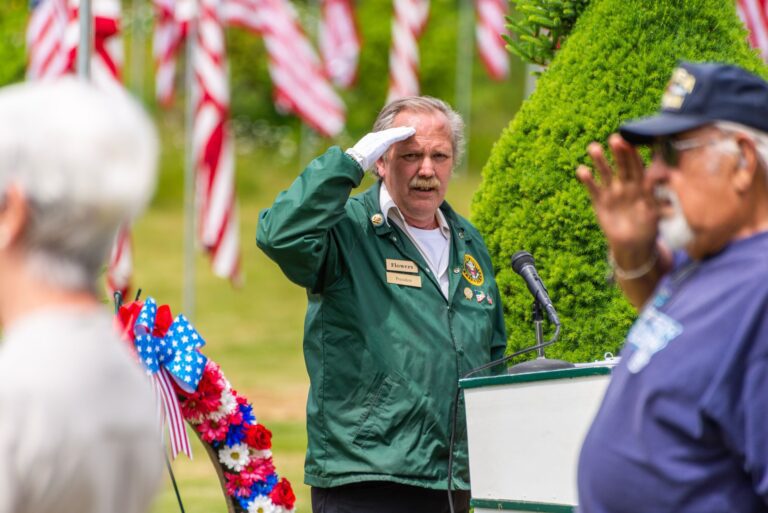
At my granddaughter’s graduation the principal called me “just the grease monkey grandpa” into the microphone, until the colonel on the stage stopped the ceremony, saluted me, and said “that man carried me out of a burning Humvee.”
I want to tell you what it felt like standing in that doorway first, before I tell you how I got there, because I have thought about that minute more than any other minute of my whole life, and I have had some big ones.
Six hundred folding chairs. Every one of them turned around to look at me. My coveralls were still stiff with transmission fluid up past the elbow, my boots were leaving faint black prints on the gymnasium floor, and Principal Dale Prentiss was standing at the podium in a suit that probably cost more than my truck, watching me walk in like I’d tracked something into his house.
He had the microphone in his hand already. He didn’t have to use it on me. He chose to.
“Looks like we’re still waiting on one more,” he said, and he let a little smile sit on it, the kind of smile a man gives when he already knows the room is going to laugh with him and not at him. “The grease monkey grandpa, finding his seat.”
The gym laughed. Not everybody. But enough. Enough that I heard it from thirty feet away, over the shuffle of programs and the hum of the ceiling fans, a ripple of it moving through the bleachers like wind through wheat.
I found a seat in the back row. I did not look for my son. I did not look for my granddaughter Katie, who I knew was sitting up front in her royal blue cap and gown, third in a row of two hundred and eleven graduates of Bellwood County High School, waiting for her name. I looked at my hands instead. Same hands I’d looked at ten thousand times before. Grease in the same creases it’s always been in.
My name is Walt Hargrove. I am seventy-two years old. I have run the same two-bay garage on Route 9 in Bellwood, Missouri, for thirty-eight years, and before that I spent twenty-two years as a mechanic with the Missouri Army National Guard, most of it as a motor sergeant, retiring a Sergeant First Class. I have never minded being called the grease monkey. Kids in this town have called me that since before some of their parents were born, and on any regular Tuesday I’d tip my hat to it.
But that morning wasn’t a regular Tuesday, and I want to explain why I was late, because it matters to what happened next, even though nobody in that gym knew it yet.
At six fifteen that morning, Linda Pruitt from First Baptist called my cell phone in a panic. The church van, the fifteen passenger Ford that carries the youth group to the summer mission trip, had died in the parking lot with six teenagers and two chaperones standing around it, and they were supposed to leave for the bus station in Springfield by ten. Linda didn’t ask if I could help. She just asked how fast. I told her I’d have it there by nine.
I want to be honest. I could have told her no. Katie’s graduation started at ten, and I could have said I had somewhere to be. But I have fixed cars in this town for thirty-eight years on the principle that when somebody needs you and you are able, you go, and I wasn’t about to break that principle on the one morning I most wanted to feel like the man I’ve tried to be my whole life. So I went.
The transmission wasn’t the problem. It was a fuel pump relay, cheap part, twenty-two dollars, but it took me until eleven fifteen to chase it down because the wiring harness on a fifteen year old church van is not a forgiving thing to work with. By the time I had that van running and those kids on their way to Springfield, I had maybe forty minutes to get across town, and I did not have forty minutes to go home, shower, and put on the one good sport coat hanging in my closet.
So I drove straight to Bellwood County High School in my coveralls. I told myself nobody would care. I told myself I’d slip in the side door, find a seat, and clap loud enough for Katie that it wouldn’t matter what I was wearing.
I did not account for Dale Prentiss deciding to make an example of me in front of six hundred people.
Let me tell you about Katie, because she is the reason any of this happened at all, though I didn’t understand that until later that same afternoon.
Get a new story in your inbox every morning.
Facebook doesn’t show you every story we post. Our free newsletter does. Join 2,500+ readers.
Katie is my son Danny’s daughter. Danny married a good woman named Renee, and they gave me one granddaughter, which I have always said was one more blessing than I had any right to expect. When Katie was nine, Danny took a job running heavy equipment for a pipeline outfit that kept him gone three weeks out of every four, and Renee worked second shift at the hospital in Springfield, and so a good chunk of Katie’s raising happened at my kitchen table and in the second bay of my garage, where she used to sit on an overturned bucket and hand me sockets by size before she was old enough to know what half of them were for.
Katie is smart in a way that skipped a generation or two in our family. She graduated third in her class of two hundred eleven. She had a partial scholarship to the University of Missouri waiting on her, first Hargrove in the history of our family to walk onto a four year campus with anything but a tool bag. I had pressed forty dollars into her hand two weeks before graduation and told her to buy something nice for the ceremony, and she’d hugged my neck so hard I had to sit down after.
What I did not know, what I would not find out until that very afternoon, was that Katie had spent the better part of the spring writing letters.
Here is the part of my life I have to go back and tell you about now, because it’s the part that made sense of everything else that happened in that gym.
In the winter of 2005, my Guard unit, the 1140th Engineer Battalion out of Springfield, was activated and sent to Al Anbar Province, Iraq, attached to a transportation company running convoy security and route clearance out of a forward base west of Ramadi. I was fifty-one years old at the time, which made me old for that deployment by about fifteen years, and my job was motor sergeant, keeping the wheeled vehicles running in sand that ate engines alive and heat that would crack a radiator hose just from sitting in the sun.
There was a young Lieutenant in that transportation company, twenty-four years old, fresh out of ROTC at the University of Missouri, if you can believe that, same school Katie would end up choosing on her own twenty-one years later without either of us ever discussing it. His name was Lieutenant James Whitfield, and he ran a platoon of five vehicle convoy escorts, and he used to come by my motor pool most evenings just to talk, because I think being around a man old enough to be his father steadied him some out there, and because I never minded the company.
On the third of March, 2005, Lieutenant Whitfield’s lead Humvee hit a pressure plate IED on Route Michigan, the main supply road running east out of our base. I was two vehicles back in the recovery truck, doing what motor sergeants do on convoy days, riding along in case something broke down mechanically, which is a different kind of danger than the kind that found us that morning.
The blast lifted the front end of his Humvee and set the engine compartment on fire almost immediately. I remember the sound more than the sight, a flat crack that didn’t sound like what I expected an explosion to sound like, more like a door slamming somewhere far away, and then the black smoke, and then people screaming words I couldn’t make sense of for a full three or four seconds because my ears were ringing so bad.
I am not a young man’s version of brave. I want to say that plainly. I did not run toward that burning vehicle because I felt fearless. I ran toward it because my body moved before my mind caught up with what my body had decided to do, and because Lieutenant Whitfield was pinned against the driver’s door with the frame bent in on his left leg, and the fire was already climbing up through the engine bay toward the fuel cell.
I got the door open with a pry bar I kept in my truck for exactly the kind of stuck door that a mechanic’s instinct tells him he might need one day. I got my arms under his and I got him clear of that Humvee about sixty yards before the fuel cell went up, and the two of us went down into the drainage ditch running alongside the road, and I lay on top of him because that’s what you do, you put your body between the man you’ve pulled out and whatever comes next, and small arms fire was cracking off the berm on the far side of the canal for a good ninety seconds while the rest of the platoon suppressed it.
Lieutenant Whitfield had a broken femur, second and third degree burns on his left arm and hand, and a concussion. I had a dislocated shoulder from the drag and burns on my forearms that still show today if you know where to look. We were both medevaced out within the hour. I was back with my unit inside three weeks. He was sent stateside for surgery and recovery, and by the time I finished my deployment that fall, he had already transferred to a different post for his next assignment, and Army life being Army life, we lost track of each other the way you do.
I never told that story to anybody in Bellwood. Not because I was hiding it, but because there wasn’t much occasion to bring it up over the parts counter at the auto supply store. My wife Carol knew, because I told her everything, and she passed twelve years ago from a stroke that took her fast and without warning on a Tuesday afternoon while she was watering her tomato plants. My son Danny knew the outline of it. Katie, I found out later, had known almost nothing at all, until she went looking.
What Katie did, and what I did not know until that afternoon, was this. Back in February, cleaning out a closet in my house while I was at the shop, doing me the kindness of organizing what she called my “man cave of paperwork,” she found an old cigar box on the top shelf that had my discharge papers in it, my Army Commendation Medal with a “V” device for valor that I had never once mentioned to her, and a torn corner of a letter with the name James Whitfield and a unit designation on it, the last piece of correspondence I ever got from him, sent from a hospital in Germany, thanking me and saying he’d find a way to repay it someday, a promise that time and distance and two more decades of Army postings had simply worn away.
Katie is not a girl who lets a thread like that sit unpulled. She spent two months tracking down whether James Whitfield was even still in the Army, using nothing but a library computer and a stubbornness I am fairly sure she inherited from her grandmother. She found him. Colonel James Whitfield, United States Army, currently serving as a brigade commander, based two hours from Bellwood, and as it happened, scheduled that spring to give a commencement address at a different high school forty miles away, an invitation he’d accepted as a favor to an old Army friend on that school’s board.
Katie wrote him a letter. Not asking him to come to her graduation. Just telling him, in her own seventeen year old words, that the mechanic who pulled him out of that Humvee in 2005 was her grandfather, that he still ran a garage on Route 9 in Bellwood, that he had never once mentioned the medal in that cigar box to her in her whole life, and that she thought Colonel Whitfield ought to know the man he’d been trying to thank for twenty-one years was still right there, still fixing engines, forty miles down the road.
Colonel Whitfield called Bellwood County High School himself the following week. He asked Principal Prentiss, directly, whether he might change his commencement commitment and speak at Bellwood instead. Prentiss said yes so fast Katie told me later she thought the man might have injured himself reaching for his own phone to confirm it, delighted at the prestige of landing a full bird colonel and combat veteran for his graduation program. Katie never told me a word of it. She wanted, she said afterward, to see my face when I understood.
I did not understand any of that yet as I sat in the back row of that gymnasium in my grease stained coveralls, listening to the laughter fade and the ceremony roll on without me in it.
Names started being called around eleven forty. I watched two hundred and eleven kids cross that stage, shake Prentiss’s hand, and collect a rolled diploma, and I clapped for every single one of them because that’s what you do at a graduation, you clap for other people’s children the same as your own, because somebody is always clapping for yours when you can’t be there.
When they called “Katherine Renee Hargrove,” I stood up. I couldn’t help it. Grease stains and all, I stood up in the back row and I clapped with both hands over my head, and I saw her find me across that whole gymnasium, and she smiled at me, not embarrassed, not the way I’d feared she might be after what Prentiss had done to me an hour before. She smiled at me like I was the only person in that room worth looking for.
I did not know it yet, but that smile was the first half of what she’d built for me that day.
After the diplomas, Principal Prentiss returned to the podium to introduce the commencement speaker, and I’ll tell you, I was barely listening. I was still nursing the sting of that microphone joke, still turning it over, wondering if I should have just stayed home in my coveralls and let somebody video the ceremony for me. I heard Prentiss say “distinguished guest,” and “decorated combat veteran,” and “honored to have him,” in the particular oily voice a man uses when he wants credit for having arranged something impressive, and I looked up at the stage mostly out of habit.
Colonel James Whitfield stood at that podium in his Army service uniform, full colonel’s eagle on each shoulder, a chest of ribbons I recognized the shape of even from the back row, and for a second, just a second, I thought he looked familiar in a way I couldn’t place, the way a song from thirty years ago sounds familiar before you remember the words.
He started his remarks the way commencement speakers do. Thanked the school. Thanked the families. Told the graduates something generic about the road ahead being longer than they expected and shorter than they’d wish, once they were standing at the end of it looking back. Ordinary stuff. Good stuff, but ordinary.
And then he stopped.
He stopped mid sentence, looked out over the folding chairs, and his eyes moved slow and deliberate across that back row until they landed on me, and I watched a man’s whole face change in real time, the practiced commencement calm falling away and something rawer coming up underneath it.
“I’m going to depart from my prepared remarks,” he said, and I could hear, even from the back of that gym, that his voice had gone tight in his throat. “Because I just realized there is a man sitting in the back row of this gymnasium that I have spent twenty-one years trying to find.”
The room went dead quiet. I mean dead quiet, the kind of quiet you only get in a room full of people who sense something real is about to happen and don’t want to be the one who makes noise through it.
“On March third, 2005, outside Ramadi, Iraq, my Humvee hit an IED,” Colonel Whitfield said. “The vehicle caught fire with me pinned inside it. I was twenty-four years old and I remember being entirely certain, in the way you’re certain of very few things in your life, that I was going to burn to death in that vehicle. And then a fifty-one year old motor sergeant, a man who had no medical training, no obligation beyond the one he’d made to himself, pried that door open with a bar he kept in his own truck, pulled me out, and lay on top of me in a drainage ditch under small arms fire until my platoon could get us both clear.”
He paused. I could see his hand gripping the edge of the podium.
“That man’s name is Walt Hargrove,” Colonel Whitfield said. “And ten minutes ago, before this ceremony started, this same man was introduced to this entire gymnasium as, and I believe I’m quoting it correctly, ‘the grease monkey grandpa.'”
I have never in my life heard six hundred people go that silent that fast, and then I have never in my life heard a gymnasium make that much noise that fast either, because it went from silence to something between a gasp and a roar inside about two seconds, and somewhere in the middle of that noise I heard my granddaughter, up in the graduate section in her royal blue gown, start to cry.
Colonel Whitfield stepped away from the podium. He walked to the front edge of the stage, and he looked down the length of that gymnasium straight at me, seventy-two years old, sitting in the back row in coveralls that still smelled like fuel pump grease, and he came to attention, and he raised his right hand, and he held a salute, full and formal and correct in every way the Army teaches a man to render one, aimed at me across six hundred folding chairs.
“That man carried me out of a burning Humvee,” he said, loud enough that it carried to every corner of that gym without the microphone’s help. “He is the reason I am alive to stand on this stage today, to have a career, to have a family, to have the privilege of watching your children graduate. I would not be here, none of what I’ve done in the last twenty-one years would exist, without Sergeant First Class Walt Hargrove.”
I don’t remember standing up. Danny told me later I was on my feet before Whitfield finished the sentence, and that half the row around me was on their feet too, reaching to steady me, though I don’t think I needed steadying, I think I just needed a minute for the ground to feel solid again.
I walked down that center aisle. I want to tell you I walked with some dignity, some soldierly bearing befitting the moment, but the truth is my knees aren’t what they used to be and I favor my left hip these days, and I walked down that aisle the way a seventy-two year old mechanic walks anywhere, careful and a little crooked, and every single person in that gymnasium stood up as I passed them, and by the time I reached the front, the applause had turned into something that didn’t sound like applause anymore, it sounded like a wall of sound with no edges to it.
Colonel Whitfield met me at the bottom of the stage steps. He didn’t wait for me to climb them. He came down to where I was standing, and in front of the graduating class of Bellwood County High School, in front of every parent and grandparent in that gym, in front of Principal Dale Prentiss, who I could see standing off to the side of the stage with a look on his face like a man who has just realized the floor beneath him is not where he thought it was, Colonel James Whitfield took both my hands in his, the same hands that had been mocked into a microphone an hour earlier, and he said, quiet now, just for me, “Twenty-one years, Walt. I looked for you for twenty-one years.”
I told him the only thing I could think to say, which was, “You found me at a good time. My granddaughter’s right up there.”
He laughed, a real laugh, wet around the edges, and he turned to the crowd and asked if Katherine Hargrove would come down and join her grandfather, and Katie came off those bleachers so fast her graduation cap nearly went sailing, and the three of us stood there together while six hundred people who did not know a single fact about my life twenty minutes earlier stood and clapped for a man they’d laughed at.
Colonel Whitfield told the room the rest of it, right there, unscripted. He told them about the cigar box. He told them about Katie’s letter, about how a seventeen year old girl had spent two months of her senior year tracking down an Army colonel because she’d found a medal in a closet that her grandfather had never bothered to mention. He said that in twenty-three years of Army service, in every ceremony and every ribbon and every ounce of recognition the institution had ever given him, nothing had moved him the way discovering that letter had, because it meant the debt he’d carried for twenty-one years had finally found its way home, carried there not by the Army’s paperwork but by a girl who loved her grandfather enough to go looking.
Then Colonel Whitfield reached into his jacket and pulled out a small case I hadn’t noticed him carrying, and he told the crowd that when Katie’s letter reached him, he had gone back through the paperwork from 2005 and confirmed what he had always suspected and never had the standing to correct, that my Army Commendation Medal with valor device had been the wrong award for what I’d done that day, downgraded somewhere in the fog of a busy wartime awards process, and that he had spent the last two months, on his own initiative, working through Army channels to have that corrected. He opened the case. Inside it was a Bronze Star Medal with a “V” device, the paperwork already processed, the award already approved, twenty-one years after the fact.
He pinned it on my coveralls himself. Grease stains and all. He told me afterward he wanted it pinned exactly where I’d been standing when he found me, on the man I actually was that day, not a man dressed up for the occasion.
I am not going to pretend I didn’t cry in front of six hundred people. I did. I am seventy-two years old and I cried in a high school gymnasium in front of the whole town of Bellwood, and I am not ashamed of a single tear of it.
Principal Dale Prentiss came to find me afterward, out in the parking lot, while Danny and Renee were loading the folding chairs Katie’s aunts had brought, and Katie was taking pictures with half her graduating class who all wanted to shake the hand of the man in the coveralls. He didn’t have his microphone anymore. He looked about ten years older than he had at ten o’clock that morning.
“Mr. Hargrove,” he said, and he had to stop and start again. “I owe you an apology, and I know an apology doesn’t undo what I said up there.”
I let him stand with that for a second before I answered, not to punish him, but because I wanted him to feel the weight of it the way I’d felt the weight of his joke an hour before.
“You didn’t know,” I told him. “That’s the truth of it. You saw a man in dirty coveralls and you made a judgment before you had the facts, and that’s a mistake plenty of people make plenty of times a day. Difference is, most of us don’t make it into a microphone in front of six hundred people.”
He nodded. He said the school board would be hearing from him about it, that he intended to say something to the whole faculty about it come fall, and I believe he meant it, because I saw him a few weeks later at the farm supply store and he crossed the whole parking lot just to shake my hand again and tell me he’d been thinking about that day every week since.
I don’t need Dale Prentiss’s whole career to burn down over one bad joke made on a stressful morning. I’ve made my own share of mistakes in seventy-two years, and I know the difference between a man who’s cruel down to the bone and a man who said something thoughtless and then had the decency to feel it. What I do want, and what I got, was for that room to know the truth before they went home that night. That’s justice enough for a mechanic. I never needed the last word. I just needed the true one.
The Springfield paper ran a story on it three days later, front page of the local section, with a photograph of Colonel Whitfield pinning that Bronze Star on my coveralls that Katie’s friend had taken on her phone and that ended up getting shared around this whole county faster than I could keep track of. The Bellwood VFW post asked if they could hang a framed copy of that photo on the wall next to the honor roll, and I told them that was fine, so long as they hung it a little crooked, the same way I’ve always hung everything in my own garage.
Colonel Whitfield and I have had dinner twice since that day, once at his house with his wife and two boys, once at mine, where Katie made a pot roast that I will say, with all the pride an old man is allowed, was better than her grandmother’s, may Carol forgive me for saying so out loud. He told me, that first dinner, that he’d carried a version of guilt for twenty-one years, not because he’d done anything wrong, but because he’d never gotten the chance to properly close the circle on the worst and most important day of his life, and that Katie’s letter had done more for him than any medal the Army ever pinned on his own chest.
Katie left for the University of Missouri three weeks after that graduation. I drove her up myself in my truck, coveralls left home this time, in the good sport coat I’d meant to wear all along, and when I hugged her goodbye in that dormitory parking lot, I told her the only thing that felt big enough to say.
“You gave an old man his story back,” I told her. “I’d have gone to my grave never telling anybody about that ditch outside Ramadi. You went and found the one man on this earth who could stand up and tell it for me.”
She told me she didn’t do it for the medal, and I believe her completely, because Katie has never once in her life cared about a medal. She did it because she found a cigar box in a closet and refused to let the man who raised her keep being smaller than the truth of who he actually was.
I still open the garage at seven every morning. I still answer the phone when Linda Pruitt’s church van breaks down, and it breaks down more than you’d think for a vehicle that old. I still wear the coveralls, grease and all, because that’s who I am and I’ve never been ashamed of it, not before that graduation and certainly not after.
But there’s a Bronze Star in a shadow box on the wall of my office now, right next to the parts counter, hung a little crooked on purpose, right where every customer who walks in can see it while I’ve got my head under their hood. Most of them don’t ask about it. A few do. And when they do, I tell them the whole thing, the church van, the coveralls, the microphone, the salute, all of it, because I learned something in that gymnasium I hadn’t fully understood in seventy-two years of living.
A man’s worth was never in what he was wearing when they called his name. It was always in what his hands had done, long before anybody was watching, and in the granddaughter who loved him enough to make sure the whole world finally found out.