
I want to start with the number, because everything else in this story only makes sense once you know it. Fifty eight thousand dollars. That is what strangers paid for our father’s tractor, his plow, his tools, and every piece of iron that had ever stood in that barn, on a Saturday morning in September while I was three weeks out from a hysterectomy and still believed, right up until a neighbor’s phone call, that I owned half of it.
My name is Linda. I am forty six years old, and I grew up on a hundred and ten acres outside Millbrook, Ohio, ground my father worked for more than forty years before his heart finally gave out on him the spring before last. My brother Michael is two years older than me. We buried our father in April. By September, Michael had sold everything Dad ever built, bought, or fixed with his own two hands, and he had forged my signature on the paper that let him do it.
I need you to understand what that barn was before I tell you what he did to it, because the fifty eight thousand dollars is not really the wound. The wound is what he took from the version of me that used to stand in that doorway at seven years old, watching my father grease a chain in the lamplight, and feel like the safest kid in the whole state of Ohio.
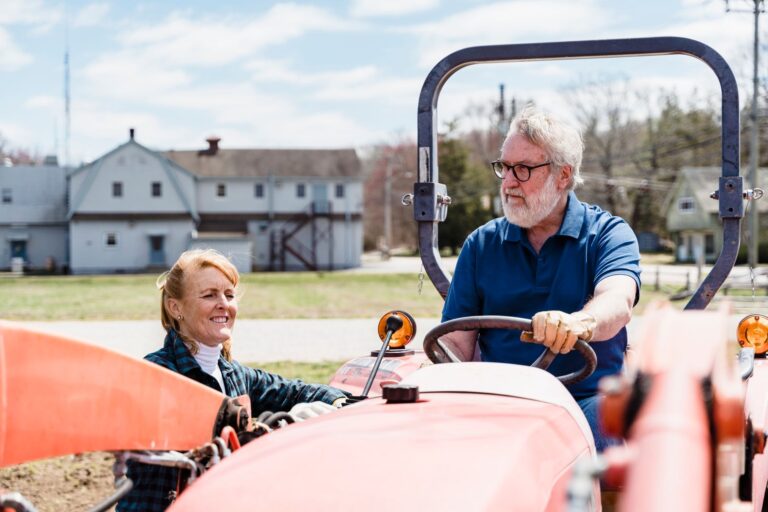
Dad built that barn himself the year he married my mother, board by board, on land his own father had cleared. He ran cattle for a while, then switched mostly to corn and soybeans once his knees gave him trouble with fence lines. The barn held the working life of it all: a 1975 International Harvester tractor he kept running on nothing but stubbornness and a parts catalog held together with duct tape, a three bottom plow, a disc harrow, a grain drill, a hay rake, an old flatbed wagon with wooden sides gray from forty winters. Along the back wall he’d built a bench and hung a pegboard over it, every wrench and clamp and hand saw outlined in marker so he’d know at a glance if something wasn’t back where it belonged. I used to stand on an overturned bucket to reach that pegboard, handing him tools before I was tall enough to see over the bench myself. That barn smelled like diesel and cut hay and the bar soap he kept by the door to get the grease off his hands before supper. I have never smelled that combination anywhere else in my life without feeling nine years old again.
Michael stayed local. He took over the day to day running of the place the last several years, once Dad’s knees and then his heart made the real work too much for him. I moved into town when I married, twenty minutes away, close enough to help but not close enough, in Michael’s eyes, to have earned any real say in what happened to that farm. He never said it in those exact words until the end, but I heard it under everything he said for years. You don’t live out here. You don’t do the work. I do.
When Dad died, his will was plain and simple, drawn up by the same lawyer who’d handled his taxes for two decades. The house and the acreage went into a trust the two of us shared equally, with Michael given the right to keep farming it and buy me out over time if he chose to. But the barn’s contents, the tractor, the implements, the tools, all of it, was left to the two of us jointly and outright, split down the middle, no trust, no conditions. Dad had said as much to my face the year before he passed, sitting at his kitchen table with his coffee going cold. “That barn is half yours and half his, Linda. Whatever happens to it, happens because the two of you agree, not because one of you decides for the other.” I remember thinking, at the time, that he was being careful for no reason. I did not yet understand what my brother was capable of when he thought no one who mattered was watching.
I had been putting off a hysterectomy for the better part of a year. Fibroids, mostly, and the kind of bleeding that had worn me down to nothing without me quite admitting how bad it had gotten, because the farm always seemed to need one more thing from me first: helping Michael file the estate paperwork, driving Dad to appointments those last months, then the funeral, then six more months of grief errands nobody warns you about. By late summer my doctor told me plainly that I was risking my own health by waiting any longer, and my husband finally put his foot down too, in the gentle way he does, and we scheduled the surgery for the second Tuesday in September.
I was admitted to Cedar County Memorial at quarter to six that morning. My husband sat with me through the paperwork and the IV and the endless questions about my birthdate, and he held my hand until they wheeled me back through the double doors at half past seven. I remember the anesthesiologist’s face, kind and unhurried, telling me to count backward from ten. I do not remember getting past seven.
The surgery itself ran a little over an hour. I was in recovery by nine, still under the fog of general anesthesia, a nurse checking my vitals every fifteen minutes the way they do, each one timed and initialed on a chart that would later matter more to me than almost any document I have ever held. My husband told me afterward that I opened my eyes around eleven and asked him, slurring, whether the chickens had been fed, which tells you exactly what kind of morning it had been for both of us even through the drugs. I stayed two nights in that hospital, and I came home sore, hollowed out, moving like a woman twenty years older than I am, and grateful simply to be alive and done with it.
I want to be plain about something. At no point that Tuesday, not at quarter to six, not at nine ten, not at any hour of that day, was I anywhere within forty minutes of my own kitchen table, let alone anyone else’s. I was strapped to a gurney and then a hospital bed the entire time, documented by strangers in scrubs whose only job that morning was to know exactly where I was and what state I was in, minute by minute. I did not know yet how much that would matter. I only knew I hurt, and that my husband kept the house quiet, and that for the first two weeks of my recovery I barely made it past the living room couch.
It was during that same stretch, while I was healing at home and Michael was, as far as I knew, minding the farm the way he always did, that he quietly picked a Saturday, called an auction house out of the county seat, and put every piece of equipment in our father’s barn up for public sale.
Get a new story in your inbox every morning.
Facebook doesn’t show you every story we post. Our free newsletter does. Join 2,500+ readers.
I did not find out from Michael. I found out three weeks after my surgery, still moving carefully, still not driving myself anywhere, from a neighbor who has lived down the road from our family land for as long as I can remember. She called one afternoon just to check on my recovery, the way good neighbors do, and near the end of the call she said, almost as an afterthought, that she was sorry about the auction.
“What auction,” I said.
The silence on her end of the line lasted long enough that I knew, before she said another word, that whatever she was about to tell me was going to change something in me permanently.
She told me there had been signs up along the county road for a full week beforehand. FARM AUCTION SATURDAY. TRACTOR, IMPLEMENTS, TOOLS, ANTIQUES. She’d assumed I knew, assumed Michael and I had agreed on it together, until she ran into me at the pharmacy that morning, moving stiff and slow, clearly still recovering, and it occurred to her that a woman three weeks out from surgery had probably not spent her Saturday standing in a gravel lot watching her father’s tractor get sold to strangers. She said she almost hadn’t mentioned it at all, not wanting to stir up trouble, but something about the timing had sat wrong with her for weeks and she finally couldn’t hold it in any longer.
I got off that call and sat very still in my kitchen for a long time before I did anything else.
Then I called Michael.
He answered on the second ring, easy as anything, the way he always does when he thinks he has nothing to explain. I asked him, as calmly as I could manage, whether it was true that he had auctioned off Dad’s equipment. He did not deny it. He did not even hesitate.
“Yeah, it went well. Cleared right around fifty eight thousand after the auction house’s cut. I was going to call you about it once you were feeling better.”
I asked him how, exactly, since the release the auction house required had to be signed and notarized by both of us, jointly, per Dad’s own will. I remember my voice shaking, not from anger yet, just disbelief.
“You signed it, Linda,” he said, like I was the one being unreasonable. “Don’t you remember? You signed it before you went in for your surgery. I had it notarized the same morning, just to get it out of the way before everything got crazy with you being in the hospital.”
I told him I had not signed anything. I told him I had been in pre op at quarter to six that morning and unconscious on an operating table well before any hour he could be describing. He talked right over me, the way he does, telling me I was confused, that surgery and anesthesia mess with people’s memories more than they realize, that I’d probably signed it in the parking lot on our way in without even thinking twice about it, half asleep with nerves. He said it so smoothly, so certain, that for one terrible minute I actually doubted my own memory of my own morning. That is a particular kind of cruelty, being made to distrust the inside of your own head by someone who shares your blood.
But I know my own hand. And more than that, I have never in my life been the kind of person who signs a legal document without reading it, groggy or not, half asleep or not. Something in me refused to let that doubt take root, and instead of arguing with him further on the phone, I hung up and went looking for proof instead.
I called the hospital’s records office the next morning and requested a full copy of my surgical file. It took a few days to arrive, but when it did, it laid my entire morning out in black and white. Admitted five forty five a.m. Pre op checklist completed six ten. Wheeled to the operating suite seven twenty. Surgery start seven thirty two, surgery end eight fifty one. Transferred to recovery nine oh four. Vitals checked and initialed every fifteen minutes after that by name, by nurse, straight through the rest of the morning. There was no gap in that timeline wide enough to drive to a notary’s kitchen table, sign a legal document, and drive back, even if I had somehow been conscious and mobile enough to do it, which I was not.
I still needed to know what Michael had actually filed, and whose signature was on it, and whose name was in whatever notary’s book had logged it. So I drove out, still moving slow, to see the one person in this county whose entire job is to write down exactly when and where a signature happens.
Her name is Paula. She has lived in Cedar County her whole life, and for the last twenty years she has done notary work out of her own kitchen for anyone in the township who needs a document witnessed, a deed signed, a power of attorney made official. Half the farm families around here have sat at that same oak table at one point or another. I went to her not looking for a fight, but because I wanted to see, with my own eyes, the page where my supposed signature had been logged, and be sure I was not somehow losing my grip on my own memory the way Michael kept insisting.
Paula welcomed me in without a hint of suspicion, the way she welcomes everyone. When I told her why I’d come, that I wanted to see the notarization entry for the equipment release Michael had filed, she didn’t blink. She keeps a bound journal, required by Ohio law for every notarization she performs: the date, the time, the type of document, the signer’s name, the form of identification presented. She pulled it down off the shelf in her back room without a second thought, because as far as she knew, she had done nothing that morning but her job the same as always.
She found the entry quickly. Her finger ran down the page, and she read the date and time out loud to me before she’d even fully registered what she was saying: the second Tuesday of September, nine ten in the morning, a notarized release for the estate of our father, signed by Linda, identification presented as a Ohio driver’s license.
I asked her to read it again. She did, a little slower the second time, watching my face change as she said it.
At nine ten that morning I was lying in a recovery bay at Cedar County Memorial, still fogged from anesthesia, a nurse’s initials on a chart marking my vitals at that exact quarter hour, forty minutes from Paula’s kitchen table by the fastest road there is between our two halves of the county. There is no version of that Tuesday where I am both of those places at once. Somebody sat across from Paula that morning, signed my name in her presence, showed some form of identification good enough to satisfy her, and walked out with a notarized document good enough to hand an auction house. It was not me.
I watched something shift across Paula’s face as the math of it landed on her too. She is not a careless woman. In twenty years of doing this work off her own kitchen table, she had never once, to her knowledge, notarized a forgery. She asked me, quietly, if I was certain of my hospital times, and I told her I had the paperwork in my car to prove every minute of it. She sat down across from me at that same oak table, and for a long moment neither of us said anything at all.
What she told me next is the part I want to walk through slowly, because it matters, and because it changes how I think about what my brother is actually capable of.
Paula told me that Michael had come to her alone that Tuesday morning, not with me, carrying a document he said I had already signed the evening before at his place, before I checked into the hospital. He told her I was already prepped for surgery that morning, groggy and anxious, and that he was simply bringing the paperwork by on my behalf so she could complete the notarization without making a sick woman travel across the county to sit at her table in person. He had, Paula admitted, a photocopy of my driver’s license with him, one he must have taken from paperwork of mine lying around from some earlier errand, one of the small trusting favors siblings do for each other without a second thought. Ohio notary law requires the signer to appear in person, and Paula knew that rule as well as anyone. But Michael is a familiar face, a longtime neighbor she has known his whole life, and he told her, standing right there in her own kitchen, that I would be by within the week to confirm everything in person if she had any doubts at all. She logged the entry the way he described it to her, trusting a man she’d known since he was a boy on a bicycle, and she never thought to question it again until I sat across from her, three weeks later, with a hospital chart in my hands.
I do not believe Paula meant any harm. I believe she was deceived the same way I was, by a man who knew exactly which corners to cut and exactly which people would trust him enough not to check. But the fact remains: no signature of mine belongs in that journal at that hour on that date, because I was never at her table, not that morning, not any morning near it. Whatever hand signed my name there, it was not mine, and whoever presented my identification did so without my knowledge or consent.
I laid the journal page, which Paula let me photograph, next to my own hospital discharge summary on my kitchen table that same afternoon, side by side, the two timestamps sitting there like two halves of a lie finally forced to look at each other. Nine ten in the morning, notarized release, Linda’s signature, according to Paula’s book. Nine oh four to nine thirty, vitals check, recovery bay four, according to the hospital. Forty minutes apart by road, and I was pinned to a hospital bed the entire time either document could have been true. Both could not be.
I sat there a long while with that proof in front of me, and I felt something in me go very cold and very still. Not the kind of anger that makes you shout. The kind that makes you plan.
I did not confront Michael again right away. Instead, I spent the better part of the next month building a case I knew could not be argued away with a phone call and a shrug. I contacted the estate lawyer who had handled Dad’s will and walked him through the timeline. He went quiet on the other end of the line the same way Paula had, and told me plainly that what I was describing, if it held up, was forgery, and that Ohio treats a forged notarization as a serious matter, not a family disagreement to be smoothed over at a holiday dinner. I also filed a formal complaint with the Ohio Secretary of State’s notary commission office, which oversees every notary in the state, and requested a certified copy of the journal entry directly from their records, so that what I held in my hands was not just a photograph from Paula’s kitchen but an official document with the state’s own seal on it. It took several weeks to arrive, longer than I expected, weeks in which I said almost nothing to Michael at all, letting him believe, I think, that I had accepted his version of events the way I had a hundred smaller slights before.
I had not.
While I was building that case quietly, I learned something else that made the whole thing sit even worse in my chest. Michael sits on the board of the Cedar County Fairgrounds Association, has for several years, mostly handling the equipment and grounds committee, the tractors and mowers and old machinery that keep the fair running each summer. Word around the county, the kind of word that travels fast in a place this size, was that at the fall harvest meeting in October, the one every farm family in three townships turns out for, Michael was going to be installed as the new committee chairman. Part of the reason, I was told, was that he had recently donated a piece of “family history” to the fairgrounds’ small heritage museum: our father’s old forge and anvil, the very one I used to watch him bank coals in on winter evenings, presented as a tribute to Dad’s memory and Michael’s own commitment to preserving it.
I want you to sit with that for a moment the way I had to. My brother forged my signature, sold our father’s life’s work out from under me while I lay recovering from surgery, and then used a single piece of that stolen inheritance as a public relations gesture to burnish his own name in front of the whole county, right before being handed a position of honor for it.
I decided, sitting at my kitchen table with the state’s certified copy finally in hand, that I was not going to confront him privately, quietly, the way our family has always smoothed things over. I was not going to let him accept applause for something built on a forgery only I and Paula knew about. I was going to bring the proof to the one room in this county where everyone who mattered, everyone who knew both of us, would be sitting together at the same time.
I called Paula the week before the meeting and asked her a single question: would she come with me, and if asked directly, would she tell the truth about what actually happened that Tuesday morning. She did not hesitate. She told me she had thought about almost nothing else since the day I sat across from her with that hospital chart, and that she owed it to her own name, and to mine, to make it right in front of whoever needed to hear it.
The meeting was held on a Thursday evening in the fairgrounds’ exhibition building, folding chairs set out in long rows, the same building where 4H kids show their steers every August. It was packed, the way it always is for the fall meeting, farm families filling every row, the smell of coffee and cider donuts drifting from a table in the back. I sat near the front with Paula beside me and a folder in my lap that felt heavier than any folder has a right to feel.
The board went through its usual business first, budget items, a discussion about the grandstand roof, before the president moved to new appointments and called Michael up to the front of the room. He walked up smiling, comfortable, a man who had clearly rehearsed this moment in his head more than once. The president said a few warm words about his years of service and his recent gift to the heritage museum, honoring “the memory of a man who gave this county forty years of hard work,” and the room applauded. Michael took the microphone and began thanking everyone, his voice easy, and I remember thinking, watching him stand up there wearing our father’s legacy like a coat that was never his to wear, that I had never in my life wanted to interrupt anything more.
I stood up before he finished. I asked the board president, as steadily as my voice would allow, if I could address the board on a matter directly related to the estate Michael had just been praised for honoring. The room went quiet in that particular way a crowd goes quiet when it senses something it was not expecting. The president, a little uncertain, said the floor was open for a brief comment.
I told them plainly what I am telling you now. That our father’s barn had been sold at auction for fifty eight thousand dollars while I lay in a hospital recovering from surgery. That the sale required both my brother’s signature and mine, jointly, per our father’s own will. That I had never signed any such release, had never been anywhere near a notary’s table that morning, and had the hospital’s own timestamped records to prove exactly where I was, minute by minute, during the hour a notarization bearing my name was logged forty minutes away.
I held up the certified copy from the Ohio Secretary of State’s office and read the date and time out loud. Nine ten in the morning, the second Tuesday of September. Then I read the hospital’s own vitals log from that same window, nine oh four to nine thirty, recovery bay four, initialed by a nurse whose name is a matter of hospital record. Forty minutes apart by road. Both could not be true.
I asked Paula, sitting beside me, to tell the room what she had told me at her own kitchen table. She stood, and in a voice steadier than I expected from a woman who had spent the last two weeks dreading this exact moment, she told them plainly that Michael had come to her alone that morning, told her I had already signed the evening before and was too unwell that day to appear in person, and that she had notarized the document on his word and a photocopy of my identification, trusting a neighbor she had known his whole life. She said she deeply regretted not following her own protocol, and that she stood by every word of it now that the truth had come to light.
I want to describe Michael’s face in that moment, because I have thought about it many times since. For one second, maybe two, I watched him try the same easy smile he’d worn walking up to that microphone, the one that has talked his way out of trouble his whole life. It did not hold. I watched it fail in real time, in front of a room full of people who have known our family for decades, people who had just applauded him, people who were now looking at him with an expression I have never seen a room turn on my brother before.
He tried, briefly, to say I was confused, the same tired line he had used on the phone weeks earlier. But a room full of farmers who deal in facts and weather and the honest math of a harvest is not an easy room to talk in circles in front of, not when a certified state document and a hospital timeline are sitting side by side in someone’s hands, and not when the notary herself has just stood up and confirmed the whole thing under her own name.
The board president, visibly shaken, said the installation would be tabled immediately pending a full review, and asked Michael to step down from the microphone. Michael did not argue. He walked back to his seat in a silence so total I could hear the exhibition building’s old heating system ticking in the rafters. Nobody applauded him back to his chair.
I will not pretend the room erupted into some satisfying spectacle. It did not. What happened instead was quieter and, I think, worse for Michael than shouting would have been. People simply stopped looking at him the way they had looked at him twenty minutes before. A few farmers near the back got up and left early. Someone I did not know well leaned over to Paula afterward and thanked her for her honesty, loud enough for half the row to hear it.
What happened in the weeks after was handled the way these things get handled once the truth is out and undeniable, through the estate lawyer, through a formal letter laying out exactly what Ohio law says about a forged notarization and what a forgery complaint filed with the county prosecutor would mean for my brother. He did not fight it. Faced with the certified copy, the hospital record, and Paula’s own sworn account, there was nothing left to fight with. Within a month, under the lawyer’s supervision, Michael repaid my half of the auction proceeds in full, twenty nine thousand dollars, drawn from his own accounts rather than risk what a real forgery charge would have cost him in front of a judge. The fairgrounds board quietly removed him from the equipment committee altogether, and the anvil he had donated for applause was moved, at his own request, out of the heritage museum’s main display and into storage, where as far as I know it still sits.
I did not get our father’s tractor back, or his plow, or the tools that used to hang outlined in marker on that pegboard. Those are gone for good, scattered now to strangers across three counties, and no amount of money changes that. What I got instead was the truth, plainly stated in front of the one room where it could not be talked away, and a number in my own bank account that at least matches what I was owed under our father’s own will.
Michael and I do not speak now, not the way we used to, not the way brothers and sisters are supposed to. I do not know if we ever will again, and I have stopped pretending to myself that I am waiting for it. Some betrayals cost you the thing that was stolen. This one cost me that, and it also cost me the last of whatever I still believed about my brother’s word being worth anything at all. I have made my peace with getting one of those two losses back and not the other.
I still drive past that farm sometimes, out of habit more than anything. The barn stands there mostly empty now, the pegboard bare down to the outlines Dad drew in marker decades ago, a rectangle of clean concrete where the workbench used to sit. I do not go inside anymore. But I know, finally, exactly what happened in there while I lay in a hospital bed trusting my own brother to do right by me, and I know exactly what it took to make him answer for it in front of the one room in this county that mattered enough to hold him to it. That is not the ending I would have chosen for us. It is, at least, the true one.
This story is a dramatization. Names, characters, and details are invented, and any resemblance to real people or events is coincidental.