The Seventy Five Dollar Tractor That Saved Everything
I was twenty two years old the morning I made the worst purchase anybody in Dawson County had ever seen, and I want to tell you the whole thing, start to finish, because the man who laughed at me that day never knew how the story ended. Most people around Lexington, Nebraska still don’t. I kept it quiet for a long time, partly out of respect for a dead man I never met, and partly because some things a person has to sit with alone before he can hand them to anybody else. I am ready now.
My name is Dale Perkins. I was born in 1947 on eighty acres of bottom land along the Platte River, the only son of Walter and Mary Perkins. My father farmed that ground for twenty years before I was old enough to help him, and another dozen after that with me at his side. We were never rich. Some years we were not even comfortable. But we ate, and we paid what we owed, and my father repaired everything himself because there was never enough left over to pay somebody else to do it. I grew up in his workshop with grease under my fingernails before I could reach the pedals of the truck. He taught me to weld before I could legally drive to town. He taught me to rebuild an engine before I could vote. By the time I was sixteen there was not a machine on that farm I could not take apart in an afternoon and put back together by supper.
I tell you all of that so you understand what I lost in the spring of 1968, and why a rusted seventy five dollar tractor mattered so much to a boy who by all rights should have known better.
My father had a heart attack while plowing the North Field on an ordinary Tuesday in April. He was fifty one years old. By the time my mother saw the tractor sitting still in the middle of the row and ran out to find him, he was already gone. The ambulance came from town, but there was nothing for them to do but carry him home.
I was twenty one. I became, in the space of one afternoon, the only man on eighty acres of debt neither my mother nor I had known the full size of, because my father, like a lot of men of his generation, did not discuss money with his family. He carried what he carried and he did not set it down where we could see the weight of it. I found out slowly, through letters from the bank and the co-op and the feed store, exactly how much he had been carrying.
Worse than the debt was the tractor. Our only tractor, a 1954 Farmall Super M, had thrown a rod the fall before my father died. He had been nursing it along on borrowed parts and patience, planning to pull the engine that winter and do it right. He never got the chance. So I inherited eighty acres, a grieving mother, debts I hadn’t known about, and a dead tractor sitting in the machine shed like a monument to everything that had gone wrong that year.
For a full season I farmed with borrowed equipment and rented machinery, showing up late to every field because I had to wait my turn for somebody else’s tractor, falling further behind with every month that passed. A farm does not forgive a man for being behind. The weeds do not wait. The planting window does not stretch. By the winter of 1968 I understood that if I did not find a tractor of my own before spring, I was not going to have a farm much longer to worry about it.
New tractors cost thousands of dollars I did not have and no bank in Dawson County was going to lend a twenty two year old with an inherited debt load the money to buy one. The used market had been picked clean by farmers who were doing better than I was, expanding while I was scraping. I checked every listing in the county paper for months and found nothing I could afford that still had an engine in it.
Then, in March of 1969, I heard that the Hollister estate equipment was finally going to auction.
What Was Sitting At The Edge Of The Lot
The name Hollister still meant something in Dawson County in 1969, even if most people had stopped remembering exactly why. Clarence Hollister had farmed a small operation north of Lexington through the 1940s and into the 50s, a quiet man who kept to himself and ran maybe half the acreage my father had. He died in 1952. His widow sold the land not long after and moved out to California to live near her sister, and by every account she left in a hurry, wanting nothing more to do with Nebraska or the farm or the grief that came with both. The equipment sat in a barn on the property for seventeen years while the estate wound its way through whatever paperwork keeps these things tied up that long. Now, finally, somebody had settled it, and the Dawson County Equipment Auction was selling off what was left.
I went to that auction on a Saturday morning in April of 1969 hoping to find a used cultivator or a decent set of tires, something small I could afford. I was not looking for a tractor. I did not think I could afford a tractor.
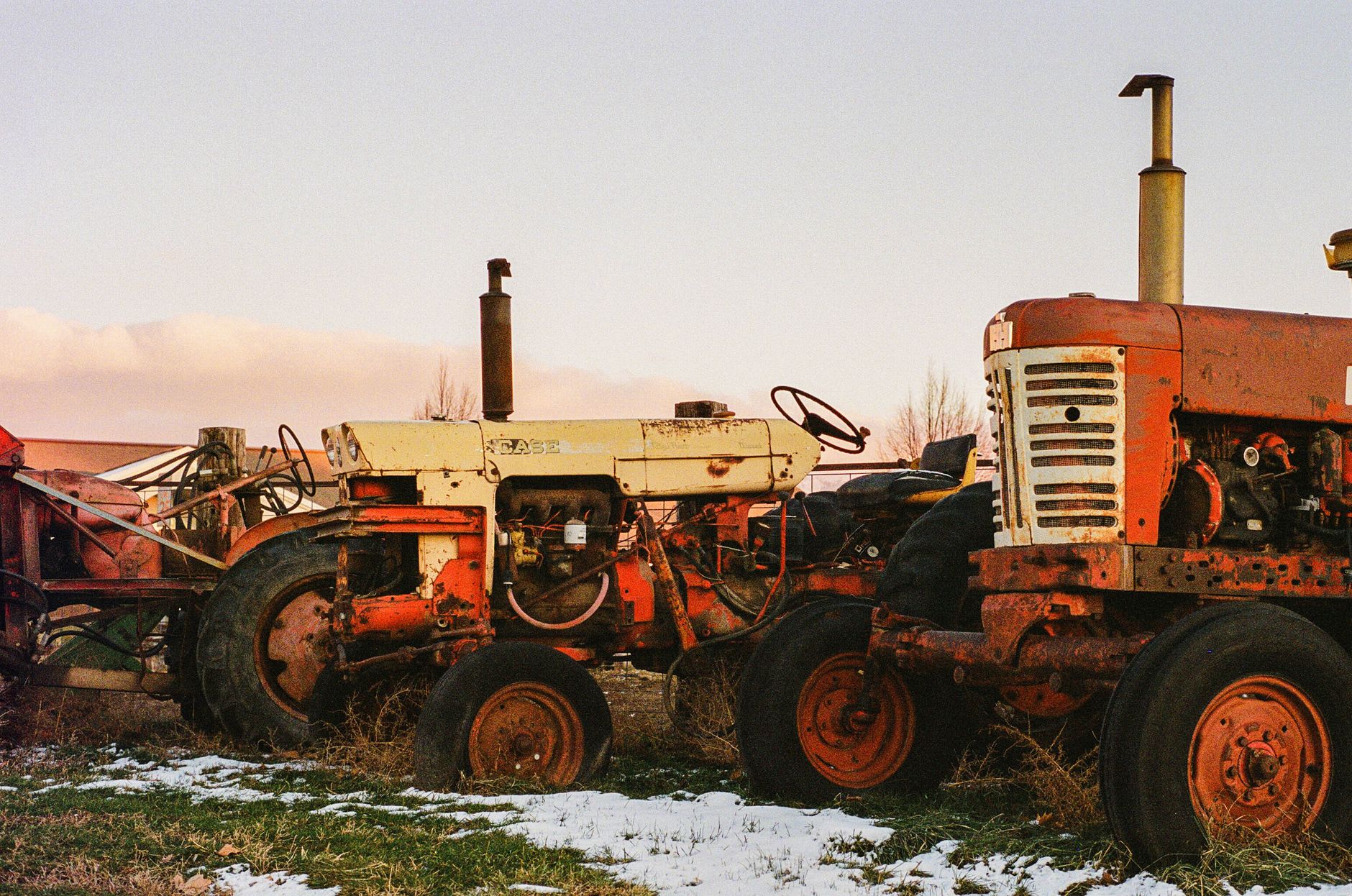
It sat at the far edge of the lot, off by itself, separated from the respectable equipment the way you’d keep a sick animal away from the healthy herd. A 1948 Farmall M. The red paint had gone the rust brown of something left outdoors too long, though I would later learn it had at least been under a barn roof, which was the only reason there was anything left to save. The tires were flat and cracked clean through in places. Birds had built a nest in the air cleaner. Somebody, at some point, had scratched the word “junk” into the hood with a nail, and looking at it, nobody standing in that lot was inclined to argue.
The auctioneer nearly skipped it. I remember his exact words because I have turned them over in my head a thousand times since. All right, folks, last item of the day. 1948 Farmall M. Sold as is, where is. This one’s from the Hollister estate. Been sitting in a barn since ’52. Probably good for parts, maybe. Do I hear fifty dollars for silence?
A few people laughed. He tried again. Fifty dollars for a genuine piece of history. Somebody’s got to want it. More silence. He was about to move on and close the auction when I raised my hand.
Fifty, I said.
He looked surprised that anybody had said anything at all. I have fifty, he said. Do I hear sixty? Nothing. Fifty going once. Fifty going twice.
I do not fully know what came over me in that half second, except that I could see the engine block from where I stood, and something in the shape of it, in the way the casting sat, told me it was the same basic architecture as my father’s Super M. I knew that engine. I had rebuilt pieces of it my whole life. Before the auctioneer’s gavel came down I heard my own voice again, bidding against myself.
Seventy five.
The crowd laughed outright at that. Who bids against himself for a pile of junk. The auctioneer, maybe worried I would keep going and embarrass us both, brought the gavel down fast. Sold, to the young man in the back. Son, he said, you just bought yourself a real antique or a boat anchor. Hard to say which.
More laughter. I walked up to the payment table and counted out seventy five dollars in small bills, which was most of what I had in the world that spring, and I took my receipt and folded it into my shirt pocket like it was a deed to something bigger than it was.
That is when Vernon Krebs found me.
The John Deere Dealer
Vernon Krebs sold more tractors than anybody in Dawson County. He ran the John Deere dealership on the edge of Lexington, wore a clean pressed shirt even on a Saturday, and smelled like aftershave and new rubber tires. He had opinions about everything, and he was not shy about sharing them, especially with a young man who had just done something foolish in front of half the county.
Dale Perkins, he said, stepping into my path before I could get back to my truck. I heard you just spent seventy five dollars on that Hollister pile of rust.
Yes sir, I said.
Boy, do you know what seventy five dollars could have bought you? He gestured toward the parking lot where his dealership truck sat, gleaming, hitched to a trailer with a green and yellow tractor on it that I could not have afforded in three lifetimes. That’s a down payment on a real tractor. A John Deere. Something that actually runs.
I can fix this one, I said.
Vernon laughed, a big loud laugh that carried clean across the auction yard and turned heads. Fix it, he said. Son, that tractor hasn’t run since Truman was president. The engine is probably seized solid. The transmission is full of mice. You would need a thousand dollars in parts and a year of Sundays just to get it to cough, and even then you’d have a twenty year old tractor instead of no tractor at all.
I can fix it, I said again.
No, he said. You can’t. He stepped closer and dropped his voice into something that was trying to sound fatherly and came out patronizing instead. Listen, son. Your daddy was a good farmer, God rest him. But you’re twenty two years old. You’ve got eighty acres of sandy bottom land and a mama to look after, and you just spent seventy five dollars on a tractor that isn’t worth fifteen. That’s not farming. That’s foolishness.
I looked at Vernon Krebs standing there in his clean shirt with his soft hands and his confident smile, a man who had never once had to pull a rod out of an engine by lantern light because there was no money for a mechanic, and I told him the only thing I had to tell him.
My daddy taught me something, Mr. Krebs, I said. He said the worst thing a man can do is let other people tell him what’s possible.
I walked past him toward my rusted purchase and left him standing there with his mouth still open. Behind me I could hear the laughter still moving through the crowd like it had somewhere to go. I did not look back. I had a tractor to get home, and no idea yet what I had actually bought.
Getting It Home
I borrowed a flatbed trailer from Ellis Cobb, one of the few neighbors still willing to lend me anything after word of my father’s debts had gotten around, and I hauled the Farmall M back to our place that same afternoon. It took four of us, Ellis and two of his boys and me, just to push it up onto the trailer, because the wheels would not turn and the steering had locked solid from seventeen years of sitting still. We shoved and cursed and finally got it chained down, and I drove it home slow, worried the whole way that it would shift and roll off into the ditch.
That first week was the closest I ever came to admitting Vernon Krebs was right.
The engine would not turn over by hand, not an inch, which meant it was seized just like he said. I spent three days pouring penetrating oil into every cylinder I could reach and letting it sit, then coming back to try again with a breaker bar and every bit of leverage I owned. On the fourth day something gave, just a fraction of an inch, and I nearly cried out there alone in the shed. By the end of the first week I had it turning freely enough to pull the head.
What I found inside was about what you would expect after seventeen years. Rust scale flaking off the cylinder walls. Sludge in the crankcase gone thick as roofing tar. A mouse nest, just as Vernon had predicted, packed into the bell housing where the transmission met the engine, with a little skeleton curled up in the middle of it that told me the mouse had not gotten out in time either. I cleaned it all out with rags and kerosene and my mother’s old dish brushes, working by the light of a kerosene lantern most nights because I could not afford to run electricity out to that shed and still buy the parts I needed.
I ordered rings and a gasket set from the Farmall dealer in Kearney, paying for them a few dollars at a time out of what little the farm brought in that spring. I found a rebuilt magneto at a salvage yard outside North Platte for eight dollars. I patched the radiator myself with solder. I mounted a used set of tires I traded a day of fence work for. Piece by piece, through the spring and into early summer of 1969, I brought that tractor back from the dead.
It started on the eleventh of June, on the third pull of the crank, and it ran rough for about a minute before it smoothed out into the steadiest sound I had heard in over a year. I stood there in the yard with grease to my elbows and cried like a boy half my age, because for the first time since my father died I had something under me that was mine, that worked, that nobody could take away because nobody else had wanted it in the first place.
I never did tell Vernon Krebs it ran. I did not need to. Word travels in a county that size whether you tell it or not, and I heard later that he had made some comment about a stopped clock being right twice a day. I let it go. I had a farm to save.
Sixteen Years Of Ordinary Life
I want to be honest with you about what came next, because it was not one dramatic turn after another. It was sixteen years of ordinary farming, which is its own kind of hard.
That Farmall M got me through the 1969 planting season and every season after it for a long while. I paid down my father’s debt a little at a time, some years faster than others. I married a schoolteacher named Linda Ostrander in 1971, a woman patient enough to marry a man whose idea of a honeymoon was three days off before spring planting, and we had two children, a son named Walter after my father and a daughter named Grace. My mother lived with us until she passed in 1979, and she got to see her grandchildren grow up on the same ground my father had worked, which mattered to her more than almost anything.
Vernon Krebs and I settled into the kind of coexistence small towns force on people who do not much like each other. He sold tractors to bigger operations. I kept mine running myself, the way I always had, because I never fully trusted a man who had once told me my father’s memory did not entitle me to try. Over the years his laugh got a little less loud and his opinions got a little less certain, the way most men’s do once life has had a chance to correct them a few times. I do not think he ever apologized, not in words. But there came a point, sometime in the mid 1970s, when he stopped bringing up the auction at all, and I took that as close to an apology as Vernon Krebs was built to give.
The Farmall M kept running because I kept it running, the same way my father had taught me, patching what needed patching, never letting a small problem become a big one. But an engine that had sat idle for seventeen years before I ever got my hands on it was never going to run forever without a real overhaul, a full teardown of the block itself, not just the top end I had rebuilt back in 1969. I put that job off for years because it was the kind of job that took the tractor out of service for weeks, and weeks I did not have to spare, not with a young family and a farm that never once let up.
By 1984 the sound coming out of that engine told me I could not put it off any longer. And by 1984, as it happened, I could not have picked a worse or a better year to need to go that deep into the machine.
The Year The Farms Started Falling
If you lived through the farm crisis of the 1980s in this part of the country, I do not need to explain it to you. If you did not, I will tell you it was as close to a second Depression as I ever hoped to see. Land prices that had climbed through the 1970s on cheap credit came crashing back down. Interest rates on farm loans climbed past eighteen percent, higher in some cases. Grain prices fell. A lot of men who had borrowed to expand in the good years, believing the good years would keep coming, found themselves holding notes they could no longer service on land that was suddenly worth half what they had paid for it.
I was one of them. In 1979 I had borrowed against the farm to buy forty adjoining acres from a retiring neighbor, the first real expansion since my father’s time, and the payments on that note had seemed reasonable when I signed for them. By 1984 they were not reasonable anymore. The bank in Lexington, under a loan officer named Aldous Ritter who had the manner of a man reading a eulogy no matter what he was actually saying, sent me a letter that spring informing me that if I could not bring the note current by the following January, the bank would begin foreclosure proceedings on the whole eighty acres, not just the forty I had borrowed against, because my father’s original land had been pledged as additional collateral without my ever fully understanding what that meant when I signed the papers as a grieving twenty two year old.
I want you to understand what that letter meant. It meant the farm my father died plowing, the farm his father had broken sod on, the only ground I had ever known, was eight months from belonging to a bank in a town forty miles away.
I did not tell Linda how bad it was at first. I told my son Walter even less, though he was fourteen by then and sharp enough to read the worry on my face at the supper table most nights. I worked harder that summer than I had worked since 1969, trying to wring every dollar I could out of a crop that the weather was not cooperating with either. It was not enough. By October I had accepted, quietly, in the way a man accepts a diagnosis, that I was probably going to lose the farm.
And that October, with nothing left to lose and the tractor running rougher than ever, I finally pulled the Farmall M’s engine down to the block for the overhaul I had been putting off for fifteen years.
What Was Inside
I want to walk you through exactly what happened, because I have told this part of the story fewer times than any other, and I want to get it right.
I had the block stripped down to bare iron, working in the same shed where I had first brought that engine back to life in 1969, when I noticed something wrong with the crankshaft counterweight area, a section of the casting that did not look original. It looked like someone had bored out a cavity there and welded a steel plate over it, then ground the weld smooth and painted over it so many years ago that only a man who had spent his whole life inside engines would ever have noticed the seam. I had missed it entirely back in 1969 because I had never had a reason to look that closely at that particular casting. This time, tearing the whole engine down to the bone, I saw it.
I took a cold chisel to the edge of that plate, more out of curiosity than anything else, half expecting to find nothing but a manufacturing flaw somebody had patched at the factory. Instead the plate popped free after a few taps, and behind it, wedged into a cavity somebody had deliberately hollowed out of that block, was a coffee can wrapped in oilcloth and packed tight with cotton waste to keep it from rattling.
I sat on the dirt floor of that shed for a long time before I opened it. My hands were shaking, and it was not from the cold.
Inside the coffee can, wrapped in a second layer of oilcloth, I found silver dollars, dozens of them, mostly Morgan and Peace dollars from before 1920, along with a smaller cloth pouch holding eleven gold coins, twenty dollar Liberty pieces. And folded around the whole bundle, brittle with age but still legible, was a letter.
It was dated March of 1952, a few months before Clarence Hollister died. I have kept that letter to this day, and I will not reproduce all of it here because it was written to whoever eventually found it, not to a wide audience, and some of it feels like it belongs only to the person it was meant for. But I will tell you what it said in substance, because it is the reason this story matters.
Clarence Hollister wrote that he had watched the Farmers and Merchants Bank in Lexington fail in 1932, watched his own uncle lose every dollar he had saved with them in a single week, and he had never trusted a bank again after that, not fully, not with everything. He and his wife had no children, and he worried, as a man in his fifties sometimes does, about what would happen to her if something happened to him first and the bank got its hands on whatever they had before she understood what was owed and what was not. So over the years he had quietly converted a portion of their savings into coin and hidden it in the one place he was certain no banker and no lawyer would ever think to look: inside the block of the tractor he worked every single day, the machine that never left the property and that nobody but him ever had reason to take apart.
He wrote that he intended to tell his wife where it was before he got too old to remember, but that if anything happened to him first, he hoped whoever eventually found it, family or stranger, would use it for something worth using it for. He signed it simply, Clarence Hollister, and under his name he had written one more line. The tractor never leaves the farm. That’s why I trusted it.
I sat there in that shed with a letter from a dead stranger in one hand and a coffee can of gold and silver in the other, eight months from losing the same kind of farm he had been so afraid of losing, and I understood something about Clarence Hollister that seventeen years and then sixteen more had not managed to erase. He had trusted a machine over an institution, and he had been right to, because that machine had kept his secret for thirty three years and delivered it to exactly the kind of man who needed it, a farmer’s son with dirt under his nails and a debt he had not chosen but could not walk away from either.
What I Did With It
I did not touch a dollar of it until I had it appraised properly, because I was raised to do things right even when doing them fast would have been a comfort. A coin dealer in Omaha valued the silver and gold at a little over thirty eight thousand dollars, driven up by collector premiums on some of the earlier dates and by how much silver and gold had appreciated since 1952. It was more money than I had ever held at one time in my life, and it was, almost to the dollar, enough to bring my note current, cover the back payments, and put a real cushion between my family and the next bad year.
But before I walked into that bank, I did one more thing. I found out what I could about Clarence Hollister’s widow. It took some letters and a few long distance phone calls, the kind that cost real money in 1984, but I learned that she had passed away herself in 1976, in California, with no children and, as far as anyone in Dawson County could determine, no surviving family closer than a niece by marriage who had never met either of the Hollisters and had not known they existed until my phone call. I sent that niece a letter explaining what I had found and offered to share it, because it felt wrong to keep every dollar of another man’s careful, frightened saving without at least offering. She wrote back and said, kindly, that she wanted nothing from strangers on a tractor she had never seen, and that it sounded to her like Clarence Hollister had left it for whoever needed it most, and that she believed that was me.
I also did one thing purely for Clarence himself. His grave, out at the small cemetery north of town, had only a plain government style marker with his name and dates, nothing more, the kind a widow leaves behind when she is too grieved and too far away to arrange anything better. I paid to have a proper stone set, and I had it carved with a line that felt right after everything his letter had told me. It reads: He trusted what he built. I go out there some Aprils, on the anniversary of that auction, and I put my hand on the stone the same way I put my hand on the hood of that tractor for thirty years.
I walked into Aldous Ritter’s bank in November of 1984 and paid the note current in full, in cash, and I watched a man who had spent eight months speaking to me like my farm was already his flinch at the sight of it. I will not pretend that did not feel good. I put the rest into savings I refused to touch except for real emergencies, and it saw my family through two more hard years before the farm economy finally leveled back out.
I saw Vernon Krebs one more time that I want to tell you about. It was the spring of 1985, and I drove the Farmall M into Lexington for the first time since the rebuild, running smoother than it had in years, to pick up a part at the co-op two doors down from his dealership. He was out front, older now, gray through his hair, and he watched me pull up on that same tractor he had called a boat anchor sixteen years before. He did not say much. He walked over, put his hand flat on the hood the way a man does when he is testing whether something is as solid as it looks, and he said, still runs, huh.
Still runs, I told him.
He nodded slowly, like he was working something out that had taken him a long time to get to. Your daddy would be proud of you, he said, and then he went back inside his dealership, and that was the last real conversation we ever had before he retired a few years later. I do not know if he ever heard the rest of the story. Some things a small town lets a man keep to himself if he wants to, and for a long time, I wanted to.
I still farm that ground today, what is left of the working years I have in me, alongside my son Walter, who runs most of it now with his own boy learning in the same shed I learned in. The Farmall M sits under a lean to behind the barn, retired from real work but not from its job, because every spring I start it up and let it idle for a few minutes, just to hear it run.
People ask me sometimes what the lesson is, and I have thought about it enough over the years to give a real answer instead of a easy one. It is not that junk is always treasure, because it usually is not, and I would be lying if I told a young farmer to go bid seventy five dollars on the worst thing at every auction hoping for gold. The lesson, the one my father gave me the day before I ever needed it, is the one I gave Vernon Krebs standing in that auction lot with my mouth still tasting like fear. The worst thing a man can do is let other people tell him what’s possible. Clarence Hollister believed that enough to trust a tractor over a bank. I believed it enough to spend the last of what I had on a machine four strong men could barely push onto a trailer. Neither one of us was wrong to believe it, even though neither one of us lived to see exactly how it would pay off for the other.
Seventy five dollars, one stubborn engine, and thirty three years of patience is what it took. I would not trade a single hour of the wait.