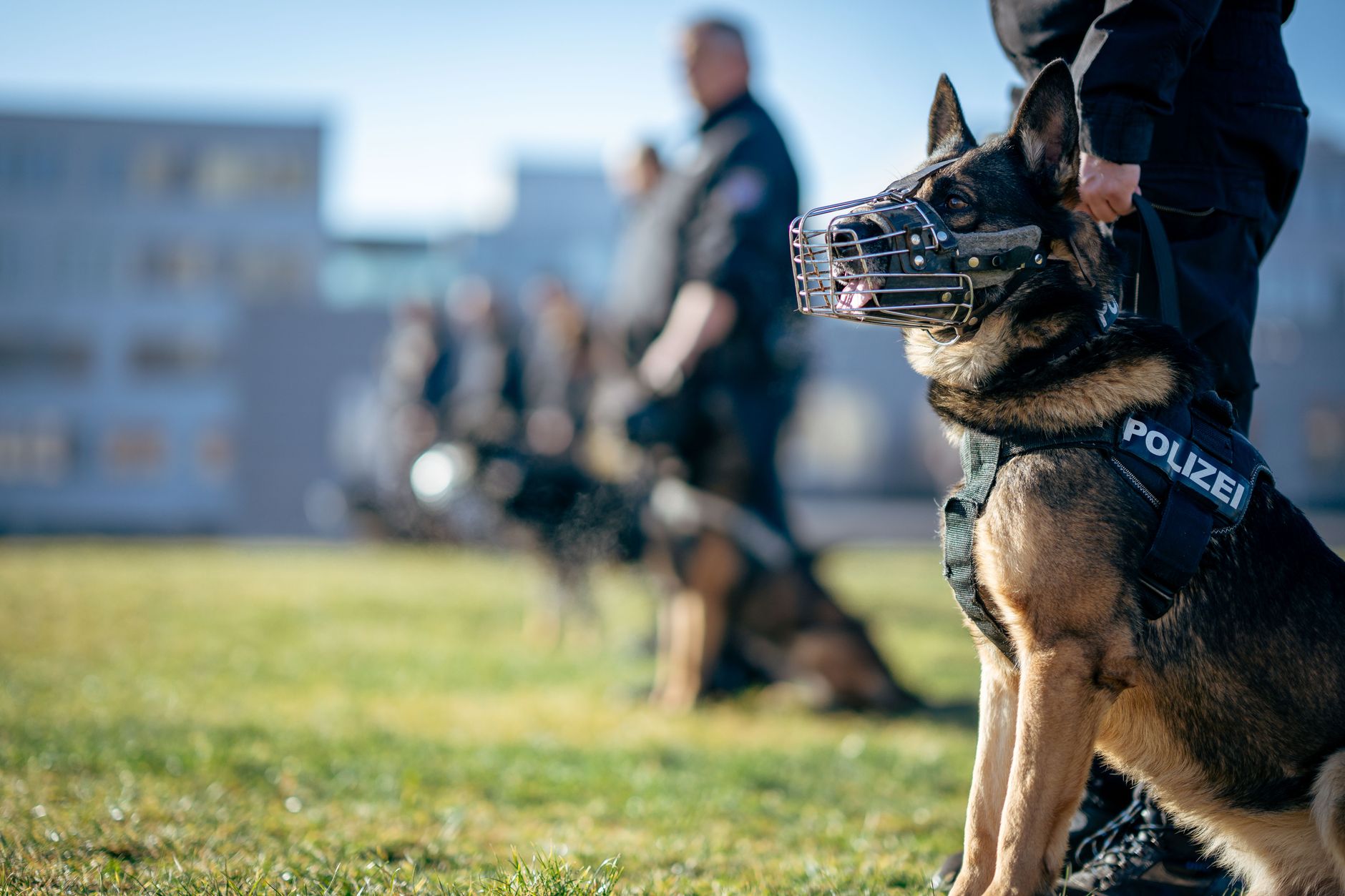
The K9 They Scheduled To Put Down
Sergeant Walt Pruett did not answer my daughter’s question the way she expected. Emily told me later that she had braced herself for a flat no, for the kind of sentence that would have put her on her knees in that parking lot at 6:40 in the morning, still wearing the scrub top she had not changed out of since the night before. Instead he looked at her for a long moment, glanced at his watch, and said, “He’s still in his run. But Rourke walks through that door at eight, and once he’s in his office with his coffee, this is out of my hands. If you want to see that dog before this turns into a decision made by a man on paperwork instead of a man who’s actually looked at him, we need to move now.”
Emily has told me since that she does not remember her own feet carrying her across that lot. She remembers the smell of the kennel building before she ever reached the door, the particular mix of bleach and dog and cold concrete that she says never leaves you once you have worked around animals for a living. She remembers Officer Mia Delgado meeting them at the side entrance with a set of keys already in her hand, not waiting to be asked, because Mia was the one who had called Emily two weeks earlier in the first place, the one who had watched Ranger stop eating and had not been able to stop thinking about it since.
I was not there yet. I want to be honest about that, because this is not a story where I stood shoulder to shoulder with my daughter through every part of it. I was three hours away at my own kitchen table, in the same chair I had been sitting in since her call woke me at eleven the night before, with a cup of coffee gone cold in front of me and my phone lying face up on the table like it might ring itself if I stared at it hard enough. What I know of that morning at the department, I know because Emily told it to me twice, once in pieces over the phone while I was driving to reach her, and once in full that night, sitting on my porch steps with Ranger’s head heavy across both our laps, the same way I imagine she used to sit with him ten years ago after he pulled her out of the river.
I need to go back before I can tell you the rest, because none of what happened in that kennel building makes any sense unless you understand what that dog is to my family, and what my daughter was willing to give up to get to him.
Ten years ago this past spring, I was loading groceries into the bed of my truck at the boat ramp turnout off Route 9, the flat gravel lot everybody in Caldwell County uses when the low bridge floods and the state road gets shut down for the day. It had rained for four days straight that week, the kind of steady gray rain that does not look dangerous until you realize the creek that has been a trickle your whole life has become something with a current in it, something that pulls. Emily was seven. She had wandered off after a barn cat that kept darting along the edge of the bank, the way seven year olds do, certain that the whole world is exactly as safe as it has always been for them, right up until the second it isn’t.
I did not see her go in. I have replayed that morning so many times that I have almost convinced myself I did see it, that I turned around half a second sooner than I actually did, but the truth is I turned around to a sound, not a sight, a splash and then nothing, and then my daughter’s small hand breaking the surface of brown water that was moving faster than any water I had ever watched a child stand near.
A Caldwell County cruiser had pulled up to the flooded crossing at almost the same moment, a young K9 handler named Dale Whitfield checking the water level before he radioed it in as impassable. His dog was two years old, new to the unit, still more puppy than veteran in some ways, still working off pure instinct as much as training. Dale told me later he had not given Ranger any command at all. There was no whistle, no hand signal, no order any textbook would recognize. Ranger simply looked at the water, looked at the small shape struggling in it, and went off the bank in his vest before Dale had finished opening his mouth to call him back.
I watched a German shepherd swim harder than I have ever seen an animal move, angling himself downstream of my daughter so the current would carry her into him instead of past him, and I watched him get his jaws around the collar of her jacket and drag her, both of them coughing, toward a shallow stretch of bank where Dale was already wading in to meet them. By the time I got my own arms around Emily, Ranger was standing over both of us, shaking river water everywhere, refusing to stop licking her face no matter how many times Dale told him to sit. I have never in my life been so grateful for a dog’s disobedience.
Emily was quiet for a long time after that, the way children get quiet after something that big happens to them, and then slowly, over the following year, quiet turned into something else. She started asking Dale if she could come by the department and see Ranger. She started asking me endless questions about what a K9 handler does, what a veterinarian does, whether dogs know they have done something brave or whether they are just doing what feels right in the moment and the rest of us decide to call it brave afterward. By the time she was in high school, she had already decided. She wanted to spend her life on the side of things that save people, she told me once, in exactly those words, and I did not fully understand what she meant until years later, watching her walk across a stage in a cap and gown with a veterinary degree in her hand and Ranger’s old department photo taped inside the cover of the notebook she carried through every single exam.
She built a practice three counties over eventually, a good one, the kind where the waiting room is always a little too full and the front desk is always a little behind. She is good at the parts of the job most people do not see, the late nights, the hard calls with worried families, the surgeries that go long. And every single year, on the anniversary of that morning at the low bridge, she has driven back to Caldwell County with a bag of treats for the department kennel, mostly for Ranger, sitting with him for an hour or two in whatever spare stretch of concrete they had for him, telling him things I doubt he understood a word of and did not need to.
Ranger did not spend the ten years between the river and his retirement resting on that one morning’s reputation, either, though the department would have let him if he’d wanted to. He worked. He tracked a missing eighty-one year old man with dementia two townships over and found him sitting against a fence post half a mile from his own back door, alive because Ranger would not stop pulling at his handler’s sleeve toward one particular fence line long after the search grid on paper said to move on. He did demonstrations at the elementary school every fall, letting a line of eight year olds pet him one at a time while an officer explained bite work and article searches to kids who mostly just wanted to know his name. He worked a dozen ordinary calls nobody wrote articles about, the kind of steady, unglamorous service that does not make the news but is the actual substance of what a working dog gives a county over a decade, one search and one school visit and one quiet, uneventful patrol shift at a time.
Ranger turned twelve this winter. Big shepherds carry weight in their hips that smaller dogs never have to, and his had been going for a couple of years, the way any working dog’s joints eventually go after more than a decade of jumping out of vehicles and clearing fences and doing exactly what Ranger did that morning at the river without stopping to think about what it would cost his body forty years down the line, except a dog’s forty years arrive a great deal sooner than ours do. The department retired him last spring with a small ceremony and a framed photo that got hung in the front hallway for about a week before somebody took it down to make room for a new hire’s certificate. Dale Whitfield had transferred to a department two counties north eighteen months before that, chasing a promotion, and in the scramble of that move nobody formally filed the paperwork that names a retired K9’s ongoing caretaker. Ranger became, on paper, a dog with no assigned handler and no open file, which sounds like a small clerical gap until you understand what it means in practice. It means nobody in that building was responsible for him. It means nobody was required to advocate for him when a decision came down about what to do with an aging animal nobody had budgeted for.
Two weeks ago, Mia Delgado, the kennel officer who feeds and waters every animal that comes through that building, called Emily because she did not know who else to call. She told her Ranger had stopped eating, that he had started snapping, actually snapping, at anyone who touched his back legs, which anyone who has ever loved an old dog will tell you is not meanness, it is pain talking in the only language a dog has for it. She told Emily that a new commanding officer, a captain named Rourke who had transferred in from a much larger department only four months earlier and did not know a single story attached to a single animal in that kennel, had reviewed the roster of dogs with no assigned handler and no active case file, seen a twelve year old shepherd in visible physical decline with nobody’s name attached to his care, and added him to Thursday’s list. The same list used for strays too sick to place. Nobody had called Emily first. There was, on paper, no reason anyone should have. She was not his handler. She was not even, officially, his family. She was a woman who showed up once a year with a bag of treats, and paperwork does not have a line for that.
I have thought a great deal, in the days since, about how much of this world runs on exactly that kind of gap. Not cruelty. Not a villain twirling a mustache and deciding a good dog does not deserve to live. Just a form that never got filed, a handler who moved on, a new captain doing what looked to him like a reasonable and even merciful thing with a folder full of animals he had never met and facts he had never been given the chance to learn.
Emily had four surgeries booked that week. She canceled every one of them by six that evening, called each client herself, personally, and rebooked them with an apology she meant down to the bone. She left her clinic a little after ten at night with a cooler of pain medication on the passenger seat, the kind she would not normally hand-carry across county lines without the right paperwork, and a folder she had spent the last hour of daylight assembling, printouts of every retired K9 disposition regulation she could find, the actual state statutes governing transfer of a working animal to a qualified caretaker in cases of documented medical need. It is 340 miles by the interstate from her clinic to Caldwell County. She did not stop except for gas and coffee, and somewhere around three in the morning she called me from a truck stop, not because she needed anything from me in that moment, but because she said she was scared of what she would find when she finally got there, and she needed to hear my voice say her name before she got back in that car.
That call was the one that woke me. I did not go back to sleep. I sat at my kitchen table in my robe with the porch light on, thinking about a river ten years gone and a dog who had not waited for permission, and by the time the sky outside my window had gone from black to gray, my own coat was already on the hook by the door, keys in the pocket, because I had made a decision somewhere around four in the morning that I was not going to sit at that table for the whole day not knowing. I called Emily back once, told her I was coming, and she did not argue with me, which told me more about how frightened she was than anything else she said that whole night.
Three hours is a long time to drive with nothing to do but think, and I spent most of it back at that river, the way I imagine Emily spent most of her drive somewhere similar. I thought about the sound the water made. I thought about how young Dale Whitfield had looked standing in that current afterward, soaked to the bone, apologizing to me over and over for something that was not his fault at all, and how Ranger had not looked sorry about anything, had looked, if a dog’s face can be said to look like anything, satisfied, like he had simply done the one thing in front of him that needed doing. I thought about all the years since. The birthday treat bags. The photos on Emily’s refrigerator of a dog getting grayer around the muzzle year over year while my daughter got older beside him in the same frame. I thought about how a decade is both a very long time and no time at all, and how a debt like that does not have an expiration date printed anywhere, even if a county form does.
Emily filled in the rest for me piece by piece while I was still an hour out, texting when she could, calling twice when she had a spare minute standing in a hallway. Mia walked her back to the kennel run before the building had officially opened for the day, technically against the posted visiting hours, and did it anyway because she said afterward that some rules exist to be broken by the person who cares enough to break them. Emily told me Ranger heard her before he saw her. His head came up off the concrete floor of his run and his whole body went rigid, ears forward, nose working, and then he was on his feet despite hips that clearly did not want him to be, crying, an actual high broken sound Emily said she had never heard him make even as a puppy, throwing himself against the chain link hard enough that Mia had to steady the gate before she opened it. Emily went down on her knees on that concrete in her scrub pants and let a twelve year old shepherd who could barely stand knock her flat onto her back, and she stayed down there with him for a long time, she said, not saying anything at all, just letting him press his whole graying face into her neck the way he used to when she was seven years old and soaked to the skin on a riverbank.
She did not waste the moment, though. That is the part of my daughter I am proudest of. Even flat on her back on a kennel floor with an old dog crying into her collar, she was already working, running her hands down his back legs the way she has run her hands down a thousand dogs’ back legs in her career, feeling for the specific pattern of muscle wasting and joint swelling that tells a trained vet exactly how much pain an animal has been quietly carrying and for how long. She had brought the medication for exactly this. She drew it up right there in the kennel, talking to him low and steady the whole time the way she talks to every frightened animal on her own table, and within twenty minutes Emily said she watched something in his whole body ease, watched him settle onto the concrete with his head in her lap instead of pressed rigid against the fence, the first real rest Mia said she had seen him take in days.
That was the scene Captain Rourke walked into a little after eight o’clock. A veterinarian in scrubs sitting cross-legged on his kennel floor with a department K9 sedated and calm in her lap, a folder of state statutes open beside her, and his own night sergeant standing at the gate with his arms crossed, having clearly decided which side of this he was on before his captain ever arrived.
Emily told me Rourke was not unkind about it, not at first, and she wanted me to understand that, because it would have been easy to make him the villain of this and he was not, not really. He was a man four months into a new command with a stack of policies he had inherited and no context for any of the individual animals attached to them. He told her, evenly, that Ranger was department property, that there was a process for transferring custody of a retired working animal, that he could not simply hand a K9 over to a member of the public standing in his kennel building uninvited, folder or no folder. He said it the way a man says something he has said a hundred times before at a different department, about a different set of rules, and Emily said she could see in his face that some part of him already suspected this particular case did not fit the shape he was used to.
She did not raise her voice. She told me that surprised her about herself, given how little sleep she had, but she said something in her went very calm and very clear the second he started talking about process. She opened the folder and showed him the state statute governing early release of a working animal to a licensed veterinary caretaker on documented medical grounds, which she had underlined twice the night before. She told him her name and her credentials and the name of her clinic. And then she told him about a flooded low bridge on Route 9 ten years ago, and a two year old K9 who went off the bank without a command, and a seven year old girl who grew up to become exactly the kind of caretaker the statute in front of him was written to allow.
Sergeant Pruett spoke up then, unasked, and told his captain flatly that every officer who had worked that building more than three years knew this dog’s story, that it was the reason half the rookies who came through asked to meet him their first week. Mia said something too, quieter, about the medical records she had been keeping informally for months, the ones showing exactly how long Ranger had been declining with nobody’s name on his file to answer for it. And then, Emily told me, other people started arriving for the morning shift and stopping in the hallway outside the kennel, drawn by the sight of a captain standing over a crying dog and a stranger in scrubs, and word of what was happening moved through that building fast enough that by the time Rourke had finished reading the statute himself, there were six or seven officers standing in the doorway, not saying anything, just watching, the way people do when they can feel a decision being made that matters more than the paperwork attached to it.
One of the older officers standing in that doorway, a patrol veteran named Curtis who had been on shift the morning of the river ten years earlier, spoke up too, telling Rourke plainly that he had stood on that bank himself as backup and watched a two year old dog do something no amount of training could have guaranteed, and that if the department could not find a way to take care of that same dog now that his body had finally failed him, then every ceremony and every framed photo the department had ever hung in that hallway did not mean a thing. Emily said the room went quiet after that in a different way than it had been quiet before, the kind of quiet where everyone is thinking the same thought and nobody wants to be the one who has to say it out loud.
Rourke read the statute twice. Emily said she watched something shift in his face somewhere in the second reading, the moment he stopped looking at a policy problem and started looking at an old dog with his head in a stranger’s lap who was, by every account in the room, not a stranger to that dog at all. He asked her one more question, whether she understood the liability she’d be assuming, the ongoing cost of care for a dog with his level of joint deterioration, and Emily told him she had already priced out a surgical consult and had the money set aside before she ever left her clinic the night before, because she had known the answer to that question before she asked it of herself.
He stepped out into the hallway to make a call. Nobody in that kennel room said much of anything while they waited, Emily told me, except that Mia sat down on the concrete next to her and put a hand on Ranger’s flank without a word, and Sergeant Pruett refilled his coffee cup twice out of pure nervous habit and did not drink any of it.
When Rourke came back in, he had a form in his hand, already partially filled out, a medical-needs disposition release that he told Emily existed exactly for situations that fell through the gap between a handler transfer and a routine retirement, a gap he admitted plainly he had not known Ranger had fallen into until that morning. He apologized to her, not performatively, she said, but like a man actually working through what he had almost let happen without knowing it. He signed the release standing right there in the kennel, and then, because somebody in that hallway suggested it and nobody argued, they walked Ranger’s retired tag and collar tag over from the front case where it had been sitting since his retirement ceremony, and Rourke himself knelt down on that concrete floor and clipped it back onto Ranger’s collar, the collar he had worn for ten years of service, before Emily led him, slow and stiff-legged but upright, out of that kennel for the last time.
I pulled into that parking lot a little before nine, having driven the last forty miles faster than I probably should have, and I will tell you honestly that I did not recognize the scene in front of me at first. A dozen or so officers were standing in a loose half circle near the side door, several of them still in uniform from the overnight shift, and in the middle of them, on the pavement, was my daughter on her knees again, this time with an old graying shepherd standing over her instead of collapsed against her, his tail moving in slow, careful sweeps like even that cost him something. I got out of my car and Emily looked up and saw me, and the two of us met in the middle of that lot the same way we had met on a muddy riverbank a decade before, except this time nobody was coughing up water and nobody was afraid.
Ranger recognized me too, or recognized something, some scent from all those years of birthday visits, because he pushed his head into my hands the same patient, deliberate way he used to when Emily was small, and I stood there in a parking lot full of officers I had never met, crying in a way I had not let myself cry the whole three hour drive, with my hand on the same dog who had once pulled my daughter out of a river with his own jaws.
Sergeant Pruett had thought to bring out a padded dog bed from somewhere in the building, and between the three of us, Mia included, we got Ranger settled across the back seat of Emily’s car as gently as his hips would allow, with the cooler of pain medication now doing exactly the job it had been packed for. Rourke walked over before we pulled out, and he shook Emily’s hand and then, a little awkwardly, mine, and told us he would be updating the department’s retirement transfer policy that same week so no other dog fell through the same crack. I believed him. I still do.
Emily and I drove the three hours home together in two cars, hers with Ranger stretched carefully across the back seat, mine trailing behind, and we stopped twice more than we needed to, once so she could check on him and once because I think we both just wanted an excuse to see for ourselves, again, that this was real and not something we would wake up from. By the time we pulled into my driveway that afternoon, the light had gone soft and gold the way it does in early evening out here, and Ranger walked himself, slow but steady, right up my porch steps and through my own front door like he already knew the way, and lay down on my kitchen floor in the exact spot of afternoon sun I keep meaning to move the table out of.
That is where he is right now as I write this, stretched out across my kitchen tile with his graying muzzle resting on his paws, worn out in the particular way of an animal who has just been given back something he had already stopped expecting. Emily has him scheduled for a full orthopedic consult next week, and she has already told me, in the plain, steady voice she uses when she has decided something and does not intend to be talked out of it, that whatever his hips need, surgery, medication, a ramp built onto every set of steps he will ever climb again, he is going to have it, for as long as he needs it, for the rest of whatever years are left to him.
Dale Whitfield called Emily’s cell phone that same evening, having heard about the whole morning from Sergeant Pruett secondhand, and Emily put him on speaker so I could hear him too. He did not say much at first, and when he finally did speak his voice was not entirely steady. He told her he had thought about that dog every single day since he transferred out, had meant a dozen times to file the paperwork that would have kept his own name attached to Ranger’s file even from two counties away, and had let it slide every one of those times because there was always something more urgent in front of him. He said he was not going to let that happen again, and that he intended to drive down himself the following weekend, off duty, just to sit on somebody’s porch with the dog he had once trusted enough to follow off a riverbank without giving him a single command. Mia told Emily a few days later that Rourke had the old retirement photo reframed and rehung in the front hallway of the department, this time with a small brass plate beneath it listing the date of the river rescue alongside his years of service, and that he had personally seen to it that no dog’s file in that building would ever again sit unclaimed the way Ranger’s had.
I keep thinking about that morning ten years ago, about a dog who did not wait for a command before he went into the water after my daughter, and about a morning three hours away and years later when my daughter did not wait for anyone’s permission either, before she went and got him back. Some debts, I have come to believe, are not the kind you settle with paperwork. They are the kind you drive all night for. Ranger is asleep on my kitchen floor tonight, home, and safe, and loved by exactly the people he saved, and that, as far as I am concerned, is the only ending this story was ever going to have.
This story is a dramatization. Names, characters, and details are invented, and any resemblance to real people or events is coincidental.