
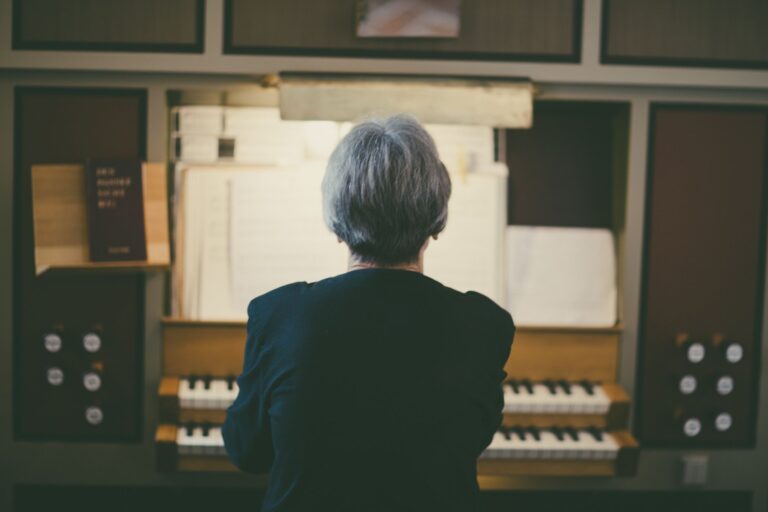
My name is Marilyn. I am fifty five years old, and for thirty one years I have climbed the same eleven steps into the choir loft at Amity Baptist every Sunday morning of my adult life, robe over my good dress, alto folder in my hand. I have sung there through three pastors, two floods, one tornado that took the roof off the fellowship hall in 2003, and every funeral this small town has held in a generation. I thought I understood what that loft could hold. I did not know, until three weeks ago, that it could also hold a silence loud enough to change a man.
This is the rest of what happened after that silence, because a hallway is no place to tell it, and I promised I would tell it right.
My mother, Norma, spent most of her married life with an iron in her hand that was not her own. She took in other people’s shirts and tablecloths and good linen napkins for weddings, pressing them on the same board in our kitchen where she rolled out biscuit dough, and she kept the money in a coffee can on top of the icebox that my father was under strict instructions never to touch, not even the week the tractor broke down and we were short for seed corn. That can was hers. She was saving it, she told us, for something the family would remember longer than a tractor part.
In the winter of 1974 she carried that coffee can, and two more just like it that she had filled and emptied and refilled over six years of other people’s laundry, into a piano store forty minutes from here, and she came home with a spinet piano, cherry finish, a little scratched already on one leg from the delivery truck, and she set it in our front room like she had just brought home a fourth child. She played it every evening after supper for the rest of that year. Hymns mostly, a little Chopin she had learned as a girl and never quite forgot, and “Down in the Valley” for my father, who could not carry a tune in a bucket but liked to hum along anyway with his eyes closed in his chair.
My father died that same year, in October, of a heart that gave out in the middle of combining beans, and the men found him still sitting upright at the wheel like he had just decided to rest a minute. I was three years old and do not remember the funeral itself, only what my mother told me about it for the rest of her life, which was that she stood in our front room the night before the service, looking at that piano, and she made up her mind about something.
She did not want it sitting in a front room where nobody but our family would ever hear it again. She wanted it doing the work it was built for.
The week she buried my father, my mother arranged for three men from the church’s men’s fellowship, men who are themselves buried in the cemetery behind Amity Baptist now, to carry that spinet piano up the church’s front steps and into the sanctuary, and she told the pastor at the time, a man named Brother Aldous who has been gone almost as long as my father, that the piano was not a loan and it was not a gift with strings on it. It was Amity’s now, plain and simple, and it would outlive every one of them. My mother was not a woman given to grand pronouncements. She said that one sentence and then she went home and finished pressing a stack of shirts that were due back Friday, because grief did not pay the bills and neither did a piano nobody else could hear.
She was right about it outliving them. She played the offertory on that piano every single Sunday for the next four decades, through my growing up, through my own wedding at the front of that same sanctuary, through the births of my two children and the slow accumulation of grandchildren who called her Meemaw and fought over who got to sit next to her on the bench during Wednesday choir practice. Arthritis started stealing her hands in her seventies, first just stiffness in the cold months, then knuckles that would not close around a doorknob, let alone a chord. She kept playing past the point most people would have quit, simplifying the hymns down to their bones, one note where there used to be three, because she said the congregation did not need her to be fancy, they needed the tune to start on time.
She played her last offertory the spring before she died, four years ago this coming September. By then her hands could manage maybe eight bars before they cramped, and Dot, our choir director, would ease onto the bench beside her without a word and finish out whatever hymn my mother had started, so that nobody in the pews ever quite knew where Norma’s playing ended and Dot’s began. That was its own kind of mercy, the whole choir loft closing ranks around an old woman so she never had to hear anybody say out loud that her hands were done.
When she died, she had already told me, more than once, exactly what she wanted and did not want. No open casket, she said. She did not care for the idea of people filing past looking at her hands, the same hands that had ironed and played for fifty years, folded still in a box. What she wanted instead was for the choir to stand around her piano and sing “Blessed Assurance,” which had been her favorite hymn since she was a girl, and let that be the way the town said goodbye to her. Dot arranged it exactly that way. All fourteen of us stood in a half circle around that piano in the sanctuary, my mother’s photograph propped on the closed lid where her hands used to rest, and we sang every verse without a single instrument behind us, because none of us could bring ourselves to touch the keys that day. I have never in my life heard a room hold that much love and that much grief at the exact same volume.
That is the piano Neil sold for four hundred dollars.
Neil came to us in the spring of this year, after our previous pastor retired to be closer to his grandchildren in Missouri. The search committee brought him in for two Sundays of preaching and a potluck, and by the second Sunday half the church had already decided. He was thirty one years old, easy with a joke, quick to learn everybody’s name and remember it the following week, and he talked in his interview about growing the youth group, which had shrunk to four teenagers rattling around a fellowship hall built for forty, and about fixing the gutters and the flashing on the sanctuary roof, which everybody agreed had needed attention since before the old pastor left. The search committee called him a breath of fresh air. I did not disagree with them. None of us did.
Get a new story in your inbox every morning.
Facebook doesn’t show you every story we post. Our free newsletter does. Join 2,500+ readers.
He settled in fast. He started a Wednesday night youth pizza night that actually brought kids in. He learned to run the sound board himself instead of waiting on whoever showed up. And every single Sunday, standing at the front to lead the announcements before the service properly started, he would rest one hand flat on the closed lid of my mother’s piano, the way a man rests his hand on a fence post or a truck hood, some object he considers steady and his own, and he would lean into it while he talked about the potluck signup sheet or the youth car wash. I noticed it the way you notice a small thing you decide not to mention. It was just a piano to him. It had always just been a piano to him. I understand that now in a way I did not understand it three weeks ago, and understanding it does not excuse what he did, but it explains the shape of the mistake.
I came in early on a Wednesday morning three weeks back to set out the choir folders for evening practice, the way I have done a thousand Wednesdays before that one, and something about the loft was wrong before I could even say what. Too much light coming across the floor where there should have been a shadow. Too much open carpet. It took me a full three seconds standing in the doorway to understand that the piano was gone, and in its place was a bare rectangle pressed into the carpet fibers, flattened dark by forty years of a piano’s weight, the precise outline of where my mother’s instrument had stood since before I could walk.
I stood in that doorway a long time. I did not call out. I did not cry, not yet. I walked over and knelt down on that empty rectangle and put my hand flat against the carpet the way Neil put his hand flat against the lid every Sunday, and I felt nothing but flattened fiber and the cold of the floor coming up through it, and I understood in my body before I understood it in my head that something had been taken from this church that no insurance policy would ever replace.
I found the church secretary in the office before I found Neil, because some part of me was afraid of what I already knew Neil would say, and I wanted one more minute of not knowing for certain. She told me it went to a piano and organ dealer over in the next county, sold for four hundred dollars, no vote taken by the congregation, no notice posted on the bulletin board where every other piece of church business gets posted, not even a mention at the last business meeting I had personally attended not three weeks before. She looked almost as unsettled telling me as I felt hearing it, and she said Neil had handled it himself, quietly, the way you handle something you have already decided does not require anybody else’s opinion.
I found Neil in the hallway outside his office a few minutes later. I asked him straight out, no preamble, whether it was true. He said yes, plainly, no hesitation in it at all, and he told me the roof flashing needed repair before winter set in and water started getting behind the shingles into the sanctuary ceiling, and the piano, in his words, was an underused asset the church could no longer justify keeping silent six days out of seven when the building had real, pressing needs. He said it so evenly. Like he was reading a line off a budget spreadsheet instead of telling a woman that her dead mother’s piano, the one she carried up these very steps with three men the week she buried her husband, was gone to a dealer forty minutes away for less money than most people spend on a used refrigerator.
I did not raise my voice. I have never been a woman who raises her voice in a church hallway, and I was not about to become one that morning. I told him I needed to go, and I went home, and I sat at my kitchen table for a long while before I picked up the phone.
I called Dot before I called anybody else, because Dot has directed this choir for going on twenty years and there is nobody alive who understands what that piano meant to this loft better than she does. I did not even finish my sentence. I got as far as “Neil sold Mama’s piano” and Dot said, flat and certain, “We are not singing Sunday,” and that was the whole conversation. No debate. No committee. Just two women who had stood around that instrument four years earlier singing a woman home, deciding in under a minute that we were not going to stand in that loft and sing like nothing had happened.
Nobody called a meeting. Nobody wrote anything down. It moved through the choir the way water finds a crack in a foundation, one phone call leading to the next, Dot calling two women, those two calling two more, until by Saturday night all fourteen of us knew exactly what we intended to do on Sunday morning and exactly what we did not intend to announce ahead of time. There was something almost holy in how quiet that agreement was. Fourteen women who had spent decades harmonizing four-part hymns without ever once needing a director’s downbeat to know when to come in together, coming together on this the very same way, without a single meeting, because we had been rehearsing this kind of unspoken understanding for years and just never had a reason to use it for anything but music.
A few of the women wanted to say something to Neil directly before Sunday, warn him, give him a chance to make it right before it ever became a scene in front of the whole congregation. I understood the impulse. I did not agree with it. My mother spent fifty years letting her hands do the talking on that instrument, one note at a time, never raising her voice about anything either, and it seemed right to me that the loft say what it needed to say the same way she always had. Not with a phone call. With silence, where a sound was supposed to be.
Sunday morning we walked up into that loft in our robes, same as every Sunday for thirty one years for me and far longer than that for some of the others. Neil opened the service with announcements same as always, and I watched his hand come up out of habit and rest against air, an inch above where the piano lid used to sit, before he seemed to remember, mid-sentence, that there was nothing there to rest it on anymore. He recovered smooth enough that I doubt anybody in the pews caught it. I caught it. I have thirty one years of watching that loft and that front of the sanctuary, and I caught every flicker that crossed his face that morning before he had any idea what was coming.
He nodded for the choir to rise for the opening hymn, the same small nod he gives every single week, and we rose. All fourteen of us stood up straight in that loft, robes buttoned to the collar, hymnals closed and held in both hands the way you hold something you have decided not to open, and none of us made a sound.
Our organist looked up from the bench, confused for half a beat, and then understanding arrived on her face all at once, and she took her hands off the keys and let the introduction die out into nothing. The whole sanctuary went quiet in that particular way a room goes quiet when two hundred people understand, all at the same moment, that something is happening that was not on the bulletin. I have sat and stood in that sanctuary my entire adult life and I have never once heard it go that silent, not during a moment of silence for the departed, not during the longest pastoral prayer anybody ever prayed. It was a silence with a shape to it.
I watched Neil’s face change from where I stood in the front row of the loft. Surprise first, plain and unguarded. Then something like a search, his eyes moving fast across all fourteen of us, arms folded, mouths shut, trying to read what this was and coming up, for the first time since I had known him, without a ready answer. And then, slowly, I watched his eyes drop from our faces down to the floor at the front of the sanctuary, to that bare rectangle of flattened carpet where the piano used to stand, the one I had knelt on three weeks before with my hand pressed flat against the fibers, and I watched him see it, truly see it, the way I do not believe he had ever let himself see it before, not as an empty patch of floor but as a wound with a shape.
Somebody in the third pew stood up. Then two more, further back, an older couple who has sat in that same pew for as long as I have sung in that loft. I heard a woman behind them start to cry, quiet at first and then not quiet at all, and nobody hushed her, because I think half that congregation understood exactly what those tears were about even if they could not have named it out loud.
We stood like that through the entire hymn, silent, while the organist sat with her hands folded in her lap and the congregation stood or sat in a silence of their own, uncertain which one honored us more, and Neil stood at the pulpit with his hand still hovering an inch above nothing, and I have sung in that loft for thirty one years and I have never felt a room say so much without a single one of us opening our mouths.
When the hymn’s silence finally ran its course, Dot gave the smallest nod, and we sat down in our chairs the way we do every Sunday, robes settling around us, and the service went on. We did not refuse the rest of it. That was never the point, and every one of us had agreed on that much beforehand even without saying it in so many words. We were not there to punish the congregation, who had done nothing wrong, or to turn a Sunday morning into a siege. We stood our silence exactly once, for exactly one hymn, to say the one thing that needed saying, and then we let the rest of the service belong to the people who came to worship. We sang the closing hymn in full voice, the way we always do, four parts locking together the way they have locked together for decades, and if anybody in those pews found that whiplash strange, singing full-throated an hour after standing silent, I think most of them understood it anyway. Grief does not cancel worship. It just insists on being heard somewhere inside it.
Neil got through the rest of the service. His sermon that morning, on the parable of the lost coin, of all things, came out a little rougher than usual, a few sentences trailing off before he found his footing again, and more than once I watched him glance up at that empty rectangle of carpet like it had become impossible for him not to.
After the benediction, while most of the congregation filtered out toward the fellowship hall for coffee, Neil came up the side stairs into the choir room where we hang our robes, and he did not come in with any of the smooth, easy manner that had carried him through five months of announcements and potlucks. He stood in the doorway a moment before he came all the way in, and he asked, quiet, if he could talk to us. All of us. Not just Dot, not just me.
He did not defend himself first, and I want to say that plainly, because I had braced myself for the roof flashing and the underused asset language all over again, and it did not come. What came instead was a question. He asked us to tell him what he had not understood. Not what the piano cost, not what it looked like on the church’s books, but what it was, in plain terms, to the people standing in that room.
So I told him. I told him about the coffee can on the icebox and six years of other people’s laundry. I told him about the week my father died and the three men from the fellowship who carried that piano up the very steps he walks up every Sunday. I told him about forty years of my mother’s hands on those keys, about arthritis stealing them a note at a time, about the spring four years ago when her hands finally stopped and Dot’s hands quietly finished what hers started so the congregation never had to watch her stop in front of them. And I told him about the day we buried her, no casket for people to file past, just fourteen women standing in a half circle around that instrument singing “Blessed Assurance” because that was the one thing she asked us for.
I watched something happen in his face while I talked that I had not seen in five months of knowing him. He did not interrupt. He did not reach for the spreadsheet language again. When I finished, he was quiet long enough that the silence in that small robing room started to feel like its own kind of answer, and then he said, low, that he had known the piano was old and that it belonged to the church, but that nobody had ever told him it belonged to a family, to a specific woman, to a specific week of grief, because in his mind an object like that was either serving the church’s mission or it was not, and nobody had shown him the difference between an asset and an inheritance.
He told us the roof money had not even come through the way he’d hoped. The flashing contractor’s real estimate had come back at nearly ten times what the piano sale brought in, so the four hundred dollars sat untouched in the maintenance fund, the repair still not scheduled, which meant, in his own words, that he had sold a piece of this congregation’s history and gained nothing lasting for it in return. He said that sentence like it cost him something to say out loud, and I believe it did.
He asked for time. Not forgiveness yet, he was careful about that, he did not ask us to forgive him on the spot in a robing room still warm from a Sunday service. He asked for time to try to make it right, and he asked me, specifically, where the dealer was.
I did not expect him to drive out there himself. I found out later, from the church secretary, that he left first thing Monday morning, before office hours, in his own truck, and drove the forty minutes to the piano and organ dealer in the next county without telling anybody but her where he had gone.
The dealer, a heavyset man near seventy who has run that same shop out of a converted feed store for better than thirty years, still had the piano. Upright pianos, it turns out, do not move the way people assume they do. They sit in showrooms for months. But he told Neil, when Neil finally worked up to explaining why a young pastor had driven forty minutes on a Monday morning looking half sick about a four-hundred-dollar spinet, that a couple from two towns over had come by just the week before and put a hold on it, meaning to use it as a decoration piece for a wedding-venue barn they were converting out past the highway, and that hold was due to be finalized with a deposit by Thursday.
Neil told the dealer the whole story standing right there in that shop. The coffee can. My father. The three men carrying it up the steps. Forty years of Sunday offertories and a funeral with no casket. He told me later he had not planned to say any of it, that he had gone in meaning only to ask the price, and the whole story had come out of him anyway because by that point it had become the only way he knew how to explain himself.
The dealer heard him out, and then he did something Neil did not expect and did not ask for. He said he was not going to make a second profit off a piano that clearly should never have left the building it came from in the first place, and he told Neil he could have it back for exactly what he had paid the church for it. Four hundred dollars, not a dollar more, and the dealer would call the couple with the wedding-barn plans himself and explain the hold was off, no hard feelings owed on either side.
Neil paid it out of his own pocket that same morning, not out of the church’s maintenance fund, not out of any collection plate. He told me afterward that after what he had done, taking church money to fix his own mistake felt like it would only compound it, and that this one, at least, needed to come out of what belonged to him and nobody else. He arranged for the dealer’s truck to bring it back Thursday afternoon while the sanctuary sat empty, and he called two men from the fellowship, the same men’s fellowship whose predecessors carried that piano in the week my father died, and asked them to help him carry it back up those same front steps.
He had it tuned before Sunday too, out of his own pocket again, by a piano tuner who drove in from two counties over and told Neil, working over the keys that afternoon, that a piano this well built and this well loved does not go out of tune easily, it just goes quiet when nobody plays it, which is a different thing entirely, and closer to the truth than the tuner probably realized he was speaking to.
We did not know any of it until we walked into the sanctuary the following Sunday morning.
I came in early again, same as always, to set out the choir folders, and this time the loft was wrong in the opposite direction. The light fell the way it was supposed to fall. The bare rectangle in the carpet was gone, covered again by the shape it had been covered by for forty years, cherry finish a little scratched on one leg the way it had always been scratched, sitting exactly where my mother left it. I stood in that doorway again, the same doorway, and this time I did cry, right there before a single other soul had arrived for the service.
Neil was already in the sanctuary when I came down, standing near the piano, not touching it, just standing near it the way a man stands near something he has decided to earn the right to touch rather than simply claim. He told me he had been there since before dawn. He did not say much else to me that morning. I think he wanted the rest of the church to see it the same way the choir had, all at once, without him standing at the pulpit narrating his own redemption before anybody else had a chance to feel it for themselves.
When the whole choir arrived and saw it, there was a good deal of noise in that robing room that had nothing polite about it, women crying and laughing at the same time, Dot pressing both hands over her mouth the way you do when a feeling is too big for your face to hold by itself.
Neil opened the service that morning differently than he ever had before. He did not lead with announcements. He stood at the pulpit, looked out at a congregation that had watched a choir go silent one week and now sat wondering what this next Sunday held, and he told them, plainly, without any of the polish I had grown used to in his announcements, that he had made a decision five weeks earlier that he had no business making alone, that he had sold something that was never fully the church’s to sell in the spirit he sold it, because it belonged just as much to a woman’s memory and to thirty one years of this choir’s Sunday mornings, and that he was sorry, not in the careful pastoral way men in his position sometimes learn to be sorry, but plainly, the way you are sorry to a person and not to a room.
He told them where the piano had been for three weeks and how it came home, the drive, the dealer, the hold that nearly cost us the chance to get it back at all. And then he announced, right there, that from that morning forward, nothing in that sanctuary that carried a family’s name and a congregation’s history would ever again be sold, moved, or given away without it coming before the whole church body first, in the open, on the bulletin board where such things belong. He asked Dot and me, in front of everyone, if we would be willing to serve on a small committee to help him understand, going forward, which pieces of this old building carried that kind of weight, so a mistake like this one never happened to somebody else’s mother’s piano the way it happened to mine.
Then he did something I did not expect and had not been told to expect. He asked if I would play the offertory.
I have not sat down at a piano in front of a congregation since I was a girl taking lessons from a woman two farms over who charged fifty cents a week. My mother was the piano player in our family, not me. But she did teach me, patient afternoons at that same instrument when I was young enough to still be more interested in the birds outside the window than the scales in front of me, and some of it stayed in my hands even after forty years of mostly singing instead. I had not touched those keys once since the day we sang her home around them, because I was not ready, and grief has its own schedule that does not answer to anybody else’s calendar.
I was ready that morning. I do not know exactly why that particular Sunday and not some other one, except that maybe watching a piano come home teaches a person something about what it means for a thing, or a person, to finally be ready to be touched again.
I sat down on the same bench my mother sat on for forty years, my hands a good deal less certain than hers ever were, and I played “Blessed Assurance,” the same hymn we sang standing around that piano the day we buried her, the same hymn she chose herself because she trusted it to carry more than any eulogy could. I got through it slower than she ever would have, and I hit at least one wrong note in the second verse that I am fairly sure only Dot caught, and it did not matter one bit. The choir stood up behind me without anybody cueing them, and they sang every word, full voice, the way we always sing when the loft has nothing left to say in silence and everything to say out loud, and I played for my mother, and I think, in whatever way these things reach the people we have lost, she heard it.
The piano still sits where it has sat since 1974, minus three weeks that none of us who love it will ever forget. Neil still leads the announcements every Sunday, and I have noticed he no longer rests his hand on the lid the way he used to, out of habit, like it was simply furniture that happened to be his to lean on. Now he touches it different. Careful. The way you touch something you have learned costs more than its price tag says, and are grateful, every single week, to still have standing in the room.
I do not know that I would call what happened between Neil and this choir forgiveness exactly, not in the quick, easy sense some people mean by that word. It was slower than that, and it cost him something real to earn it, a drive and a dealer’s grace and four hundred dollars out of his own pocket and a public accounting in front of the whole congregation that could not have been comfortable for a man not yet forty who still had to lead these same people the following Sunday and every Sunday after. But I have come to believe that is exactly what real forgiveness costs somebody, on both sides of it. It is never free, and it is never quick, and it very rarely announces itself with words at all.
Most Sundays, it starts the same way ours did. With a room full of people deciding, together and without a single meeting, that some silences say more than any argument ever could, and trusting that the right person, given enough time and enough love shown to him plainly, will finally look down and see the shape of what is missing.
This story is a dramatization. Names, characters, and details are invented, and any resemblance to real people or events is coincidental.