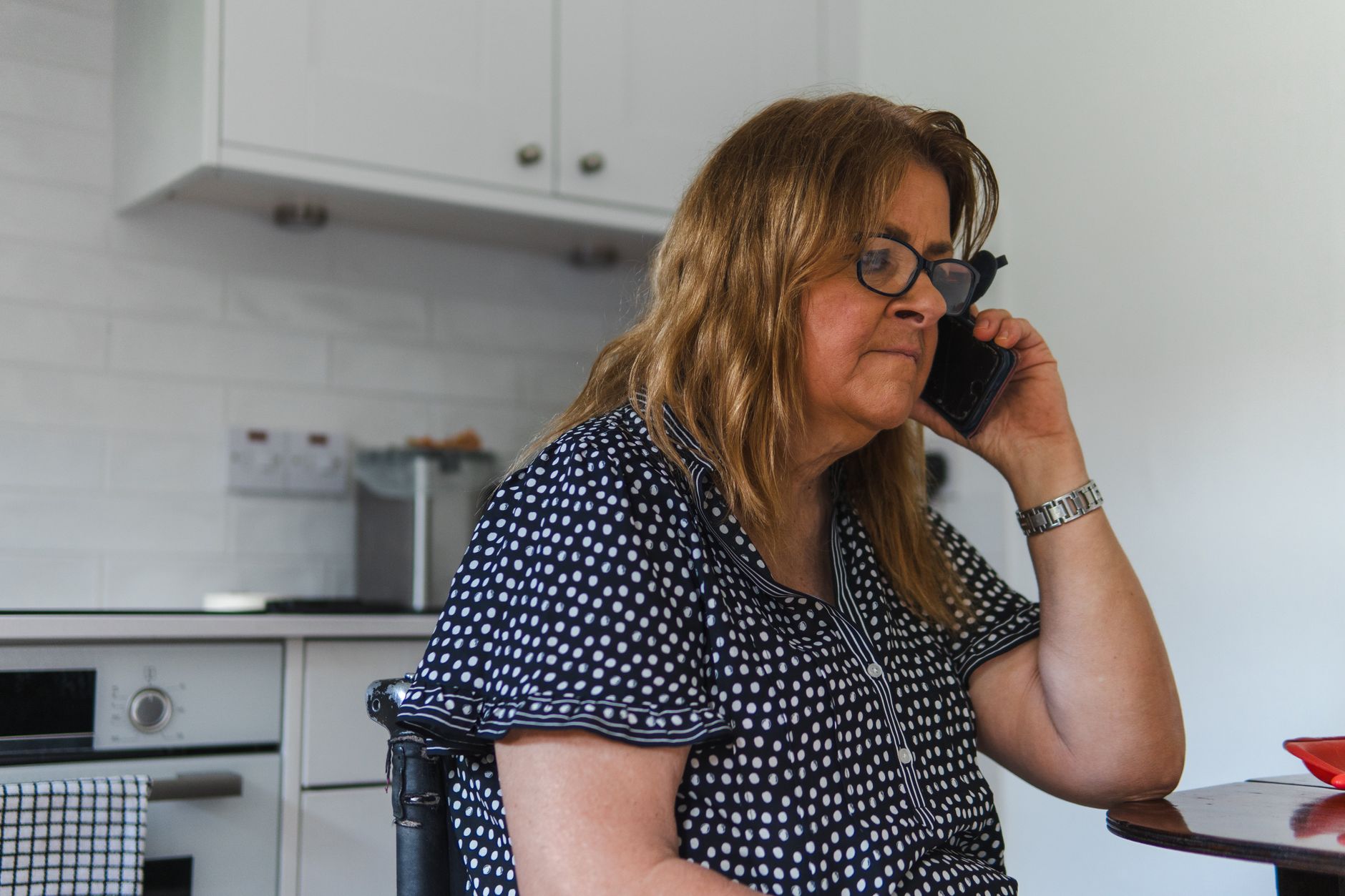
The Account Grandma Had Already Closed
I heard the boys before Aaron even said hello. That is the first thing I want you to understand, because it tells you everything about how the next ten minutes went. A phone held out at arm’s length in a dorm room does not stay quiet. I heard the creak of somebody’s desk chair. I heard a can of something crack open. I heard a voice, not Aaron’s, say “shut up, shut up, she’s gonna hear you,” which of course meant I already had.
Then Aaron came on the line, too bright, too fast, the way he gets when he wants something and thinks his grandmother has not noticed a pattern in nineteen years of watching him want things. “Grandma, hey, quick thing, the bank called about fraud on your account and they need you to read off your PIN so I can verify it for you.”
I want to walk you through exactly what I did with that sentence, because I turned it over in about a second and a half, and every part of it failed the test.
Banks do not call about fraud and then ask you to read your PIN over speakerphone to your grandson. Banks do not need a nineteen-year-old to “verify” anything for a woman who has held her own checking account since Lyndon Johnson was president. And if there really had been fraud, the last person who’d need to hear my PIN read aloud, digit by digit, is a boy with five sets of ears in the room behind him.
I have sat through enough of those AARP seminars at the community center, the ones with the laminated handouts about grandparent scams, to know the shape of this call cold. I have gotten the real version of this call twice myself, from strangers with fake urgency in their voices claiming to be a lawyer holding my grandson in a Tijuana jail cell, and I hung up on both of them inside of thirty seconds. I know the shape.
But this was not a stranger’s voice. This was Aaron’s voice, cracking a little at the edges the way it still does sometimes when he is nervous, the same voice that used to ask me to check under his bed for monsters, and underneath the dumb, harmless little scheme he and his friends had cooked up, I could hear exactly what it actually was. Not a threat. A dare. Five boys in a dorm room on a Tuesday night, somebody had said “I bet you can’t get your grandma to read you her bank PIN,” and Aaron, God love him, had picked up the phone to try.
So I did not say any of what I knew. I said, “Oh, honey, let me find my card,” in the softest, most rattled voice I own. I have used that voice exactly twice before in my life, both times on telemarketers who had it coming, and I want it on the record that it is a truly useful voice to keep in your back pocket at seventy years old. People stop listening to you the second you sound confused. That is not an insult. It is a tool, and I have learned to use it the way I learned to use a torque wrench on Frank’s truck after he passed, because nobody else was going to hand it to me.
Here is what none of those boys, crowded around Aaron’s phone in a dorm room three hours away, had any way of knowing. That very morning, before the sun had even burned the frost off my porch railing, I had driven myself into Millhaven, parked in my usual spot outside the bank on Main Street, and closed that account for good.
Nothing dramatic. I had been meaning to do it for two years. Nancy, who has worked the second window at First Millhaven since before Aaron was born, had been after me to move my money into an account that actually pays real interest instead of the ancient one I opened back when Frank and I bought our first refrigerator on layaway. “Judy,” she’d say every time I came in to deposit a check, “you are sitting on money that is doing nothing for you.” I would nod and go home and not do it, because forty-one years of balancing that same checkbook by hand had made me fond of it in a way that did not make a lick of financial sense.
But that Tuesday I finally did it. I sat across from Nancy at her little desk with the silk plant nobody waters, and I signed the last of the paperwork, and she made her joke about me finally joining the current century, and I laughed because it is a fair joke. Then I drove home with the closing statement folded in my purse, made myself a cup of coffee, and set the statement on the kitchen table next to the phone, meaning to file it away in the accordion folder where I keep everything important.
It was still sitting there, unfiled, when Aaron called that night. I could see the corner of it out of the corner of my eye the entire time I was pretending to shuffle around looking for my card. My own grandson was asking me, at the direction of five nineteen-year-olds who thought they were about to pull off something clever, to read him the PIN to a bank account that had not existed for eleven hours.
I am not a cruel woman. I want to say that plainly before I tell you the rest of this, because I know exactly how the next part can sound if you don’t know me. I decided, standing in my kitchen with the phone against my shoulder, that I was going to give those boys precisely what they were asking for.
“Now let me think,” I said, patting around the counter for my glasses, which were sitting on top of my head the entire time, right where they always are. “Is it the little card or the big one, honey? I never can keep them straight.”
“The little one, Grandma, the debit card,” Aaron said, and I heard someone behind him snort into a pillow.
“Oh, this one. All right. Hold on now, I need my glasses to see these little numbers, they make them so small these days.”
I heard the creak of a chair again, somebody shifting their weight, the particular held-breath quiet of a room full of boys trying not to laugh too loud into a live phone call. I took my time. I have never in my life enjoyed being slow so much as I enjoyed being slow in that exact minute.
“All right, honey, I’ve got it right here,” I said. “You want me to just say the numbers?”
“Yeah, Grandma, just say them slow so I can write it down.”
Slow. As if I were going to do anything else.
I said the first number. I paused, the way you would if you were squinting at a card through drugstore reading glasses. I said the second number. I heard, very clearly, a voice I would later learn belonged to Aaron’s roommate Logan whisper, “oh my god, she’s actually doing it,” and then a muffled, strangled sound that was somebody trying to laugh without making noise and losing that particular battle. I said the third number. I said the fourth. I made them wait for every single one, and somewhere around the third digit I understood something about myself that I had honestly half forgotten in the ten years since Frank died: I am, deep down, exactly as much of a ham as my late husband always accused me of being at Thanksgiving, when I would tell the story about the time I chased a raccoon out of the pantry with a broom and a wooden spoon, embellishing it a little more every single year until it involved, by the end, something closer to a badger.
“There now,” I said when I finished, in the voice of a woman who believes she has just been very helpful and is quietly proud of herself for keeping up with modern banking. “Did you get all that, honey?”
“Got it, Grandma. Thank you so much, that’s, that’s really gonna help.”
“You’re such a good boy for checking on your grandmother,” I told him, and I meant every word of it. Underneath the prank, underneath the dare, there really is a boy who worries about me, the only one of my three grandchildren who calls just to talk and not because his mother told him to. I could hear it even in the middle of the scheme. That is the strange thing about grandsons. You can see straight through what they’re doing and still be proud of the parts of them that made them try it.
We said our goodbyes. I told him to eat something besides ramen noodles at least twice a week. He told me he loved me, and I could hear in his voice that some small guilty part of him meant that extra hard right then, the part that maybe already suspected this had not gone quite the way it was supposed to.
Then I hung up, and I stood in my kitchen for a moment just breathing, and then I laughed so hard I had to sit down.
I put the kettle on. I got out the good cup, the one with the chip on the handle that I never throw away because Frank gave it to me the Christmas before he passed, and I made myself a cup of tea I did not especially need, and I sat at my kitchen table by that folded closing statement and smiled in a way I had not smiled in weeks. Some victories you get to share right away. This one, I decided, I was going to sit with alone for a while, like a good piece of chocolate you don’t want to split with anybody.
I did call my neighbor Pearl the next morning, because a secret that good does not keep past breakfast if you have a friend within walking distance who owns a coffee pot. Pearl has lived two doors down from me since before either of our husbands passed, and she is the only person I know who laughs louder than I do. When I got to the part about reading the numbers off one at a time while a dorm room full of boys held their breath, she laughed so hard she had to set her mug down on my counter before she dropped it.
“Judy Ellen,” she said, using my middle name the way she does when she’s especially delighted with me, “you are going to get that boy in some kind of trouble.”
“He’s the one who tried to trick his grandmother,” I said. “Whatever trouble finds him, he built it himself. I just handed him the tools.”
I did not tell my daughter Carol, Aaron’s mother, any of it. Not that week. Carol worries in a way that turns fun things serious, and I did not want this turned serious. I wanted it to stay exactly what it was: a very silly thing that had happened between a grandmother and a grandson who loved each other, that was going to work itself out without anybody needing to get on the phone and lecture anybody. I have raised enough children and buried enough worries of my own to know the difference between a problem that needs an adult and a problem that just needs time.
So I let two days pass the way two days normally pass for me. I watered the tomatoes, which were coming in late this year on account of the cool June we’d had. I went to my Thursday coffee with Pearl and two other women from church, and I did not say a word about any of it, though I will admit I smiled into my coffee more than once for no reason anybody else at that table could see. I balanced my new checkbook, the one for the account that finally pays real interest, and admired, not for the first time, how satisfying it still is to write a number down by hand and watch it add up to exactly what you expected.
Then, two days later, right around eleven in the morning, my phone rang, and it was not Aaron at all. It was Nancy, calling from the bank, and for one half of one second my stomach did the small automatic drop it always does when Main Street shows up on my caller ID out of nowhere.
“Judy, don’t panic,” she said, which is a sentence that has never once in the history of the English language kept anybody from panicking. “Nothing’s wrong with your new account. This is about the old one. The one we closed Tuesday.”
“What about it?”
“Well, it’s closed, so there’s nothing anybody can actually do with it, but our system still flags any attempt to use a card tied to it, closed or not, just in case somebody’s trying something funny. Yesterday morning somebody tried your old debit card at an ATM up at State, outside the student union. Denied, obviously, account doesn’t exist anymore. But it kicks a courtesy call up to us so we can check with the customer, make sure it wasn’t a skimmer or somebody who got hold of a card they shouldn’t have.”
I sat down at my kitchen table, and I am not ashamed to tell you I had to put my free hand flat on the surface to keep from laughing loud enough that Nancy would think I’d lost my mind entirely.
“Nancy,” I said, “I think I know exactly who that was.”
I told her the whole thing, right there over the phone, the fraud call, the PIN read out one slow digit at a time, the dorm room full of boys. By the end of it Nancy was laughing so hard I could hear her covering the receiver, and she told me she was going to have to note the account file with something more interesting than “attempted use, denied,” because in eleven years at that desk she had never once gotten to write down the actual reason behind a fraud flag and have it turn out to be somebody’s grandson getting outsmarted by his own grandmother. She promised to mark it closed for good, no further calls needed, and she thanked me, still laughing, for making her Thursday.
I hung up with a bank fraud file confirming, in writing, exactly what I already knew: Logan had gone straight to that ATM the very next morning, just as I would learn from Aaron myself a few hours later, and the machine had done my arguing for me before I’d said a single word to anybody.
Then, right around suppertime that same evening, my phone rang again, and this time it really was Aaron.
This time I knew before I even answered that something had shifted. It rang the way a phone rings when the person on the other end has been standing in front of it for a full minute deciding whether to actually make the call. I picked it up anyway, same as always, and said, “Well hello, stranger.”
“Hey, Grandma.” His voice was different. Not scared exactly. Sheepish, the way he used to sound as a little boy standing next to something broken that he was fairly sure I was going to find out about eventually whether he told me or not. “So, uh. Weird question. Is there, like, anything wrong with your old debit card? The one that’s on my account too? The emergency one?”
Now, Nancy had only given me the bare bones of it that morning, a denied card and a location. I did not yet have the shape of the whole story, who had actually stood at that machine or why, and it took me the better part of that phone call with Aaron, and a much fuller retelling of it at Thanksgiving a few months later once Logan’s pride had healed enough to let Aaron tell it right, to piece the rest of it together. I am going to lay it out for you now the way I finally understood it, because it is, without a doubt, my favorite part of this whole story.
Back when Aaron left for State two years ago, I did something I never told anybody about except Nancy, who helped me set it up. I added him as an authorized user on that old checking account and got him his own little debit card, loaded with just enough for real trouble: a flat tire, a breakdown on the interstate at two in the morning, a copay his student insurance wouldn’t cover, whatever might come up for a boy three hours from home. I told him, handing it to him in the driveway the day he left, “This is not for pizza, Aaron. This is so you’re never stranded.” To his credit, he never once used it for pizza. He kept it tucked behind his student ID, mostly, I think, as a talisman rather than an actual card, proof that somebody back home had his back. He’d mentioned it to Logan once, early in the semester, the way boys mention things they’re a little proud of and a little embarrassed to be proud of. “My grandma set me up so I’d never be stuck.” Logan had filed that away.
So on the night I read out that PIN, after we hung up, the dorm room did not immediately settle down. According to Aaron, the boys were practically vibrating. Somebody had it on video, of course, the whole speakerphone call, my voice patiently reciting numbers into a room full of stifled laughter, and it made its way around their little group chat inside of an hour, captioned with something along the lines of confused grandma actually did it lol. For one night, I gather I was something of a minor celebrity in that dormitory.
But here is where boys that age get themselves into trouble, and it is not malice, I want to be clear, it has never once been malice. It is that a joke, once it lands, wants to keep going. Somebody, and Aaron swears to this day it was Logan and not him, said something like, “I bet it doesn’t even work though. I bet she gave you the wrong numbers on purpose.” And Logan, who has apparently spent the whole semester needling Aaron for being, in his words, “such a grandma’s boy,” saw an opening to make the joke bigger, to turn a prank on a grandmother into a chance to prove that Aaron’s grandma’s boy softness had, for once, actually paid off in something real.
“So prove it,” Logan said. “You’ve got her card, right? The emergency one? Let’s just check the balance. That’s not even stealing, we’re not taking anything, we’re just checking if the PIN’s even real.”
Aaron, to his credit, hesitated. He told me later that some part of him did not love the idea, that some part of him already felt a little sick about the whole thing, the way you do the morning after a joke has had all night to curdle in your stomach. But five nineteen-year-olds in a dorm room at eleven at night operate on a kind of gravity all their own, and Aaron, who did not want to be the one who “chickened out” in front of his roommate and four other boys, handed over his wallet.
The next morning, before Aaron’s first class, the five of them walked over to the ATM outside the student union, the same one everybody uses between classes, with a small audience of the same crowd that had laughed at the phone call two nights before trailing along because word had gotten around and nobody wanted to miss it. Logan took the card. He slid it into the machine with the particular swagger of a boy who has never once in his life had a bank card fail him, because it has never once occurred to him that it could.
He typed in the PIN. I like to imagine, and Aaron more or less confirmed this for me, that there was a beat of real silence in that little knot of college boys standing around a cash machine on a Wednesday morning, the kind of silence that only exists in the second before you find out whether a bet has paid off.
The screen did not offer him a balance, or twenty dollars, or the celebratory breakfast burritos that Aaron told me were, by that point, the actual stated goal of the enterprise, the bet having quietly shifted overnight from “prove the PIN is real” to “prove it so we can eat.” Instead the machine held onto that card for a long moment and printed a small slip of paper, returning nothing but the card itself, cold and useless, with a message Aaron said Logan read out loud twice, as though reading it again might change it: This card cannot be processed. Please contact your financial institution.
There is a very particular kind of silence that follows a public failure among a group of nineteen-year-old boys, and it is nothing at all like the silence that follows a private one. For about four full seconds, Aaron said, nobody said anything. And then somebody, not Aaron, God bless whoever it was, started to laugh, the exact same helpless, can’t-stop-yourself laugh that had gone around that dorm room two nights earlier, except this time it was not aimed at a confused old woman on speakerphone. It was aimed squarely at Logan, standing at a cash machine outside the student union with a dead card in his hand and an audience that had gathered specifically to watch him win.
“Bro,” Aaron told me somebody said, in the tone of the greatest possible affection and the greatest possible mockery all at once, “you got beat by a seventy-year-old.”
I want you to sit with that image for a second, because I certainly did, and it has not once stopped delighting me. Logan, who I am told carries himself around that dorm with the easy confidence of a boy who has never really been out-maneuvered by anybody, standing at an ATM in the same spot where he had orchestrated the entire scheme two nights before, holding a dead card, in front of the exact same crowd, while the joke that had started at my expense finished, cleanly and completely, at his.
That was where Aaron’s nerve finally gave out, and where mine came in.
“So,” I said gently, once he’d stumbled his way through most of the story on the phone, still not quite willing to say the word closed out loud, still hoping, I think, that there was some boring technical explanation involving a chip malfunction or an expired card that would let this whole thing stay a funny glitch rather than what it actually was. “Is there something you want to ask me, honey?”
There was a long pause on the line. I could hear him breathing, the particular breathing of a boy working up the nerve to say something he is afraid is going to make him look foolish.
“Grandma,” he finally said, “did you close that account?”
“I did,” I said. “That morning. Before you even called me that night.”
Another pause, longer this time. And then I heard something I will treasure for the rest of my life, which was my grandson, three hours away in a dorm room, laughing so hard he had to set the phone down for a second, the kind of laugh that comes from somewhere past embarrassment and lands somewhere close to awe.
“You knew,” he said, once he’d picked the phone back up. “You knew the whole time. You knew when I called. You knew what we were doing.”
“Honey, I knew the second I heard Logan shushing somebody in the background. Banks do not call and ask a grandmother to read her PIN to her grandson. I have been driving myself to the grocery store since before your mother was born. I did not fall for a thing. I just decided to let you all have your fun and see where it landed.”
“Grandma, that is so evil,” he said, and I could hear in his voice that he meant it as the highest possible compliment.
“It gets better,” I said. “My bank called me this morning. Nancy herself. Wanted to make sure nobody had stolen my card, since somebody tried to run it at an ATM up at your school yesterday. I got to tell a bank teller I’ve known for fifteen years that the culprit was my own grandson’s roommate. She’s putting it in the file, Aaron. Somewhere at First Millhaven, there is now an official, typed-up bank record of Logan trying to rob a closed account and getting denied.”
There was a beat of stunned silence, and then Aaron absolutely lost it, a full, helpless laugh that did not sound sheepish at all anymore, the laugh of a boy who has just realized the story he was dreading telling his grandmother is actually the funniest thing that has happened to him all semester. “There’s a file, Grandma? An actual bank file?”
“An actual bank file,” I said. “You tell Logan that for me.”
“It is not evil,” I told him. “It is called being underestimated by younger people my entire adult life and finally getting a little enjoyment out of it. There is a difference, and you will understand it better once you are seventy and every twenty-five-year-old who waits on you at a phone store starts every sentence with the words actually, ma’am, so.”
He laughed again, and then he got quiet, and then he said the thing I had actually been waiting to hear this whole time, underneath all the amusement, the thing that told me this had landed exactly the way I wanted it to.
“I’m sorry, Grandma. That was a dumb thing to do. I don’t even know why I went along with it, it just, it seemed funny at the time and then it kept going and I didn’t want to be the guy who backed out.”
“I know, honey,” I said. “I was nineteen once too, if you can believe that, and I did plenty of things because I didn’t want to be the one who backed out. That’s not a grandmother-and-grandson problem. That’s a being-young-with-friends-watching problem, and it never entirely goes away, it just gets quieter as you get older. You didn’t do anything to me that actually cost me anything. You gave me the best two days I’ve had all summer, and I got to watch a boy who’s been giving you grief all semester walk face-first into an ATM that told him no. I’d call that a fair trade.”
“Logan wants to talk to you,” Aaron said suddenly, and before I could ask why on earth Logan would want any such thing, there was a fumbling sound and a new voice came on the line, younger-sounding than I expected, and considerably less sure of itself than the whispering conspirator I’d heard two nights before.
“Um. Hi, Mrs.,” he started, and then clearly realized he did not actually know my last name, having spent the entire scheme thinking of me only as Aaron’s grandma, a category of person rather than an actual woman with a name and a life and forty-one years of checkbooks behind her.
“Judy,” I said. “You can call me Judy.”
“Judy. Hi. I’m really sorry. That was, that was a really messed up thing for us to do, and I want you to know it was mostly my idea, Aaron didn’t really want to, and I feel like a real idiot right now, so. Yeah. Sorry.”
I have raised two boys of my own, and I know the difference between an apology somebody’s mother made them say and one a boy arrives at on his own, standing at the bottom of a hole he dug himself. This was the second kind. No excuses, no minimizing, just sorry, we were idiots, which is about the most honest sentence a nineteen-year-old is capable of producing.
“Logan,” I said, “I appreciate that. And I’ll tell you something, since you’re on the phone. You didn’t do anything to me. You tried, and it didn’t work, and now you get to walk around that dorm for the rest of the semester as the boy who got outsmarted by somebody’s grandmother, which I imagine is a considerably worse punishment than anything I could have cooked up myself. I don’t need you to feel terrible. I need you to remember, next time somebody’s grandmother sounds a little too easy to fool, that maybe she isn’t.”
He laughed, a real laugh, relief plain in it. “Yes ma’am. I will absolutely remember that.”
“Good. Now put my grandson back on, I want to tell him something before he goes and gets his dinner cold worrying about all this.”
Aaron came back on the line, and I told him what I have told him at every important juncture of his life since he was small enough to sit on my knee: that I loved him, that I was not angry, that everybody does something foolish at nineteen and the measure of a person is not whether the foolish thing happens but what they do in the ten minutes right after it, when nobody’s forcing them to make it right and they choose to anyway. He had chosen to. He had handed the phone to Logan without being asked. That told me more about the man he was turning into than the prank had told me about the boy he still partly was.
The story did not stay contained to that dorm room, of course. By Thanksgiving, Aaron told it at my table with the theatrical flourish of a boy who’d told it a dozen times already, complete with a hand gesture for the exact moment the ATM spat out its little slip of paper. His sisters, who had not previously understood their grandmother to be capable of any scheming whatsoever, looked at me across the mashed potatoes with something close to new respect. My daughter Carol laughed until she had to dab her eyes with her napkin, then said, “Mom, you could have told me this the day it happened,” and I told her some things are better aged a little first, like a good roast.
Nancy at the bank heard the story secondhand from me over the counter a few weeks later, while I was setting up a small automatic transfer into that new high-interest account, and she laughed so hard one of the other tellers had to come see what was so funny. “Judy,” she said, wiping her eyes, “I always knew you were sharper than you let on, but I did not know you had that kind of nerve in you.”
“Nancy,” I told her, “I have had that kind of nerve in me the whole time. Most people just never bothered to ask.”
Aaron carries a new debit card now, a real one of his own, on his own account, which he opened himself the following spring with something like actual pride, walking into a branch near campus and doing the paperwork without a single family member standing over his shoulder. He still calls me every week, same as always, though there is a new note in it now, something like the beginning of respect that had not quite finished growing in before, back when I was mostly just Grandma, the soft landing place, the woman who sends birthday cards with a twenty folded inside. I am still that. I will always be that. But I am also, now, in the private mythology of one particular dormitory three hours from my kitchen table, the seventy-year-old woman who out-thought five college boys without raising her voice once, and I will confess to you that I have not gotten tired of that reputation, not even a little.
Logan, for his part, sends me a Christmas card now, which I did not ask for and did not expect, and which I keep on my refrigerator every year next to the ones from my actual grandchildren, because a boy who is humble enough to keep apologizing a season after he needed to has earned a spot on my refrigerator as far as I’m concerned. Last year’s card had a joke inside about ATMs. I am told this has become something of a tradition among his friends, needling him about it, and that he has decided the only way through is to get out ahead of it himself. I respect that. It is more or less the same strategy I used on him, if you think about it long enough.
People ask me sometimes, when I tell this story at church or over coffee with Pearl, whether I was ever tempted to just tell Aaron the truth that first night, to save everybody the trouble. The honest answer is no, not for one second, because some lessons a person has to walk all the way to the end of themselves, and some victories are only worth having if you let them play all the way out. I have watched three grandchildren grow up believing, the way all young people do, that the older generation is a step behind them, slower on the phone, easier to fool. I do not mind that belief most days. There is nothing quite so satisfying as letting somebody underestimate you completely, and then handing them, with a smile and a slow, patient voice, exactly enough rope to teach themselves the lesson you never had to raise your voice to give.
I closed that account because Nancy talked me into better interest rates, plain and simple, nothing more mysterious than that. But I have thought more than once since that if I had waited even one more day, this whole story would have gone a very different way, and Logan might still be walking around that dorm believing he’d gotten one over on somebody’s soft old grandmother. Instead he learned something a lot of people twice his age still haven’t figured out: the quiet ones sitting at their kitchen tables with a folded bank statement and a cup of tea have usually been three steps ahead the entire time, and they are perfectly happy to let you find that out for yourself, at an ATM, in front of all your friends, at exactly the moment it will teach you the most.
I still have that chipped teacup. I still make myself an unnecessary cup of tea sometimes, just to sit with a good memory a little longer before I let anybody else in on it. And every so often, when Aaron calls on a Sunday and asks, half joking, whether I’ve closed any other accounts lately that he should know about, I just laugh and tell him a woman has to keep a few tricks in reserve. You never do know, after all, when the next dorm room full of boys is going to need a lesson.
This story is a dramatization. Names, characters, and details are invented, and any resemblance to real people or events is coincidental.