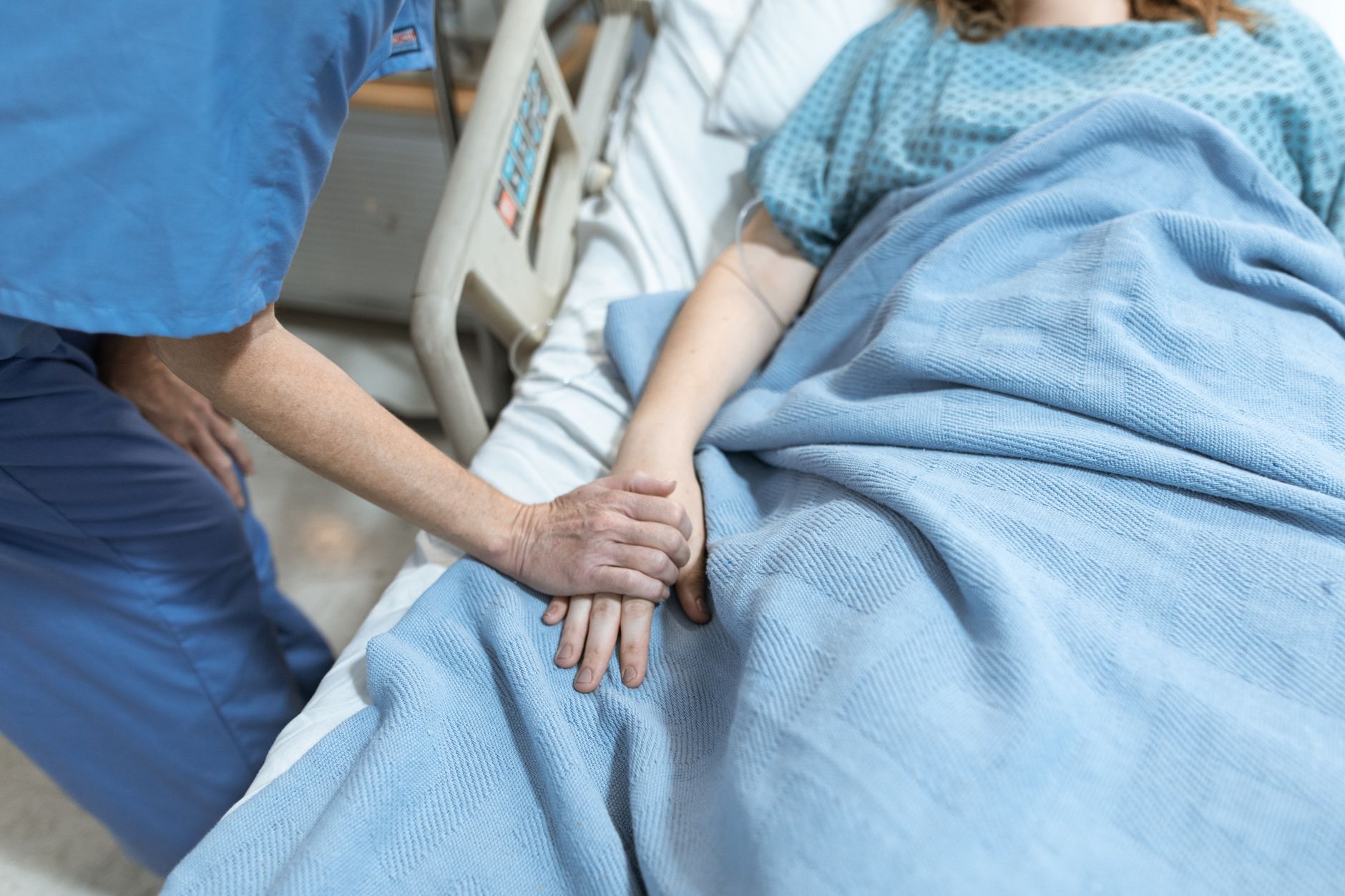
The Bag Gloria Never Let Go
The lawyer’s office smelled like coffee that had been sitting on the burner too long, and I remember thinking that was a strange thing to notice on the day I buried my wife of three days.
His name was Walter Denby, and he had the kind of steady, unhurried voice that made you trust him even when you didn’t want to trust anyone. He set Gloria’s hospital bag on the desk between us. The same bag. Green canvas, gone gray at the corners, a zipper that stuck if you pulled it too fast, a strap she’d mended herself with dental floss because she refused to let anyone buy her a new one.
For two years I had watched nurses reach for that bag to move it out of the way, and for two years I had watched Gloria take it back out of their hands, gently but firmly, the way you’d take a crying child back from someone who didn’t know how to hold it.
“She wanted you to have this,” Mr. Denby said. “Whenever you were ready. Not the day of the funeral if that was too soon. She said you’d know when.”
I put my hand on the canvas and didn’t open it yet. I wasn’t ready. I don’t think I understood, sitting in that office in my one dark suit with the funeral home’s carnation still pinned crooked to my lapel, that I was about to learn the real reason a lonely, sharp-tongued, eighty-two-year-old woman named Gloria Aldrich had asked a thirty-four-year-old orderly to marry her three days before she died.
“She chose you for a reason,” he said, and folded his hands like he’d been waiting a long time to say it.
To understand what that reason was, you have to go back to the spring I started working at Meadowlark Manor, before I knew Gloria’s name, before I knew there was a bag at all.
**
I was thirty-two when I took the job. I’d spent nine years running a forklift at a distribution warehouse outside Cedar Bend, Nebraska, until the whole facility got automated out from under two hundred of us in the space of a bad Tuesday. I had no college, a truck that needed a transmission, and a mother I’d nursed through the last eight months of pancreatic cancer two winters before, which is the only reason a nursing home would even look twice at a laid-off warehouse man with no certifications. The director, a tired, kind woman named Pam, told me during the interview that caregiving isn’t a skill you learn from a manual. Either you have the patience for it or you don’t, and she could see in about four minutes that I did.
She was right that I had the patience. What she couldn’t have known was that I also had the particular kind of grief that makes a person good at sitting with dying strangers. When my mother was in her last months, I learned that most people, even good people, run out of things to say to someone who’s fading. I never did. I think some part of me was still sitting in that room with her, and I just kept sitting.
Meadowlark Manor was a low brick building on the edge of town with a gravel lot, a flagpole that needed new rope, and a dayroom that smelled like coffee and Bengay and the lemon disinfectant they mopped the floors with every night at ten. Half the residents had family who came on Sundays with casseroles and grandkids in soccer uniforms. The other half didn’t, and you learned fast which ones were which, because the ones with no visitors watched the front door on Sunday afternoons the way a dog watches a driveway.
Gloria Aldrich was in that second group, and she was, without question, the sharpest mind in the building.
**
She’d been at Meadowlark for going on four years by the time I got there, moved in not long after a bad fall that cracked her hip and made the old farmhouse she’d lived in alone for decades too dangerous for her to stay in. She was eighty years old when I met her, quick as a whip, with reading glasses on a beaded chain and a laugh that came out like a bark when something actually struck her funny, which wasn’t often, because she had high standards for what counted as funny.
The other aides warned me about her my first week. Not in a bad way. More like the way you’d warn a new hire about a piece of machinery that had a kick to it. “She’ll test you,” one of the older CNAs told me. “She doesn’t suffer fools. But if she likes you, she’ll remember your birthday before you do.”
I met her on my third day. I was pushing the tea cart down the east hall and she flagged me down with two fingers like she was hailing a cab.
“You’re new,” she said. It wasn’t a question.
“Yes, ma’am.”
“Don’t call me ma’am. Makes me feel like I’m being addressed by a state trooper. Gloria’s fine.” She looked me over, unhurried, the way you’d size up a horse before you bought it. “You’ve got sad eyes for a young man.”
“I’ve had a couple of hard years.”
“Good,” she said. “The soft ones never last past September.” Then she asked for two sugars in her tea instead of the one the chart called for, and when I hesitated, she said, “I’m eighty years old and dying by inches in a building with a bird on the sign. Give an old woman her sugar.”
I gave her the sugar. That was the whole beginning of it, really. Two lumps I wasn’t supposed to give her.
**
Over the next two years, without either of us ever calling it anything, Gloria became the center of my shifts. I’d bring her tea before my rounds. I’d sit with her for twenty, thirty minutes after I clocked out, off the clock, because Pam looked the other way for residents like Gloria who had nobody. She told me about growing up on a wheat and cattle operation forty minutes west of town, about her father who could set a broken fence post faster than any man in the county and never said ten words doing it. She told me about the Grange hall dances, about learning to drive a tractor before she learned to drive a car, about a husband named Wendell Aldrich who used to whistle a particular four-note tune whenever he came up the porch steps so she’d know it was him and not startle.
Wendell had been dead a long time. Sixty-some years, by my math, though she was cagey about exact dates in a way I didn’t think much about at the time. She talked about him with a fondness that had gone soft and sanded down at the edges, the way old grief does when you’ve carried it long enough to make peace with the weight of it.
She never once mentioned children. I noticed, the way you notice an empty chair at a table, but I didn’t ask. Some rooms in a person’s life have the door shut for a reason, and you learn in this line of work not to go rattling handles.
What I did ask about, eventually, was the bag.
**
It went everywhere with her. To physical therapy. To the dining hall. On the two occasions I wheeled her to a doctor’s appointment in town, it rode on her lap the whole way, both hands resting on top of it like she was holding a cat down. When she had one of her hospital stays, which got more frequent that second year as her heart started giving her trouble, the bag came with her in the ambulance, and God help the paramedic who tried to stow it up front out of her reach.
The staff had theories. One aide swore it was full of cash, old bills she didn’t trust in a bank. Another was sure it was cremated remains, Wendell’s ashes maybe, or a stillborn baby’s, which struck me as a morbid guess even by nursing home standards. Somebody floated that it was a wedding dress. Somebody else said pills, though anyone who knew Gloria knew she’d have marched to the pharmacy counter herself and argued with the pharmacist before she’d have hoarded medication in secret.
I asked her about it once, straightforward, the way I asked her about everything. We were sitting in the courtyard garden, the one with the raised beds the activities director kept planted with marigolds because they were supposed to be easy to grow and hard to kill, and I nodded at the bag sitting against the leg of her wheelchair.
“What’s the story with that thing, Gloria? You’d think it had the crown jewels in it.”
She was quiet a second, which for Gloria was unusual. Normally she had a quip loaded before you finished the question.
“It’s got the answer to something,” she said finally. “Something I’ve been carrying so long I don’t rightly know how to put it down. You’ll see it when the time’s right. Not before.”
“When’s the time right?”
She looked at me with an expression I’d come to know well over those two years, half amusement, half something heavier underneath it, like a lake with a current running below a calm surface.
“When I trust you’ve earned it,” she said. “And when I’ve decided you’re the one it belongs to.”
I let it go. I always let it go with her. It felt like the kind of thing you don’t push, the same way you don’t push a person to tell you about their war, or their divorce, or the year they lost everything. You let them hand it to you when they’re ready, or you let them keep it. Either way is their right.
**
Gloria’s heart started failing for real that second winter. Congestive heart failure, the kind that sneaks up on you a little at a time and then all at once. She was in and out of Cedar Bend Regional three times between November and February, and each stay was a little longer than the last, and each time she came back to Meadowlark a little smaller than she’d left it.
I visited her at the hospital on my own time, which wasn’t strictly allowed, but Pam never said a word about it, and neither did I. I’d bring her the crossword from the Cedar Bend Courier, folded to the right page, because she liked doing it in ink to prove she didn’t need the eraser. I’d bring her hard candy from the gas station because the hospital cafeteria’s coffee, she said, tasted like it had been strained through a barn boot. Small things. The kind of things you do for a person because you like them, not because you expect anything back.
It was on one of those hospital afternoons, the third stay, a gray February day with sleet ticking against the window, that she asked me to sit down in the chair beside her bed and took my hand.
Her hand was small and cool and the skin had gone thin as paper, the way it does at that age, and I remember being careful with it the way you’d be careful holding a bird.
“I have one final wish,” she said. “And I need you to hear the whole thing before you say anything.”
I told her to go ahead.
“I don’t have much time left, Daniel. The doctor’s been kind enough to say it plain to me, which I appreciate, because I’ve never had patience for people who dance around the truth.” She squeezed my hand, and even weak as she was, there was still that current underneath. “I have spent most of my life alone. Not lonely, mind you. There’s a difference, and I’ve had good years, better than most. But I never had anyone to call my husband again after Wendell. And I find, now that the end of it’s in sight, that it matters to me more than I ever let on. I don’t want to leave this world without that. One more time, being somebody’s wife.”
I sat there with my mouth half open, the way you do when the ground shifts and your body hasn’t caught up to your ears yet.
“I know exactly how this sounds,” she said. “An old dying woman asking a young man half her age for something he has no earthly reason to give her. I’m not asking you for a marriage the way the word usually means it. I’m asking you for a kindness. The last one I’ll ever ask of anybody. Will you marry me, Daniel?”
I want to be honest about what went through my head in that silence, because I think it matters, and because I think it’s the reason for everything that came after, though I didn’t know that yet.
I thought about what people would say. My cousin Reggie, who never missed a chance at a joke, would never let me live it down. The other aides at Meadowlark would talk, and some of the talk would be unkind, because that’s what talk does. I thought about whether it was strange, whether it made me strange, a thirty-four-year-old man standing at the edge of marrying a woman fifty years his senior in a hospital bed on a Tuesday.
And then I thought about the two years of tea and marigolds and crossword puzzles in ink, about a woman who watched the door every Sunday and never once complained that nobody came through it, about the particular loneliness of being the person everybody likes to visit but nobody claims. And I thought, if this is the one thing I can give her, the very last thing, what kind of man measures that against what strangers might say about it.
“Yes,” I said. “Of course I will.”
She didn’t cry, which didn’t surprise me. Gloria wasn’t much of a crier. But she held onto my hand a good while longer than she needed to, and when she finally let go, she reached over and rested her palm flat on top of that green canvas bag, like she was making some kind of promise to it, or maybe to herself.
**
We were married the following week, in a corner of the hospital’s small interfaith chapel, on a Thursday morning with sleet still coming down outside the tall narrow windows. It wasn’t a large affair. It didn’t need to be. Chaplain Reyes officiated. Pam came from Meadowlark, along with two of the nurses who’d cared for Gloria the longest and had grown fond of her sharp tongue the same way I had. My cousin Reggie showed up too, and to his credit, he didn’t crack a single joke, not one, the whole day.
Gloria wore a cardigan the color of a robin’s egg over her hospital gown, and someone, I never did find out who, had pinned a small cluster of silk violets to the collar, the kind you might buy at a craft store, but on her it looked like something out of a photograph from 1962. She had done her hair as best she could manage from a hospital bed, and when I came into the chapel and saw her sitting there in that wheelchair with her chin up and her eyes bright, I thought, not for the first time, that there was more life left in that small tired body than in most people twice her health.
The vows were short. Chaplain Reyes kept them simple, at Gloria’s request. She said “I do” in a voice that came out steadier than I expected. I said it back and meant every word of it, though I couldn’t have told you, standing there, exactly what I was promising, only that I intended to keep it.
Afterward, one of the nurses had smuggled in a small sheet cake from the grocery store in town, yellow with white frosting, and we ate it in paper cups because nobody had thought to bring plates. Gloria ate one bite and pronounced it “adequate,” which from her was practically a rave review. It was, without a doubt, one of the strangest and one of the most tender afternoons of my life, and I have turned it over in my memory more times than I could count since.
Three days later, early on a Sunday morning, Gloria Aldrich, who had for one week been Gloria Novak, passed away peacefully in her sleep with a nurse at her side and the sleet finally turned to soft snow outside her window.
**
The funeral was small, held at the Lutheran church on the north edge of Cedar Bend where Gloria had been a member for fifty years, though she hadn’t been able to attend a service in the last several. The pastor spoke about her stubbornness and her generosity in the same breath, which felt right, because in Gloria those two things had never been separate. A handful of Meadowlark staff came. A few old neighbors from her farming days, gray now themselves, who remembered her from the Grange hall and the county fair canning competitions she’d won more years than lost.
And one man I’d never seen before, who introduced himself at the reception afterward, over the sheet pans of ham and scalloped potatoes the church ladies had laid out, as Curtis Aldrich, Wendell’s grand-nephew.
Curtis was maybe fifty, soft around the middle, wearing a suit that fit a little too well for a man who claimed he’d “just found out” about Gloria’s passing. He shook my hand too long and asked, in a voice pitched for sympathy but aimed like a fishhook, whether I knew “what Aunt Gloria’s situation was, financially speaking.” I told him I didn’t know what he meant. He said he’d be in touch, and something about the way he said it made the ham in my mouth taste like paper.
I didn’t think much more about Curtis Aldrich that day. I had a bag to open, and a lawyer’s appointment scheduled for the following week, and grief enough of my own to carry without borrowing his.
**
Mr. Denby’s office was above the hardware store on Main Street, up a narrow staircase that creaked on the fourth step. I sat with that green canvas bag on my knees for a long moment before I unzipped it, the same way Gloria used to hold it, both hands flat on top, like I needed to steady myself before I let it open.
Inside, on top, wrapped in a dish towel gone soft from age, was a photograph. Black and white, a young woman in a nurse’s aide uniform, maybe twenty years old, standing in front of what looked like the old Cedar Bend hospital before it was rebuilt in the seventies. She had a wide, unguarded smile, the kind you don’t often see in old photographs where everyone’s holding still and serious for the camera. On the back, in handwriting I recognized instantly as a much younger version of Gloria’s, it said: June Bellamy, 1962. The kindest person I ever knew.
Underneath the photograph was a passbook savings account, the old-fashioned kind with a cloth cover, the balance updated by hand in neat columns going back decades. Underneath that, a deed, the deed to the old Aldrich farmhouse and the eighty acres around it that Gloria had never sold, only rented out to a neighboring farmer for hay ground all these years. And underneath all of it, in an envelope with my name on the front in that same careful hand, was a letter.
Mr. Denby told me to take my time. I did. I sat in that office for the better part of an hour reading it, and I’m going to tell you what it said, because I think you deserve the ending Gloria never got the chance to tell me herself.
**
Dear Daniel,
If you’re reading this, then I’m gone, and I imagine you’re sitting somewhere quiet, probably confused, and probably a little angry that I let you marry me without telling you the whole of it first. I’m sorry for that. But I needed to know you’d have said yes for the reason I hoped you would, not for what’s in this bag. And you did. I watched your face when I asked you, and there wasn’t a flicker of anything in it but kindness. That’s the last confirmation I needed.
I was nineteen years old in the winter of 1962, married not quite a year to Wendell Aldrich, when he was killed in an accident with the thresher on his father’s place. I won’t describe it to you. Some things don’t need describing, only knowing that they happened. I was three months along with a baby at the time, and I lost that baby two weeks after I lost Wendell. The doctors said it was the shock, the grief, the body doing what bodies do when they’ve been asked to carry too much at once. I woke up in Cedar Bend Regional a widow and childless within the same month, nineteen years old, with a father-in-law who’d already started talking about who’d farm the land now that his son was gone, as though I were a piece of the estate to be settled along with the equipment.
I had no people of my own close by. My mother had passed when I was young and my father had moved to Ohio for work and we weren’t close. I had eleven dollars to my name and a hospital bill I had no way to pay, and I remember lying in that bed those first nights thinking I did not particularly care whether I woke up again.
There was a nurse’s aide on that ward, not much older than me, named June Bellamy. She wasn’t assigned any special duty toward me. She had a full floor of patients and a mother of her own to help support on an aide’s wages, which in 1962 were not much at all. But June started coming by on her breaks anyway. She’d sit with me. She brought me a library book on the second day, and when I told her I hadn’t finished high school and reading didn’t come easy to me, she didn’t make me feel small for it. She just started reading it out loud, a chapter at a time, every break she had, until I found I could follow along and then, slowly, that I could read it myself.
When the hospital wanted to discharge me to my father-in-law’s place, where I would have spent the rest of my young life as an unpaid housekeeper for a man who blamed me, in his grief, for his son’s death, June was the one who found out the hardware store in town needed a girl who could keep books, and she loaned me four dollars for a bus ticket and the decent dress I owned so I could go apply for it. I got that job. It kept me independent the whole rest of my life. I never had to answer to anyone else’s roof again.
I tried, over the years, to pay June back. I wrote to her. I sent her money more than once, which she always sent right back with a note saying she hadn’t done it to be repaid. Then in the autumn of 1965 she moved to Omaha to finish her nursing degree, and somewhere in the business of both our lives, the letters slowed and then stopped, the way they do, not from any falling out, just from the ordinary erosion of distance. I learned years later, through a mutual acquaintance, that June had died of a fever in 1971, only twenty-nine years old, before I ever found a way to repay what she’d given me.
I have thought of her nearly every day for sixty years, Daniel. Not with sorrow exactly, though there’s sorrow in it. Mostly with a kind of unfinished feeling, like a door I never got to close. I built a whole life on what June Bellamy gave me for nothing. I kept my books straight at that hardware store for eleven years, married Robert Aldrich, Wendell’s cousin, some years later (a good, quiet man, gone now himself a long while), farmed and saved and lived carefully, and I put a little aside every single year, not for myself, but for whoever might come along someday who reminded me of her. I decided a long time ago that if I couldn’t repay June herself, I would repay the kind of person she was, wherever I found one.
I watched you for two years before I ever said a word about any of this. I watched you bring tea to residents whose own children didn’t call them on their birthdays. I watched you sit with Mrs. Petrovsky the whole night she was dying because her son was three states away and couldn’t get there in time, and you didn’t clock that time, and you never mentioned it to anyone. I watched you learn every resident’s story, not because it was your job, but because you actually wanted to know it. You have June Bellamy’s exact particular kindness, Daniel, the kind that doesn’t calculate what it might get back. I recognized it the first week you started, and I have been quietly deciding, ever since, whether you were the one this belonged to.
The marriage was not only sentiment, though the sentiment was real and I meant every word I said to you in that chapel. I am an old woman with a farm and savings and no living children, and I know exactly how a man like Wendell’s grand-nephew Curtis operates, because his father was cut from the same cloth. I have watched him circle my situation for a decade, sending a Christmas card only once he heard I’d taken sick, calling twice a year to “check in” on an aunt he never once visited. A will alone, left to an orderly he’d call a stranger, he would have contested in court and possibly won on some argument about my state of mind. A husband cannot be so easily written off. Mr. Denby has the paperwork, two years of it, doctor’s letters on my competency, all of it done properly and in the light, because I intended for this to hold.
So here is what’s yours, if you’ll have it: the farmhouse and the ground around it, which I could never bring myself to sell because it still, in some way, has Wendell in it. The savings, which will surprise you, I expect, given how plain I always dressed. And June’s photograph, which I’d ask you to keep somewhere you’ll see it, so that some part of her keeps being remembered by somebody, the way she deserves and never got, dying so young with no one left to do it.
I would ask one more thing of you, though it’s a request, not a condition; I want you to feel free either way. Cedar Bend Regional still has a small charitable fund for patients who can’t cover their bills, the kind of fund that might have helped a scared nineteen-year-old girl if it had existed back then. I’d be glad if some portion went there, in June’s name, so that the next frightened girl in a hospital bed with eleven dollars to her name finds a little more waiting for her than I did. But that part is yours to decide, not mine to demand from the grave.
Thank you for marrying an old woman you had no reason to marry, for no better reason than that it would make her happy. That, Daniel, more than anything in this bag, is why I chose you. Not because you would take what’s inside it. Because I already knew, before you ever opened it, that you’d have been just as kind to me even if there had been nothing here at all.
With more gratitude than I ever found the right time to say out loud, Gloria
**
I sat in Mr. Denby’s office a long time after I finished reading, the letter loose in my hands, the photograph of a smiling twenty-year-old woman from 1962 propped against the lamp on his desk. Mr. Denby didn’t rush me. He told me, gently, that the estate totaled a little over three hundred and forty thousand dollars between the savings and the value of the land, which was more money than I had ever had a reason to imagine belonging to me, and that Gloria had indeed spent the better part of two years working with him on the paperwork specifically to make certain it would hold up.
He was right to have planned for it. Curtis Aldrich filed a challenge within a month, through a lawyer from Lincoln, arguing undue influence, arguing a vulnerable elderly woman had been manipulated by a hired caregiver into marriage for financial gain. It is, I understand now, an old and common story, the kind that happens often enough that courts have learned to look at it carefully. I won’t pretend those weeks were easy. Reading a filing that describes you as a predator, when you know exactly what you actually did and why, is its own particular kind of exhausting.
But Gloria had built her case as carefully as she’d built everything else in her life. Two years of documented visits with Mr. Denby. A geriatric psychiatrist’s evaluation, done the month before the wedding at Gloria’s own insistence, stating plainly that she was of sound and lucid mind. The letter itself, dated and notarized, laying out a plan she’d clearly been assembling long before I ever knew her name. Curtis’s own claim fell apart within a single hearing, and what came out sideways in the proceedings, which I did not go looking for but heard anyway, was that Curtis had not visited Gloria once in the four years she’d lived at Meadowlark, and had in fact tried twice, years before her decline, to talk her into signing the farm over to him early as an “advance,” both times unsuccessfully. The judge was not gentle with him. I did not enjoy watching a grown man be dismantled in a courtroom, even a grown man who deserved it, and afterward, in the hallway, I did something that surprised even me. I walked over to Curtis and offered him a photograph, one I’d had printed, of Gloria at eighty, laughing that bark of a laugh at something on the courtyard television. He didn’t take it. He just looked at me like I’d handed him something in a foreign language, and walked out. I understood, watching him go, that some people are simply never going to see what was right in front of them the whole time, and there’s no letter, no bag, no amount of proof that fixes that. I let it go, the same way Gloria taught me to let things go that weren’t mine to carry.
**
I still work at Meadowlark Manor. I want to say that plainly, because I know how this story could sound if I stopped there, if the ending was a payday and a resignation letter. I didn’t take this job for money and I didn’t stay in it for money either. I kept the farmhouse, and some weekends I drive out there and sit on the porch steps where Wendell used to whistle his four-note tune coming up the walk, and I think about a nineteen-year-old girl who lost a husband and a baby in the same terrible month and somehow, with the help of one stranger’s kindness, built sixty more years out of the wreckage of it.
I used part of what Gloria left me to establish the June Bellamy Patient Fund at Cedar Bend Regional, which as of this spring has covered emergency bills for eleven patients who couldn’t otherwise afford them, most of them young, most of them scared, the way Gloria was once young and scared in that same building. I put June’s photograph on the shelf above my desk, where I see it every morning, a twenty-year-old woman with an unguarded smile who never knew, dying at twenty-nine, that the kindness she handed a grieving stranger for free would still be rippling outward six decades later into the life of a man who wouldn’t be born for another twenty years.
And most evenings, after my shift, I still walk the halls of Meadowlark with the tea cart, and I still stop longest at the rooms of the residents whose families don’t come on Sundays. Not because anyone’s watching, and not because I expect it to lead anywhere. I do it because Gloria taught me, in the plainest way a person can teach another person anything, that the kindness nobody’s keeping score of is usually the kindness that matters most. She spent sixty years trying to become worthy of a gift she couldn’t repay. I don’t know that I’ll ever feel worthy of the one she left me. But I’ve decided the only honest way to carry it is the same way she did: quietly, and by handing it forward to whoever’s sitting alone in a hospital bed, watching the door.
That’s the whole of it. That’s what was in the bag, and that’s why, of all the people who came through Meadowlark Manor in those two years, Gloria Aldrich chose an ordinary orderly with sad eyes and a broken-down truck to be, for three days, and in every way that mattered after, her husband.