The Medic They Told To Undress
The lobby of the administrative building at Fort Blackhawk went quiet the second I shrugged the jacket off my shoulders, and for one long breath I stood there in the Texas heat with my back bare to a room full of strangers, thinking about how strange it is that the loudest thing a person can do is take something off.
My name is Laura West. I am fifty-one years old. I grew up forty minutes from that gate, in a town called Eagle Point where the water tower still has my graduating class’s year painted on it in fading blue, and where the diner on Route 9 has been serving the same chicken fried steak since before I was born. I left Eagle Point at eighteen with a duffel bag and a promise to my daddy that I would come home in one piece. It took me twenty-two years, three deployments I am only now allowed to speak of in the vaguest terms, one Purple Heart, one Bronze Star with a V device I never wore on my chest in public, and more nights than I can count where I did not think I would keep that promise, but I kept it. I came home. Not whole, not in the way people mean when they say that word, but home.
What I did not expect, on an ordinary Tuesday in April, was to end up standing in the exact building where I once processed in as a nineteen year old private, being told by a boy young enough to be my son that I had not earned the right to wear the uniform on my own back.
Let me back up, because the tattoo is not where this story starts. It is where it becomes visible.
The girl from Eagle Point
I enlisted in the United States Army the summer after graduation, in a recruiting office in a strip mall outside Waco with a Dairy Queen on one side and a gun shop on the other. I did not enlist because I hated home. I enlisted because my father, Staff Sergeant Ray West, retired Army, spent his whole life telling me that service was not a sacrifice, it was a debt you paid forward, and I believed him the way you believe your father when you are eighteen and he has never once lied to you about anything that mattered.
I trained as a combat medic, MOS 68W, at Fort Sam Houston, and I was good at it in the way some people are just good at staying calm when everyone around them is not. I did not flinch at blood. I did not flinch at screaming. What I flinched at, if I am honest, was the quiet after, the moment when the adrenaline drains out of a room and all that is left is what actually happened.
By my second enlistment I had the training and the temperament that certain people go looking for. I will not pretend I understood, at twenty-four, what I was being asked to volunteer for. I understood it was harder. I understood it was smaller, tighter, and that the people running it did not smile much during the selection process. I understood, once I was in, that I was now part of something that did not exist on any organizational chart anyone outside a very small room would ever see.
We called ourselves, among ourselves, the Ghost Unit. Nobody handed us that name in a ceremony. It grew the way nicknames grow in the field, out of gallows humor and repetition, because our job was to go into places that were not supposed to have Americans in them, do what needed doing, and leave no trace that we had ever been there. Extractions. Recoveries. The kind of missions where the after action report gets written in a font nobody outside three offices in Washington will ever read. I was the medic. I was the one who kept people breathing long enough to get them somewhere that could finish the job medicine started.
I will not tell you the names of the places. Some of that is still classified, and some of it I would not tell you even if it were not, because those places do not belong in a story, they belong in the ground where I left them. What I will tell you is about one mission, because that mission is why a room full of strangers went silent on a Tuesday in April, decades later, in a building with fluorescent lights and a coffee machine that took quarters.
The night the tattoo was earned
It was late in my third deployment. We had a four man element pinned down in terrain that our maps called a valley and that felt, in the dark, like the inside of a closed fist. The helicopter that was supposed to pull us out could not get a stable hover close enough, not with the ridge line lit up the way it was, and so the call came down that we were walking out. On foot. Carrying our wounded.
There were three of us who could still move under our own power by the time the sky started going gray. There was one who could not, a twenty six year old communications sergeant named Danny Ruiz, who had taken a round through the hip and lost enough blood that I had stopped believing in the math of it and started believing in stubbornness instead. I carried him for the better part of six miles, some of it on my back, some of it in a drag I had learned in a training tent in North Carolina and never once believed I would actually need. My hands took the worst of it, the ropes and the rock and the weight, which is why to this day the scars run straight across both palms, pale lines that people mistake for something else until I tell them what they are.
Danny Ruiz lived. He has three kids now and a wife named Priya and a landscaping business outside San Antonio, and every year on the anniversary of that night he sends me a photograph of his family standing in front of whatever tree they planted that spring, no caption, because we do not need one. That is the version of the story I am allowed to keep, the good version, the one that ends in a Christmas card.
Two other men from a different element did not make it out of that valley. I do not say their names in public. I say them in private, on the anniversary, standing in my kitchen in Eagle Point with a cup of coffee going cold, and that has to be enough, because it is the only place I am permitted to grieve them the way they deserve.
When I came home from that deployment, before my next one, I went to a tattoo shop in Killeen with two women I trusted with my life and had every one of my scars turned into something on purpose instead of something that just happened to me. Across my shoulder blades, running the full width of my back, a set of wings wrapped around a compass rose, and beneath it, in small deliberate script easy to miss unless you are looking, the words we all agreed on as our unofficial creed, drawn from the Gospel of John: greater love hath no man than this. Underneath that, smaller still, initials. Not names. Initials, for the ones who did not come home, and a blank space we agreed never to fill in, because we all understood that space existed for whichever one of us went next.
That ink is not decoration. It never was. It is the only monument some of those men will ever get, because their families were told, and are still told, a much smaller and much safer version of what actually happened.
Twenty two years and out
I retired as a Master Sergeant. I will tell you plainly that leaving nearly broke something in me that the deployments never touched. You spend two decades being the person other people call when the worst has already happened, and then one day they hand you a folder and a handshake and tell you your country thanks you for your service, and you drive home to a house that is too quiet and a refrigerator that does not need restocking for four people anymore, and you have to figure out who you are when nobody needs you to keep them alive at three in the morning.
What saved me was Emma.
I adopted my daughter, Emma, when she was six, the daughter of a friend from my second unit who did not come home from an accident stateside two years after his own deployment ended, the kind of quiet tragedy nobody puts on a memorial wall. Her mother had passed years before that. There was nobody else, and I was not going to let that little girl end up a file in a system. I am not, and have never pretended to be, a natural mother. I am, however, a person who does not leave anyone behind, and that has turned out to matter more than I expected. Emma is seventeen now. She wants to study nursing. She has never once, in eleven years, asked me to be anything other than exactly what I am.
I did not go back to a quiet life, not entirely. I could not. There is a particular kind of experience that the Army spends millions of dollars trying to replicate in training scenarios, and I happened to have it in my hands, so I went to work as a civilian contractor, training combat medics and reviewing trauma protocols at installations across three states. It is not glamorous work. I drive a truck with a hundred and ninety thousand miles on it and a check engine light I have learned to ignore, and I stay in the kind of motels that offer a free continental breakfast that is mostly just a waffle iron and disappointment. But I am, once again, in the business of keeping people alive, and that turns out to be the only job that has ever made the quiet bearable.
Fort Blackhawk
The reason I was at Fort Blackhawk that Tuesday was not sentiment. It was a contract. The base had stood up a new trauma simulation center, a facility built to run combat medics through the kind of high stress, low light, mass casualty scenarios that no classroom can teach, and the command wanted someone who had actually lived the thing they were simulating to review the curriculum before the next class of medics rotated through. I had been hired for exactly that reason, because on paper my file reads: former Special Operations combat medic, decorated, extensive field experience in mass casualty extraction. On paper, and nowhere else, because most of the specifics of my career are the kind of thing that stays in a room with a keypad on the door.
I parked my truck outside the gate that afternoon and sat there for a minute the way I always do before I go back onto a base, feeling the Texas heat come up off the asphalt in waves, feeling the old ache settle into my palms the way it does in the heat, remembering things I do not choose to remember, they just arrive. I was not there to make a statement. I want that understood plainly. I have spent most of my adult life trying very hard not to be noticed, because the version of me that gets noticed is the version that makes people ask questions I am not permitted to answer.
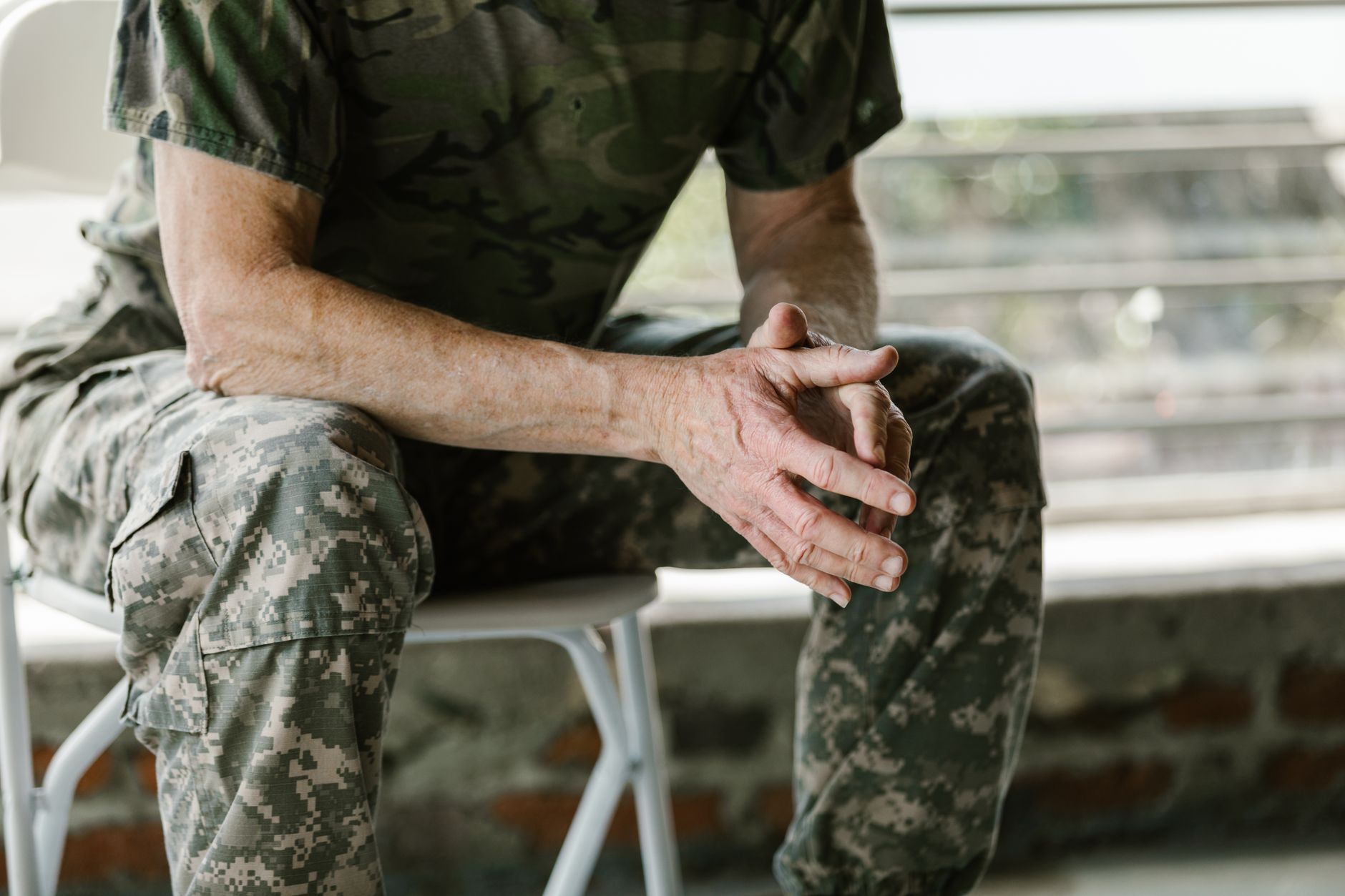
I wore the faded BDUs I always wear on a job like that, not because I was required to, but because they are, quite simply, the most practical clothing I own for walking a base and demonstrating field technique to a room of twenty two year olds. No rank on the collar. No unit patch on the shoulder. I have not worn either since the day I retired, out of respect for the fact that I no longer belong to the units those symbols represent, and because some of what those symbols would have represented is not something I am allowed to display at all. I checked in at the gate on my civilian contractor credentials, the same way I always do, and the young guard barely looked up from his clipboard. That is the way I like it.
Inside, the base was exactly what a good base should be: cadence chants rolling across a training field, the flat crack of weapons drills somewhere out past the motor pool, medics jogging between buildings with aid bags bouncing against their hips, everybody moving with purpose. Fort Blackhawk had grown since my own days coming through a facility like it, sleeker now, more glass and less cinder block, and I felt the particular ache that comes from loving an institution that has moved on without you.
I walked into the administrative building to check in with the training coordinator and get my visitor badge updated for the week. I nodded at a couple of soldiers on my way past. I did not carry myself like someone important, because I have spent two decades practicing the exact opposite of that, but I have been told more than once that there is something in the way people who have actually been through it move, a stillness, that gives them away anyway.
That was when Lieutenant Bishop stepped into my path.
Second Lieutenant Wade Bishop
His name tag read BISHOP. His uniform was pressed sharp enough to cut paper, the kind of crisp you only see on an officer who has not yet had six months of field time knock the shine off him. I found out later he was a Second Lieutenant, Military Police Corps, United States Army, six weeks into his first assignment, working the base access and installation security desk while he waited for a slot to open in a line unit. New rank, new authority, and the particular hunger that comes with both, the hunger to prove you belong in the uniform before you have actually earned the trust that goes with it.
“Ma’am,” he said, and his voice had an edge to it I recognized immediately, the sound of someone who has decided the conversation is already over before it starts. “Civilian contractors aren’t authorized to wear military uniforms on base. You need to remove it.”
The lobby, which a moment before had been full of the ordinary hum of people moving through their day, went quiet in that particular way rooms go quiet when they sense a confrontation forming. A couple of soldiers near the coffee station stopped pretending not to listen.
I looked at him for a moment before I answered. Not with anger. I want to be honest about that, because it would be easy to tell this story as though I felt something righteous in that moment, some flare of indignation, and I did not. What I felt, mostly, was tired, and a familiar kind of patience, the patience you learn from twenty two years of being underestimated by people who have not yet lived long enough to know what they do not know.
“I have authorization to be here,” I told him, and I slid my contractor credentials and my base access paperwork across the counter toward him.
He did not look at the papers. He looked at my boots, which were older than most of the soldiers currently walking that base, and at the faded fabric of the BDUs, and something in his face closed like a door.
“You heard me,” he said, louder now, the way people raise their voice when volume is the only tool left in the box. “You didn’t earn that uniform. Take it off.”
I want to tell you what went through my mind in that second, because I think it matters. I thought about my father, who used to say that the man who has to announce his own authority has already lost it. I thought about Danny Ruiz’s kids and the tree they plant every spring. I thought about Emma, who was going to hear about this exact moment before the end of the week no matter what I did, because bases talk, and I thought about the fact that I had absolutely nothing left to prove to a twenty three year old lieutenant six weeks into his first posting.
So I nodded.
Not because he was right. Not because he deserved my compliance. I nodded because I have learned, the hard way, in rooms far more dangerous than that lobby, that some battles are not worth fighting on the terms the other person has chosen, and because a small, tired, almost amused part of me wondered what exactly he thought was going to happen next.
I unzipped the jacket. I let it slide off my shoulders in the heavy, air conditioned quiet of that lobby, and I set it over my arm.
The silence
I have been in rooms go quiet before. I have been in rooms go silent the specific way a room goes silent right before something very bad happens, and I know the difference, and this was not that. This was something else. This was a room recognizing something it did not have words for yet.
Across my shoulder blades, wing to wing, the wings and the compass rose caught the fluorescent light. Beneath them, small and deliberate, the words some men and women I loved and lost chose to live and die by. Beneath that, initials that most people in that room would never be permitted to have explained to them, not because the Army is cruel, but because some debts are paid in silence and stay that way.
Lieutenant Bishop’s face did something complicated. I watched the certainty drain out of it in real time, replaced first by confusion, then by the particular kind of alarm that comes from realizing you have just done something you cannot take back in front of an audience.
It was not Bishop who spoke next. It was a voice from the far side of the lobby, older, rougher, a voice that had clearly spent thirty years giving orders in places louder than this one.
“West,” it said. “Laura West.”
Colonel Reyes
I turned to find Colonel Marcus Reyes, the installation commander, standing in the doorway of his office with a folder still in his hand, the kind of stillness on his face that I recognized because I have worn it myself. Colonel Reyes and I had never met, not directly, but Colonel Reyes had spent four years of his career as a young captain assigned to a joint task force that existed, on paper, mostly as a series of blacked out lines in a report, and Colonel Reyes had, it turned out, been in the operations center the night four men walked out of a valley on their own feet because a medic with scarred palms refused to let a math problem decide who lived.
He had never known my name. Names were not something that made it into those reports. What he had known, for twenty five years, was a designation, a call sign, and a single line item buried in a debrief he had never been allowed to forget: extraction completed, no further casualties, medic sustained non life threatening injuries during manual evacuation of wounded personnel.
He crossed that lobby in about six strides, and he did something I did not expect and will not forget for as long as I live. He came to attention, and he saluted me, a retired Master Sergeant standing half out of my uniform jacket in the middle of an administrative building, in front of two dozen soldiers who had no idea what they were watching.
“Lieutenant Bishop,” Colonel Reyes said, without turning his head, his eyes still on me, “you are looking at the reason a Special Forces communications sergeant named Danny Ruiz has three children today. You are looking at one of maybe a dozen people alive who can tell you what that unit patch would have meant, if she were permitted to wear one, which she is not, because that unit does not officially exist. Put your hand down and apologize.”
I have to tell you, because it is the truth and because it is the only part of this story I am not embarrassed to admit moved me: I cried a little, standing there. Not for myself. For Danny. For the two men whose names I still will not say out loud in a room full of strangers. For twenty two years of carrying something heavy and mostly invisible, and for one unexpected moment when somebody else in the room understood exactly how heavy it had been, without me having to explain a single word of it.
What came after
Lieutenant Bishop apologized. I want to be fair to him, because he is twenty three years old and he made a mistake born of inexperience and a rule book he was enforcing correctly on its face, if not in its spirit, and because the young man who apologized to me in that lobby, red faced and clearly rattled, was not the same young man who had demanded I strip off my jacket ten minutes earlier. He asked, quietly, after Colonel Reyes had stepped away to take a phone call, whether he could shake my hand. I let him. I told him the truth, which is that the rule he was enforcing exists for good reasons, that most people wearing an unauthorized uniform on a base are not who I am, and that he had done his job the way he was trained to do it. I also told him that the next time his gut told him something did not add up about a person in front of him, the correct move is curiosity, not volume, and that if he remembers one thing from that day, it should be that.
I finished my contract at Fort Blackhawk that week. I sat in on four training cycles at the new trauma simulation center, and I will tell you, without exaggeration, that watching twenty two year old medics learn to keep their hands steady when a simulated casualty is screaming is one of the most hopeful things I have done since I retired.
There was a private first class in the second cycle, a nineteen year old kid from somewhere outside Tulsa who froze the first time the scenario called for a two person carry under simulated fire, the kind of freeze I remember from my own first weeks at Fort Sam Houston, the body simply refusing to believe the exercise is not real. I did not lecture him. I walked over, put his hands where mine had been on a hundred carries, and told him the only thing that ever actually worked on me, which is that fear does not go away, you just get more practiced at moving while you carry it. By the fourth run through, he had it. He came and found me afterward, still sweating through his uniform, and thanked me in that awkward, over formal way young soldiers thank people they have decided to respect, and I thought about Danny Ruiz at that same age, and about how the whole purpose of everything I had lived through was standing in front of me in the shape of a kid who was going to save someone’s life someday because of an afternoon in a simulation lab in Texas.
Colonel Reyes asked me, before I left, whether I would consider coming back on a longer contract to help build out the advanced evacuation module. I told him I would think about it, and I am thinking about it still, because Emma starts her nursing prerequisites in the fall and there is a version of this next chapter where my daughter and I are, in our very different ways, both still in the business of keeping people alive.
The phone call home
Emma heard about the lobby before I even got back to my motel that night. Somebody’s cousin knows somebody stationed at Fort Blackhawk, and word travels through military families the way it always has, faster than any official channel, and by the time I called her that evening she already had the broad strokes and none of the truth.
“Mom,” she said, before I had even gotten through hello, “is it true some lieutenant tried to make you take your uniform off?”
I told her yes, and I told her the rest of it, the parts that do not travel well through a rumor chain, Colonel Reyes and his salute, the initials on my back, the reason I have never once explained the full shape of that tattoo to her even though she has seen it a thousand times since she was six years old climbing onto my back for a piggyback ride in our kitchen in Eagle Point. She was quiet for a long moment on the other end of the line, the particular quiet of a seventeen year old absorbing something too large for the space she has to put it in.
“You never told me it meant all that,” she finally said.
“Some of it isn’t mine to tell,” I told her, which is the truest thing I know how to say about most of my career. “But you should know the shape of it, even if you never get the whole picture. You should know what your mother carried, and who she carried it for.”
She has decided, in the way seventeen year olds decide things, that she wants to hear the rest of it someday, when I am ready, and I have decided, in the way mothers decide things, that I will tell her more of it than I have told almost anyone, because she is going to spend her own career keeping people alive, and she deserves to know exactly what that costs and exactly what it is worth.
I do not tell this story often. I did not tell it that day expecting it to become a story at all. I told it because a young man in a pressed uniform decided, on the strength of a set of boots and a faded jacket, that he already knew everything he needed to know about the woman standing in front of him, and because sometimes the only answer to that kind of certainty is the truth, worn quietly across your own back, in ink that has been there far longer than his opinion of me ever will be.
Danny Ruiz called me that weekend, the way he always does when word travels through the old network. He did not say much. He never does. He just asked how I was holding up, and I told him the truth, that I was fine, that it had actually felt good, in a strange and complicated way, to be seen for one afternoon instead of overlooked, and that I still had his family’s Christmas photo taped inside my truck’s visor where I see it every single day I drive.
“You still got the tattoo?” he asked, like he does every year, like it is a joke between us that never quite stops being serious.
“Every letter of it,” I told him. “Every last one.”
Some uniforms come off at the end of a career. Some things you carry never do, and I have made my peace with that, sitting in my truck outside a base I no longer belong to in the way I used to, in a town forty minutes from the water tower with my graduating year painted on it, in a life that is quieter now, and smaller, and, on most days, more than enough.