The Mechanic Who Redesigned Her Braces
The letter from my landlord was still folded in my back pocket that Thursday morning, and I hadn’t told a single soul about it. Ninety days to catch up on rent or vacate. I’d read it four times over coffee and then done what I always did with bad news: I put on my coveralls, unlocked the bay doors, and went to work like the world hadn’t just tilted a little further off its axis.
My name is Ethan Cole. I run, or ran, or maybe still run, depending on the day you ask me, a garage on the outskirts of Austin, Texas, on a stretch of frontage road where the city gives up being a city and starts turning into scrub oak and chain link fences. Cole’s Auto Repair. My father’s name was on the sign before mine was, and his father kept a garage before that, out past Lockhart, fixing tractors and pickups for farmers who paid him in eggs half the time. I liked to think I came from people who were good with their hands and bad with money, and I was living proof the tradition hadn’t died.
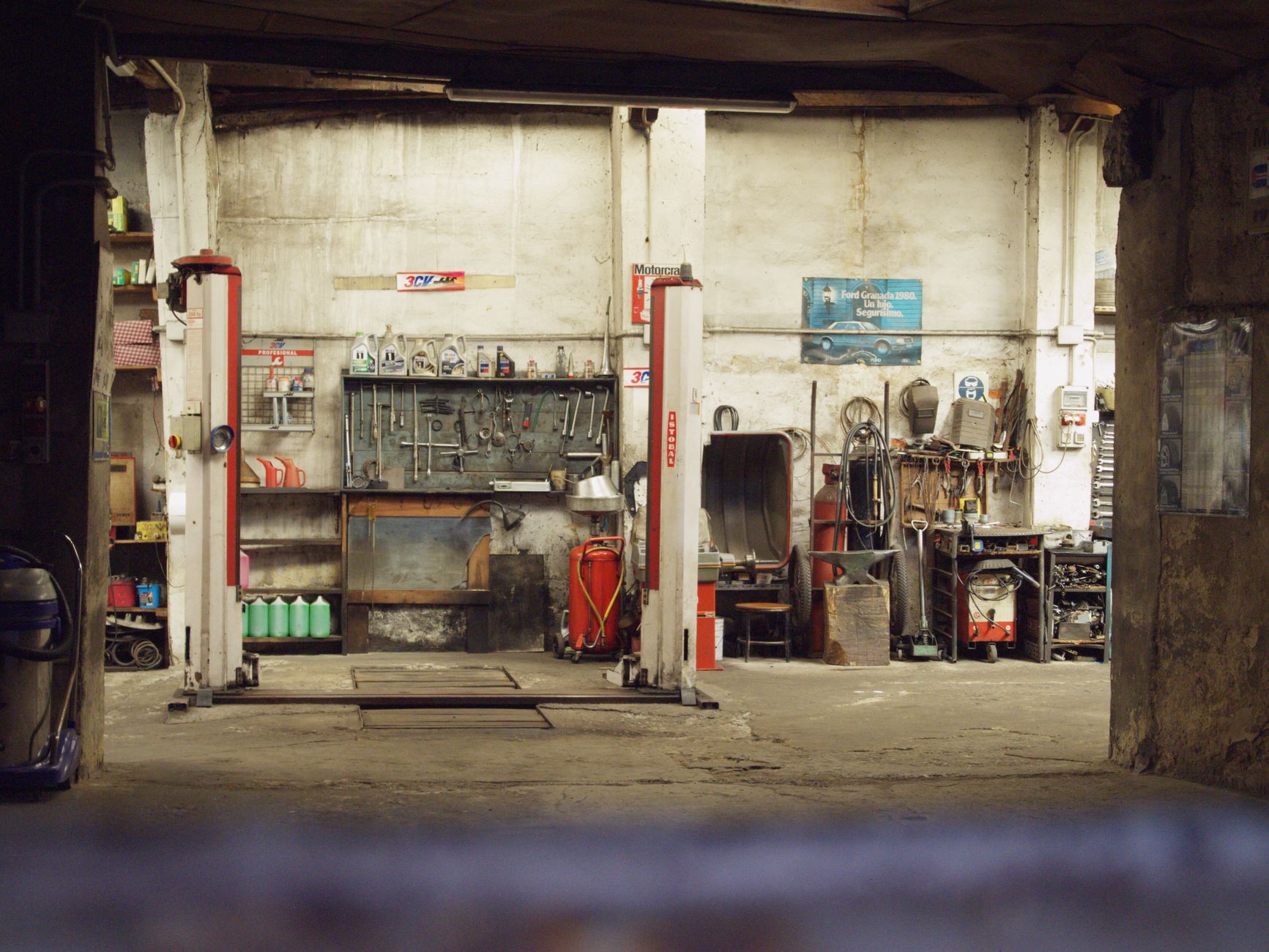
The shop wasn’t much to look at. Cracked concrete floor with a stain map of forty years of oil changes. Two lifts, one of which groaned like it was praying every time it went up. A cooler in the corner that held exactly one thing: sweet tea, because I didn’t drink and I didn’t see the point in keeping anything else cold. But I was honest. I charged what a job cost and not a penny more, I told people the truth about their cars even when the truth cost me money, and I never once turned away somebody who truly needed their vehicle running to get to work or to church or to a hospital. That reputation was worth something in that part of the county. It just wasn’t worth enough, not anymore, not with parts prices climbing and the rent on the lot climbing faster.
So that morning, with the eviction notice folded up like a threat in my pocket, I was elbows deep in a Buick’s alternator when I heard something that did not belong on my road. A low, clean hum, the sound of an engine that had never once had to work hard for anything in its life. I wiped my hands on a rag and stepped out from under the hood.
A black SUV was coming up the gravel apron in front of my bay, moving slow and careful, like the driver wasn’t sure this was really the place. It was the kind of vehicle that made everything around it look poorer just by comparison, mine included. I remember thinking it had probably taken a wrong turn off the highway, that in a minute it would swing back around and disappear toward the nicer parts of town.
It didn’t. It rolled to a stop maybe fifteen feet from where I was standing, and the back door opened.
A young woman stepped out first, and stepped is the word, though it cost her something to do it. She had metal braces locked around both legs, hinged at the knee and ankle, and she used the door frame and then a set of forearm crutches to ease herself down onto the gravel, moving with the kind of careful, practiced patience of someone who had done this a thousand times and would do it a thousand more. She looked to be about nineteen. Soft brown hair pulled back, a face that was tired in the way of someone managing pain she wasn’t going to mention, but there was nothing fragile in her eyes. She looked at my garage, at me, at the whole unpolished mess of the place, with open curiosity instead of the wince I sometimes got from people who weren’t used to seeing a shop this rough.
Behind her came a woman I recognized before she said a word, because her face had been on a billboard off I-35 for a real estate firm that had put up half the glass towers downtown. Valerie Stone. Confidence came off her like heat off asphalt, but underneath it, walking toward my garage that morning, she looked like someone bracing for a door to be slammed in her face.
“Our SUV started overheating on 71,” she said, before I’d even gotten a word out. “The driver said this was the closest place. I know it’s not what we’re used to.” She caught herself on that last part, and I watched her decide it had come out wrong. “I don’t mean that as an insult. I mean we’re not from around here.”
“Everybody’s not from around here at some point,” I said. “Pop the hood and let’s see what she’s doing.”
I want to be honest about something. In that first minute, my mind was on the coolant system and nothing else. I was thinking about a cracked hose or a bad thermostat, doing the math on how much a job like that might be worth and whether it might buy me another week with my landlord. That’s the truth, and I won’t dress it up as something nobler than it was. I was a man with a folded letter in his pocket, looking at a rich woman’s overheating SUV and doing arithmetic.
But while I worked the latch and got the hood up, I kept glancing over at the young woman. She’d settled onto the wooden bench I kept outside the office door, the one with the busted armrest, and she was sitting the way people sit when their body isn’t giving them a choice about how they sit. Not restless. Not complaining. Just present in it. And there was something about the angle of the braces at her ankles that snagged on the part of my brain that spends all day noticing when metal is fighting against itself instead of working with it.
I checked the SUV’s radiator, found the leak fast, a hairline crack that any competent shop could have caught and fixed in twenty minutes. But my eyes kept drifting back to that bench.
Finally I wiped my hands and walked over, and I did something I want you to understand was not me being nosy. It was me being a mechanic who couldn’t turn the noticing off. I crouched down near her, not touching anything, hands visible, and asked, “Are those supposed to feel that tight at the top strap?”
She blinked at me. I watched something shift in her face, a kind of surprise that had nothing to do with the question itself and everything to do with who was asking it.
“Nobody’s ever asked me that,” she said. “They ask if I’m okay. They ask if I need help getting somewhere. Nobody’s ever asked if the hardware fits right.”
“I’m Ethan,” I said.
“Amelia,” she said, and there was the faintest smile at the corner of her mouth, like she’d decided something about me in that half a second. “And yes. They’re too tight. They’ve been too tight for two years and everybody tells me that’s just how they’re supposed to feel.”
Valerie had come around the SUV in time to hear that last part, and I saw her jaw set. Not at me. At the words. Like she’d heard some version of that sentence too many times and every time it landed the same way, a small stone dropped into a well that never filled up.
“Amelia was in an accident when she was eight,” Valerie said, coming to stand near her daughter, protective in the way I recognized from watching my own mother stand over my little sister after she’d broken her arm falling out of a hayloft. Not hovering. Just present, a wall between her kid and whatever the world wanted to throw next. “A car accident. Spinal injury. The doctors told us walking without support wasn’t something to expect. We’ve seen every specialist west of the Mississippi. Surgeries. Physical therapy three times a week for six years. The braces she’s wearing now were custom-built by the top orthotics company in the country. And she’s still in pain every single day she wears them.”
I want to say something clearly here, because it matters to me that you understand it the way I understood it standing in my own gravel lot that morning. Amelia was not a problem to be solved. She was a nineteen-year-old woman who’d been living her whole adult life inside a body that worked the way it worked, and she’d built an entire self around that, same as any of us build a self around whatever hand we’re dealt. What she needed wasn’t fixing. The equipment strapped to her legs needed fixing. Those are two very different things, and I’ve met plenty of people since who blur them together without meaning any harm by it, but the blurring does harm anyway.
“Would you mind if I looked at them?” I asked her, not her mother. Her.
She glanced at Valerie, some old habit of checking in, and then looked back at me and answered for herself. “Go ahead.”
I knelt down slow, asked before I touched the first strap, and worked my way along the hinge at her knee, then the one at her ankle. I’ve spent twenty-two years with my hands on machines that carry human weight and human trust, tractors and trucks and cars that people’s whole lives depend on running right, and something in the way those braces were built started setting off alarms in the part of my brain that never really clocks out.
The alignment was off by a few degrees at the knee joint, not enough that a doctor glancing at an X-ray would flag it, but enough that with every step, weight was loading unevenly onto one side of her leg instead of distributing clean through the whole limb. The joints themselves were rigid in a way that fought her natural movement instead of working with it, like a hinge on a door that’s been mounted a hair crooked, so it grinds every single time instead of swinging free. And the straps, the ones causing that pressure at the top she’d mentioned, were positioned to hold the brace secure rather than to spread the load evenly across her skin. Somebody had engineered this thing to be strong and had never once sat down and thought about what it actually feels like to wear a piece of hardware against your own body for sixteen hours a day, every day, for years.
“These aren’t built right,” I said.
Valerie’s spine went straight. “They were designed by engineers with medical degrees. This is a two-hundred-thousand-dollar piece of custom equipment.”
“I believe you,” I said, and I meant it, because I wasn’t questioning anybody’s credentials. “I’m not saying they don’t know medicine. I’m saying I know metal. And metal doesn’t care about your degree if the geometry’s wrong. This joint here,” I tapped it, gentle, “is fighting her instead of moving with her. That’s not a medical problem. That’s a mechanical one. It’s the same thing I see under a hood every day of my life, something built strong that nobody ever tuned.”
Amelia was watching me with an expression I’d come to know well over the following weeks, a kind of cautious hope she seemed almost embarrassed to be feeling, like she’d trained herself a long time ago not to let hope get too far off the leash because of how much it hurt when it got called back in.
“I don’t have a medical degree,” I told Valerie plainly, because I wasn’t going to let her find that out later and feel like I’d hidden it. “I’ve got a high school diploma and twenty-two years fixing engines and machinery. I’m not promising to cure anything, and I want to be real clear about that, because that’s not what this is. I’m talking about better balance. Less pressure on the skin. Joints that move the way her leg actually wants to move instead of against it. Comfort. That’s all I’m offering, and I won’t charge you a dime to try, because if I’m wrong, you’ve lost nothing, and if I’m right, you’ve lost nothing either way.”
Valerie looked at her daughter, and I watched a whole conversation happen between them without a word said, the kind that only exists between two people who’ve been through something together that nobody else in the room could understand. Trust, I was learning, was not a thing this family handed out easy, and I didn’t blame them one bit for that. When you’ve watched your child struggle for eleven years and been failed more than once by people with impressive letters after their names, you get careful. You get careful the way I got careful with money after watching my father lose the shop once already, back when I was nineteen, before he clawed it back two years later through nothing but stubbornness and Saturday work.
“Mom,” Amelia said quietly. “Let him try.”
Valerie’s eyes went bright and wet in a way I don’t think she wanted me to see, and she blinked it back fast. “I want to watch every step of it,” she said. Not a request. A condition.
“Wouldn’t have it any other way,” I told her.
That was the start of it.
I fixed the SUV’s radiator hose free of charge, told their driver it was safe to get them home, and asked if they’d be willing to leave the braces with me overnight. Amelia had a spare pair, an older set she kept for exactly this kind of situation, stiffer and heavier but functional. She switched into those before she left, and I carried the newer set into my shop like they were something precious, because by then, to me, they were.
I want to tell you honestly that I did not sleep that night. I laid the braces out across my workbench under the shop light and studied them the way I’d study an engine nobody could figure out, piece by piece, joint by joint, asking each part what it was trying to do and whether it was actually doing it. It didn’t take long to see the whole pattern. This equipment had been engineered by people thinking about strength and durability and impressive specifications, the kind of thing that reads well in a brochure. Nobody had built it while picturing a nineteen-year-old girl trying to sit through a full day of college classes without wincing every time she shifted her weight.
The knee joint needed a wider range of motion with better resistance control, so it would move with her stride instead of locking against it. The ankle hinge needed to be lighter, machined from a different alloy that could hold the same strength with less mass, because I’d bet money that two extra pounds of dead weight at the end of her leg all day long was costing her more fatigue than anybody had bothered to calculate. And the straps needed to be redesigned entirely, wider where they crossed pressure points, contoured instead of flat, so the load spread out instead of digging in at one line across her skin.
I called a buddy of mine, Marcus, who ran a small machine shop two towns over and had access to a metal lathe better than mine, and I told him I needed a favor and I didn’t have money to pay for it yet, and he told me to shut up and tell him what I needed. That’s the kind of county I lived in. People helped you first and worried about the money later, or sometimes never.
I worked through the night and most of the next day. I reused what materials I could from the original braces, because I wasn’t about to waste good aircraft-grade aluminum, and I sourced the rest from parts I had on hand or that Marcus could mill for me. I tested the new knee hinge on a mockup rig I built out of scrap pipe, checking the range of motion by hand a hundred times until it moved smooth instead of catching. I reshaped the straps on a leather stretcher I usually used for truck seat repairs. By the time Valerie and Amelia came back the next morning, I was still hunched over the bench, unshaven, running on gas station coffee, but I had something to show them.
Amelia’s face when she saw the reworked braces is something I’ll carry with me the rest of my life. Not because they were beautiful. They weren’t. They were rougher-looking than the sleek factory originals, welded and machined by hand in a garage instead of stamped out in some clean California facility. But she picked one up and turned it over in her hands and I watched her actually feel the difference in weight before she’d even put it on, and something in her face opened up.
“It’s lighter,” she said.
“Almost a pound and a half lighter, each leg,” I told her. “And the knee joint’s got a wider range now. It shouldn’t fight you when you bend it. The straps are going to sit different too. Wider, so it’s not all pressure on one line.”
Valerie stood back and watched, arms crossed, careful in the way she’d promised to be, while I helped Amelia fit the new braces on, checking every buckle before I let her put weight on them. I want to be honest that the first fitting wasn’t a miracle. It wasn’t the kind of moment you see in a movie where somebody stands up and the music swells. The knee hinge caught slightly on the left side, and Amelia told me straight out that it still didn’t feel right, and I made her tell me exactly where, because I’d rather hear the truth from her than have her be polite about my work and suffer for it. We adjusted, and adjusted again, and I spent that whole second day going back and forth between the workbench and Amelia standing carefully in my garage bay, testing, listening to her, adjusting some more.
That’s a part of the story people skip over when they hear it secondhand. It wasn’t one afternoon of genius. It was days of failure and correction, the same as any real work is. By the end of that second day, though, Amelia stood in my garage, weight settled evenly through both legs for what she told me was the first time in longer than she could remember, and she didn’t say anything for a long moment. She just stood there, breathing, testing the balance of it, moving her weight slow from one side to the other.
“It doesn’t hurt,” she said finally, quiet, like she didn’t quite trust the sentence. “At the top. It doesn’t hurt.”
Valerie had her hand pressed over her mouth.
Over the two weeks that followed, mother and daughter came back to my garage nearly every day. Valerie stayed watchful the whole time, same as she’d promised, asking sharp, smart questions about materials and stress points that told me she’d done her homework on engineering somewhere along the way, maybe from building her real estate empire from nothing the way I’d heard she had. But Amelia was the one who changed the most. She started showing up early, before her mother even, sitting on that same busted-armrest bench with a notebook, sketching the joints herself, asking me why I’d chosen one alloy over another, why the pressure distributed the way it did across a wider strap versus a narrow one.
“You’ve got a mechanic’s brain,” I told her one afternoon, and she laughed, a real laugh, the first one I’d heard out of her.
“I used to want to be an engineer,” she said. “Before the accident, I mean. I used to take apart my brother’s remote control cars just to see how the gears worked. Everybody stopped asking me about that stuff after I got hurt. It was like the accident erased everything I used to be interested in and replaced it with just being someone people worried about.”
That sentence stuck with me more than almost anything else she said that whole summer, because I recognized the shape of it. People do that. They see a wheelchair or a set of braces and their whole sense of a person narrows down to the equipment instead of staying wide enough to hold the whole human being standing there.
She told me about the accident that afternoon, sitting on my bench with a socket wrench in her hand that she wasn’t using for anything, just holding it while she talked. A rainy night, a driver who ran a red light, her father at the wheel and walking away without a scratch while eight-year-old Amelia didn’t walk away at all, not the same way. She told me about six years of physical therapy three times a week, about surgeries that helped some and didn’t help others, about specialists who talked to her mother over her head like she wasn’t in the room, about the slow way she’d had to rebuild a sense of herself that had nothing to do with whether or not she could stand.
“I used to think I was waiting for something to fix me,” she said. “Some doctor, some surgery, some miracle. It took me a long time to figure out I wasn’t broken and waiting to be fixed. I was just me, and some of the equipment I needed to move through the world was broken instead. That’s different. That’s really different, and it took me years to understand it.”
I told her I understood the difference now too, because that was exactly what I’d seen the first day I knelt down next to her bench. Not a girl who needed fixing. A person whose equipment had failed her.
The braces held up beautifully through that whole first month, and word of what I’d done got around the way things do in a small enough world, first through Valerie’s assistant, then through a physical therapist Amelia saw twice a month who couldn’t stop asking questions about the design. But I want to tell you the part of this story that almost didn’t happen the way you’d expect.
About five weeks in, the left ankle joint on Amelia’s braces started catching again, worse than before, and I couldn’t figure out why. I’d built that hinge with my own hands, tested it a hundred times, and now it was failing on her in a way that scared me, because by then I wasn’t thinking about her as a job anymore. I was thinking about her as somebody I’d have walked through fire for. Valerie drove her over that same evening, worried, and I spent four hours taking the joint apart piece by piece under the shop light while Amelia sat on the bench and talked me through exactly what it felt like, where it caught, what movement triggered it. It turned out to be something simple in the end, a bolt I’d torqued slightly too tight during the second round of adjustments, one that had been working itself into a bind over five weeks of daily wear. But those four hours taught me something about this whole process I hadn’t understood before. This wasn’t a one-time fix. Equipment that carries a person through her whole life needs somebody willing to keep showing up for it, not just a single burst of inspired work and then walking away.
“I’m not going anywhere,” I told her that night, once the joint was moving free again and she’d tested it walking the length of my garage bay three times to be sure. “Whatever this needs, however long it needs it, I’m not going anywhere.”
She looked at me like she was deciding whether to believe that, the same careful weighing I’d seen in her mother’s eyes that first morning. “People say that,” she said.
“I know they do,” I said. “I’m not most people. Ask around this county. I’ve never once said a thing to a customer I didn’t mean.”
Valerie, who’d been standing in the doorway that whole time, said quietly, “He’s right. We checked. Everyone we talked to about this garage said the same thing about him before we ever came out here that first day. Our driver picked this shop because people up and down the highway said if you needed something fixed right and fixed honest, this was the place.”
I hadn’t known that. I’d thought that overheating radiator had brought them to me by pure dumb luck. Finding out it was my own reputation that led them there, built up over twenty-two years of doing right by people who mostly couldn’t pay me any extra for it, meant more to me than I have easy words for.
By the middle of that summer, Amelia was moving through my garage with a kind of ease I hadn’t seen in her that first week, standing at my workbench for whole afternoons without shifting her weight every few minutes to manage discomfort, walking the length of the gravel lot on her crutches and the braces without the strain I used to watch cross her face. I want to say this as plainly and honestly as I know how, because it matters: she was still living with paralysis. The braces didn’t undo what happened to her at eight years old, and nothing I built in that garage ever claimed to. What changed was that the equipment finally worked with her body instead of against it, and the difference between those two things turned out to be the difference between pain and comfort, between exhaustion and endurance, between a girl gritting her teeth through every hour and a young woman who could go a full day without her equipment being the loudest thing in the room.
The moment that broke something open in Valerie happened on a Sunday afternoon near the end of August, at a family reunion out at Amelia’s grandmother’s place near Dripping Springs, a sprawling property with a wide back lawn that led down toward a creek. Amelia told me about it after, because I wasn’t there, but I’ve pictured it enough times since that it feels like I was. Cousins running around, aunts setting out folding tables, the whole sprawling chaos of a big Texas family gathering. And Amelia, for the first time since she was eight years old, stood at the edge of that lawn for two straight hours, moving in and out of conversations, crossing the grass to help her grandmother carry a pitcher of tea, standing at the horseshoe pit cheering her uncle on, without once needing to sit down and rest partway through.
Valerie told me later that she stood on the porch and watched her daughter move across that lawn and simply could not stop crying. Not because Amelia was fixed. Valerie was very clear with me about that distinction too, once she understood it the way her daughter had come to understand it. She wasn’t crying because her daughter had been made whole, as if she’d been broken before. She was crying because for two hours, on an ordinary Sunday, her daughter had gotten to just be a person at a family party instead of a person managing pain at a family party, and that was a kind of freedom nobody with a medical degree had ever been able to hand her.
“You didn’t give her back what the accident took,” Valerie told me, standing in my garage a few days after that reunion, composed again but with something in her voice I hadn’t heard from her before, something softer than the guarded confidence she’d walked in with that first day. “I need you to know I understand that. You gave her back time. Hours in a day where the pain wasn’t the loudest thing in the room. That’s not nothing. That might be everything.”
She tried to pay me then. A number that would have cleared my landlord’s letter a hundred times over and then some, a number I won’t repeat here because it isn’t the point of this story. I turned it down, and I want to explain why, because I’ve thought about that decision a lot since.
I hadn’t done that work for money. I’d have done it if she’d shown up in a rusted-out pickup instead of a black SUV, because the work itself, the puzzle of it, the chance to build something that actually served the person wearing it, that was payment enough for the hours I put in. Taking a fortune for it would have turned something honest into something that felt, to me anyway, like it cheapened what had actually happened between the three of us that summer.
What I told Valerie instead was this. My landlord’s letter was still folded in my back pocket that day, and I finally told her about it, the first time I’d said the words out loud to anyone. I told her the garage was hanging by a thread and I didn’t know how much longer I could keep it running. And I told her that if she wanted to do something, I had an idea, one that had been forming in the back of my mind through all those weeks of watching Amelia sketch joint mechanics in her notebook on my bench.
There are families all over this country like the one that came to my garage that first Thursday, people whose kids wear braces and prosthetics and mobility equipment that was engineered for strength and specification sheets instead of for the actual daily experience of the human being wearing it. Most of those families don’t have the resources Valerie had to knock on a stranger’s garage door and hope for a miracle they weren’t even asking for. What if the work I’d done for Amelia, purely by accident, could become something more deliberate. A small workshop, funded and connected the way Valerie’s business could make possible, staffed by people like me who understood metal and mechanics, working alongside physical therapists and the people actually wearing the equipment, building adaptive devices the way you’d build anything else worth building: by asking the person using it what it actually feels like, and then fixing that.
Valerie didn’t answer right away. She looked at her daughter, who was standing at my workbench that afternoon running her fingers along the edge of a brace mockup, and something passed between them that I’d learned by then meant they were having one of those wordless conversations again.
“I want to help design it,” Amelia said, before her mother could speak. “Not just watch. Design it. I’ve got two years of notes in that book already.”
That’s how Cole and Stone Mobility Works came to exist, a name Amelia picked out herself over my objections that my name didn’t need top billing, on a lot two properties down from my original garage, which Valerie’s company bought and renovated without ever touching a single beam of my original shop, because I asked her not to. Some things you keep the way they are. My father’s sign still hangs over my original bay, and I still turn wrenches on Buicks and pickups most days of the week, same as always, same prices, same honesty. But three days a week now I walk two lots over to a bright, well-equipped workshop where Amelia, home from her first semester studying mechanical engineering at UT, spends her afternoons between classes bent over a workbench of her own, and where two young men who lost legs in ways they don’t always want to talk about are learning, alongside me, how to build equipment that listens to the body wearing it instead of fighting it.
Amelia still wears braces. She still uses crutches on long days and a wheelchair on the days her body asks for it, and none of that has changed, and none of it needs to change for this story to be exactly what it is. What changed is smaller than a miracle and bigger than it sounds: the tools finally fit the person, instead of the person being asked to fit the tools. She walks across her grandmother’s lawn every family gathering now without needing to count the minutes until she can sit down, and she’ll tell you herself, plain as anything, that she was never the broken part of that equation. She just spent eleven years surrounded by well-meaning people who never thought to ask.
My landlord got his rent, every dollar of it caught up within the month, though by then I didn’t need Valerie’s money to do it, because word about the workshop had brought more honest business through my original bay doors than I’d seen in five years. I kept the letter, though. It’s taped up inside my toolbox lid, right where I see it every single morning when I reach for a wrench, a reminder of the Thursday I was ninety days from losing everything and a black SUV rolled up my gravel drive anyway, carrying a mother who’d learned to be careful and a daughter who’d never once needed anybody to feel sorry for her, only to finally build her something that fit.